Electric Motors in HVAC/R
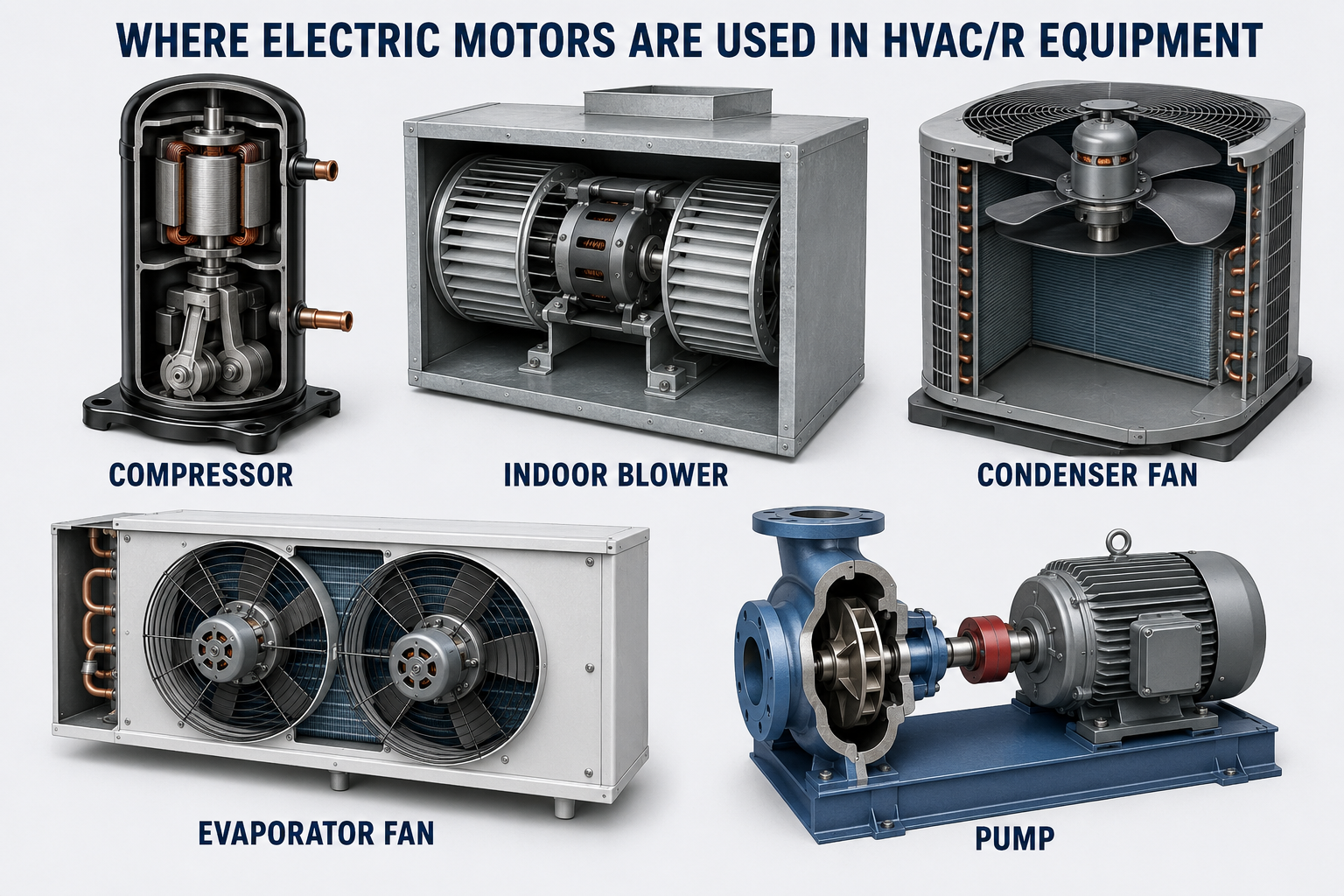
Electric motors operate compressors, blowers, condenser fans, evaporator fans, pumps, cooling towers, and other essential HVAC/R equipment. Correct service requires more than recognizing that a motor turns: technicians must understand how the motor starts, develops torque, changes speed, connects to the supply, responds to its load, and is protected.
This section progresses from motor construction and electromagnetic operation through single-phase motor families, hermetic compressor motors, ECMs, three-phase motors, variable-frequency drives, motor controls, overload protection, and systematic electrical diagnosis.
What You Will Learn
The lessons connect motor theory with the equipment and diagnostic decisions encountered in residential, commercial, and refrigeration service.
Construction and Magnetic Operation
Identify stators, rotors, windings, bearings, poles, synchronous speed, induction, torque, and slip.
Single-Phase Motors
Compare shaded-pole, split-phase, PSC, CSIR, and CSCR motors and their starting circuits.
Compressor Motors
Understand hermetic construction, C-S-R terminals, winding-resistance relationships, and terminal hazards.
Electronic and Variable-Speed Motors
Study ECM construction, power and control signals, VFD power stages, speed commands, and variable-capacity applications.
Three-Phase Motors
Explain three-phase waveforms, rotating magnetic fields, wye and delta connections, induction, slip, balance, and rotation.
Control, Protection, and Diagnosis
Trace motor power and control circuits, understand overload protection, and use a systematic troubleshooting sequence.
Different Loads Require Different Motors and Controls
A small evaporator fan, indoor blower, hermetic compressor, chilled-water pump, and variable-air-volume air handler do not have the same torque, speed-control, efficiency, supply, or environmental requirements. Motor selection begins with the driven load and equipment design.
Wire colors, terminal positions, capacitor sizes, speed taps, overload settings, ECM pinouts, VFD parameters, and acceptable test values are not universal. Use the specific nameplate, wiring diagram, service literature, and approved replacement information.
Electric Motors in HVAC/R Lessons
Work through the lessons in order. The section begins with motor fundamentals, develops the major single-phase and three-phase motor families, and then applies those concepts to connections, electronic controls, protection, and troubleshooting.
Introduction to Electric Motors in HVAC/R
Begin with the major jobs motors perform in HVAC/R equipment and learn the broad differences among the motor families encountered in the field.
Motor Families
Torque
Service Safety
Motor Construction and Electromagnetic Operation
Identify the main motor components and examine magnetic fields, electromagnetic induction, motor poles, synchronous speed, and slip.
Rotor
Magnetism
Slip
Motor Nameplates and Replacement Requirements
Read motor nameplate information and match the complete electrical, mechanical, performance, control, and environmental requirements for replacement.
Horsepower
Frame
Replacement
Single-Phase Motor Fundamentals
Learn why a single-phase induction motor needs an auxiliary magnetic effect to establish starting direction and torque.
Auxiliary Winding
Phase Shift
Starting Torque
Shaded-Pole Motors
Study the simple shaded-pole starting method, operating sequence, low starting torque, common uses, and service limitations.
Small Fans
Fixed Speed
Low Torque
Split-Phase Motors
Examine main and start winding construction, centrifugal-switch operation, starting sequence, torque, and common failure patterns.
Centrifugal Switch
Acceleration
Diagnosis
Permanent Split Capacitor Motors
Learn how a run capacitor and auxiliary winding remain energized during starting and running and how multi-speed PSC blowers are applied.
PSC
Blowers
Speed Taps
Capacitor-Start Motors: CSIR and CSCR
Compare capacitor-start induction-run and capacitor-start capacitor-run circuits, starting relays, start capacitors, and run capacitors.
CSCR
Start Capacitor
Starting Relay
Hermetic Compressor Motors and Terminals
Look inside the hermetic shell, identify common, start, and run terminals, and understand compressor-terminal and stored-energy hazards.
C-S-R
Terminal Venting
Compressor Safety
Compressor Motor Winding Resistance Tests
Use resistance relationships to identify single-phase C-S-R terminals and compare equal winding paths on conventional three-phase compressors.
C-S-R Identification
Three-Phase Balance
Insulation
Multi-Speed, Dual-Voltage, and Reversing Motor Connections
Study PSC speed taps, series and parallel dual-voltage windings, and the winding relationships used to reverse applicable motors.
Dual Voltage
Series/Parallel
Reversing
Electronically Commutated Motors
Examine ECM permanent-magnet construction, electronic commutation, power and control connectors, programmed output, and diagnostic procedures.
DC Bus
Control Signals
Airflow
Three-Phase Power and Motor Operation
Learn how three waveforms separated by 120 electrical degrees create a rotating field and compare balanced wye and delta relationships.
Rotating Field
Wye
Delta
Three-Phase Induction Motors and Rotation
Explore squirrel-cage motor construction, rotor induction, torque, slip, starting methods, phase sequence, and safe rotation changes.
Slip
Phase Sequence
Rotation
Variable-Frequency Drives and Variable-Speed Applications
Trace VFD power through the rectifier, DC bus, and PWM inverter and apply variable speed to HVAC/R fans, pumps, and approved systems.
PWM
Affinity Laws
Variable Speed
Motor Controls and Overload Protection
Distinguish disconnects, branch protection, contactors, overload relays, operating controls, and safety circuits in coordinated motor systems.
Overloads
Branch Protection
Control Circuits
Motor Troubleshooting and Electrical Diagnosis
Follow a complete diagnostic sequence and evaluate winding faults, insulation, capacitors, voltage, current, and three-phase balance.
Winding Faults
Voltage Balance
Current Balance
HVAC/R Motor Review and Comparison
Compare the complete motor family, review selection and diagnostic relationships, and apply the course concepts to field scenarios.
Selection
Field Scenarios
Final Review
Match the Motor to the Load and Control Method
Small Single-Phase Fan Motors
Shaded-pole and small PSC motors serve low-torque fan and appliance loads where size, simplicity, cost, efficiency, and control requirements determine the design.
Blower and Fan Motors
Multi-speed PSC motors and ECMs are common in air-moving equipment, but their speed selections, control signals, airflow responses, and replacement procedures differ.
Compressor Motors
Single-phase compressors may use PSC, CSIR, CSCR, or manufacturer-specific starting circuits, while larger systems commonly use three-phase or approved inverter-driven compressors.
Commercial Three-Phase Motors
Three-phase squirrel-cage motors provide rugged operation for pumps, fans, compressors, cooling towers, and air handlers using magnetic starters, soft starters, or VFDs.
Electronically Controlled Motors
ECMs and inverter systems combine motor construction, power electronics, programmed operation, control signals, protection, and system feedback.
Replacement Applications
A replacement must match application, voltage, phase, frequency, horsepower, speed, rotation, torque, frame, mounting, shaft, capacitor, control, duty, enclosure, and environment.
Start With the Complete System
A motor symptom does not automatically identify a motor failure. Verify power, controls, connections, protection, capacitors, programming, mechanical load, airflow, pressure, and operating conditions before condemning the motor.
Verify the Complaint
Define the symptom, operating mode, timing, motor type, nameplate data, diagram, recent changes, and protective device involved.
Inspect Before Testing
Look for overheated connections, contamination, blocked cooling, damaged wiring, poor bearings, incorrect rotation, belt problems, and load faults.
Isolate Hazardous Energy
Disconnect, lock and tag, discharge capacitors, control mechanical and pressure energy, wait for DC-bus discharge, and verify absence of voltage.
Test the Correct Circuit
Isolate the motor and protect electronics before resistance or insulation tests; use approved energized procedures only when necessary.
Identify the Fault Area
Separate power and control faults from motor and connection faults and from mechanical-load or equipment-system problems.
Correct and Verify
Repair the root cause, restore guards and covers, verify rotation and operating current, test protection and controls, and document the results.
Use the Electrical Knowledge Behind Every Motor Circuit
Motor diagnosis depends on safe meter use, circuit tracing, voltage and current relationships, capacitors, contactors, relays, transformers, overcurrent protection, and schematic interpretation. Review the broader HVAC/R and electrical material whenever a prerequisite needs reinforcement.