Shaded-Pole Motors
A shaded-pole motor is one of the simplest single-phase induction motors. Instead of using a separate start capacitor, relay, or centrifugal switch, it uses a short-circuited copper shading coil around part of each stator pole to delay magnetic flux and establish a direction of rotation.
This simple construction makes shaded-pole motors compact and inexpensive, but it also produces low starting torque and relatively low efficiency. They are therefore used mainly for small fan loads that are easy to start, including some evaporator fans, refrigeration case fans, unit-heater fans, and equipment ventilation fans.
Learning Objectives
Identify the Construction
Recognize the main stator winding, salient poles, copper shading coils, squirrel-cage rotor, shaft, bearings, and air gap.
Explain the Shading Effect
Describe how induced current in the shading coil delays magnetic flux in the shaded portion of each pole.
Relate Design to Application
Explain why low starting torque, low efficiency, simple construction, and fixed rotation limit the loads for which the motor is suitable.
Diagnose Common Problems
Evaluate the power supply, winding, shading coil, bearings, rotor, fan blade, mounting, airflow, and mechanical load.
A Shorted Copper Loop Creates the Starting Effect
The shaded-pole motor has a laminated stator core with projecting pole faces, a main stator winding, and a squirrel-cage rotor. A heavy copper loop or band surrounds only part of each pole face. This loop is the shading coil, also called a shading band or shading ring.
The shading coil is a closed, short-circuited conductor. It is not connected to the line-voltage supply and does not have external start-component terminals. Changing magnetic flux through the loop induces current within it, and that induced current changes the timing of the magnetic flux in the shaded portion of the pole.
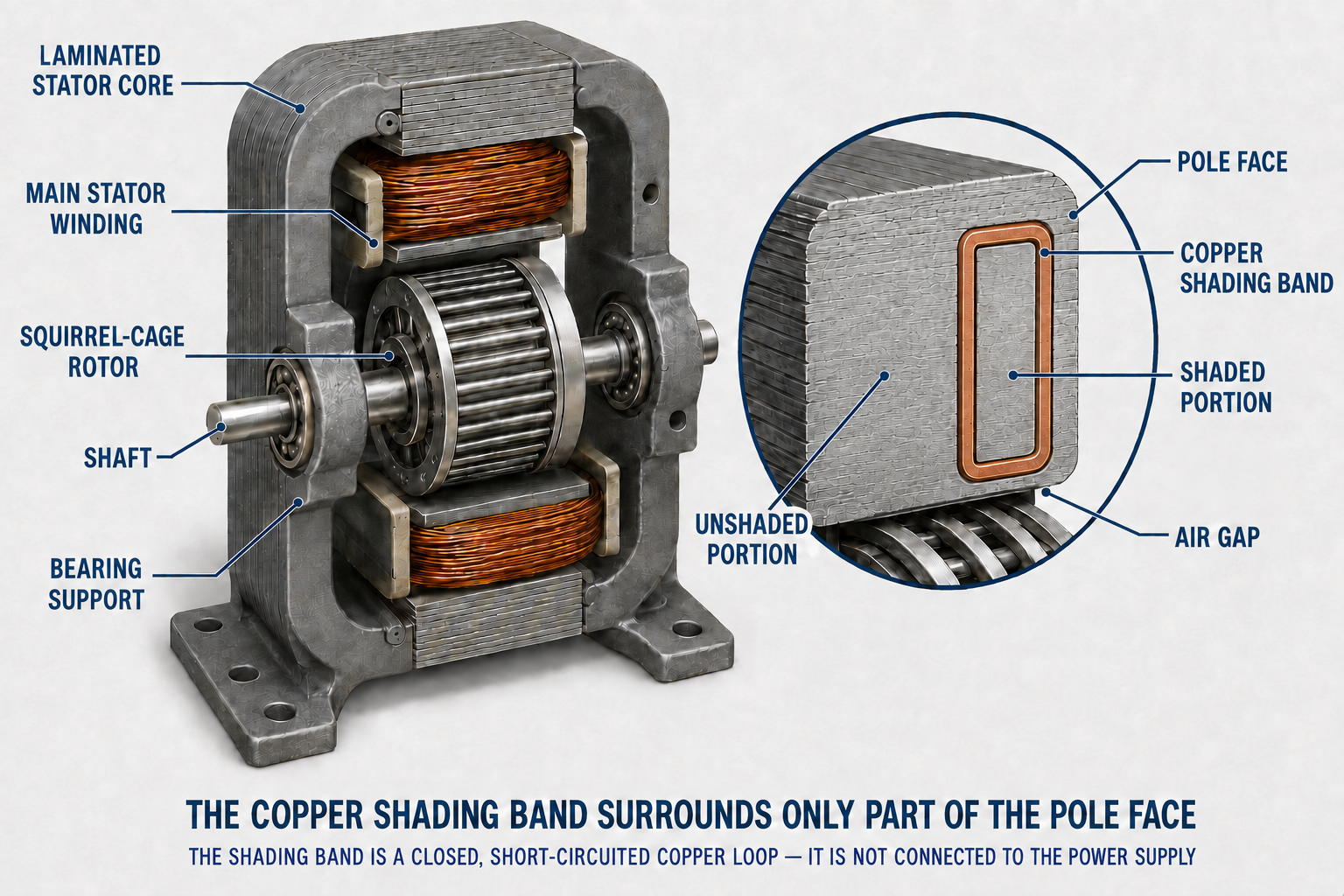
| Component | Function | Service Significance |
|---|---|---|
| Main Stator Winding | Creates the alternating magnetic flux in the stator poles. | An open, shorted, grounded, overheated, or incorrectly supplied winding prevents normal operation. |
| Shading Coil | Acts as a short-circuited auxiliary winding and delays flux in the shaded pole portion. | A cracked, open, loose, or damaged loop can eliminate or weaken starting torque and may cause noise. |
| Shaded Pole Portion | Receives the delayed magnetic effect produced by current in the shading coil. | Its position relative to the unshaded portion establishes the motor’s normal direction of rotation. |
| Squirrel-Cage Rotor | Develops torque when induced rotor current interacts with the shifting stator field. | Rotor rubbing, damage, or misalignment can cause weak torque, noise, vibration, and high current. |
| Shaft and Bearings | Support rotation and transfer torque to the fan or other load. | Because starting torque is low, small increases in bearing drag or load can prevent starting. |
| Laminated Core and Air Gap | Provide the magnetic path and clearance between the stator and rotor. | An uneven air gap, loose laminations, or stator-to-rotor contact may indicate bearing or alignment damage. |
Induced Current Delays Flux in Part of the Pole
As alternating current in the main winding rises and falls, magnetic flux through the pole face changes. This changing flux cuts through the closed shading coil and induces current in it. The magnetic field produced by the induced current opposes the change that produced it, so the shaded portion does not follow the main pole flux at exactly the same time.
The resulting flux distribution appears to sweep across the pole face from the unshaded portion toward the shaded portion during the useful part of each alternating-current cycle. This shifting field induces rotor current and produces a small starting torque in a definite direction.
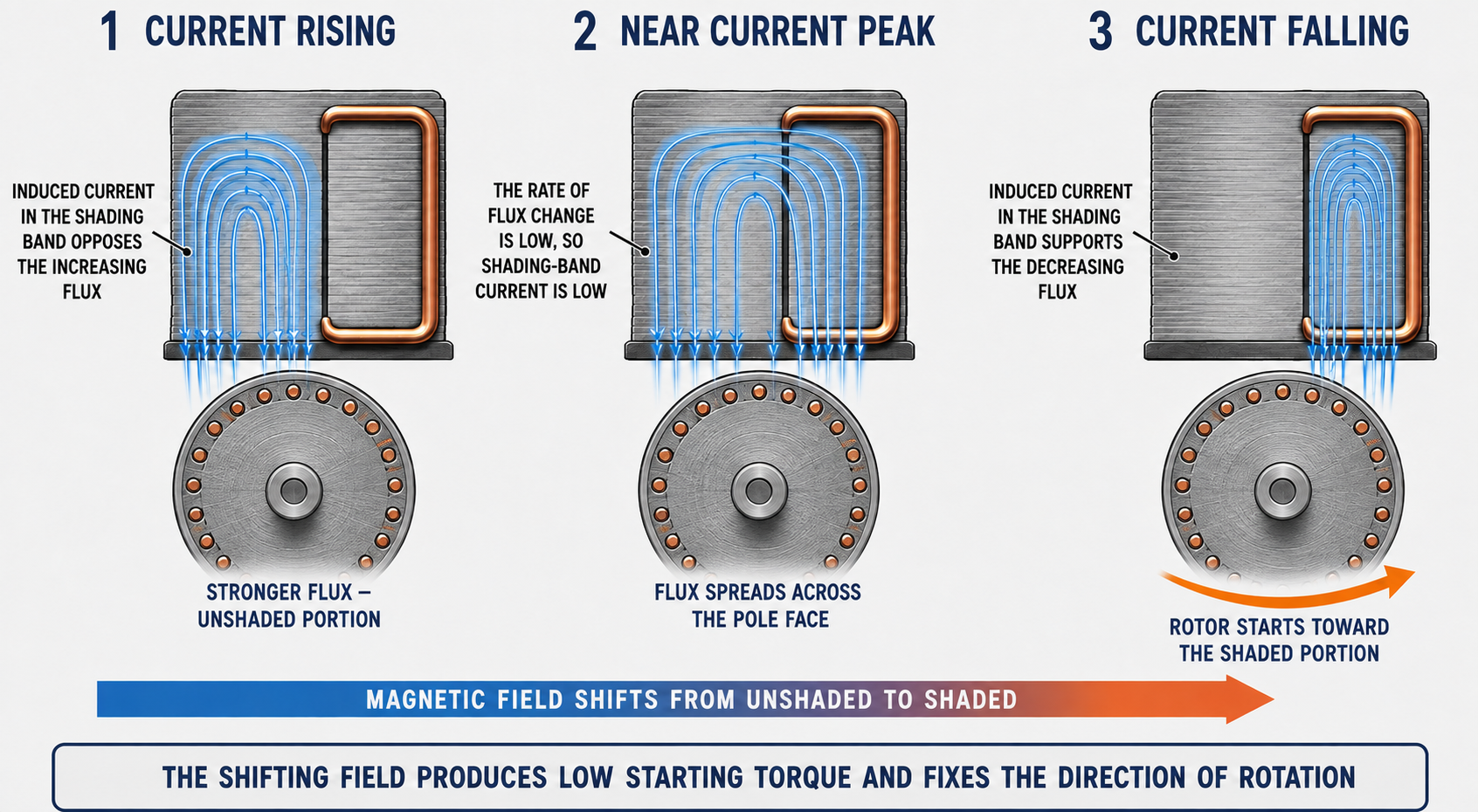
Main Current Rises
Increasing main-winding current produces rapidly increasing magnetic flux in the pole. The changing flux induces current in the shading coil.
The Shading Coil Opposes the Increase
The induced shading-coil field opposes the increase in flux through the shaded portion, so flux is initially stronger in the unshaded portion.
Main Current Approaches Its Peak
The rate of flux change falls near the peak, induced shading-coil current decreases, and flux spreads more evenly across the pole face.
Main Current Falls
The shading-coil current reverses its effect to oppose the decrease, helping maintain flux in the shaded portion after unshaded flux begins falling.
The Field Appears to Shift
The strongest flux moves across the pole face from the unshaded portion toward the shaded portion.
The Rotor Accelerates
The shifting field induces rotor current and produces low starting torque in the direction established by the pole construction.
Simplicity Comes With Important Limitations
Low Starting Torque
The shading effect creates only a weak rotating-field component. The motor is suitable for small loads that require little torque to begin moving.
Low Efficiency
Current and heat in the shading coil, stator losses, and the motor’s magnetic design make shaded-pole motors less efficient than many PSC and electronically commutated alternatives.
Low Power Factor
The motor generally has relatively poor power factor because much of its current supports magnetization rather than useful mechanical output.
Fixed Direction
Rotation is normally established by the physical location of the shading coils. Conventional field wiring cannot simply reverse the motor.
Simple Starting System
There is no start capacitor, run capacitor, centrifugal switch, or external starting relay in the basic shaded-pole design.
Small Output
The design is used primarily for small fractional-horsepower loads rather than compressors, large blowers, pumps, or other loads requiring substantial starting torque.
Do Not Apply a Shaded-Pole Motor to a High-Torque Load
A motor that cannot accelerate its load remains at high slip and may draw damaging current while producing little useful airflow or motion. Replacement selection must follow the equipment and motor manufacturer requirements rather than physical size alone.
Use Is Limited to Small, Easy-to-Start Loads
Shaded-pole motors have traditionally been common where low cost, compact size, simple construction, and modest output are more important than high efficiency or strong starting torque. The exact motor must still be identified from the nameplate and equipment documentation because a small fan motor may instead be PSC or electronically commutated.
Refrigeration Evaporator Fans
Some refrigerated cases, reach-ins, unit coolers, and small evaporators use shaded-pole motors to drive lightweight fan blades with low starting resistance.
Condenser and Equipment Fans
Small condensing units, ice machines, vending equipment, and component compartments may use shaded-pole motors for limited air-moving duties.
Unit-Heater Fans
Some small heating appliances and unit heaters use shaded-pole motors where the fan load is light and the motor is approved for the operating temperature.
Ventilation and Draft Applications
Small equipment-cooling or ventilation fans may use the design when the required airflow, duty, ambient conditions, and safety approvals are satisfied.
The Pole Construction Determines Direction
Because the magnetic field shifts toward the shaded portion, the position of the shading coils establishes the normal direction of rotation. Reversing the two incoming supply leads changes the polarity of both half-cycles but does not move the shading bands to the opposite side of the pole, so it does not reverse a conventional shaded-pole motor.
Some specialized assemblies may be mechanically reconfigured by the manufacturer, but a service technician should never assume that a shaded-pole motor is field reversible. Select a replacement with the correct direction when viewed from the specified end, along with matching voltage, frequency, speed, output, shaft, mounting, duty, enclosure, ambient rating, airflow, and fan-blade requirements.
| Replacement Check | What to Confirm |
|---|---|
| Electrical | Voltage, frequency, current, phase, protection, lead arrangement, and equipment control compatibility. |
| Performance | Rated output, full-load speed, starting capability, fan load, airflow, and duty. |
| Rotation | Required clockwise or counterclockwise direction and the end from which rotation is viewed. |
| Mechanical | Shaft diameter and length, mounting holes or brackets, motor dimensions, fan hub, blade position, and clearances. |
| Environment | Ambient temperature, moisture, airflow, enclosure, insulation, refrigeration temperature, and defrost conditions. |
| Approval | Equipment manufacturer replacement information and any required listing, certification, or sanitation requirements. |
Check the Supply, Motor, and Fan as a System
Identify the Motor
Read the nameplate and equipment diagram and confirm that the motor is shaded-pole rather than PSC or electronically commutated.
Inspect the Application
Look for ice, dirt, a bent or loose fan blade, contact with a guard, incorrect blade position, blocked airflow, loose mounting, and signs of water damage.
Control Hazardous Energy
Follow the required energy-control procedure, verify de-energization, and wait for all moving parts to stop before touching the motor or fan.
Check Mechanical Freedom
With energy safely isolated, inspect the bearings, shaft, rotor, fan blade, and air gap for drag, looseness, rubbing, or misalignment.
Perform Appropriate Electrical Tests
Qualified persons can verify supply voltage under operating conditions and test the isolated winding for continuity, resistance, and unwanted continuity to ground using approved procedures.
Verify the Repair
Confirm correct rotation, reliable starting, normal current, quiet operation, secure mounting, blade clearance, airflow, and control operation before closing the equipment.
There Is No Start Capacitor to Replace
A basic shaded-pole motor does not use a start or run capacitor. If the motor hums or fails to start, investigate the supply, main winding, shading coil, bearings, rotor, fan, mounting, and mechanical load rather than adding a capacitor or applying a capacitor-motor test procedure.
Symptoms Can Have Electrical or Mechanical Causes
Hums but Does Not Start
Possible causes include low voltage, an open or damaged shading coil, bearing drag, a bound fan, rotor rubbing, incorrect replacement, or a damaged main winding.
Runs Slowly
Check voltage under load, bearing condition, blade clearance, ice or dirt, fan loading, rotor condition, winding damage, and whether the motor matches the application.
Runs Hot
Some heat is normal, but excessive temperature may result from overload, low or incorrect voltage, restricted cooling, frequent starting, bearing drag, winding damage, or excessive ambient temperature.
Noisy or Vibrating
Inspect for dry or worn bearings, loose laminations, a loose shading band, damaged mounting, a bent shaft, an unbalanced blade, rotor contact, or ice accumulation.
Wrong Direction
Confirm the viewing end, correct replacement part, fan installation, and equipment airflow requirement. Reversing the supply leads will not normally correct direction.
Repeated Failure
Investigate voltage, moisture, defrost drainage, ice, ambient temperature, airflow, cycling, mounting, blade load, and the suitability of the replacement motor.
Avoid These Errors
“The Shading Coil Receives Line Voltage”
The shading coil is a closed copper loop. Current is induced in it by changing magnetic flux; it is not wired to the supply.
“The Shading Coil Is a Capacitor”
The shading coil is a short-circuited conductor embedded around part of the pole face. A basic shaded-pole motor has no capacitor.
“Reversing the Leads Reverses Rotation”
Direction is fixed by the position of the shading coils, so reversing the line leads does not change the field’s shift from unshaded to shaded.
“A Small Motor Can Start Any Small Load”
Shaded-pole starting torque is low. A small compressor, tight pump, heavily loaded blower, or dragging fan may require a different motor design.
“Humming Proves the Winding Is Good”
Humming shows that some magnetic activity may be present, but it does not prove correct voltage, an intact winding, a complete shading coil, free bearings, or a sound rotor.
“A Free-Spinning Blade Proves the Motor Is Good”
A mechanical freedom check is useful, but the winding, shading coil, supply, rotor, protection, and load must also be evaluated.
Review Questions
1. What is the shading coil?
Answer: It is a closed, short-circuited copper loop that surrounds part of a stator pole face and acts as an auxiliary winding.
2. Is the shading coil connected to the external power supply?
Answer: No. Changing magnetic flux induces current in the closed copper loop.
3. How does the shading coil help produce starting torque?
Answer: Its induced current delays magnetic flux in the shaded portion, causing the field to shift across the pole face and establish a direction of torque.
4. In which direction does the field shift across a conventional shaded pole?
Answer: It shifts from the unshaded portion toward the shaded portion.
5. Why are shaded-pole motors limited to easy-to-start loads?
Answer: The shading effect produces relatively low starting torque.
6. Does a basic shaded-pole motor use a start capacitor, run capacitor, or centrifugal switch?
Answer: No. Its shading coils provide the starting effect without those components.
7. Why does reversing the supply leads not normally reverse a shaded-pole motor?
Answer: Direction is established by the physical position of the shading coils, which is unchanged when the supply leads are reversed.
8. Name four mechanical conditions that can prevent a shaded-pole motor from starting.
Answer: Examples include worn or tight bearings, a bound or obstructed fan, rotor rubbing, a bent shaft, incorrect blade position, ice accumulation, or misalignment.
Lesson 5 Summary
- A shaded-pole motor is a single-phase induction motor with an auxiliary short-circuited winding displaced in magnetic position from the main winding.
- The auxiliary short-circuited winding is a copper shading coil, band, or ring around part of each pole face.
- The shading coil is not connected to the external power supply.
- Changing main-pole flux induces current in the shading coil.
- The induced current delays flux in the shaded portion of the pole.
- The magnetic field shifts from the unshaded portion toward the shaded portion.
- The shifting field establishes a direction and produces low starting torque.
- Shaded-pole motors generally have low starting torque, low efficiency, low power factor, and small output.
- The basic design has no start capacitor, run capacitor, centrifugal switch, or external starting relay.
- Rotation is normally fixed by shading-coil position and is not reversed by swapping the supply leads.
- Typical applications include small refrigeration, equipment, ventilation, and unit-heater fans.
- Low starting torque makes bearing drag, rotor rubbing, ice, dirt, and fan obstruction especially important.
- Replacement requires the correct electrical ratings, speed, direction, shaft, mounting, duty, environment, airflow, and equipment approval.
- Troubleshooting must include the power supply, winding, shading coil, rotor, bearings, fan, mounting, airflow, and mechanical load.