Capacitors in HVAC/R
Capacitors are used in conventional motor circuits, compressor starting systems, fan and blower applications, and the power-electronics sections of inverter-driven HVAC/R equipment. Correct service requires understanding what each capacitor does, how it is rated, how it is connected, and how stored electrical energy is controlled.
This section progresses from basic capacitor operation through run capacitors, dual run capacitors, start capacitors, start-assist components, replacement requirements, testing, troubleshooting, and the high-voltage DC bus capacitors found in variable-frequency drives, mini-splits, and other inverter-driven equipment.
What You Will Learn
The lessons focus on the capacitor applications most frequently encountered in HVAC/R installation, maintenance, and electrical diagnosis.
Capacitor Fundamentals
Understand charge storage, capacitance, dielectric construction, phase shift, and the major HVAC/R capacitor applications.
Run and Dual Run Capacitors
Trace PSC motor circuits and identify the C, FAN, and HERM terminals used on dual run capacitors.
Start Capacitors and Controls
Examine starting sequences, potential relays, current relays, PTC devices, electronic controls, and start-assist applications.
Ratings and Replacement
Read capacitor markings and match capacitance, voltage, type, duty, terminals, mounting, and manufacturer requirements.
Testing and Troubleshooting
Recognize failure causes and clues, test capacitance safely, interpret measurements, and diagnose the complete circuit.
Inverter DC Bus Capacitors
Follow inverter power conversion and understand DC bus operation, residual-voltage hazards, construction, and failure modes.
Different Capacitors Perform Different Jobs
A run capacitor remains in a conventional motor circuit during operation. A start capacitor provides additional starting torque for a brief interval and must be removed by the appropriate control. A DC bus capacitor operates inside an electronic drive, where it smooths rectified voltage and stores energy for the inverter switching section. These applications are not interchangeable.
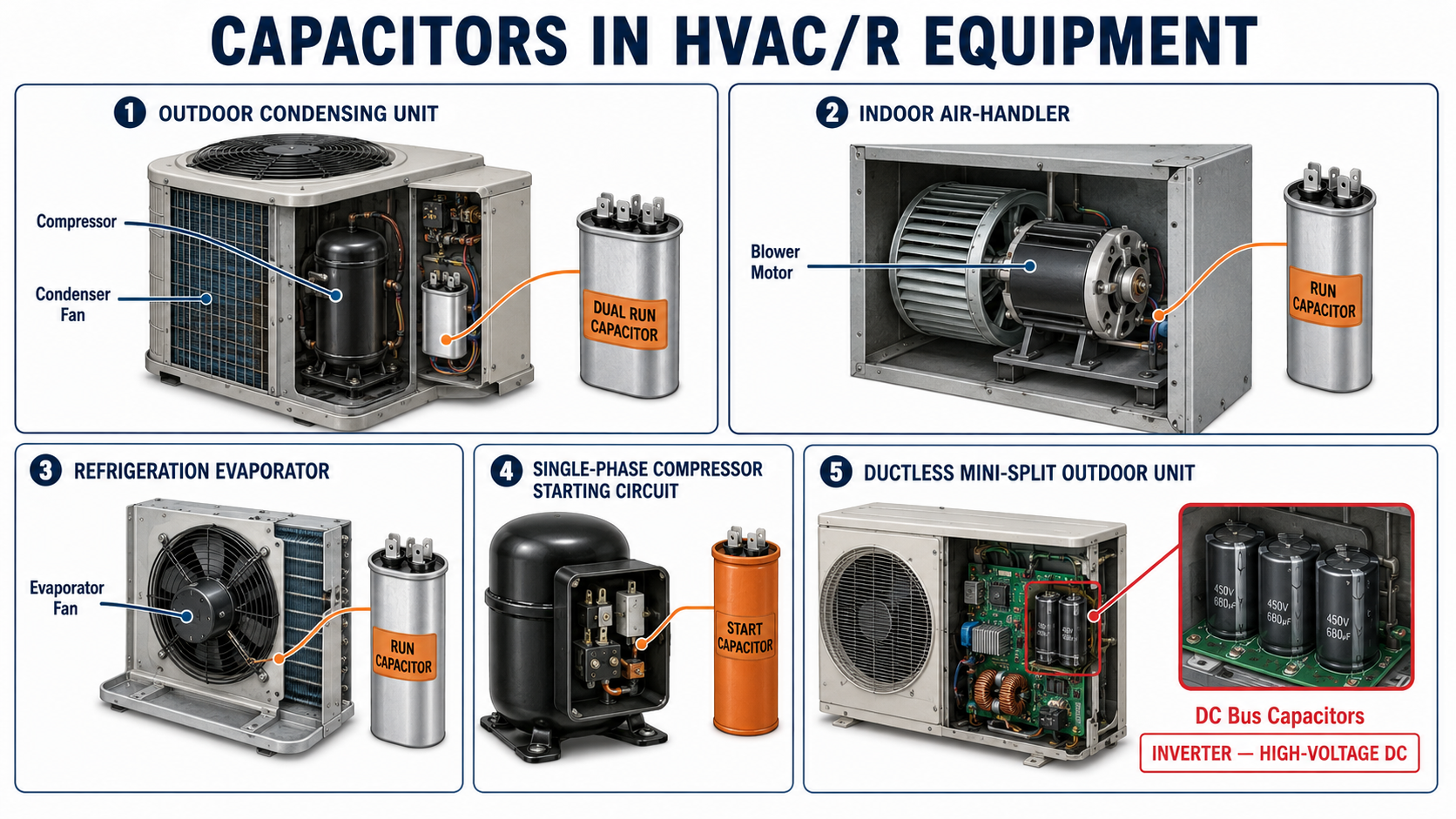
Capacitance values, voltage ratings, tolerances, terminal arrangements, starting controls, acceptable substitutions, discharge times, and inverter test points are not universal. Use the specific wiring diagram, nameplate, service literature, and approved replacement information for the equipment being serviced.
Capacitors in HVAC/R Lessons
Work through the lessons in order. The section begins with conventional HVAC/R capacitors and concludes with the high-voltage energy-storage capacitors used in inverter-driven equipment.
Introduction to HVAC/R Capacitors
Begin with capacitor construction, electrical charge storage, phase shift, schematic symbols, and the major capacitor applications encountered in HVAC/R equipment.
Capacitance
Phase Shift
Applications
Run Capacitors and Dual Run Capacitors
Learn how run capacitors support PSC motors and how the C, FAN, and HERM terminals connect the two sections of a dual run capacitor.
Run Capacitors
Dual Run
C-FAN-HERM
Start Capacitors and Start-Assist Components
Trace the starting sequence and compare start capacitors, potential relays, current relays, PTC devices, electronic controls, and approved start-assist applications.
Potential Relays
PTC Devices
Start Assist
Capacitor Ratings, Selection, and Replacement
Read capacitor labels and compare microfarads, tolerance, voltage, capacitor type, duty, terminals, physical installation, and manufacturer specifications.
Voltage Rating
Tolerance
Replacement
Capacitor Testing and Troubleshooting
Study why capacitors fail, recognize physical and operating clues, perform safe isolated capacitance tests, and investigate the root cause of failure.
Visual Clues
Safe Testing
Diagnosis
DC Bus Capacitors in Inverter-Driven HVAC/R Equipment
Follow power through the rectifier, DC bus, and inverter while examining stored-energy hazards, capacitor construction, drive symptoms, and service limitations.
DC Bus
Inverter
Residual Voltage
Match the Component to the Circuit
Fan and Blower Motors
PSC fan and blower motors use a run capacitor selected for the motor’s winding design, voltage, duty, and operating requirements.
Conventional Compressors
Single-phase compressors may use a run capacitor alone or an approved CSIR, CSCR, or start-assist circuit with specific starting components.
Dual Run Applications
A dual run capacitor combines separate compressor and fan capacitance sections in one enclosure with common, fan, and hermetic-compressor terminals.
Replacement Motors
A replacement motor may require a different capacitor from the original motor, so the replacement motor’s specifications must be followed.
Start-Assist Circuits
Start capacitors and their relays, PTC devices, or electronic controls must be selected and applied as a compatible approved system.
Inverter-Driven Equipment
Mini-splits, variable-capacity systems, ECMs, and VFDs may contain high-voltage DC bus capacitors inside their electronic power sections.
Test the Capacitor, Then Diagnose the Complete System
A capacitance measurement can identify a capacitor outside its marked tolerance, but it does not explain why the capacitor failed or prove that the connected motor, compressor, wiring, voltage supply, starting control, or inverter is operating correctly.
Verify the Complaint
Define the symptom, operating mode, capacitor application, connected load, recent changes, and protective device involved.
Inspect Before Testing
Look for swelling, leakage, burned terminals, corrosion, damaged wiring, loose mounting, excessive heat, and vibration.
Control Stored Energy
Disconnect and lock out every source, follow the specified discharge procedure, wait the required time, and verify voltage before contact.
Measure the Correct Terminals
Isolate conventional capacitors before testing and use C-to-HERM and C-to-FAN for the two sections of a dual run capacitor.
Identify the Root Cause
Evaluate voltage, wiring, controls, motor or compressor condition, mechanical load, airflow, temperature, cycling, and application.
Correct and Verify
Install the approved replacement securely, repair related faults, restore covers and barriers, test operation, and document the results.
Build on Capacitor and Motor-Circuit Fundamentals
Capacitor diagnosis depends on safe meter use, motor operation, circuit tracing, contactors, relays, overload protection, compressor starting circuits, and inverter power conversion. Use the related training sections whenever a prerequisite needs reinforcement.