Types of Air-Conditioning Systems
Air-conditioning equipment can be arranged in several different ways. Some systems place the major heating, cooling, and air-moving equipment in one outdoor cabinet, while others divide the refrigeration system between indoor and outdoor equipment connected by refrigerant piping.
This section builds on the refrigeration theory, components, and piping covered elsewhere in the course. The emphasis here is system recognition: learning how complete systems are arranged, how conditioned air is distributed, and how packaged units, conventional split systems, ductless mini-splits, and evaporative coolers differ from one another.
What You Will Learn
The refrigeration cycle does not have to be relearned for every type of air-conditioning equipment. Instead, this section examines how familiar components are assembled into complete systems and teaches you to recognize those configurations in the field.
Packaged Systems
Recognize systems in which the major cooling, heating, and air-moving equipment is contained within a single outdoor cabinet.
Conventional Split Systems
Identify systems that divide the refrigeration equipment between an outdoor condensing unit and indoor air-moving equipment.
Air Handlers and Furnaces
Distinguish a split system using an indoor air handler from one using a gas furnace with a separate evaporator coil.
Ductless Mini-Splits
Recognize single-zone and multi-zone mini-split systems and understand how they distribute conditioned air without conventional central ductwork.
Evaporative Cooling
Understand how direct evaporative coolers use water evaporation instead of a vapor-compression refrigeration circuit.
System Identification
Use equipment location, ductwork, refrigerant piping, utility connections, indoor equipment, and other field clues to identify common cooling systems.
Same Cooling Principles — Different Equipment Arrangements
The packaged, conventional split, and ductless systems covered in this section all use the same basic refrigeration principles already taught in The Basic Refrigeration Cycle and Refrigeration Theory. What changes is where the equipment is located and how conditioned air is delivered to the building.
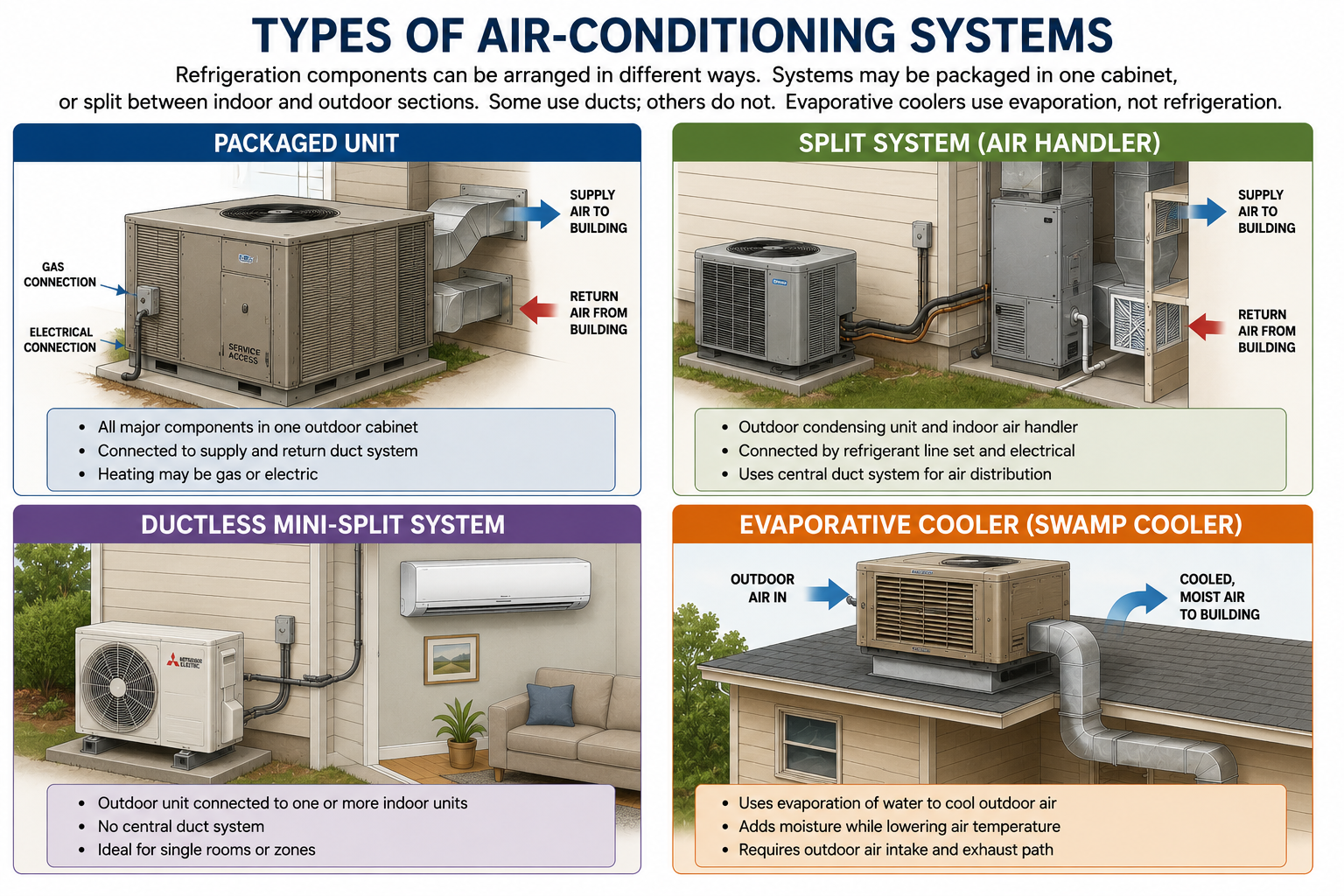
The detailed operation of compressors, condensers, evaporators, metering devices, refrigerant line sets, and refrigeration theory has already been covered elsewhere in the course. Here, the goal is to recognize how those concepts appear in complete working installations.
Types of Air-Conditioning Systems Lessons
Work through the lessons in order. The section begins with refrigeration-based equipment configurations, compares the major system types, then introduces evaporative cooling before finishing with a complete system-identification review.
Understanding Air-Conditioning System Configurations
Begin with the major equipment arrangements and learn the difference between packaged systems, conventional split systems, ductless mini-splits, and evaporative cooling.
Split Systems
Ductless
Evaporative
Gas/Electric Package Units
Learn how cooling equipment, gas heating, the blower, and building duct connections are combined within a single outdoor cabinet.
Gas Heat
Airflow
RTUs
All-Electric Package Units
Compare an all-electric package unit with gas/electric equipment and learn how electric resistance heating changes the heating section without changing the packaged-system arrangement.
Package Units
Resistance Heat
System Identification
Split Systems With Air Handlers
Examine the common arrangement of an outdoor condensing unit connected by refrigerant piping to an indoor air handler and central duct system.
Air Handler
Line Set
Ductwork
Split Systems With Gas Furnaces
Learn how an outdoor condensing unit and indoor evaporator coil operate with an upflow gas furnace that provides both gas heat and the blower used during cooling.
Cased Coil
Upflow
Shared Blower
Ductless Mini-Split Systems
Study single-zone and multi-zone mini-splits, common indoor-unit styles, and how these systems provide zone conditioning without conventional central ductwork.
Multi-Zone
Indoor Heads
Ductless
Comparing Refrigeration-Based Air-Conditioning Systems
Bring the refrigeration-based configurations together and compare packaged units, air-handler split systems, furnace/coil systems, and ductless mini-splits.
Packaged
Split Systems
Identification
Introduction to Evaporative Cooling
Move beyond vapor-compression refrigeration and learn how direct evaporative cooling uses water evaporation to reduce the temperature of hot, dry outdoor air.
Swamp Coolers
Humidity
Wet Bulb
Evaporative Cooler Construction
Look inside a direct evaporative cooler and identify the media, reservoir, pump, float valve, water distribution system, blower, and air and water paths.
Water Pump
Reservoir
Blower
Evaporative Cooler Operation and Application
Learn how climate, building relief airflow, wet-bulb conditions, water quality, mineral buildup, and seasonal maintenance affect evaporative-cooler performance.
Dry Climate
Water Quality
Maintenance
System Selection and Final Review
Use the entire section to identify common systems in the field, compare equipment arrangements, and understand some of the factors that influence system selection.
Field Identification
Comparison
Final Review
Three Refrigeration Arrangements and One Different Cooling Process
Packaged Systems
The major cooling and air-moving equipment is contained within one outdoor cabinet connected directly to the building’s supply and return ducts.
Conventional Split Systems
An outdoor condensing unit is connected by refrigerant piping to an indoor air handler or evaporator coil installed with a furnace.
Ductless Mini-Splits
Outdoor and indoor refrigeration equipment remain separated, but conditioned air is normally delivered directly to individual zones instead of through conventional central ductwork.
Direct Evaporative Cooling
Outdoor air is cooled by water evaporation rather than by a vapor-compression refrigeration circuit.
Look at the Complete Installation
A technician should not identify a system from cabinet shape alone. Look at where the equipment is located, what connects to it, how air enters and leaves, and what type of indoor equipment is present.
Duct Connections
Large supply and return ducts connected directly to an outdoor cabinet are an important clue that the equipment is packaged.
Refrigerant Lines
A line set connecting outdoor equipment to an indoor air handler, evaporator coil, or zone unit indicates a split refrigeration system.
Gas and Electrical Connections
Utility connections help identify the heating method and distinguish gas/electric equipment from all-electric arrangements.
Indoor Equipment
An air handler, furnace and coil, or individual mini-split head provides important information about how the system is configured.
Water System
A water reservoir, pump, distribution system, and evaporative media indicate direct evaporative cooling rather than vapor-compression refrigeration.
Equipment Nameplate
Visual clues provide the starting point, but the nameplate and manufacturer information should confirm the final equipment identification.
Use the Refrigeration Knowledge You Already Have
This section is designed to connect complete HVAC installations with the theory and components covered elsewhere in the Air Conditioning / Refrigeration course.
Start With the Major System Configurations
Begin by learning how packaged, conventional split, ductless, and evaporative cooling systems differ before moving into the individual equipment arrangements.
Start Lesson 1 – Understanding Air-Conditioning System Configurations →