Comparing Refrigeration-Based Air-Conditioning Systems
The previous lessons introduced several common air-conditioning system configurations: packaged units, split systems with air handlers, split systems with gas furnaces, and ductless mini-splits. Although the equipment arrangements look different, each of these systems uses the same basic vapor-compression refrigeration principles to move heat.
This lesson brings those configurations together so you can compare them side by side. The goal is to recognize the equipment arrangement, determine where the indoor and outdoor portions are located, identify how conditioned air is distributed, and determine what clues distinguish one system from another.
Learning Objectives
Compare Packaged and Split Systems
Recognize whether the major refrigeration equipment is contained within one cabinet or divided between separate indoor and outdoor assemblies.
Identify Indoor Equipment
Distinguish an air handler, furnace/coil combination, and ductless indoor unit by looking at the equipment arrangement and air-distribution method.
Recognize Air Distribution
Determine whether a system uses central supply and return ductwork or conditions individual rooms or zones directly.
Identify Systems in the Field
Use external equipment clues such as duct connections, refrigerant piping, gas service, indoor heads, and equipment location to classify the system.
The Configuration Changes, but the Basic Cooling Process Does Not
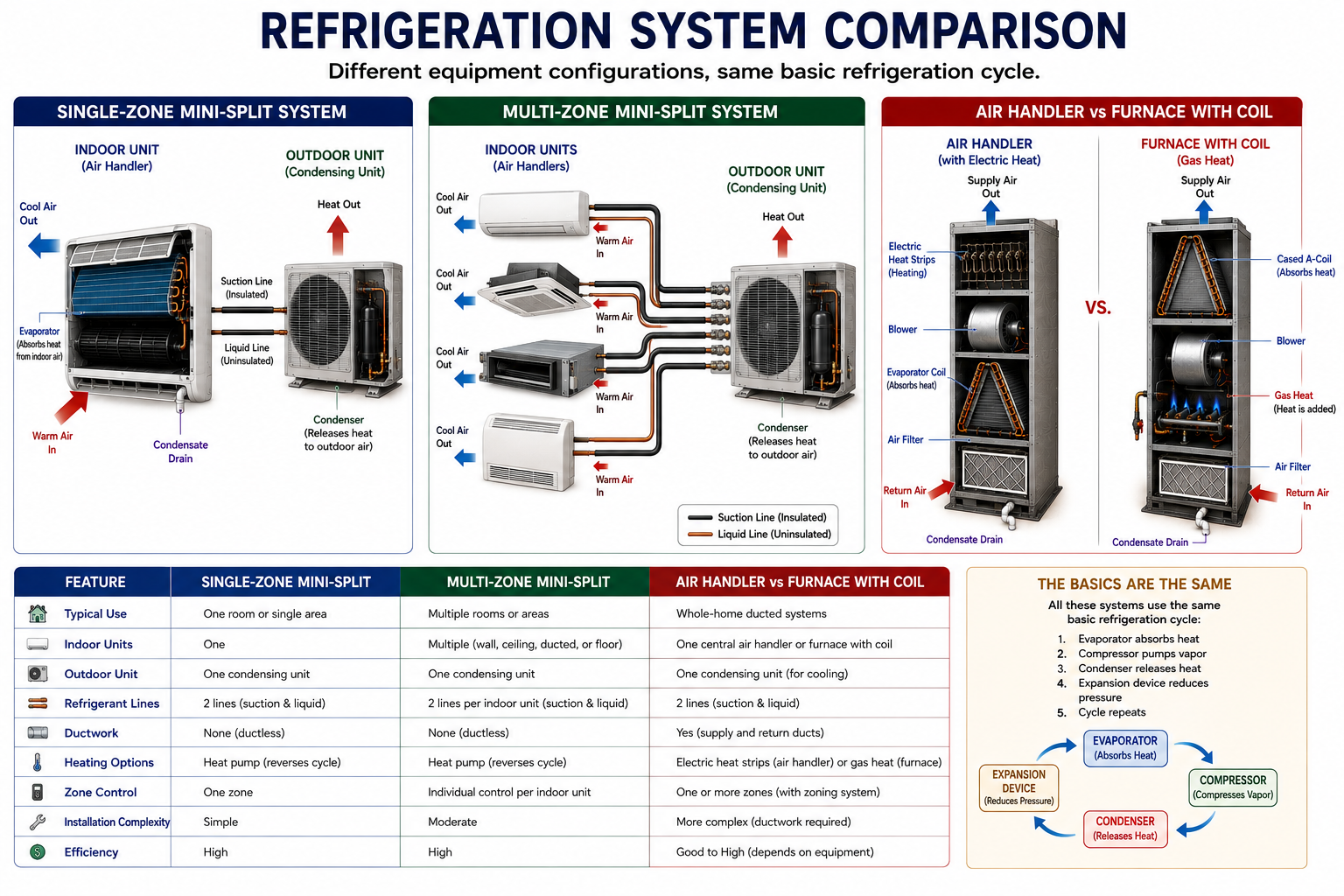
Package units, conventional split systems, and mini-splits may look very different when installed, but their cooling operation is based on the same basic refrigeration cycle. The evaporator absorbs heat, the compressor moves refrigerant through the system, the condenser rejects heat, and the metering device creates the pressure difference needed for evaporation.
What changes is the physical location of those components and how building air is moved across the indoor heat exchanger.
Everything Is Concentrated in One Outdoor Cabinet
A packaged system is usually the easiest configuration to distinguish from the others because the major cooling and air-moving equipment is contained within one outdoor cabinet.
Rather than looking for refrigerant piping leading to a separate indoor evaporator, look for supply and return ductwork connected directly to the packaged equipment.
Equipment Location
The major cooling and air-moving assemblies are contained in one outdoor cabinet.
Building Connection
Supply and return ducts connect directly between the package unit and the conditioned building.
Refrigerant Line Set
A conventional field-installed line set between separate indoor and outdoor units is not required because the refrigeration equipment is packaged together.
Heating Clues
A gas connection and combustion vent indicate gas heat, while an all-electric unit does not require gas service or combustion exhaust.
Separate Outdoor Unit and Indoor Air Handler
A conventional split system separates the refrigeration equipment between an outdoor condensing unit and an indoor air handler. The two assemblies are connected by a refrigerant line set.
The indoor air handler contains the evaporator coil and blower and connects to the building’s central return and supply duct system. It may also contain electric resistance heating elements depending on the system design.
Outdoor Clue
A separate outdoor condensing unit is connected to the building by refrigerant piping rather than by large supply and return ducts.
Indoor Clue
A single indoor air-handler cabinet contains the evaporator and blower sections.
Air Distribution
The air handler connects to central supply and return ductwork serving the building.
Heating Possibilities
Depending on the system, heating may be provided by electric resistance elements, heat-pump operation, or another approved arrangement.
The Furnace Provides the Indoor Blower
This configuration still uses a separate outdoor condensing unit, but the indoor equipment differs from the air-handler arrangement. A gas furnace provides the blower and gas heating section, while a separate evaporator coil is installed in the building air path.
In the common upflow arrangement studied in Lesson 5, the cased evaporator coil is installed above the furnace. The refrigerant line set connects the outdoor unit to this coil rather than to the gas-heating portion of the furnace.
Outdoor Clue
A separate outdoor condensing unit connects to the indoor evaporator coil through a two-line refrigerant line set.
Indoor Clue
Look for a gas furnace with a cased evaporator coil installed above it in a typical upflow arrangement.
Heating Clue
A gas supply and combustion venting identify the gas-fired heating equipment.
Shared Blower
The furnace blower moves building air during both gas heating and air-conditioning operation.
Split Refrigeration Equipment Without Conventional Central Ductwork
A ductless mini-split also separates the indoor and outdoor refrigeration equipment. The major visual difference is that the indoor equipment is located directly within the room or zone rather than being connected to a conventional central supply and return duct system.
A single-zone mini-split uses one outdoor unit and one indoor unit. Multi-zone equipment can serve multiple indoor units when designed for that purpose.
Outdoor Clue
A compact outdoor refrigeration unit connects to one or more indoor units through refrigerant piping and electrical or communication wiring.
Indoor Clue
Look for high-wall units, ceiling cassettes, floor-mounted units, or concealed ducted indoor equipment.
Air Distribution
Typical ductless indoor units condition and circulate air directly within the zone rather than relying on a central duct system.
Zone Clue
Several indoor units connected to suitable outdoor equipment indicate a multi-zone configuration.
Look at the Equipment Arrangement First
| Characteristic | Package Unit | Split + Air Handler | Split + Gas Furnace | Ductless Mini-Split |
|---|---|---|---|---|
| Outdoor Equipment | Main packaged cabinet | Condensing unit | Condensing unit | Mini-split outdoor unit |
| Indoor Equipment | No separate indoor refrigeration cabinet | Air handler | Gas furnace + evaporator coil | One or more indoor units |
| Central Supply and Return Ducts | Yes | Yes | Yes | Usually no |
| Field Refrigerant Line Set Between Indoor and Outdoor Units | No conventional field line set | Yes | Yes | Yes |
| Indoor Blower | Contained in package unit | Contained in air handler | Contained in furnace | Contained in each indoor unit |
| Gas Heating Possible in Configuration Studied | Yes on gas/electric package unit | No gas furnace in basic air-handler arrangement | Yes | Normally not part of the indoor mini-split unit |
| Electric Heating Possible | Yes | Yes | Possible supplemental arrangements, but gas furnace is primary configuration studied | Many systems provide heat-pump heating |
| Typical Identification Clue | Large outdoor cabinet connected directly to ducts | Outdoor condensing unit + indoor air-handler cabinet | Outdoor condensing unit + gas furnace + coil | Outdoor unit + wall, ceiling, or other zone-mounted indoor units |
Ask a Few Questions Before Opening the Equipment
System identification often begins before a service panel is removed. The physical layout of the equipment can provide enough information to determine the general configuration.
Are Large Ducts Connected Directly to the Outdoor Cabinet?
If yes, you are probably looking at packaged equipment rather than a conventional split-system condensing unit.
Are Refrigerant Lines Running Into the Building?
If yes, look for the indoor equipment served by those refrigerant lines. This suggests a split-system configuration.
What Is the Indoor Equipment?
A central air-handler cabinet suggests an air-handler split system, while a gas furnace with a separate evaporator coil indicates a furnace/coil arrangement.
Are Indoor Units Mounted in Individual Zones?
Wall, ceiling, floor, or concealed indoor units connected directly to outdoor refrigeration equipment suggest a mini-split or multi-split system.
Is There a Gas Connection?
A gas connection and combustion venting can help distinguish gas-heated equipment from all-electric equipment.
Confirm With the Nameplate
Visual clues help identify the general configuration, but the equipment nameplate and manufacturer information should confirm the actual equipment type and capabilities.
Use the Entire Equipment Arrangement
Individual clues can be misleading when used alone. A rooftop cabinet is not automatically gas/electric, an outdoor condensing unit does not tell you whether the indoor equipment is an air handler or furnace, and a small outdoor unit does not prove that the system is a heat pump.
Confirm Before You Assume
Use equipment location, duct connections, refrigerant piping, utility connections, indoor equipment, nameplate information, and manufacturer documentation together. Correct identification is especially important before troubleshooting electrical controls, determining heating operation, adding refrigerant, or replacing components.
Avoid These System-Identification Errors
“The Outdoor Unit Is the Air Conditioner”
Not with a split system. The outdoor unit is only one part of a complete system that also includes the indoor coil, air-moving equipment, refrigerant piping, controls, and air distribution.
“Every Indoor Cabinet Is a Furnace”
Incorrect. The indoor equipment may be an air handler, furnace, mini-split fan coil, or another equipment type.
“If It Has Ducts, It Must Be a Split System”
Incorrect. Packaged units also use supply and return duct systems. The important question is where those ducts connect.
“Mini-Splits Are Not Split Systems”
Incorrect. The refrigeration equipment is divided between indoor and outdoor assemblies connected by refrigerant piping.
“Every Package Unit Uses Gas Heat”
Incorrect. Package units may use gas heat, electric resistance heat, or heat-pump arrangements depending on the equipment.
“All Split Systems Have Air Handlers”
Incorrect. A conventional split air conditioner may use an air handler or an evaporator coil paired with a furnace.
Review Questions
1. What is the easiest general distinction between packaged and split equipment?
Answer: Packaged equipment concentrates the major cooling and air-moving assemblies in one outdoor cabinet, while a split system divides the refrigeration equipment between separate indoor and outdoor assemblies.
2. What is the primary visual clue that distinguishes a package unit from a conventional outdoor condensing unit?
Answer: A package unit normally has large building supply and return duct connections directly at the outdoor cabinet, while a conventional condensing unit connects to indoor equipment through refrigerant piping.
3. What indoor equipment is used in the split-system configuration from Lesson 4?
Answer: An indoor air handler containing the evaporator coil and blower.
4. What indoor equipment is used in the split-system configuration from Lesson 5?
Answer: A gas furnace provides the blower and heating section while a separate evaporator coil provides the indoor cooling heat exchanger.
5. What distinguishes a typical ductless mini-split from the other split systems covered here?
Answer: Its indoor units normally condition individual rooms or zones directly rather than relying on a conventional central supply and return duct system.
6. Does a package unit normally require a field-installed refrigerant line set connecting it to a separate indoor evaporator?
Answer: No. The major refrigeration equipment is contained within the packaged cabinet.
7. How can you distinguish a split system with a gas furnace from one with an air handler?
Answer: Look at the indoor equipment. A gas-furnace system has gas heating equipment and usually a separate evaporator-coil cabinet, while an air-handler system contains the blower and evaporator within the air-handler assembly and does not contain a gas furnace.
8. Why should equipment identification always be confirmed with the nameplate?
Answer: Different equipment can look similar. The nameplate and manufacturer information confirm the actual model, heating and cooling configuration, electrical requirements, refrigerant, and other system information.
Lesson 7 Summary
- Packaged, conventional split, and ductless mini-split systems use the same basic vapor-compression refrigeration principles during cooling.
- The main differences among the systems are equipment location, indoor equipment arrangement, heating configuration, and air-distribution method.
- A package unit contains the major cooling and air-moving equipment within one outdoor cabinet and connects directly to building ductwork.
- A split system with an air handler uses a separate outdoor condensing unit and indoor air handler connected by refrigerant piping.
- A split system with a gas furnace uses the furnace blower and a separate evaporator coil connected to the outdoor condensing unit.
- A ductless mini-split uses separate indoor and outdoor refrigeration equipment but normally does not rely on conventional central ductwork.
- Single-zone mini-splits use one indoor unit, while multi-zone equipment can serve multiple indoor units.
- Supply and return ducts connected directly to an outdoor cabinet are an important clue that the equipment is packaged.
- A refrigerant line set running from an outdoor unit into the building is an important clue that the system is split.
- Gas connections and combustion venting help identify gas-heated equipment.
- System identification should use the entire equipment arrangement rather than relying on one visual clue.
- The equipment nameplate and manufacturer information should always confirm the final identification.