Introduction to Evaporative Cooling
The systems covered in the previous lessons all used the vapor-compression refrigeration cycle to move heat. Evaporative cooling is different. A direct evaporative cooler, commonly called a swamp cooler, uses the evaporation of water to reduce the temperature of moving outdoor air before that air is supplied to the building.
Because evaporative cooling depends on the ability of air to absorb additional moisture, it performs best in hot, dry climates. This lesson introduces the cooling process, compares it with mechanical refrigeration, and explains why evaporative cooling must be treated as a separate type of building cooling system.
Learning Objectives
Recognize Evaporative Cooling
Identify evaporative cooling as a building-cooling method that uses water evaporation rather than a vapor-compression refrigeration circuit.
Understand the Cooling Process
Explain how hot outdoor air is cooled as water evaporates into the moving air stream.
Compare Cooling Methods
Recognize the important differences between refrigeration-based air conditioning and direct evaporative cooling.
Recognize Climate Limitations
Explain why evaporative cooling generally performs better in hot, dry air than in humid conditions.
No Refrigeration Circuit Is Required
Mechanical air-conditioning systems use refrigerant, a compressor, condenser, metering device, and evaporator to transfer heat from the conditioned space to the outdoor environment. A direct evaporative cooler does not use that refrigeration cycle.
Instead, the cooler brings outdoor air into contact with water. As some of that water changes from liquid to vapor, it absorbs heat from the air. The air temperature decreases while the amount of moisture in the air increases.
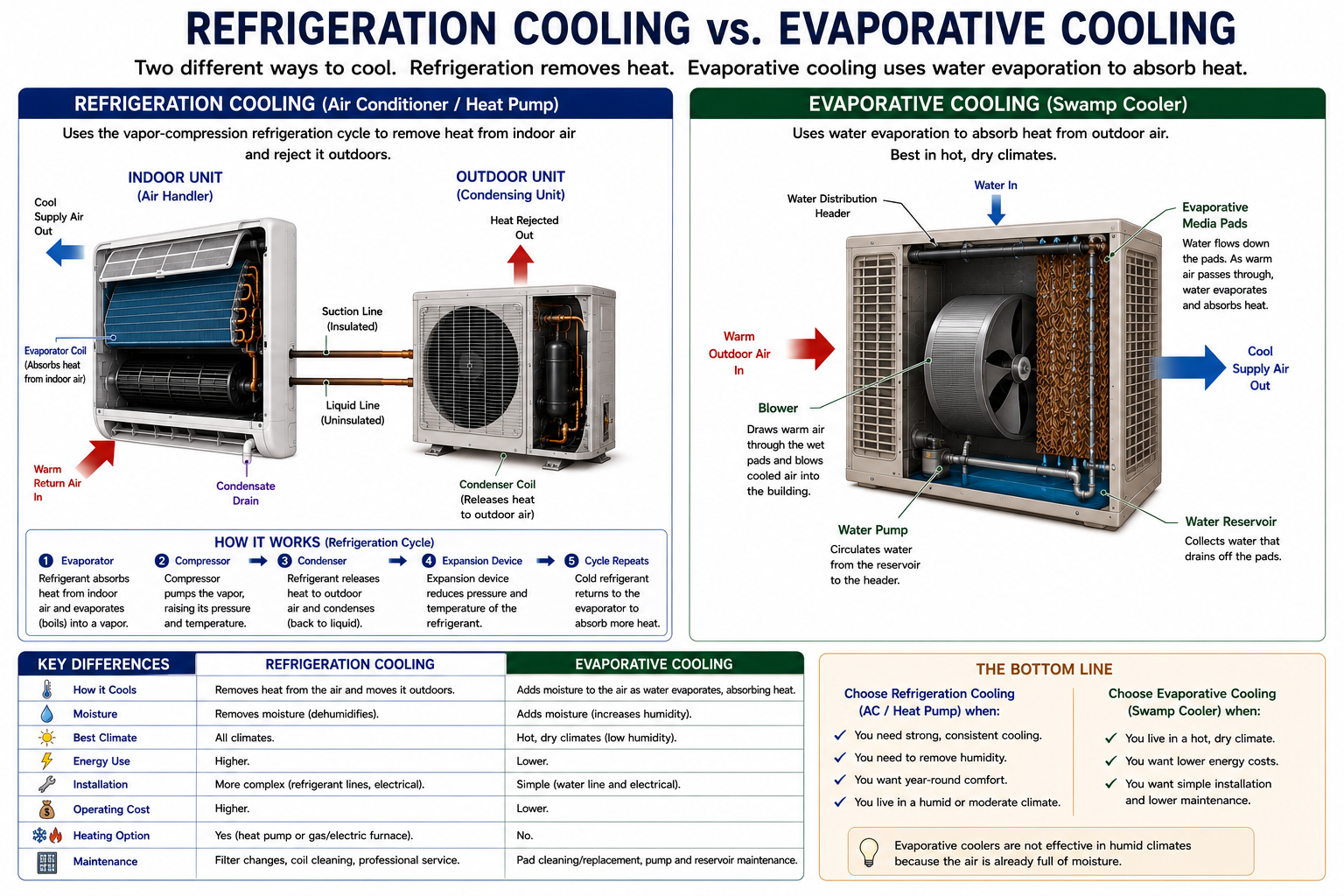
An Evaporative Cooler Is Not a Refrigeration System
A conventional direct evaporative cooler does not require a compressor, condenser, refrigeration metering device, refrigerant evaporator coil, or refrigerant line set. If those components are present, you are examining a different type of cooling system.
Evaporation Requires Heat
The cooling effect should already make sense from the heat and state-change principles studied in Refrigeration Theory. Changing liquid water into water vapor requires energy. That energy is supplied as heat from the air passing through the cooler.
As water evaporates, sensible heat from the incoming air is used in the evaporation process. The dry-bulb temperature of the air decreases while its moisture content increases.
Outdoor Air Passes Through Wetted Media
A direct evaporative cooler normally draws outdoor air through water-wetted pads or other evaporative media. Water distributed over the media keeps it wet while a blower moves air through the material.
As the outdoor air passes through the wet media, some of the water evaporates. The leaving air is cooler than the entering air but contains more moisture. The blower then supplies that air to the building.
Outdoor Air Enters
Hot outdoor air is drawn into the evaporative cooler rather than simply recirculating the same indoor air.
Air Passes Through Wet Media
Water distributed over the evaporative media provides the wet surface needed for evaporation.
Water Evaporates
Some of the liquid water changes to vapor and absorbs heat from the moving air stream.
Air Temperature Drops
As heat is used for evaporation, the dry-bulb temperature of the moving air decreases.
Air Moisture Increases
The evaporated water becomes part of the air stream, so the leaving air contains more moisture than the entering air.
Cooled Air Enters the Building
The blower delivers the cooler, more humid air into the conditioned space or supply duct system.
The Two Systems Treat Air Differently
A conventional refrigeration-based air conditioner normally recirculates a large portion of the building air. That air passes repeatedly through the indoor cooling coil, where sensible heat and moisture can be removed.
A direct evaporative cooler normally depends on a substantial flow of outdoor air. That outdoor air is cooled through evaporation, supplied to the building, and then must eventually leave the building so that additional cooled outdoor air can enter.
| Characteristic | Mechanical Refrigeration | Direct Evaporative Cooling |
|---|---|---|
| Primary Cooling Process | Vapor-compression refrigeration | Water evaporation |
| Refrigerant Circuit | Yes | No |
| Compressor | Yes | No refrigeration compressor |
| Source Air | Normally substantial recirculation of indoor air | Primarily outdoor air |
| Effect on Air Moisture | Can remove moisture during cooling | Adds moisture to the air |
| Best Climate | Useful across a broad range of climates when properly designed | Most effective in hot, dry conditions |
| Water Required for Cooling | Not for the basic direct-expansion refrigeration process | Yes |
Air Must Be Able to Accept Additional Moisture
Evaporative cooling works best when the entering outdoor air is relatively dry. Dry air can accept more water vapor, which allows more water to evaporate from the media and produces a greater cooling effect.
When the outdoor air is already humid, it has less capacity to accept additional moisture. Less water evaporates, so the temperature reduction available from a direct evaporative cooler becomes smaller.
Hot and Dry
Greater evaporation can occur, allowing a larger reduction in air temperature and making evaporative cooling much more useful.
Hot and Humid
Less evaporation can occur because the air already contains substantial moisture, reducing the available cooling effect.
Climate Determines Application
Evaporative cooling is strongly influenced by outdoor air conditions. A system that performs well in an arid climate may provide inadequate cooling in a humid climate even when the equipment itself is operating properly.
A Useful Way to Think About Cooling Potential
The amount of cooling available from direct evaporation is related to the difference between the outdoor dry-bulb temperature and wet-bulb temperature. This difference is commonly called the wet-bulb depression.
When the air is dry, the difference between dry-bulb and wet-bulb temperature can be relatively large. That larger difference indicates greater potential for evaporative temperature reduction. As humidity increases, dry-bulb and wet-bulb temperatures move closer together and the available evaporative cooling potential decreases.
This Is Not a Full Psychrometrics Lesson
The purpose here is simply to recognize the relationship: a larger dry-bulb-to-wet-bulb difference generally means greater direct evaporative cooling potential. Detailed psychrometric analysis can be studied separately.
Evaporative Cooling Is Also a Ventilation Process
A direct evaporative cooler does not normally operate by repeatedly cooling the same sealed volume of indoor air. It continually introduces cooled outdoor air into the building.
For that process to continue effectively, air already inside the building must have a way to leave. Open windows, doors, relief openings, up-ducts, exhaust openings, or other properly designed relief paths may be used depending on the building and system.
A Tightly Closed Building Can Restrict Airflow
If supply air is continually introduced but there is no adequate path for air to leave the building, building pressure increases and evaporative-cooler airflow can be reduced. Proper relief or exhaust airflow is part of a direct evaporative cooling installation.
Do Not Expect Refrigeration-System Behavior
It Does Not Use Refrigerant
A conventional direct evaporative cooler uses water as part of the cooling process rather than circulating refrigerant through a refrigeration circuit.
It Does Not Dehumidify
Direct evaporative cooling adds water vapor to the supply air instead of removing moisture from it.
It Does Not Have a Condensing Unit
There is no refrigeration condenser rejecting heat outdoors as there is in the systems studied in Lessons 1 through 7.
It Does Not Depend on a Refrigeration Compressor
Electrical energy is still required for the blower, water pump, and controls, but no refrigeration compressor is required for direct evaporative cooling.
A Practical Cooling Method in the Right Climate
In suitable climates, evaporative cooling can provide useful building cooling with relatively simple mechanical equipment. The major electrical loads are typically associated with moving air and circulating water rather than operating a refrigeration compressor.
The system also introduces a large amount of outdoor air into the building, which can be desirable in some applications. However, the equipment consumes water, adds humidity to the conditioned air, and requires regular water-system and media maintenance.
Simple Cooling Process
The system uses water evaporation and air movement rather than a complete vapor-compression refrigeration circuit.
Fresh Outdoor Air
The cooler continually brings outdoor air into the building rather than relying entirely on recirculated indoor air.
Water Consumption
Water must continually be supplied because some of it leaves the cooler as water vapor and additional water may be discharged for water-quality control.
Climate Dependent
The usefulness of evaporative cooling depends heavily on outdoor temperature and humidity conditions.
Avoid These Evaporative-Cooling Mistakes
“A Swamp Cooler Is Just Another Air Conditioner”
It is building cooling equipment, but its cooling process is fundamentally different from vapor-compression air conditioning.
“It Uses Refrigerant to Cool the Air”
Incorrect. Direct evaporative cooling depends on the evaporation of water.
“It Removes Humidity”
Incorrect. Direct evaporative cooling adds moisture to the supply air.
“It Works Equally Well Everywhere”
Incorrect. Performance decreases as outdoor humidity increases because less additional water can evaporate into the air.
“The Building Should Be Sealed Tight”
Incorrect for normal direct evaporative cooling operation. The incoming outdoor air requires an appropriate path for air to leave the building.
“No Compressor Means No Maintenance”
Incorrect. Evaporative coolers require maintenance of the water system, pump, media, reservoir, blower, drainage, and other components.
Review Questions
1. What is the major difference between evaporative cooling and the systems covered in Lessons 1 through 7?
Answer: The earlier systems use vapor-compression refrigeration. A direct evaporative cooler uses the evaporation of water to reduce air temperature.
2. Does a direct evaporative cooler require a refrigeration compressor?
Answer: No. It requires air movement and water circulation, but a refrigeration compressor is not part of the direct evaporative cooling process.
3. What happens to water as air passes through the wetted evaporative media?
Answer: Some of the liquid water evaporates into the moving air stream and absorbs heat during the phase change.
4. What happens to the air temperature during direct evaporative cooling?
Answer: The dry-bulb temperature decreases as heat from the air is used to evaporate water.
5. What happens to the moisture content of the air?
Answer: It increases because evaporated water becomes water vapor in the supply air.
6. Why does evaporative cooling work better in dry climates?
Answer: Dry air can accept more additional water vapor, allowing more water to evaporate and producing a greater cooling effect.
7. What does wet-bulb depression describe?
Answer: It is the difference between dry-bulb and wet-bulb temperature. A larger difference generally indicates greater potential for direct evaporative cooling.
8. Why does air need a path to leave a building cooled by a direct evaporative cooler?
Answer: The cooler continuously introduces outdoor air. Existing building air must be relieved or exhausted so additional supply air can enter effectively.
9. Does direct evaporative cooling dehumidify the building air?
Answer: No. It adds moisture to the supply air.
Lesson 8 Summary
- Direct evaporative cooling uses water evaporation rather than the vapor-compression refrigeration cycle.
- A conventional direct evaporative cooler does not require a refrigeration compressor, condenser, metering device, evaporator refrigeration coil, or refrigerant line set.
- Hot outdoor air is drawn through wetted evaporative media.
- Some of the water evaporates and absorbs heat from the moving air.
- The dry-bulb temperature of the air decreases while its moisture content increases.
- Direct evaporative cooling performs best in hot, dry climates where the outdoor air can accept substantial additional moisture.
- Higher outdoor humidity reduces the amount of evaporation and therefore reduces the available cooling effect.
- A larger difference between dry-bulb and wet-bulb temperature generally indicates greater evaporative cooling potential.
- Direct evaporative cooling normally introduces substantial outdoor air into the building rather than simply recirculating indoor air.
- The building requires an appropriate relief or exhaust path so air can leave as cooled outdoor air enters.
- Evaporative cooling adds moisture rather than dehumidifying the supply air.
- The system still requires maintenance even though it does not contain a refrigeration compressor.