Evaporative Cooler Construction
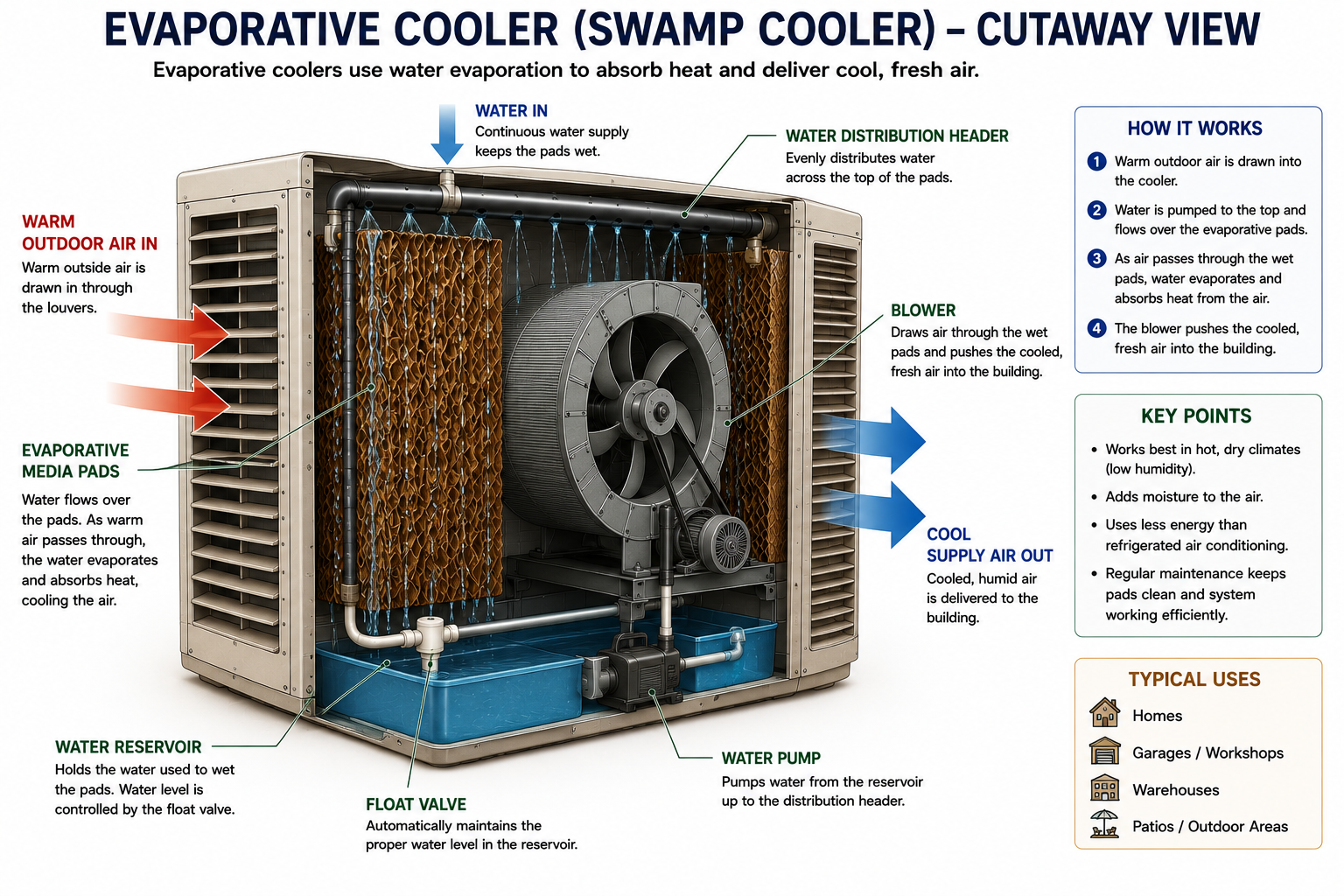
A direct evaporative cooler is mechanically simpler than a vapor-compression air-conditioning system, but it still contains several important components that must work together. Air must move through wetted media, water must be supplied and circulated, excess water must be controlled, and the cooled air must be delivered to the building.
This lesson examines the basic construction of a typical direct evaporative cooler. The goal is to recognize the major components, understand the path of air through the equipment, follow the water circulation system, and identify the parts that require routine inspection and maintenance.
Learning Objectives
Identify the Major Components
Recognize the evaporative media, water reservoir, pump, water distribution system, float valve, blower, and air openings found in a typical direct evaporative cooler.
Follow the Air Path
Trace outdoor air through the wet evaporative media and blower before it is delivered to the building.
Follow the Water Path
Explain how water moves from the reservoir through the pump and distribution system before returning to the reservoir.
Recognize Maintenance Areas
Identify the parts of the cooler most affected by mineral deposits, water quality, debris, wear, and seasonal operation.
Air Movement and Water Circulation Work Together
A direct evaporative cooler combines two basic systems: an airflow system and a water-circulation system. The airflow system brings hot outdoor air into the equipment, moves it through the evaporative media, and delivers the cooled air to the building. The water system keeps the evaporative media wet so that evaporation can continue.
Unlike mechanical refrigeration equipment, the cooler does not need a compressor, condenser, refrigerant metering device, or refrigerant piping. Its major operating components are instead associated with air movement and water circulation.
The Wet Surface Where Cooling Occurs
The evaporative media provides a large wetted surface for contact between outdoor air and water. As air moves through the media, some of the water evaporates into the air stream and produces the cooling effect introduced in Lesson 8.
Older equipment may use replaceable pad materials, while many modern coolers use thicker rigid media designed to provide a large wetted surface and an organized airflow path. Regardless of the exact design, the media must receive an adequate and reasonably even supply of water.
Must Remain Wet
Dry portions of the media provide little or no evaporative cooling and allow hot outdoor air to pass through without receiving the intended cooling effect.
Must Pass Air
The media must allow the blower to move the required amount of air through the cooler without excessive restriction.
Can Collect Minerals
As water evaporates, dissolved minerals remain behind and can accumulate on the media and other wetted surfaces.
Can Deteriorate
Media can become dirty, damaged, clogged, or physically deteriorated and should be inspected and replaced when its condition no longer supports proper operation.
Water Collects at the Bottom of the Cooler
The lower portion of many evaporative coolers forms a reservoir or sump that holds the water used by the recirculating system. Water that passes through the media without evaporating drains back into this reservoir so that it can be circulated again.
The reservoir must contain enough water to keep the pump supplied while maintaining the proper operating level. Dirt, mineral deposits, biological material, and other debris can accumulate in this area, making regular inspection and cleaning important.
Water Does Not Simply Disappear
Only part of the water supplied to the media evaporates. Water that does not evaporate drains back into the reservoir and can be recirculated through the cooler.
Maintaining the Correct Water Level
As water evaporates from the cooler, additional water must enter the reservoir to replace it. A float-operated water valve is commonly used to control the incoming water supply.
As the reservoir level falls, the float drops and allows the water valve to open. As the water level rises to the proper operating point, the float closes the valve.
Water Is Used
Some of the recirculating water evaporates into the moving air and leaves the cooler as water vapor.
Reservoir Level Falls
The reduction in stored water causes the float to move downward.
Water Valve Opens
The float mechanism allows additional supply water to enter the reservoir.
Correct Level Is Restored
As the reservoir fills, the float rises and closes the water valve at the intended operating level.
Incorrect Water Level Creates Problems
A water level that is too low can allow the pump to lose its water supply or prevent the media from being wetted properly. A level that is too high can cause overflow or other water-control problems. The float should be adjusted according to the equipment manufacturer’s requirements.
Circulating Water to the Media
A small pump draws water from the reservoir and sends it through tubing or piping to the water-distribution system above the evaporative media.
The pump does not create the cooling directly. Its job is to keep the media supplied with water so that evaporation can occur as outdoor air moves through the cooler.
Pump Inlet
The pump draws water from the reservoir and must remain adequately supplied while operating.
Pump Outlet
The discharge side carries water to the distribution tubing or header serving the evaporative media.
Restricted Pump
Dirt, debris, or mineral deposits can restrict the pump inlet or water passages and reduce the amount of water reaching the media.
Failed Pump
If the blower continues operating but the pump stops, outdoor air may pass through dry media and provide little evaporative cooling.
The Entire Media Surface Must Receive Water
Water leaving the pump travels to a distribution header, trough, tubing network, or other manufacturer-designed arrangement above the evaporative media. Openings in this system distribute water across the top of the media.
Gravity then carries water downward through the media. Water that does not evaporate falls back into the reservoir and can be recirculated.
Moving Outdoor Air Through the Cooler
The blower provides the airflow needed for the cooling process. It draws or moves hot outdoor air through the wetted evaporative media and then delivers the cooled air into the building.
Depending on the equipment design, the blower may be a centrifugal blower connected to ductwork or another fan arrangement intended for the particular cooler. The exact drive system can vary between direct-drive and belt-driven equipment.
The Pump and Blower Perform Different Jobs
The pump moves water. The blower moves air. Both normally need to operate correctly for the evaporative cooling process to perform as intended.
Outdoor Air Becomes Supply Air
The airflow path through a direct evaporative cooler is simple compared with many refrigeration-based systems. Outdoor air enters through the cooler cabinet, passes through the wetted media, enters the blower section, and is then delivered to the building.
Outdoor Air
Hot outdoor air enters through the louvered or media-covered sides of the cooler.
Wet Media
The air passes through the wetted evaporative media where some of the water evaporates.
Blower
The blower moves the cooled, more humid air through the cooler and toward the building.
Supply Air
The cooled outdoor air enters the building directly or through a supply duct system.
The Water Is Recirculated
The water path forms a separate loop within the cooler. The pump draws water from the reservoir, sends it to the distribution system, and allows it to flow downward through the evaporative media.
Some of the water evaporates into the air stream. The remaining water drains back into the reservoir, where it can be circulated again. Fresh makeup water replaces water lost through evaporation and other approved water-management processes.
Reservoir
Water collects in the sump at the bottom of the cooler.
Pump
The pump draws water from the reservoir and sends it upward.
Distribution System
Water is distributed across the top of the evaporative media.
Media
Water flows downward through the media while some of it evaporates into the passing air.
Return to Reservoir
Water that does not evaporate drains back into the reservoir.
Makeup Water
The float valve admits fresh water as needed to replace water lost from the system.
Evaporation Leaves Dissolved Minerals Behind
Water supplied to an evaporative cooler normally contains dissolved minerals. When pure water evaporates into the air stream, those minerals do not evaporate with it. They remain behind in the recirculating water and on wetted components.
Over time, mineral concentration can increase and deposits may develop on the evaporative media, reservoir, pump, distribution openings, and other surfaces. Water quality therefore has a direct effect on evaporative-cooler maintenance.
More Evaporation Means More Concentrated Minerals
As water leaves the cooler through evaporation, dissolved minerals remain in the water system. Depending on the equipment and water conditions, periodic draining, bleed-off, or another manufacturer-approved water-management method may be used to limit mineral concentration.
Simple Equipment Still Requires Maintenance
Evaporative coolers are mechanically straightforward, but they operate continuously with water, outdoor air, dust, and dissolved minerals. Those conditions make regular inspection especially important.
DOE guidance specifically recommends keeping the water reservoir clean and inspecting items such as evaporative media, the recirculating pump, and reservoir level controls. :contentReference[oaicite:1]{index=1}
Inspect the Media
Look for mineral buildup, dirt, damage, deterioration, uneven wetting, or airflow restriction.
Inspect the Reservoir
Remove accumulated debris and deposits and verify that the reservoir remains in suitable condition.
Inspect the Pump
Verify water circulation and check for restrictions, unusual noise, debris, or other signs of improper operation.
Inspect Water Distribution
Confirm that the distribution openings are clear and that the media receives water across the required surface.
Inspect the Float Valve
Verify that the water level is properly maintained without allowing the reservoir to run too low or overflow.
Inspect the Blower
Check the blower, motor, belt where used, bearings where applicable, and airflow path according to the equipment manufacturer’s service requirements.
Think in Terms of Air and Water
Many evaporative-cooler problems can initially be divided into two categories: inadequate airflow and inadequate water distribution. That does not replace proper diagnosis, but it provides a useful starting point.
Blower Runs but Air Is Warm
Check whether the media is actually wet and whether the pump and water-distribution system are operating properly.
Only Part of the Media Is Wet
Look for clogged distribution openings, restricted tubing, poor water distribution, or other causes of uneven wetting.
Very Little Airflow
Check the media for restriction and inspect the blower, belt where used, air openings, duct system, and building relief-air path.
Reservoir Runs Dry
Inspect the makeup-water supply, float valve, operating water level, leaks, and other causes of inadequate water supply.
Water Overflows
Check the float valve, adjustment, water pressure, reservoir condition, and other water-level controls.
Heavy Mineral Buildup
Inspect the media and water system and follow the manufacturer’s cleaning, water-management, and replacement recommendations.
Avoid These Evaporative-Cooler Mistakes
“The Pump Cools the Air”
Incorrect. The pump circulates water. Cooling occurs when water evaporates into the air moving through the wet media.
“If the Pump Runs, the Pads Must Be Wet”
Incorrect. Restricted tubing or distribution openings can prevent water from reaching part or all of the media even when the pump itself is operating.
“All the Water Is Used Up Each Pass”
Incorrect. Only part of the water evaporates. Much of the remaining water drains back into the reservoir and is recirculated.
“Minerals Evaporate With the Water”
Incorrect. Dissolved minerals remain behind and can become increasingly concentrated in the recirculating water.
“No Refrigerant Means No Maintenance”
Incorrect. Water pumps, media, blowers, level controls, reservoirs, distribution systems, and water-quality conditions all require attention.
“Water Level Does Not Matter”
Incorrect. The reservoir must maintain the proper level so the pump remains supplied without allowing the cooler to overflow.
Review Questions
1. What are the two basic systems operating inside a direct evaporative cooler?
Answer: An airflow system and a water-circulation system.
2. What is the purpose of the evaporative media?
Answer: It provides a large wetted surface where outdoor air can contact water and evaporation can occur.
3. What is the purpose of the water reservoir?
Answer: It stores the water used by the recirculating system and receives water that drains back from the evaporative media.
4. What does the float valve do?
Answer: It controls makeup water entering the reservoir and maintains the intended operating water level.
5. What is the purpose of the pump?
Answer: The pump moves water from the reservoir to the water-distribution system serving the evaporative media.
6. What does the blower do?
Answer: The blower moves outdoor air through the wetted evaporative media and delivers the cooled air to the building.
7. What is the basic air path through a direct evaporative cooler?
Answer: Outdoor air → wet evaporative media → blower → building.
8. What is the basic recirculating water path?
Answer: Reservoir → pump → distribution system → evaporative media → reservoir.
9. Why can mineral deposits increase in an evaporative cooler?
Answer: Water evaporates but dissolved minerals remain behind, increasing mineral concentration in the recirculating water and allowing deposits to form.
10. If the blower is operating but the air leaving the cooler is unusually warm, what basic system should be checked?
Answer: The water-circulation and distribution system should be checked to determine whether the evaporative media is receiving adequate water.
Lesson 9 Summary
- A direct evaporative cooler combines an airflow system with a recirculating water system.
- Evaporative media provides the wetted surface where outdoor air and water interact.
- The reservoir or sump stores recirculating water at the bottom of the cooler.
- A float-operated valve commonly maintains the required reservoir water level.
- The pump moves water from the reservoir to the distribution system above the evaporative media.
- The distribution system must wet the media adequately and reasonably evenly.
- The blower moves outdoor air through the wetted media and delivers cooled air to the building.
- The basic airflow path is outdoor air → wet media → blower → building.
- The basic recirculating water path is reservoir → pump → distribution system → media → reservoir.
- Makeup water replaces water lost through evaporation and other approved water-management processes.
- Dissolved minerals do not evaporate with the water and can accumulate in the water system and on wetted components.
- Media, reservoirs, pumps, level controls, water-distribution systems, and blowers require regular inspection and maintenance.
- Many operating problems can initially be approached by asking whether the cooler has adequate airflow and adequate water distribution.