System Selection and Final Review
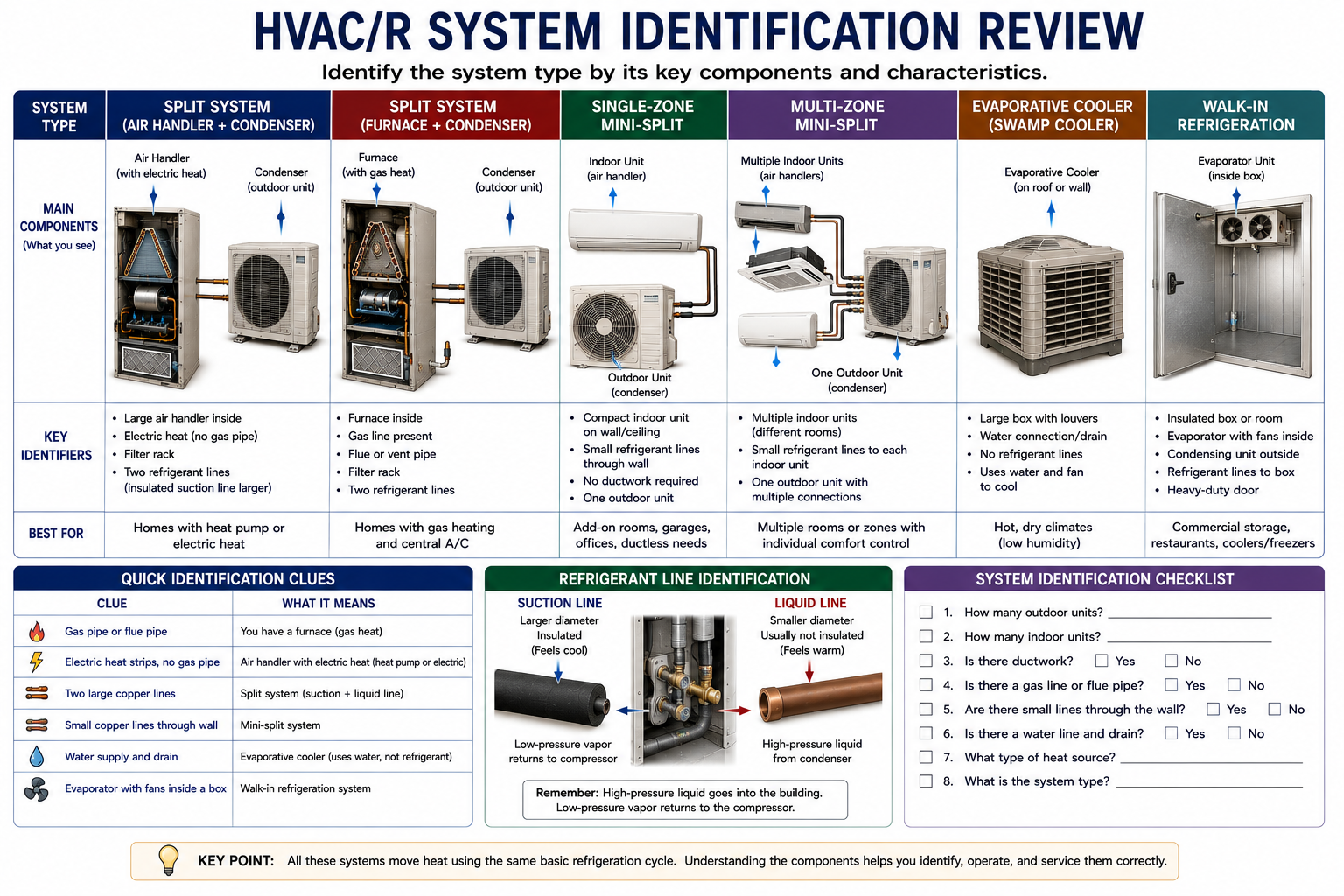
The previous lessons introduced several common ways of providing building cooling: packaged air-conditioning equipment, conventional split systems with air handlers, split systems using gas furnaces and evaporator coils, ductless mini-splits, and direct evaporative coolers. Each configuration has visual characteristics that allow a technician to begin identifying the system before opening a service panel.
This final lesson brings the section together. The goal is not to memorize one particular equipment cabinet. Instead, you should be able to look at the entire installation, determine how the equipment is arranged, recognize how conditioned air is distributed, identify the major connections, and understand some of the reasons one system configuration may be used instead of another.
Learning Objectives
Identify the System Configuration
Use equipment location, ductwork, refrigerant piping, heating equipment, and indoor-unit style to classify common air-conditioning systems.
Compare Air Distribution
Distinguish central ducted systems, zone-based mini-split equipment, and flow-through evaporative cooling arrangements.
Recognize Selection Factors
Explain why building construction, available utilities, climate, ductwork, zoning needs, water availability, and other conditions influence equipment selection.
Apply the Entire Section
Combine the concepts from Lessons 1 through 10 to approach unfamiliar equipment systematically rather than identifying systems by appearance alone.
Look at the System Before Looking at the Components
When approaching unfamiliar HVAC equipment, begin by looking at the complete installation. The location of the equipment, the type of connections entering and leaving it, and the way conditioned air reaches the building often reveal the general system configuration.
This approach is more reliable than identifying equipment from cabinet shape alone. Different manufacturers can build very different-looking equipment that performs the same function, while two cabinets that appear similar from a distance may contain very different heating or cooling arrangements.
Packaged or Split?
For refrigeration-based central air-conditioning equipment, one of the most useful first questions is whether the system is packaged or split.
Packaged
The major cooling and air-moving assemblies are contained within one outdoor cabinet. Building supply and return ducts normally connect directly to that cabinet.
Split
The refrigeration equipment is divided between indoor and outdoor assemblies. Refrigerant piping connects those assemblies so they operate as one complete system.
This distinction immediately narrows the possibilities. A large outdoor cabinet connected directly to building supply and return ducts suggests packaged equipment. An outdoor condensing unit connected to indoor equipment by refrigerant lines suggests a split system.
Do Not Use Location Alone
Outdoor location does not automatically mean packaged equipment. The outdoor condensing unit of a split system is also outdoors. The important question is what the outdoor equipment connects to: large building ducts or separate indoor equipment through refrigerant piping?
Look at the Cabinet and Utility Connections
Package units contain the major cooling and air-moving equipment in one outdoor cabinet and normally connect directly to the building’s duct system. Once you have identified the equipment as packaged, the next question is how the unit provides heat.
Gas/Electric Package
Look for a gas supply and the combustion-air or exhaust provisions associated with the gas heating section.
All-Electric Package
No gas supply or combustion exhaust is required for electric resistance heating. The electrical requirements may be substantially greater when resistance heat is installed.
Supply and Return Ducts
Large duct connections running directly between the outdoor cabinet and building are important clues that the equipment is packaged.
No Remote Indoor Coil
A conventional packaged system does not use a field-installed refrigerant line set to connect a remote indoor evaporator to the outdoor cabinet.
Find the Indoor Equipment
When refrigerant lines run from an outdoor condensing unit into the building, locate the indoor equipment served by those lines. The indoor equipment usually tells you which conventional split-system arrangement you are examining.
Air Handler
The indoor cabinet contains the evaporator coil and blower. Depending on the system, electric resistance heating may also be installed.
Gas Furnace + Evaporator Coil
The furnace contains the blower and gas-heating equipment, while a separate evaporator coil is installed in the building air path and connected to the outdoor unit.
In the common upflow furnace arrangement studied earlier, the blower is located in the lower furnace compartment and the cased evaporator coil is installed above the furnace. During cooling, the furnace blower moves air through the evaporator coil even though the gas burners are not providing the cooling.
The Line Set Identifies the Refrigeration Connection
The refrigerant line set connects the outdoor refrigeration equipment to the indoor evaporator coil. With a furnace/coil installation, the refrigerant lines connect to the coil assembly rather than to the gas-heating portion of the furnace.
Look for Zone Equipment Rather Than Central Ductwork
Mini-split equipment is also a split refrigeration system, but the indoor equipment is normally located directly within the individual rooms or zones being conditioned. ENERGY STAR describes ductless mini-splits as using indoor head units with an accompanying outdoor unit without requiring conventional ductwork.
Outdoor Unit
Look for an outdoor refrigeration unit connected to one or more indoor units rather than to a central indoor furnace or air handler.
Indoor Heads
High-wall units are common, but ceiling cassettes, floor-mounted units, and concealed ducted units may also be used.
Single-Zone
One outdoor unit serving one indoor unit represents the basic single-zone arrangement.
Multi-Zone
Outdoor equipment designed for multiple zones can serve two or more indoor units located in different areas.
Look for Water Instead of Refrigerant
Direct evaporative cooling is fundamentally different from the refrigeration-based systems in this section. Instead of looking for a compressor, condenser, refrigerant lines, and indoor refrigeration coil, look for the equipment required to move air through wetted media.
Evaporative Media
Outdoor air passes through wetted media where water evaporation produces the cooling effect.
Water Supply
A water connection, float valve, reservoir, pump, and distribution system support the evaporative process.
Blower
The blower moves outdoor air through the cooler and supplies the cooled, more humid air to the building.
Relief Air
Because the system continually brings outdoor air into the building, an appropriate path must exist for indoor air to leave.
Do Not Look for Refrigeration Components That Are Not There
A conventional direct evaporative cooler does not contain the compressor, condenser, refrigeration metering device, refrigerant evaporator coil, or refrigerant line set used by the other cooling systems covered in this section.
Put the Major Configurations Side by Side
| System | Basic Arrangement | Air Distribution | Indoor/Outdoor Refrigerant Lines | Typical Heating Arrangement Discussed |
|---|---|---|---|---|
| Gas/Electric Package | One outdoor cabinet | Central ducts | No conventional remote line set | Gas furnace section |
| All-Electric Package | One outdoor cabinet | Central ducts | No conventional remote line set | Electric resistance heat in the configuration studied |
| Split + Air Handler | Outdoor condensing unit + indoor air handler | Central ducts | Yes | Electric heat or heat-pump arrangements may be used |
| Split + Gas Furnace | Outdoor condensing unit + indoor evaporator coil + furnace | Central ducts | Yes | Gas furnace |
| Ductless Mini-Split | Outdoor unit + one or more indoor units | Direct zone conditioning in typical ductless installations | Yes | Many are heat pumps |
| Direct Evaporative Cooler | Evaporative media + water system + blower | Flow-through outdoor air | No refrigerant circuit | Cooling system only in the configuration studied |
Work Through the Installation in a Logical Order
A consistent identification process helps prevent assumptions and makes unfamiliar systems easier to approach.
Find the Cooling Equipment
Locate the major outdoor equipment, indoor equipment, or evaporative cooler serving the building or zone.
Look at the Connections
Identify large ducts, refrigerant piping, gas service, electrical service, condensate drains, water connections, and other external clues.
Determine Packaged or Split
For refrigeration equipment, determine whether the major assemblies are in one cabinet or divided between indoor and outdoor equipment.
Identify the Indoor Equipment
Determine whether the system uses an air handler, gas furnace with coil, mini-split indoor unit, or another arrangement.
Determine How Air Is Distributed
Look for central supply and return ducts, direct zone discharge, short concealed ducts, or flow-through evaporative ventilation.
Confirm the Equipment
Use the nameplate, manufacturer documentation, wiring information, and actual equipment configuration to confirm your identification.
There Is No Single Best Configuration for Every Building
System selection involves much more than choosing a refrigeration cycle. Building construction, existing infrastructure, climate, available utilities, installation space, zoning requirements, energy considerations, first cost, operating cost, serviceability, and occupant needs can all influence the choice.
Existing Ductwork
A building with an appropriate central duct system may be well suited to packaged or conventional ducted split equipment, while a building without ducts may favor another approach.
Available Fuel
The presence or absence of natural gas or another approved fuel can influence whether gas-fired heating is practical.
Building Layout
Multiple rooms with different schedules or comfort requirements may benefit from zoning or multiple indoor units.
Equipment Space
Available roof space, mechanical rooms, closets, attic space, exterior wall area, and outdoor locations can influence equipment configuration.
Climate
Outdoor temperature and humidity affect equipment loads and can determine whether direct evaporative cooling is practical. Evaporative cooling is most effective in hot, dry conditions. :contentReference[oaicite:1]{index=1}
Water Availability
Direct evaporative cooling requires an ongoing water supply, making water availability and quality part of the application decision.
Equipment Selection Requires More Analysis Than This Lesson
Actual system selection requires proper load calculations, equipment sizing, manufacturer requirements, applicable codes, efficiency requirements, climate data, ventilation requirements, economics, and other design considerations. The purpose of this lesson is to recognize why several different configurations exist, not to replace system design procedures.
Apply the Configuration Concepts
Example 1 — Small Commercial Building With Rooftop Duct Connections
A building already has central supply and return ducts terminating at a rooftop curb. A packaged unit is one possible configuration because the heating, cooling, and air-moving equipment can be concentrated at the roof and connected directly to the existing duct system.
Example 2 — House With Gas Furnace and Existing Ductwork
A conventional split air conditioner using an outdoor condensing unit and an evaporator coil installed with the existing furnace is a common configuration. The furnace blower can serve the air-conditioning system during cooling.
Example 3 — Building Addition Without Existing Ductwork
A mini-split may be a practical configuration because an indoor unit can condition the new zone without extending a large central duct system into the addition.
Example 4 — Home in a Hot, Very Dry Climate
A direct evaporative cooler may be practical when local outdoor conditions provide sufficient evaporative cooling potential, water is available, and the building can provide the required relief airflow.
These Are Examples, Not Automatic Selections
Building conditions must be evaluated before selecting actual equipment. The examples demonstrate why a configuration might be considered, not that it is automatically the correct design for every similar-looking building.
Avoid Shortcuts
“It Is Outside, So It Is a Package Unit”
Incorrect. Split systems also have outdoor equipment. Determine whether the outdoor cabinet connects to building ducts or to separate indoor equipment through refrigerant piping.
“Every Indoor Cabinet Is a Furnace”
Incorrect. The equipment may be an air handler, furnace, evaporator-coil cabinet, mini-split indoor unit, or another type of HVAC equipment.
“No Ducts Means It Is Not Split”
Incorrect. A ductless mini-split is still a split refrigeration system.
“All Package Units Use Gas”
Incorrect. Package units can use different heating arrangements, including electric resistance and heat-pump configurations.
“A Swamp Cooler Is a Refrigerant AC”
Incorrect. Direct evaporative cooling uses water evaporation and does not require the vapor-compression refrigeration circuit studied elsewhere in this course.
“If I Recognize the Cabinet, I Know the System”
Unsafe assumption. Verify the equipment with the nameplate, manufacturer information, connections, and actual internal configuration.
Ask Yourself These Questions
- Are the major cooling assemblies contained in one cabinet or separated between indoor and outdoor equipment?
- Do large supply and return ducts connect directly to an outdoor cabinet?
- Does a refrigerant line set run between indoor and outdoor equipment?
- What type of indoor equipment is present?
- Is there an air handler or a gas furnace with a separate evaporator coil?
- Are there individual wall, ceiling, floor, or concealed indoor units serving separate zones?
- Is there a gas connection and combustion vent?
- Where does the condensate drain originate?
- Does the system use conventional central ductwork?
- Is water being circulated through evaporative media instead of refrigerant through a refrigeration circuit?
- How does air enter, move through, and leave the building?
- Does the equipment nameplate confirm your identification?
Final Review Questions
1. What is the fundamental difference between a packaged air conditioner and a conventional split air conditioner?
Answer: A packaged system contains the major cooling and air-moving assemblies in one cabinet, while a split system divides the refrigeration equipment between separate indoor and outdoor assemblies connected by refrigerant piping.
2. You find a large outdoor cabinet with supply and return ducts connected directly to it. What general configuration should you suspect first?
Answer: Packaged equipment.
3. You find an outdoor condensing unit with two refrigerant lines entering the building. What should you look for next?
Answer: Locate the indoor refrigeration equipment and determine whether the system uses an air handler, evaporator coil with a furnace, mini-split indoor unit, or another approved split-system arrangement.
4. What major indoor-equipment difference separates the split systems covered in Lessons 4 and 5?
Answer: Lesson 4 uses an air handler containing the evaporator coil and blower. Lesson 5 uses a gas furnace blower with a separate evaporator coil installed in the furnace air path.
5. Is a ductless mini-split a split system?
Answer: Yes. Its refrigeration equipment is divided between indoor and outdoor assemblies connected by refrigerant piping. The term ductless describes the typical air-distribution arrangement.
6. What is the basic difference between single-zone and multi-zone mini-split equipment?
Answer: A single-zone system uses one outdoor unit serving one indoor unit. Multi-zone equipment is designed to serve two or more indoor units or zones.
7. What external clues can help distinguish a gas/electric package unit from an all-electric package unit?
Answer: A gas/electric package unit will have a gas supply and combustion provisions associated with its gas heating section. An electric resistance heating section does not require a gas supply or combustion exhaust.
8. How does direct evaporative cooling differ from all of the refrigeration-based systems in this section?
Answer: It uses water evaporation to cool outdoor air rather than using a vapor-compression refrigeration circuit.
9. Why does a direct evaporative cooler require relief airflow from the building?
Answer: The cooler continually introduces outdoor air. Existing indoor air must be able to leave so additional cooled air can enter and move through the building.
10. Why does evaporative cooling generally perform better in a hot, dry climate?
Answer: Dry air can accept more additional water vapor, allowing more evaporation and therefore greater temperature reduction.
11. Why should a technician avoid identifying equipment only by cabinet appearance?
Answer: Different equipment configurations can have similar cabinet shapes, and manufacturers use different designs. Utility connections, ductwork, refrigerant piping, indoor equipment, nameplates, and manufacturer information provide more reliable identification.
12. What should be the final step after visually identifying an HVAC system?
Answer: Confirm the identification using the equipment nameplate, model information, manufacturer documentation, and actual installed configuration.
Lesson 11 and Section Summary
- Air-conditioning systems can use the same basic refrigeration principles while arranging the equipment in very different ways.
- A packaged system contains its major cooling and air-moving assemblies within one outdoor cabinet.
- Package units may use gas heating, electric resistance heating, heat-pump operation, or other approved configurations.
- A conventional split system separates the outdoor refrigeration equipment from the indoor evaporator assembly.
- A split system with an air handler uses the blower contained within the air handler.
- A split system with a gas furnace uses the furnace blower to move air through a separate evaporator coil during cooling.
- A mini-split is still a split refrigeration system even though a typical installation does not use conventional central ductwork.
- Single-zone mini-splits serve one indoor unit, while multi-zone equipment can serve multiple indoor units.
- Direct evaporative cooling uses water evaporation rather than a vapor-compression refrigeration circuit.
- Evaporative cooling performs best in hot, dry conditions and requires an appropriate path for supply air to move through and leave the building.
- Water quality, mineral accumulation, airflow, media condition, and water distribution affect evaporative-cooler performance.
- System selection depends on building construction, ductwork, climate, utilities, space, zoning requirements, water availability, economics, and other design considerations.
- A technician should identify the overall equipment configuration before concentrating on individual components.
- Visual clues should be used together rather than relying on one characteristic.
- The equipment nameplate and manufacturer documentation should confirm the final equipment identification.
- Understanding how equipment is arranged in the field connects the refrigeration theory and component knowledge learned elsewhere in this course to complete working HVAC systems.