R-134a Refrigerant
R-134a became one of the most familiar HFC refrigerants during the transition away from CFC refrigerants such as R-12. It has been used in household appliances, commercial refrigeration, chillers, air-conditioning equipment, and motor-vehicle air conditioning.
R-134a contains no chlorine and therefore has zero ozone depletion potential, but it is a greenhouse gas with significant global warming potential. Understanding R-134a provides an important example of how refrigerant technology moved from ozone-depleting refrigerants toward HFCs and is now moving again toward lower-GWP alternatives.
What You Will Learn
After completing this lesson, you should be able to:
Identify R-134a
Recognize R-134a as a single-component HFC refrigerant with an ASHRAE A1 safety classification.
Recognize Common Applications
Identify stationary refrigeration, appliance, chiller, and historical motor-vehicle applications that have used R-134a.
Interpret R-134a Pressures
Use the correct R-134a pressure-temperature relationship when evaluating refrigerant condition.
Recognize Lubricant Requirements
Explain why POE oil is commonly associated with R-134a stationary refrigeration systems and why manufacturer requirements control lubricant selection.
Explain Environmental Characteristics
Distinguish zero ozone depletion potential from the separate issue of global warming potential.
Recognize Regulatory Context
Understand that R-134a remains present in existing equipment while its use in certain categories of newly manufactured equipment has been restricted or replaced by lower-GWP alternatives.
A Single-Component HFC Refrigerant
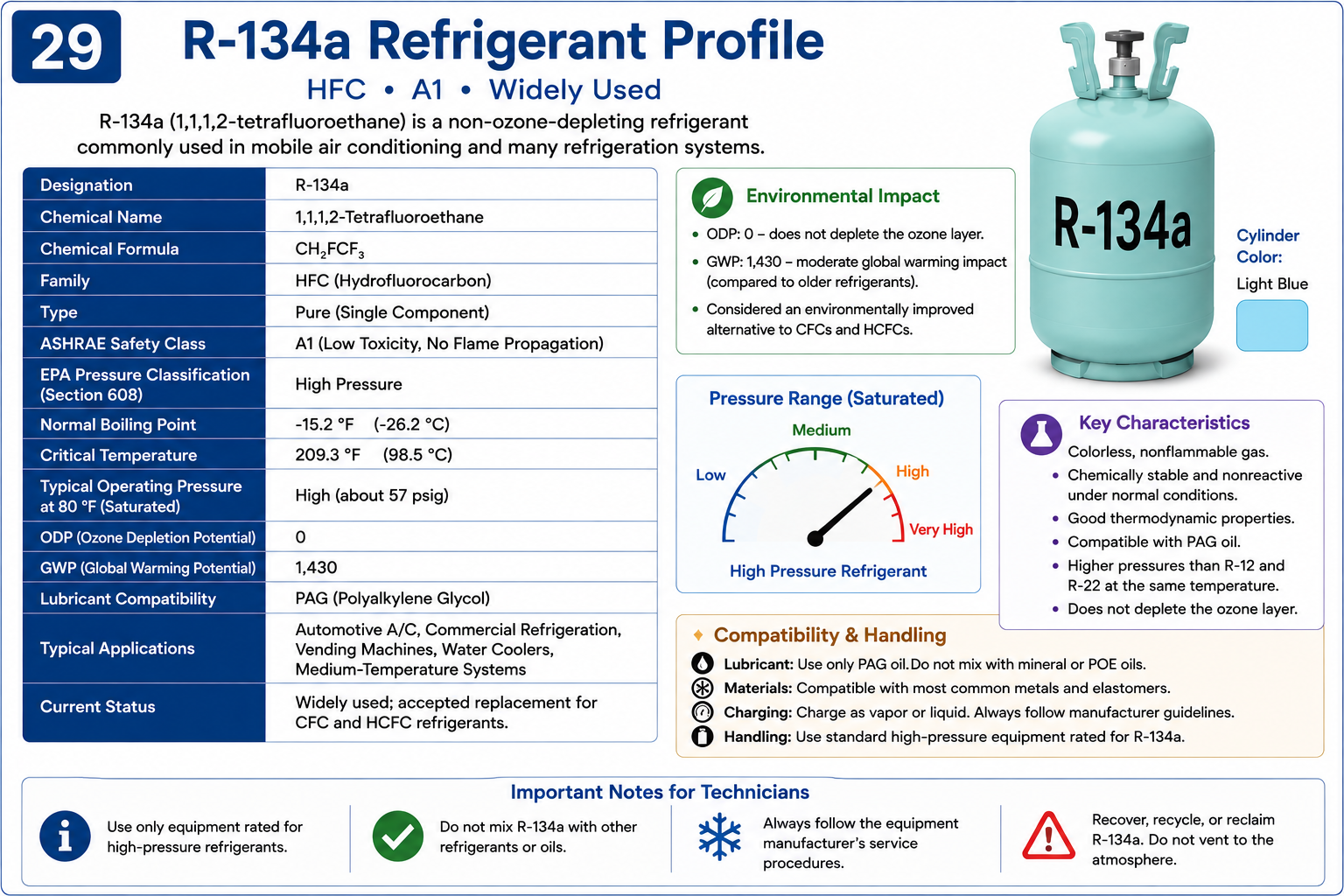
R-134a is the refrigerant designation for 1,1,1,2-tetrafluoroethane. It is a hydrofluorocarbon, or HFC, containing hydrogen, fluorine, and carbon but no chlorine.
Unlike R-404A, R-407C, R-410A, and many other commonly encountered refrigerants, R-134a is not a blend. It is a single-component refrigerant and therefore does not have the temperature glide associated with zeotropic blends.
Designation
R-134a
Refrigerant Family
HFC — hydrofluorocarbon.
Composition
Single-component refrigerant.
Safety Classification
ASHRAE A1.
Ozone Depletion Potential
0 — R-134a contains no chlorine.
100-Year GWP
Approximately 1,430 using the value used in EPA SNAP listings.
An Important Refrigerant Transition
R-134a became especially important because it could serve many applications that had historically used R-12 without introducing chlorine into the refrigerant molecule.
This made R-134a an important part of the transition away from CFC refrigerants. It provided zero ozone depletion potential while retaining useful refrigeration characteristics for many medium-temperature applications.
R-12
CFC refrigerant containing chlorine, with significant ozone depletion potential.
R-134a
HFC refrigerant containing no chlorine and therefore having zero ozone depletion potential.
Legacy Refrigerants
R-12 and R-22 and the reasons chlorine-containing refrigerants were phased out were covered in R-12 and R-22: Legacy Refrigerants.
Where R-134a Has Been Used
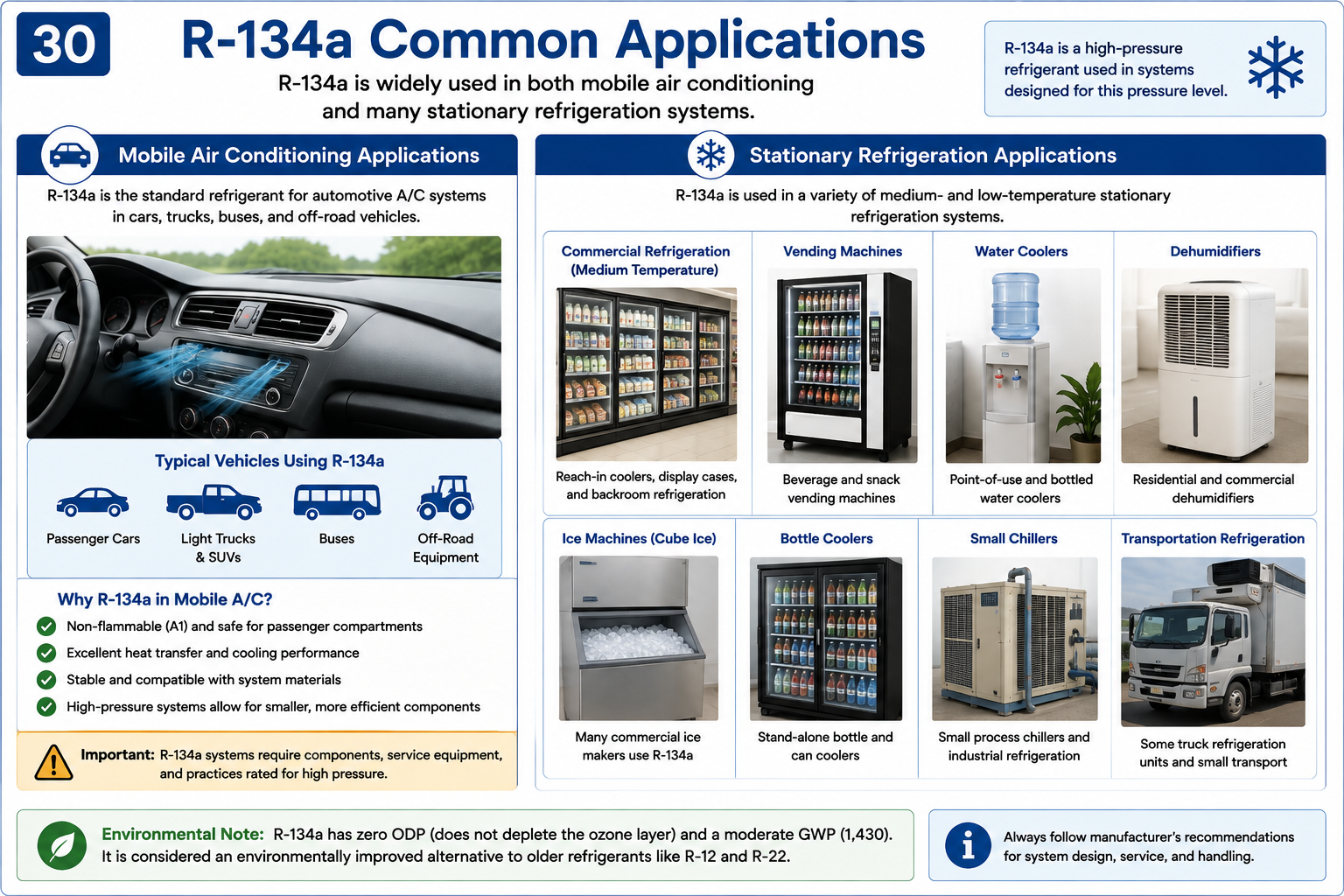
R-134a has been used in a wide range of refrigeration and air-conditioning equipment. Its applications have included both stationary refrigeration systems and motor-vehicle air conditioning.
Household Appliances
R-134a was widely used in refrigerators and freezers before newer low-GWP refrigerants became common in newly manufactured appliances.
Commercial Refrigeration
R-134a has been used in medium-temperature refrigeration, stand-alone equipment, food-service equipment, and other commercial applications.
Chillers
R-134a has been used in certain positive-pressure chiller designs and other larger refrigeration systems.
Motor Vehicles
R-134a replaced R-12 in many automotive air-conditioning systems and remains in a large existing vehicle fleet.
The Application Determines Which Certification Rules Apply
R-134a appears in both stationary refrigeration and motor-vehicle air-conditioning systems, so technicians must distinguish the application being serviced.
Stationary refrigeration and air-conditioning equipment is generally addressed under EPA Section 608. Motor-vehicle air conditioning is addressed under EPA Section 609.
This course focuses on EPA Section 608. We discuss R-134a automotive use because it is historically important, but Section 609 certification and MVAC service procedures are a separate subject.
EPA explains the distinction between Section 608 and Section 609 at Section 608 and Section 609 Overlap.
R-134a Has Its Own P-T Characteristics
Like every refrigerant, R-134a has a specific relationship between saturation pressure and saturation temperature. A technician must use an R-134a pressure-temperature chart or electronic reference when converting between saturation pressure and saturation temperature.
Because R-134a is a single-component refrigerant, it has one saturation temperature at a given saturation pressure. There is no separate bubble-point and dew-point temperature as there is with a zeotropic blend.
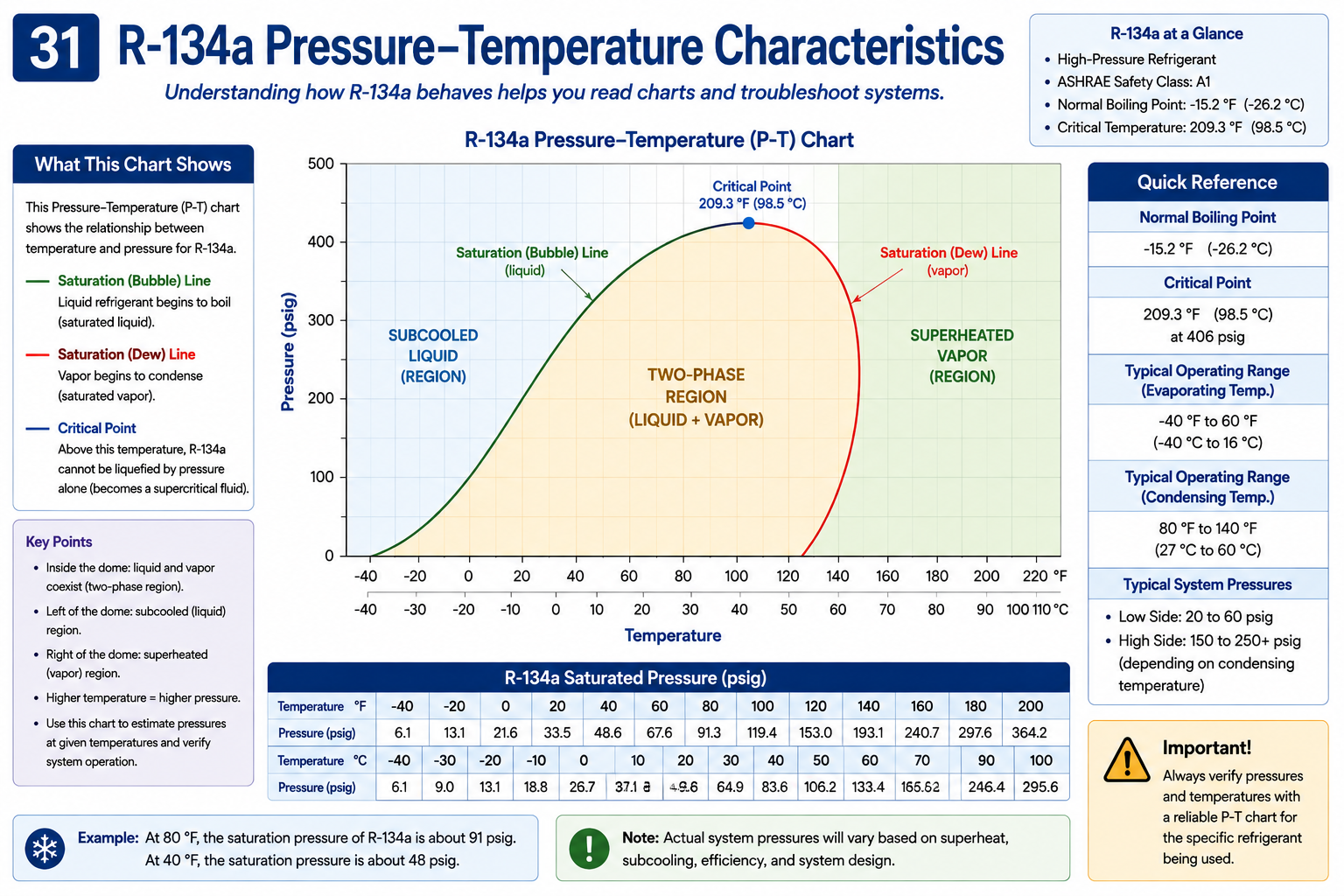
Gauge pressure alone does not tell you whether an R-134a system is operating correctly. Pressure must be considered together with temperature, system load, airflow or heat transfer, superheat, subcooling where applicable, and equipment specifications.
The Same Refrigeration Theory Still Applies
R-134a follows the same basic refrigeration principles already developed in Refrigeration Theory. Saturated refrigerant exists at the pressure-temperature relationship established for R-134a.
Vapor heated above saturation is superheated, while liquid cooled below saturation is subcooled.
Pressure, Temperature, and Refrigerant State
For a graphical review of saturated liquid, saturated vapor, superheat, subcooling, and refrigerant phase change, revisit Introduction to the Pressure-Enthalpy Diagram.
Lubricant Compatibility Changed With the Move Away From R-12
One of the major technical differences encountered during the transition from R-12 to R-134a was lubricant compatibility. Traditional R-12 systems commonly used mineral oil, while R-134a stationary refrigeration equipment commonly uses POE oil where specified by the equipment manufacturer.
Mineral oil does not provide satisfactory miscibility and oil-return characteristics with R-134a in many systems. This is why converting an older R-12 system to R-134a historically involved more than simply replacing the refrigerant.
Use the lubricant type and viscosity specified by the compressor or equipment manufacturer. Do not select oil solely from a general refrigerant compatibility chart.
POE Oil and Moisture
POE oil, lubricant compatibility, moisture absorption, oil circulation, and contamination were covered in Refrigerants and Lubricants.
Keep the Refrigeration Circuit Clean and Dry
POE oil is hygroscopic, meaning it readily absorbs moisture from atmospheric air. This requires careful handling whenever an R-134a system using POE is opened for service.
Minimize Open Time
Do not leave the refrigeration circuit open to atmospheric air longer than necessary.
Keep Oil Sealed
Keep POE containers tightly closed except when lubricant is actually being dispensed.
Use Appropriate Filter-Driers
Replace filter-driers when required by the repair procedure or manufacturer.
Evacuate Properly
Remove air and moisture before refrigerant is returned to the repaired system.
Single-Component Refrigerant Simplifies Phase Composition
Because R-134a is a single-component refrigerant, it does not fractionate like a zeotropic refrigerant blend. The refrigerant composition does not change because one blend component boils away faster than another.
That does not eliminate the need for proper charging technique. The correct method depends on the appliance, service procedure, compressor condition, and manufacturer instructions.
Single component means R-134a does not require liquid withdrawal to preserve blend composition. It does not mean liquid refrigerant can be allowed to enter a running compressor without proper control.
R-134a Is A1 — But A1 Does Not Mean Hazard-Free
R-134a is classified A1 under the ASHRAE refrigerant safety-classification system. The A indicates the lower-toxicity group, while 1 indicates no flame propagation under the applicable classification test conditions.
Technicians must still control hazards associated with pressure, frostbite, oxygen displacement, confined spaces, and refrigerant decomposition.
Pressure Hazard
Liquid and vapor refrigerant are stored and circulated under pressure.
Cold Liquid
Rapidly expanding liquid refrigerant can cause severe frostbite or eye injury.
Oxygen Displacement
A substantial refrigerant release can reduce available oxygen, especially in confined or poorly ventilated spaces.
Heat and Flame
Refrigerants exposed to extreme heat or flame can decompose into hazardous products.
Zero ODP Does Not Mean Zero Environmental Impact
R-134a solved one major environmental problem associated with CFC refrigerants: it contains no chlorine and therefore has an ozone depletion potential of zero.
However, R-134a is a greenhouse gas. EPA SNAP tables use a 100-year global warming potential of approximately 1,430 for HFC-134a. This is one reason newer equipment in many applications is transitioning toward lower-GWP refrigerants.
Ozone Depletion Potential
0
R-134a contains no chlorine.
Global Warming Potential
Approximately 1,430
R-134a is a significant greenhouse gas even though it does not deplete ozone.
ODP and GWP measure different environmental effects. A refrigerant can have zero ODP and still have substantial GWP.
R-134a Is an Existing Refrigerant in Transition
R-134a remains present in a substantial amount of existing refrigeration, air-conditioning, and motor-vehicle equipment. Existing systems can continue to require service for many years.
At the same time, EPA refrigerant rules and technology-transition requirements have restricted or displaced R-134a in a number of newly manufactured equipment categories as lower-GWP alternatives have become available. The exact status depends on the particular end use rather than on the refrigerant name alone.
EPA maintains current refrigerant status by equipment category in its SNAP Refrigeration and Air Conditioning listings. Do not assume that a refrigerant approved in one end use is automatically permitted in every other end use.
Transition Does Not Make Existing R-134a Equipment Disappear
Restrictions on the use of R-134a in certain new equipment categories do not mean that every existing R-134a appliance must immediately be replaced.
Technicians will continue to encounter existing R-134a equipment. Correct refrigerant identification, recovery, leak prevention, charging, and contamination control therefore remain important service skills.
Refrigerant transitions create overlapping generations of equipment. A technician may service R-22, R-134a, R-410A, R-32, R-454B, and other refrigerants during the same period.
R-134a Must Be Recovered During Service
The fact that R-134a has zero ozone depletion potential does not permit it to be intentionally vented during stationary refrigeration service.
EPA Section 608 prohibits intentional venting of HFC refrigerants and other non-exempt substitute refrigerants during maintenance, service, repair, and disposal, except for permitted de minimis releases associated with good-faith recovery efforts.
Recover R-134a. Zero ODP does not create an exception to the Section 608 venting prohibition for stationary refrigeration and air-conditioning equipment.
R-134a Must Remain Identifiable
Recovered R-134a should not be mixed with R-12, R-22, R-404A, R-410A, hydrocarbon refrigerants, or unidentified refrigerant.
Mixing refrigerants contaminates the recovered product, complicates reclamation, prevents normal P-T interpretation, and can create equipment or safety problems.
If the refrigerant identity is uncertain, do not contaminate a cylinder containing known R-134a. Follow procedures for handling unknown or mixed refrigerant.
Similar Application Does Not Mean Direct Interchangeability
R-134a replaced R-12 in many newly designed applications, but that does not mean it can simply be added to any existing R-12 system.
Lubricant compatibility, seals, compressor design, metering, charge amount, service fittings, system labeling, and manufacturer retrofit requirements must all be considered.
Evaluate the Complete Refrigerant Profile
Pressure alone does not determine refrigerant suitability. Review Individual Refrigerants and Refrigerant Profiles for the complete refrigerant-selection framework.
What to Remember About R-134a
For Section 608 purposes, R-134a is an important example of a non-ozone-depleting substitute refrigerant that is still subject to refrigerant-management requirements.
Remember that R-134a is an HFC, contains no chlorine, has zero ODP, is A1, and is a single-component refrigerant. In stationary applications it must still be recovered rather than intentionally vented. Automotive R-134a service falls under Section 609 rather than the stationary-equipment Section 608 program.
Avoid These R-134a Errors
“R-134a is environmentally harmless.”
No. It has zero ODP but significant global warming potential.
“A1 means no safety precautions are required.”
No. Pressure, frostbite, oxygen displacement, and decomposition hazards still require proper controls.
“R-134a is a blend.”
No. R-134a is a single-component refrigerant and does not have blend fractionation or temperature glide.
“R-134a can use any refrigeration oil.”
No. Use the lubricant specified for the compressor and equipment.
“R-134a can be vented because it has zero ODP.”
No. Section 608 prohibits intentional venting of HFC refrigerants during stationary equipment service.
“If R-134a replaced R-12, it must be a direct drop-in.”
No. Retrofit compatibility must be evaluated for the complete refrigeration system.
R-134a Refrigerant
- What refrigerant family does R-134a belong to?
- Is R-134a a single-component refrigerant or a blend?
- What is the ASHRAE safety classification of R-134a?
- Does R-134a contain chlorine?
- What is the ozone depletion potential of R-134a?
- Does zero ODP mean that R-134a has no environmental impact?
- Why did R-134a become important during the transition away from R-12?
- Name two stationary applications in which R-134a has been used.
- Does R-134a have temperature glide?
- Why must an R-134a P-T chart be used when interpreting saturation pressure?
- What lubricant is commonly associated with many stationary R-134a systems?
- What important moisture characteristic does POE oil have?
- Can R-134a be intentionally vented during stationary refrigeration service?
- Which EPA certification program generally applies to motor-vehicle R-134a air-conditioning service?
- Why is R-134a not automatically a direct drop-in replacement for R-12?
What You Should Have Learned
R-134a Is an HFC
It contains hydrogen, fluorine, and carbon but no chlorine.
R-134a Is Single Component
It does not fractionate or exhibit the temperature glide associated with zeotropic blends.
R-134a Is A1
It is in the lower-toxicity, no-flame-propagation ASHRAE classification.
ODP Is Zero
R-134a does not contain chlorine and therefore does not deplete stratospheric ozone.
GWP Is Still Significant
Zero ozone depletion potential does not mean zero climate impact.
POE Is Common in Stationary Systems
Lubricant type and viscosity must still follow compressor and equipment manufacturer specifications.
Section 608 Still Applies to Stationary R-134a
R-134a must be properly recovered during stationary refrigeration and air-conditioning service.
Existing Equipment Remains Important
Although lower-GWP alternatives are replacing R-134a in many new applications, technicians will continue servicing existing R-134a equipment.