Refrigerants and Lubricants
A refrigeration compressor depends on lubricant to reduce friction, protect moving parts, remove heat, and help provide reliable long-term operation. Because refrigerant and lubricant share the same refrigeration circuit, they must be considered together rather than as completely separate fluids.
Different refrigerants require different lubricants and behave differently when mixed with oil. Proper refrigerant-oil compatibility, oil circulation, oil return, moisture control, and contamination prevention are therefore essential parts of HVAC/R service and are also important topics in EPA Section 608 preparation.
What You Will Learn
After completing this lesson, you should be able to:
Explain Why Refrigeration Systems Need Oil
Describe the primary functions of compressor lubricant and why adequate lubrication is essential.
Identify Common Refrigeration Lubricants
Recognize mineral oil, alkylbenzene, POE, and other lubricants encountered in refrigeration systems.
Explain Refrigerant-Oil Compatibility
Describe why the refrigerant and lubricant must be appropriate for each other and for the compressor.
Explain Oil Circulation and Return
Describe how oil can leave the compressor with refrigerant and why it must return reliably.
Recognize Moisture Problems
Explain why POE oil requires careful moisture control and why evacuation and proper storage are important.
Recognize Contamination and Burnout
Identify signs of oil contamination and explain why compressor burnout requires special cleanup procedures.
The Compressor Cannot Operate Reliably Without Oil
Refrigeration compressors contain moving surfaces that require lubrication. Compressor oil forms a protective film between these surfaces, reducing friction, wear, and heat generation.
Depending on compressor design, the lubricant may also help seal clearances, carry heat away from moving components, reduce noise, and protect internal surfaces from corrosion.
Reduce Friction
Oil separates moving metal surfaces and reduces direct contact between them.
Limit Wear
A proper lubricant film helps prevent scoring, bearing damage, and premature compressor failure.
Remove Heat
Oil absorbs and transports some of the heat generated inside the compressor.
Assist Sealing
In some compressor designs, oil helps reduce refrigerant leakage between high- and low-pressure areas inside the compressor.
The lubricant is part of the refrigeration system. Oil that leaves the compressor must circulate through the system without creating problems and must return to the compressor so lubrication can continue.
Some Oil Leaves the Compressor With the Refrigerant
Even though most of the lubricant remains in the compressor, a small amount of oil can be carried out with the discharge refrigerant. That oil travels through the refrigeration circuit and must eventually return through the suction line.
System piping, refrigerant velocity, pipe sizing, vertical risers, traps where appropriate, equipment loading, and refrigerant-oil compatibility all influence successful oil return.
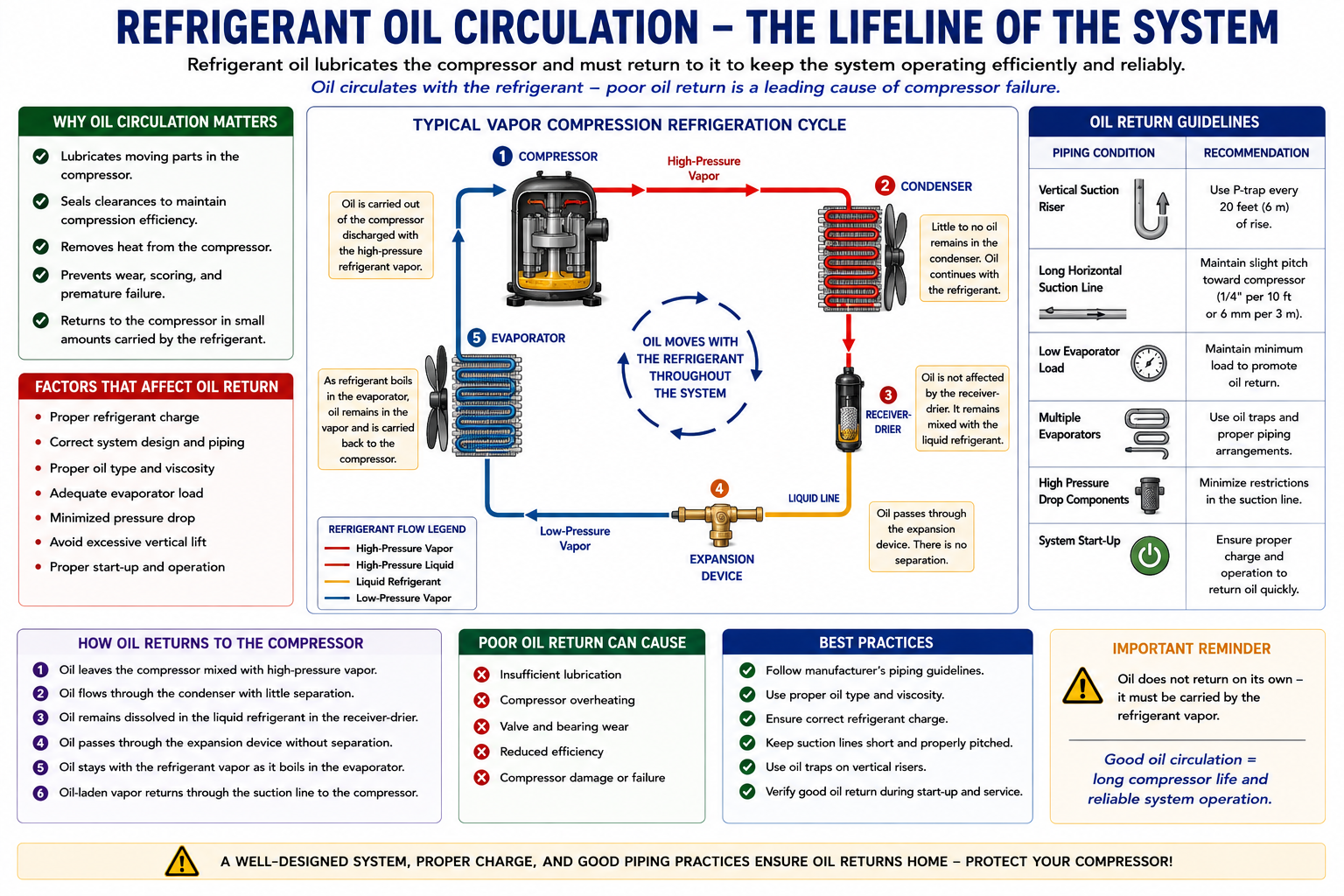
A refrigeration system can contain the correct quantity of oil and still experience lubrication problems if the oil becomes trapped in the evaporator, piping, accumulator, or another part of the system instead of returning to the compressor.
The Two Fluids Interact
Refrigerant and compressor oil can dissolve into one another to different degrees depending on the refrigerant, lubricant, pressure, and temperature. This behavior is called miscibility.
Good oil return often depends on having a refrigerant-lubricant combination that behaves properly throughout the operating temperature range of the equipment. If oil separates from the refrigerant and remains trapped in a heat exchanger or low point, compressor lubrication can suffer and system heat transfer can be reduced.
Too Little Oil Return
The compressor may be starved for lubrication, increasing wear and the possibility of mechanical failure.
Too Much Oil Elsewhere
Oil coating evaporator or condenser surfaces can reduce heat transfer and may lower refrigeration capacity.
A Traditional Refrigeration Lubricant
Mineral oil was widely used with many older CFC and HCFC refrigerants. It provided satisfactory lubrication and oil-return characteristics in systems designed around compatible refrigerants.
Mineral oil is generally not sufficiently miscible with many HFC refrigerants for normal system operation. This incompatibility was one of the important service considerations when the industry transitioned away from refrigerants such as R-12 and R-22 toward HFC refrigerants.
When servicing older equipment, never assume the lubricant based only on refrigerant family. Equipment may have been converted, retrofitted, or previously repaired. Check manufacturer information and service history when available.
A Synthetic Lubricant Used in Some Refrigeration Applications
Alkylbenzene, commonly abbreviated AB, is a synthetic refrigeration lubricant that has been used with several refrigerants and refrigeration applications.
It may provide improved miscibility compared with mineral oil in some refrigerant combinations and has been used in certain retrofit and low-temperature applications. As with any lubricant, its suitability depends on the refrigerant, compressor, and equipment manufacturer’s requirements.
Choosing refrigeration oil is not simply a matter of selecting mineral oil, alkylbenzene, or POE based on personal preference. Use the lubricant type and viscosity specified for the equipment and refrigerant.
The Lubricant Commonly Associated With HFC and Many Modern Refrigerants
Polyol ester oil, commonly abbreviated POE, became widely used because it provides suitable lubrication and refrigerant compatibility with many HFC refrigerants and continues to be used with numerous modern refrigerants and blends.
POE oil has one service characteristic that deserves special attention: it readily absorbs moisture. For this reason, POE must be handled carefully and exposure to atmospheric air should be minimized.
POE oil is hygroscopic. It can absorb moisture from the surrounding air, and moisture that becomes dissolved in the oil can be difficult to remove from the refrigeration system.
The Refrigerant, Oil, and Compressor Must Work Together
Proper refrigeration lubrication requires more than placing oil in the compressor. The oil must have suitable viscosity, chemical stability, refrigerant compatibility, thermal stability, and material compatibility for the equipment.
Using an incorrect lubricant can result in poor oil return, inadequate bearing lubrication, chemical reactions, seal problems, excessive compressor temperature, reduced capacity, or compressor failure.
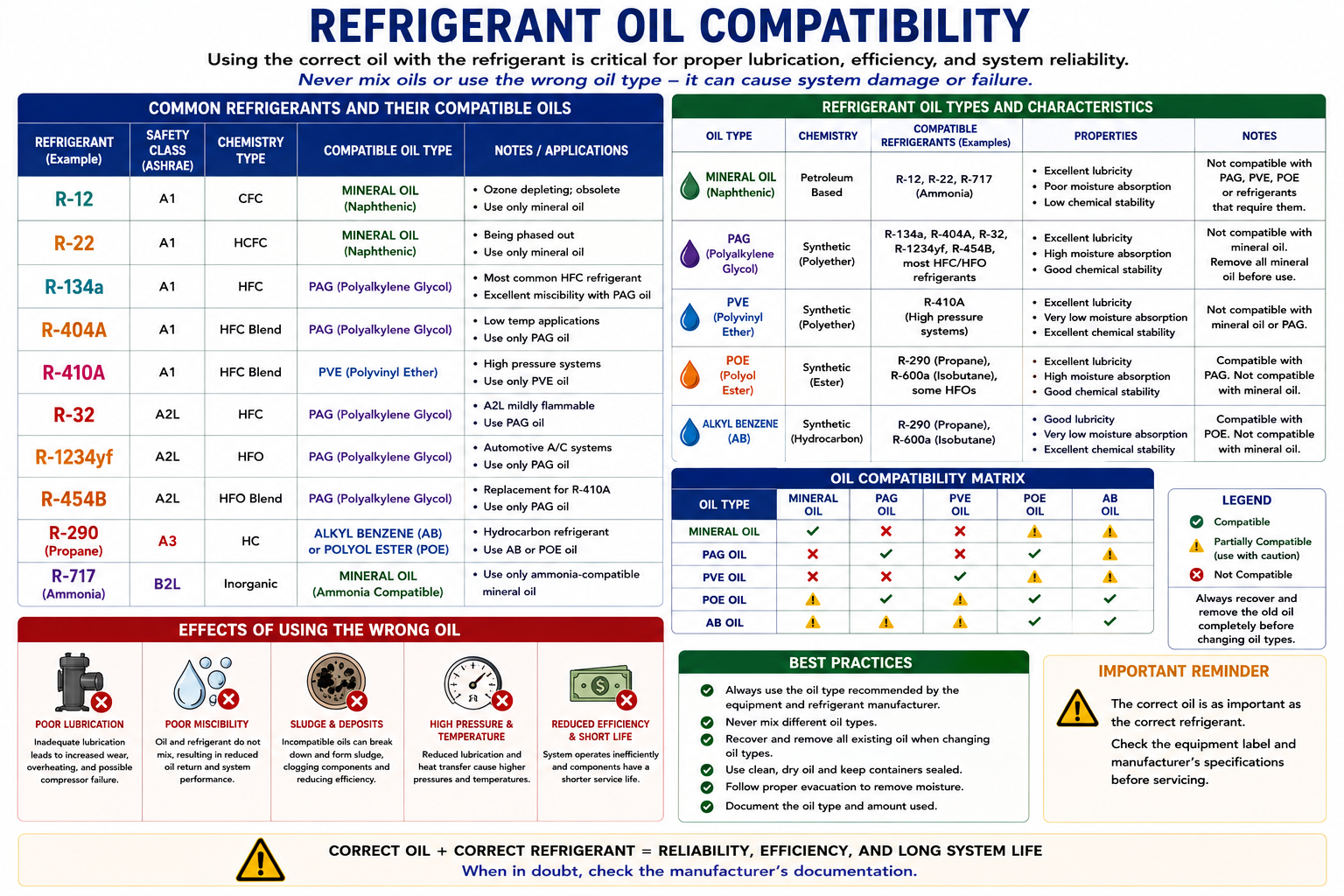
Follow the compressor or equipment manufacturer’s lubricant specification. Refrigerant compatibility charts are useful for understanding general relationships, but the approved lubricant type and viscosity for the actual equipment take priority.
The Oil Must Maintain a Useful Lubricating Film
Viscosity describes a fluid’s resistance to flow. Refrigeration oil must maintain sufficient viscosity to protect compressor surfaces while still flowing properly through the compressor and refrigeration system.
Temperature affects viscosity. Oil generally becomes thinner as temperature increases and thicker as temperature decreases. Dissolved refrigerant can also reduce lubricant viscosity.
Oil Too Thin
The lubricant film may become inadequate to prevent damaging contact between compressor surfaces.
Oil Too Thick
Oil circulation, bearing lubrication, compressor starting, and oil return may be adversely affected.
Refrigerant Can Move Into Compressor Oil While the System Is Off
When a refrigeration system is not operating, refrigerant vapor can migrate toward colder locations in the system. The compressor crankcase is often one of those locations, especially during cold outdoor conditions.
Refrigerant entering the crankcase can dissolve into the compressor oil. If enough refrigerant accumulates, the lubricant can become heavily diluted.
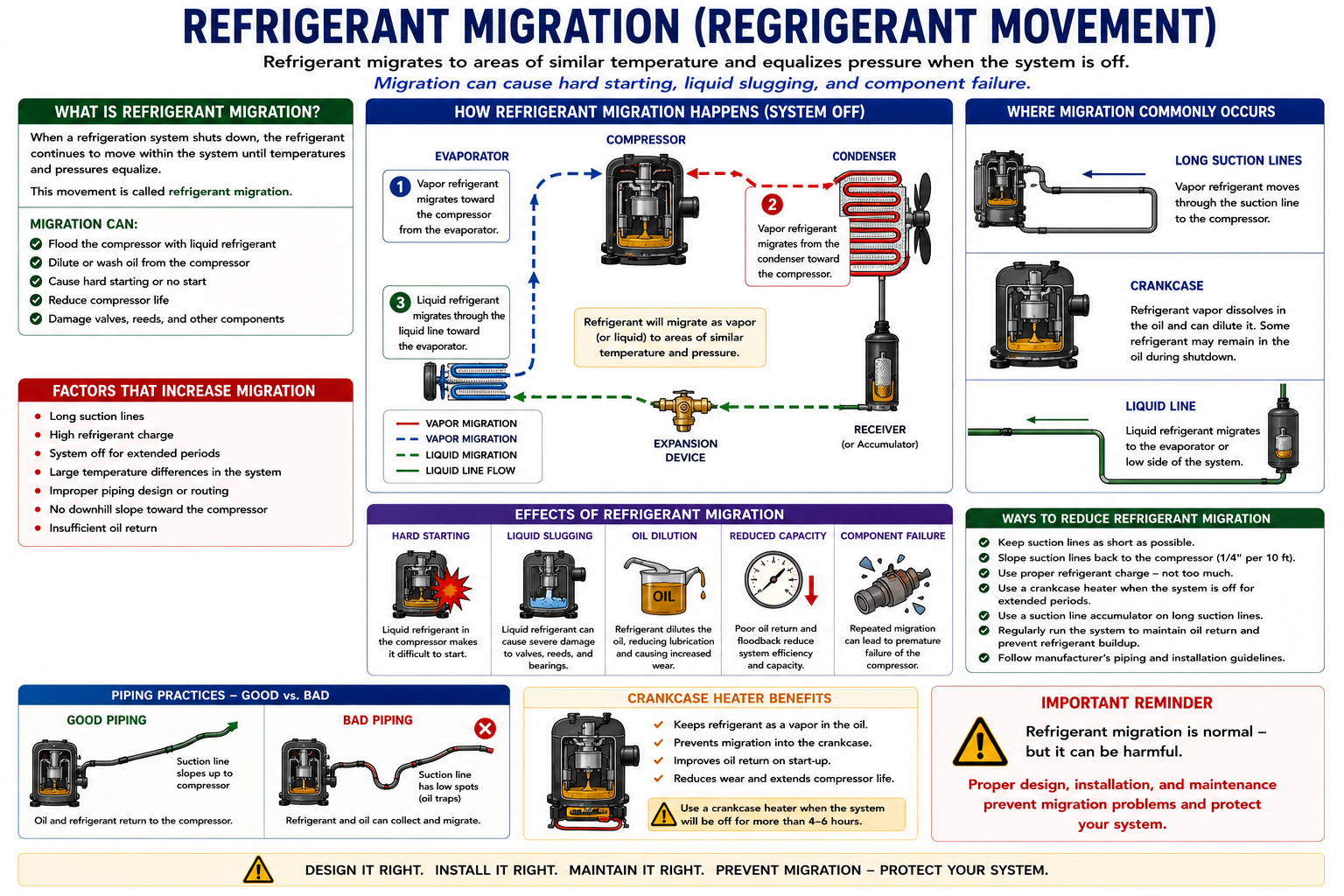
When the compressor starts, a rapid pressure reduction in the crankcase can cause dissolved refrigerant to boil out of the oil. This can produce violent oil foaming and temporarily reduce the lubricant’s ability to protect compressor surfaces.
Keeping the Compressor Warmer Discourages Refrigerant Migration
A crankcase heater helps keep the compressor crankcase and oil warmer than other parts of the refrigeration circuit while the compressor is off. This reduces the tendency for refrigerant vapor to migrate to the compressor and condense or dissolve into the oil.
Crankcase heaters are especially important on systems where the compressor may become colder than the evaporator or other refrigerant-containing components during extended off periods.
Follow manufacturer instructions regarding crankcase-heater operation before startup. Some systems require the heater to be energized for a specified period before the compressor is operated after installation or an extended shutdown.
Migration Is Different From Liquid Floodback and Slugging
Several different refrigerant-related conditions can damage a compressor, and the terms should not be confused.
Migration
Refrigerant moves through the system during the off cycle and can collect in the compressor oil.
Floodback
Liquid refrigerant continuously returns through the suction line while the compressor is operating.
Slugging
A significant quantity of incompressible liquid enters the compressor, potentially causing immediate mechanical damage.
Oil Foaming
Refrigerant dissolved in the lubricant rapidly boils from the oil when crankcase pressure drops during startup.
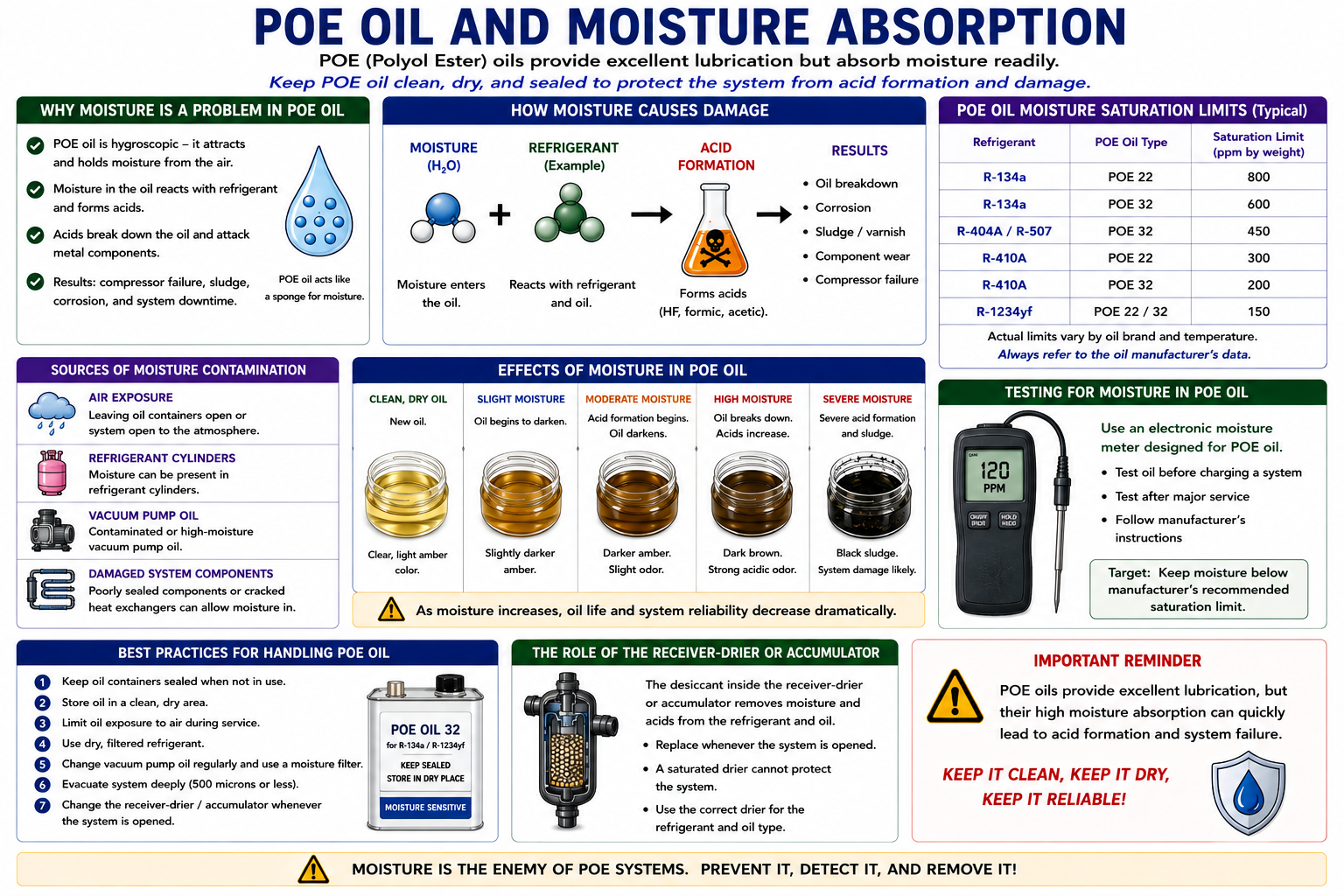
Moisture Control Is Especially Important With POE
POE oil readily absorbs moisture from atmospheric air. Leaving an oil container open, leaving a refrigeration system open unnecessarily, or allowing moisture to enter during service can contaminate the lubricant.
Moisture can contribute to chemical reactions that form acids and other contaminants. These products can attack compressor materials, motor insulation, bearings, and other system components.
Keep Oil Containers Sealed
Do not leave POE oil exposed to atmosphere longer than necessary.
Minimize Open-System Time
Complete repairs efficiently and keep tubing and components protected from atmospheric moisture.
Replace Filter-Driers When Required
Proper filter-driers help remove moisture and other contaminants circulating in the refrigeration system.
Evacuate Properly
Deep evacuation is used to remove air and moisture before the system is returned to service.
Oil Contamination Connects Directly to Proper Service Practice
A refrigeration system that has been opened for repair can contain air and moisture that must be removed before refrigerant is returned to the system. Proper evacuation reduces system pressure so that moisture can vaporize and be removed by the vacuum pump.
Evacuation and dehydration will receive a dedicated lesson later in this section because they are essential both to reliable system operation and EPA Section 608 service practices.
Pressure Changes Boiling Temperature
Evacuation works partly because reducing pressure lowers the boiling temperature of water. This is the same pressure-temperature principle used throughout refrigeration and discussed in Introduction to the Pressure-Enthalpy Diagram.
A Burnout Can Contaminate the Entire Refrigeration Circuit
An electrical or mechanical compressor failure can create high temperatures that break down refrigerant and lubricant. A severe motor burnout may leave acidic oil, carbon, sludge, metal particles, varnish, and other contamination throughout the refrigeration system.
Replacing the compressor without addressing contamination can allow acids and debris to attack the replacement compressor and lead to another failure.
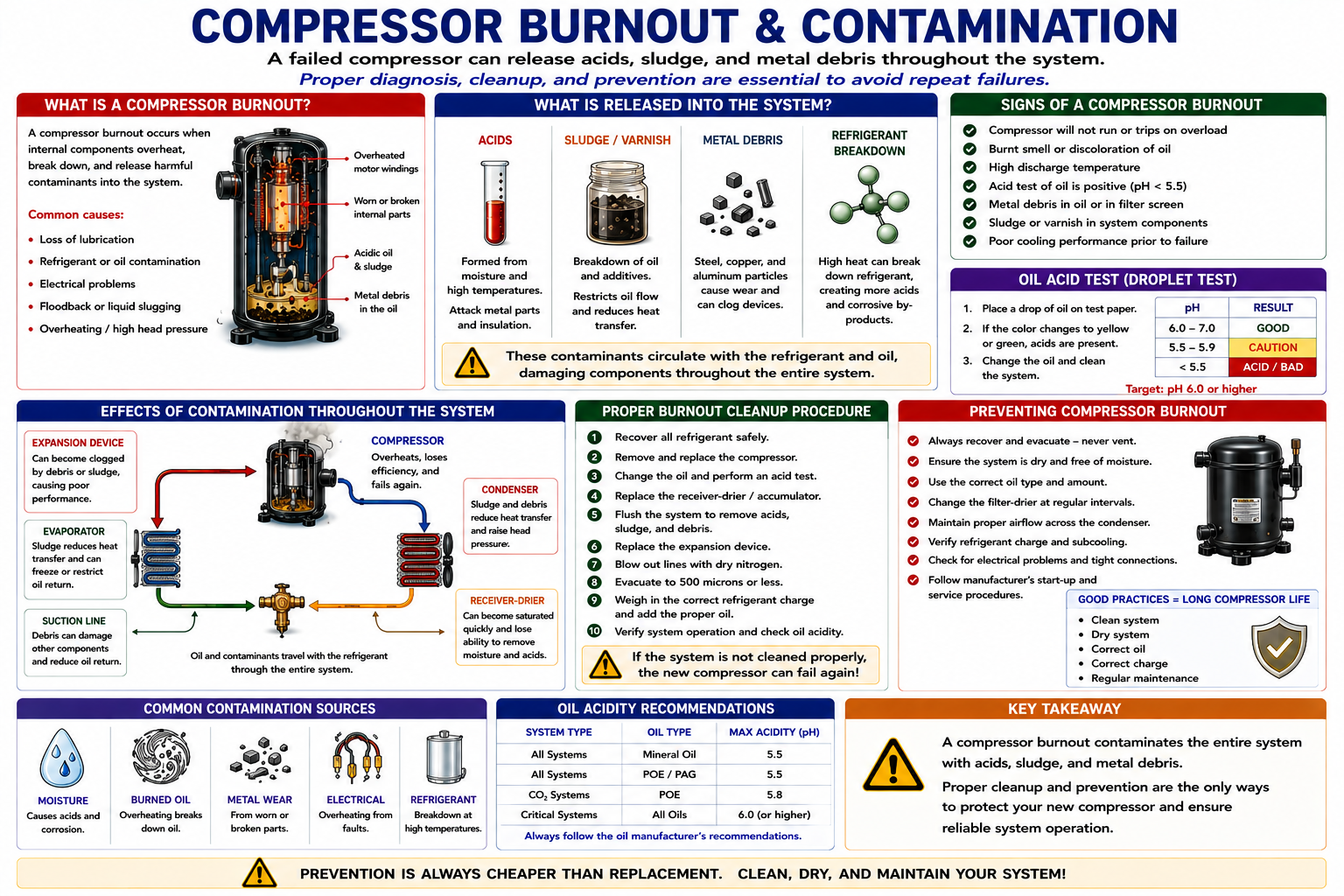
Discolored oil, a strong burned odor, abnormal acidity, sludge, or evidence of motor failure should alert the technician that the refrigeration circuit may require contamination cleanup rather than a simple compressor replacement.
The Oil Can Tell You What Happened Inside the System
Oil condition can provide useful information about the health of a refrigeration system. An oil sample may be appropriate following compressor burnout, major component failure, suspected acid formation, moisture contamination, sludge formation, or other abnormal conditions.
Acid test kits and other diagnostic methods can help determine whether contamination remains in the system and whether additional cleanup is required.
Section 608 preparation material includes refrigerant oils and recognizes the importance of oil sampling after leaks, compressor failures, suspected moisture, acid, sludge, waxing, and burnout contamination. These service concepts will reappear in the recovery and Type II lessons.
Changing Refrigerant May Require Changing Oil
A refrigerant conversion or retrofit may require lubricant changes because the original oil may not circulate properly with the replacement refrigerant. Oil compatibility is therefore one of the major reasons the term drop-in replacement can be misleading.
A proper retrofit may involve refrigerant recovery, lubricant replacement, filter-drier replacement, seal evaluation, metering-device changes, control adjustments, labeling, charging procedures, and verification of system performance.
Never choose a replacement refrigerant solely because its operating pressures appear similar to the original refrigerant. Refrigerant-oil compatibility is only one of several system-design factors that must be evaluated.
Clean, Dry, and Correctly Charged
Good refrigeration service is fundamentally about controlling what is allowed inside the sealed refrigeration circuit. The system should contain the correct refrigerant, the correct lubricant, and as little moisture, air, acid, dirt, and other contamination as practical.
Correct Refrigerant
Do not mix refrigerants or introduce an unidentified product into the system.
Correct Oil
Use the lubricant type and viscosity specified for the compressor and refrigerant.
Keep Moisture Out
Seal oil containers, protect open tubing, use appropriate filter-driers, and evacuate properly.
Keep Air Out
Air and other noncondensables can increase operating pressures and reduce system performance.
Control Burnout Debris
Remove acids, sludge, carbon, and other contamination before returning the system to service.
Document Retrofits
Clearly identify the refrigerant and lubricant after an approved system conversion.
Why Refrigerant Oils Appear on the Certification Exam
Refrigerant recovery and service work requires technicians to understand what may be present in the refrigerant circuit besides refrigerant. Lubricant can contain dissolved refrigerant, moisture, acids, and contamination that affect recovery and repair procedures.
Know that refrigerant and oil compatibility matters, POE oil readily absorbs moisture, refrigerant can migrate into compressor oil during an off cycle, crankcase heaters help reduce migration, and compressor burnout can contaminate the oil and refrigeration circuit.
Avoid These Refrigerant-Oil Errors
“Oil stays inside the compressor.”
No. Some oil normally leaves with the refrigerant and must return through the refrigeration circuit.
“Any refrigeration oil will work.”
No. Lubricant type and viscosity must be appropriate for the refrigerant, compressor, and application.
“POE oil only absorbs moisture when it is hot.”
No. POE can absorb atmospheric moisture whenever it is exposed to humid air.
“A crankcase heater warms the refrigerant for better capacity.”
No. Its primary purpose is to keep the compressor crankcase warm enough to discourage refrigerant migration and accumulation in the oil during off periods.
“Oil foaming always means too much oil.”
No. Refrigerant rapidly boiling out of diluted compressor oil during startup can create severe foaming.
“Replace the compressor and the burnout is fixed.”
Not necessarily. Acid and debris from a severe burnout can remain throughout the system and damage the replacement compressor.
Can You Explain Refrigerant and Lubricant Interaction?
- What are two major purposes of compressor lubricant?
- Does all of the refrigeration oil remain inside the compressor?
- Why must oil that circulates through the system return to the compressor?
- What is refrigerant-oil miscibility?
- Why can excessive oil in an evaporator reduce system performance?
- Which type of refrigeration oil was commonly associated with many older CFC and HCFC systems?
- What does AB stand for in refrigeration lubricant terminology?
- What does POE stand for?
- What important moisture-related characteristic does POE oil have?
- Why should POE oil containers remain tightly sealed?
- What is viscosity?
- What normally happens to oil viscosity as temperature increases?
- What is refrigerant migration?
- Why can refrigerant migration dilute compressor oil?
- What is the purpose of a crankcase heater?
- What is the difference between migration and floodback?
- What is compressor slugging?
- Why may an oil sample be useful after a compressor burnout?
- Why can a refrigerant retrofit require a lubricant change?
- Why should a severe compressor burnout be treated as a system-contamination problem rather than only a failed-component problem?
What You Should Have Learned
Compressors Require Lubrication
Oil reduces friction, limits wear, removes heat, and performs other important compressor functions.
Oil Circulates With Refrigerant
Some lubricant leaves the compressor and must return reliably through the refrigeration circuit.
Compatibility Matters
The refrigerant, lubricant, compressor, materials, and operating conditions must be suitable for one another.
Different Oils Serve Different Systems
Mineral oil, alkylbenzene, POE, and other lubricants have different refrigerant compatibility and service characteristics.
POE Requires Moisture Control
POE is hygroscopic and should be protected from unnecessary atmospheric exposure.
Refrigerant Can Migrate Into Oil
Off-cycle migration can dilute compressor oil and contribute to severe foaming during startup.
Crankcase Heat Reduces Migration
A crankcase heater helps discourage refrigerant accumulation in the compressor oil during off cycles.
Burnout Can Contaminate the Entire System
Acid, carbon, sludge, metal debris, and degraded oil can remain after compressor failure and must be addressed before reliable operation is restored.