Refrigerant Properties and EPA Pressure Classifications
Refrigerants differ considerably in their physical and thermodynamic properties. Two refrigerants operating in similar equipment can have very different pressures, saturation temperatures, densities, heat-transfer characteristics, safety classifications, and environmental characteristics.
For EPA Section 608 certification, technicians must also recognize refrigerants and appliances according to pressure classifications. These classifications help determine which certification type, recovery procedures, evacuation requirements, and service practices apply.
What You Will Learn
After completing this lesson, you should be able to:
Compare Refrigerant Properties
Explain why different refrigerants operate at different pressures and temperatures.
Use Pressure-Temperature Relationships
Explain how saturation pressure and saturation temperature are related for a refrigerant.
Recognize EPA Pressure Classes
Distinguish low-, medium-, high-, and very-high-pressure refrigerant applications.
Recognize Common Examples
Associate familiar refrigerants and equipment with their general pressure characteristics.
Separate Two Classification Systems
Distinguish EPA pressure classifications from ASHRAE toxicity and flammability classifications.
Connect Pressure to Service
Explain why refrigerant pressure affects tools, cylinders, recovery procedures, and technician safety.
Every Refrigerant Behaves Differently
A refrigerant is selected because its properties make it useful for a particular refrigeration application. No single refrigerant has the ideal combination of characteristics for every type of equipment.
Refrigerants differ in boiling temperature, saturation pressure, vapor density, liquid density, latent heat, critical temperature, chemical stability, lubricant compatibility, material compatibility, toxicity, flammability, and environmental characteristics.
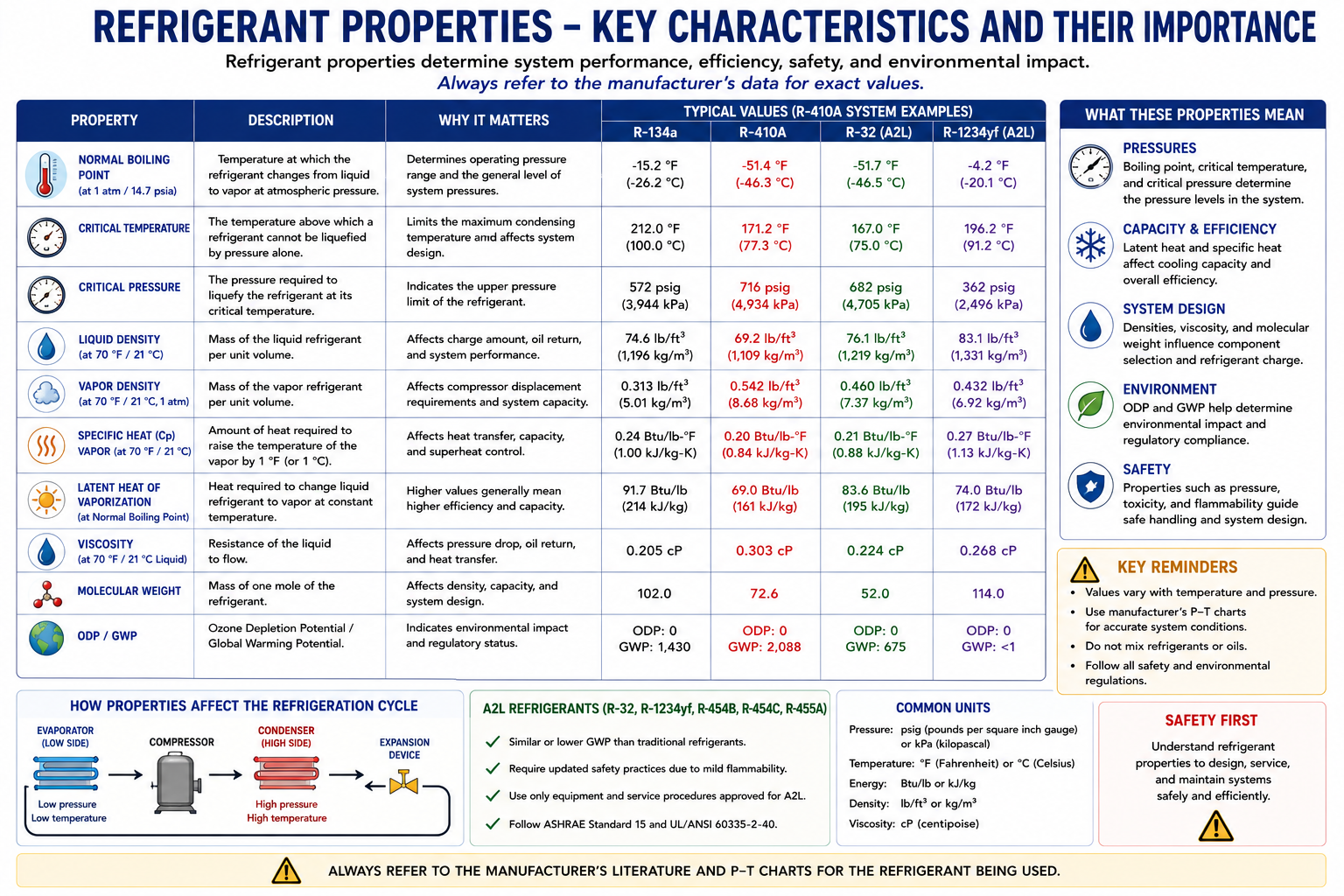
Refrigerants are not interchangeable simply because they perform the same general job. A refrigeration system is designed around the operating characteristics of a particular refrigerant or specifically approved refrigerants.
Refrigerants Must Boil at Useful Temperatures
For a refrigerant to absorb heat in an evaporator, it must be capable of boiling at a temperature below the temperature of the space, air, product, or process being cooled.
The normal boiling point of a refrigerant provides useful information, but refrigeration systems do not normally operate only at atmospheric pressure. The actual saturation temperature inside the system depends on the refrigerant pressure.
Heat Moves From Warmer to Colder
The evaporator must be colder than the material being cooled for heat to flow into the refrigerant. This basic heat-transfer principle was introduced in Introduction to Mechanical Refrigeration.
Each Refrigerant Has Its Own P-T Relationship
When liquid and vapor refrigerant exist together in a saturated condition, pressure and temperature are directly related. If the saturation pressure is known, the corresponding saturation temperature can be determined. If saturation temperature is known, the corresponding saturation pressure can be determined.
However, that relationship is unique to each refrigerant. A pressure that corresponds to one saturation temperature for R-22 may correspond to a very different saturation temperature for R-410A, R-134a, R-32, or another refrigerant.
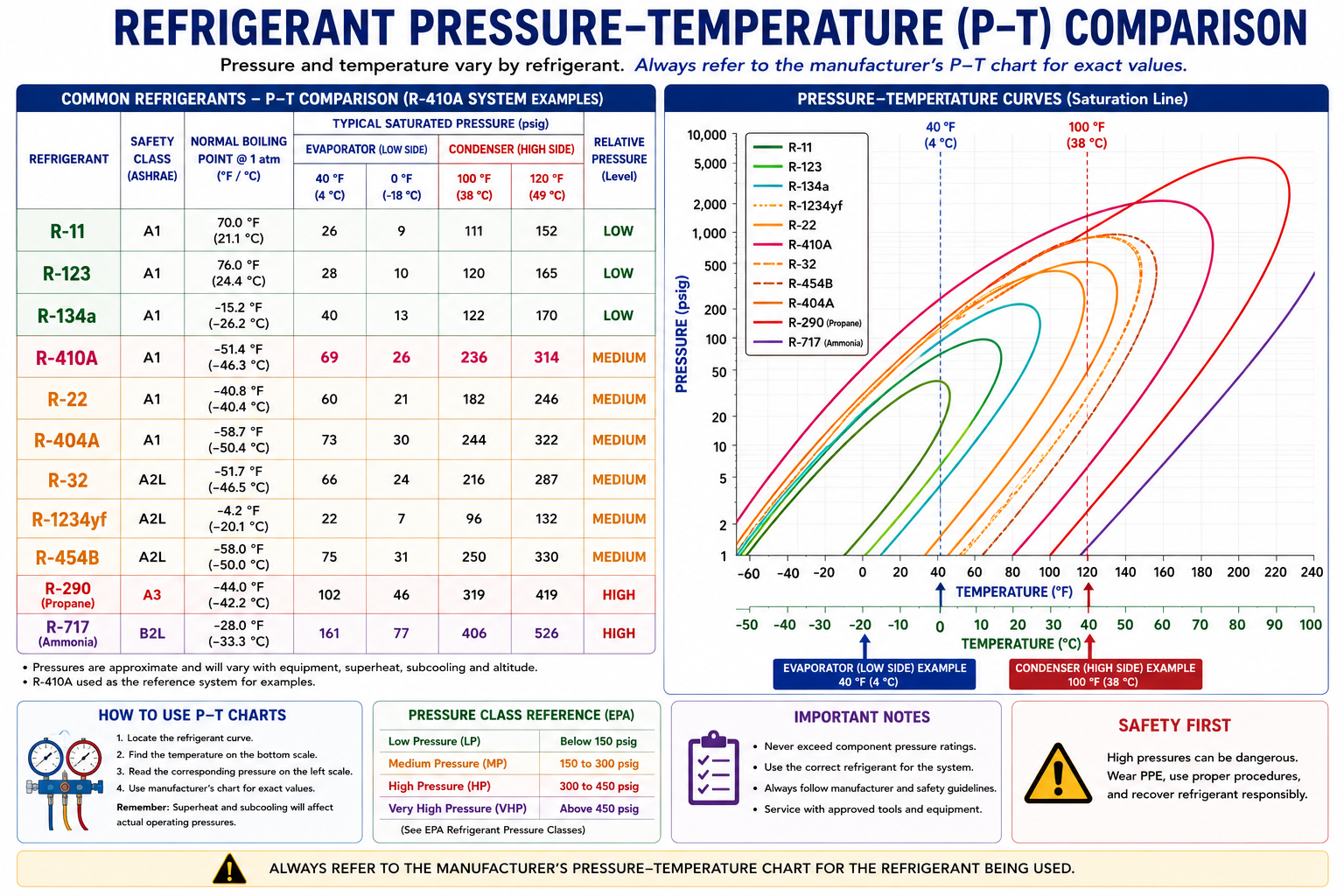
A pressure reading by itself does not tell you the refrigerant temperature condition unless you know which refrigerant is in the system and use the correct pressure-temperature relationship.
Pressure Determines Saturation Temperature
Increasing the pressure on a refrigerant increases its saturation temperature. Decreasing refrigerant pressure decreases its saturation temperature.
This relationship is fundamental to vapor-compression refrigeration. The compressor and metering device create the pressure difference that allows the same refrigerant to evaporate at a low temperature and condense at a higher temperature.
Lower Pressure
Lower saturation pressure produces a lower saturation temperature, allowing refrigerant to absorb heat in the evaporator.
Higher Pressure
Higher saturation pressure produces a higher saturation temperature, allowing refrigerant to reject heat in the condenser.
Reading Refrigerant Condition
For a more detailed treatment of saturation, superheat, subcooling, pressure, temperature, and refrigerant state, review Introduction to the Pressure-Enthalpy Diagram.
Refrigerants Move Large Amounts of Heat During Phase Change
A major reason refrigerants are effective heat-transfer fluids is their ability to absorb or reject substantial amounts of energy while changing state.
In the evaporator, refrigerant absorbs latent heat while changing from liquid to vapor. In the condenser, refrigerant rejects latent heat while changing from vapor to liquid.
Different refrigerants have different latent-heat characteristics. This is one of many factors that influence refrigerating effect, mass flow rate, compressor displacement, and overall system design.
Evaporation absorbs heat. Condensation rejects heat. Refrigerant properties determine how effectively this process occurs under a particular set of operating conditions.
Refrigerant Vapor Occupies Space
Refrigerants differ in vapor density and specific volume. These characteristics influence how much refrigerant vapor a compressor must move to produce a given refrigeration capacity.
This is one reason compressors designed for different refrigerants may have different displacement requirements even when the refrigeration capacity is similar.
Changing refrigerants can alter compressor loading, refrigerant mass flow, system capacity, discharge temperature, operating pressure, and other conditions. A refrigerant substitution must therefore be evaluated as a complete system change rather than simply changing the contents of the refrigeration circuit.
There Is a Limit to Conventional Condensation
Every refrigerant has a critical temperature. Above this temperature, increasing pressure alone cannot condense the refrigerant into a conventional liquid.
The critical temperature is important in equipment design because it affects how a refrigerant can reject heat. Most conventional vapor-compression systems operate below the refrigerant’s critical temperature during condensation.
Carbon dioxide systems may operate above the critical point in transcritical operation. Those systems require different terminology and operating concepts from conventional subcritical refrigeration systems.
Why EPA Groups Refrigeration Equipment by Pressure
For Section 608 purposes, refrigeration and air-conditioning equipment is divided into pressure categories. The pressure characteristics of the refrigerant and appliance affect recovery requirements, evacuation procedures, service methods, and the certification required for technicians working on that equipment.
The categories encountered in Section 608 training are low pressure, medium pressure, high pressure, and very high pressure.
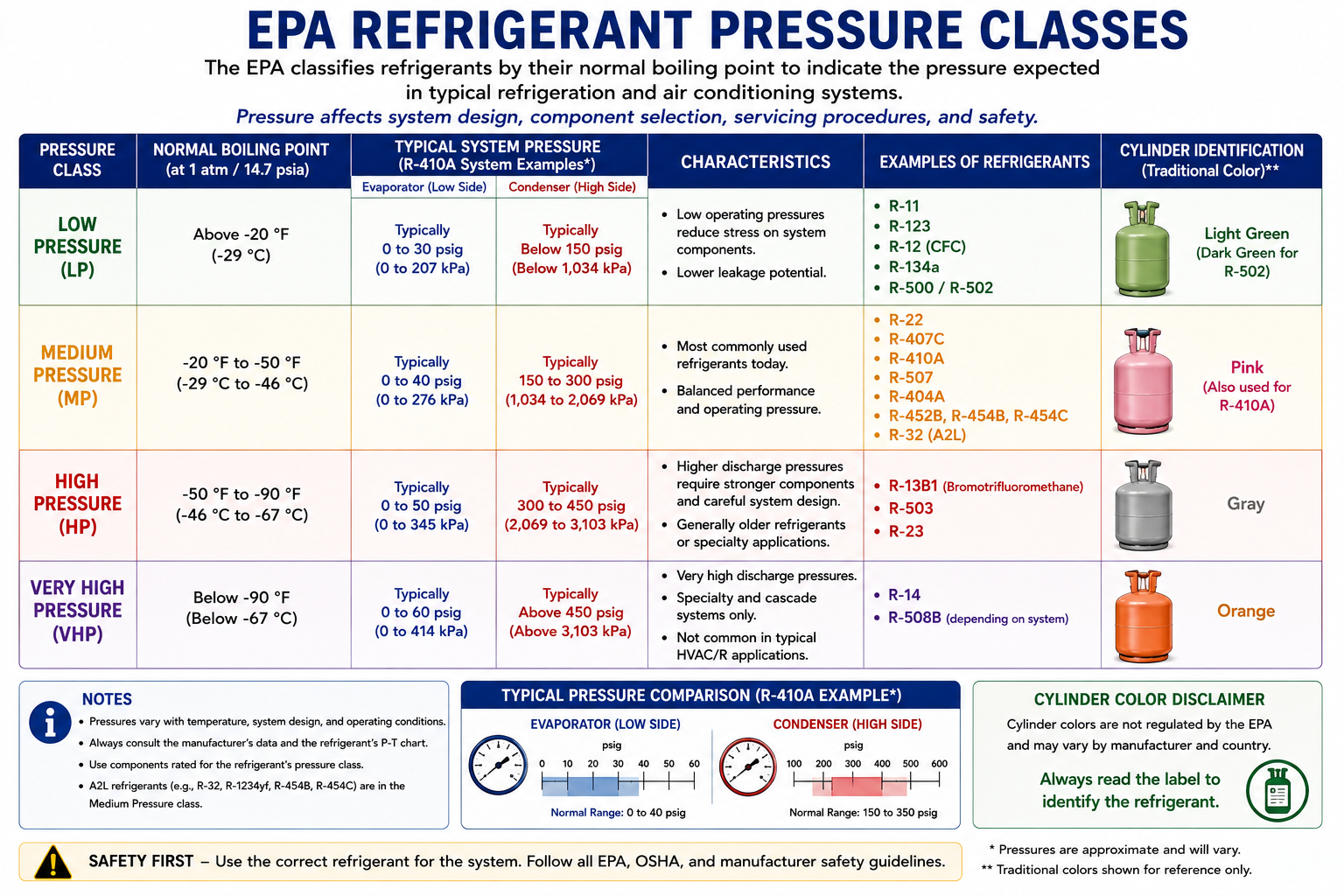
The pressure category matters because EPA service and recovery requirements are not identical for every appliance. Later lessons will apply these classifications directly to required recovery and evacuation levels.
Systems That May Operate Below Atmospheric Pressure
Low-pressure appliances are most commonly associated with large centrifugal chillers using refrigerants designed to operate at relatively low pressures.
Unlike typical residential air-conditioning systems, portions of a low-pressure system may operate in a vacuum. A leak in such a system can therefore allow air and moisture to enter the appliance rather than simply allowing refrigerant to escape.
Type III certification applies to technicians servicing or disposing of low-pressure appliances.
Because low-pressure systems may operate below atmospheric pressure, leak detection, purging, evacuation, and opening procedures differ from those used on conventional positive-pressure systems.
The Middle Pressure Category
Medium-pressure appliances use refrigerants whose pressure characteristics fall between the EPA low- and high-pressure categories.
Although the term appears less often in everyday residential service discussions, technicians preparing for Section 608 certification should recognize medium pressure as a distinct EPA category because evacuation requirements may differ from those for high-pressure appliances.
Do not assume that every appliance that is not low pressure is automatically treated identically. EPA evacuation tables distinguish medium-pressure equipment from high- and very-high-pressure equipment. :contentReference[oaicite:1]{index=1}
The Category Most HVAC Technicians Encounter Regularly
Many common comfort-cooling and refrigeration systems fall within the high-pressure appliance category for Section 608 purposes.
This includes much of the equipment encountered in residential air conditioning, heat pumps, commercial refrigeration, and similar applications.
Type II certification covers technicians servicing or disposing of high- and very-high-pressure appliances, except small appliances and MVACs. :contentReference[oaicite:2]{index=2}
Equipment Requiring Special Attention to Pressure
Very-high-pressure appliances operate with refrigerants capable of producing substantially higher pressures than those encountered in conventional high-pressure refrigeration equipment.
The higher pressure affects recovery equipment, cylinders, hoses, gauges, fittings, and service procedures. Equipment used with these refrigerants must be suitable for the pressures that can occur.
Never assume that service equipment suitable for one refrigerant is automatically suitable for a higher-pressure refrigerant. Check the working-pressure ratings of gauges, hoses, recovery equipment, cylinders, and other components before use.
Cylinder and System Pressure Rise With Temperature
A refrigerant’s saturation pressure increases as its temperature increases. This applies whether the refrigerant is inside an operating refrigeration system, a recovery cylinder, or a supply cylinder containing both liquid and vapor.
A refrigerant cylinder left in a hot vehicle or exposed to excessive heat can therefore develop much higher internal pressure than the same cylinder stored at a moderate temperature.
Temperature changes pressure. Refrigerant containers must be stored, transported, and handled according to applicable requirements and manufacturer instructions.
Never Identify an Unknown Refrigerant From Gauge Pressure Alone
Technicians sometimes encounter equipment whose refrigerant identity is uncertain. A pressure reading can provide useful diagnostic information, but pressure alone is not positive refrigerant identification.
Several refrigerants can produce similar pressures under certain temperature conditions. Mixed or contaminated refrigerant can make pressure readings even less useful for identification.
Use equipment labels, service documentation, cylinder labels, and refrigerant identification equipment when necessary. Do not contaminate a recovery cylinder containing known refrigerant by adding an unidentified refrigerant to it.
EPA Pressure Class Is Not ASHRAE Safety Class
Lesson 3 introduced the ASHRAE refrigerant safety classification system. It is important to keep that system separate from the EPA pressure classifications used in Section 608.
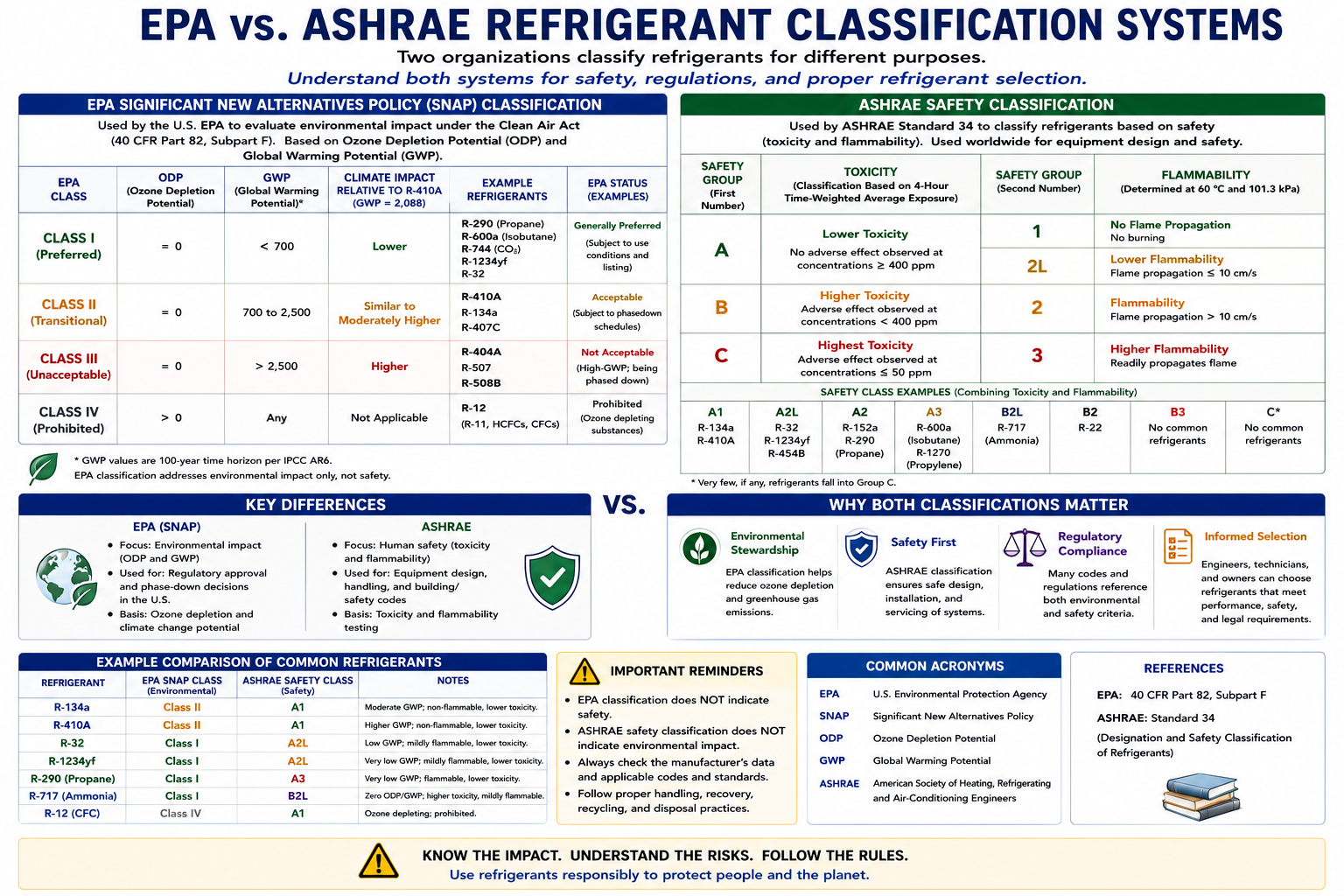
EPA Pressure Classification
Describes the pressure characteristics of refrigerants and appliances for Section 608 service and recovery requirements.
Low • Medium • High • Very High
ASHRAE Safety Classification
Describes refrigerant toxicity and flammability characteristics.
A or B • 1, 2L, 2, or 3
Do not use one classification to answer a question about the other. A refrigerant’s ASHRAE safety class does not tell you its EPA pressure classification.
Pressure Classification Affects Service Procedures
Section 608 recovery and evacuation requirements vary according to appliance type, pressure category, refrigerant charge, and the recovery equipment being used.
For example, EPA’s current service-practice table specifies different evacuation requirements for very-high-pressure, high-pressure, medium-pressure, and low-pressure appliances. Low-pressure appliances are specified using an absolute-pressure evacuation level, while other categories use different requirements. :contentReference[oaicite:3]{index=3}
Do not try to memorize all evacuation levels from this lesson. Recovery equipment, evacuation requirements, required vacuum levels, and the differences among Type I, Type II, and Type III service procedures will be taught in dedicated Section 608 lessons.
The Refrigerant and the Equipment Are Designed Together
Changing the refrigerant changes more than the pressure shown on the gauges. Refrigerant properties influence virtually every part of the refrigeration system.
Compressor
Mass flow, displacement, motor loading, lubrication, and discharge temperature can all be affected by refrigerant selection.
Condenser
Operating pressure, heat rejection, condensing temperature, and required heat-transfer area depend partly on refrigerant properties.
Metering Device
Refrigerant flow characteristics affect metering-device sizing and operation.
Evaporator
Refrigerant properties influence boiling behavior, pressure drop, heat transfer, and refrigerating effect.
Lubricant
The refrigerant must operate with a lubricant that provides proper compressor lubrication and oil return.
Service Equipment
Gauges, hoses, recovery equipment, cylinders, and other tools must be appropriate for the refrigerant and its operating pressure.
Avoid These Refrigerant Property Errors
“The same pressure means the same saturation temperature.”
No. Pressure-temperature relationships are refrigerant specific.
“High pressure means high temperature everywhere.”
No. Refrigerant condition depends on pressure, temperature, phase, and location in the refrigeration cycle.
“A1 means low-pressure refrigerant.”
No. A1 is an ASHRAE toxicity and flammability classification, not an EPA pressure class.
“Low-pressure systems cannot leak refrigerant.”
Incorrect. Depending on operating condition and location, low-pressure systems can lose refrigerant, but operation below atmospheric pressure also creates the important possibility of air and moisture leaking inward.
“Any recovery machine can recover any refrigerant.”
No. Recovery equipment must be appropriate for the refrigerant, pressure, and applicable safety classification.
“Refrigerants can be substituted if the pressures are close.”
No. Pressure is only one property. Capacity, lubricant compatibility, materials, safety, controls, metering, and manufacturer requirements must also be considered.
Pressure Classification Has Practical Consequences
EPA Section 608 certification is divided partly according to the equipment being serviced. Type II covers high- and very-high-pressure appliances except small appliances and MVACs, while Type III covers low-pressure appliances. Universal certification covers all appliance types after the applicable examinations are successfully completed. :contentReference[oaicite:4]{index=4}
Be able to distinguish low-, medium-, high-, and very-high-pressure categories and understand that the pressure category can affect certification, recovery, evacuation, and service requirements.
Can You Apply Refrigerant Properties and Pressure Classes?
- Why do different refrigerants have different operating pressures?
- What happens to refrigerant saturation temperature when saturation pressure increases?
- What happens to saturation temperature when pressure decreases?
- Why must the refrigerant be known before using a pressure-temperature chart?
- What happens to refrigerant pressure in a cylinder as cylinder temperature increases?
- What is latent heat?
- What happens to heat during refrigerant evaporation?
- What happens to heat during refrigerant condensation?
- What is the critical temperature of a refrigerant?
- What four pressure categories are encountered in EPA Section 608 training?
- Which certification type applies to low-pressure appliances?
- Which certification type generally applies to high- and very-high-pressure appliances?
- Why can leaks be especially troublesome in a low-pressure chiller?
- Can refrigerant pressure alone positively identify an unknown refrigerant?
- What does an ASHRAE safety classification describe?
- What does an EPA pressure classification describe?
- Does an A2L classification mean that the refrigerant is an EPA low-pressure refrigerant?
- Why must service tools be rated appropriately for the refrigerant being serviced?
What You Should Have Learned
Refrigerants Have Different Properties
Pressure, boiling point, density, latent heat, critical temperature, safety, compatibility, and environmental characteristics vary among refrigerants.
P-T Relationships Are Refrigerant Specific
The same pressure does not represent the same saturation temperature for every refrigerant.
Pressure Controls Saturation Temperature
Increasing saturation pressure increases saturation temperature; decreasing pressure decreases saturation temperature.
EPA Uses Pressure Categories
Section 608 training distinguishes low-, medium-, high-, and very-high-pressure equipment.
Type II and Type III Are Different
Type II applies to high- and very-high-pressure appliances within its scope, while Type III applies to low-pressure appliances.
Low-Pressure Systems Can Draw Contaminants In
When portions of the system operate below atmospheric pressure, leaks can allow air and moisture to enter.
Safety Class and Pressure Class Are Separate
ASHRAE classifications describe toxicity and flammability; EPA pressure classifications serve a different purpose.
Equipment Must Match the Refrigerant
System components, lubricants, tools, recovery equipment, and service procedures must be appropriate for the refrigerant being used.