Individual Refrigerants and Refrigerant Profiles
The first five lessons established the fundamentals needed to understand refrigerants: refrigerant families, blends, identification, safety classifications, pressure characteristics, environmental considerations, and lubricant compatibility. We can now apply those concepts to the individual refrigerants technicians encounter in the field.
Each refrigerant in the lessons that follow will be examined using the same basic profile. This consistent approach makes it easier to compare refrigerants and, more importantly, helps prevent the common mistake of judging refrigerant suitability by only one characteristic such as pressure.
What You Will Learn
After completing this lesson, you should be able to:
Read a Refrigerant Profile
Identify the major information included in the standardized refrigerant profiles used throughout this section.
Compare Refrigerants
Use family, composition, pressure, safety, environmental, lubricant, and application information to distinguish refrigerants.
Recognize Service Differences
Explain why refrigerants with similar applications may still require different tools, charging procedures, lubricants, and safety precautions.
Avoid Improper Substitution
Explain why similar operating pressure alone does not make one refrigerant a suitable replacement for another.
Identify the Refrigerant First
Recognize positive refrigerant identification as the starting point for safe and accurate service.
Use Profile Information in Practice
Connect refrigerant-profile information to charging, recovery, troubleshooting, safety, and equipment service.
Now We Look at the Refrigerants Themselves
Up to this point, we have primarily discussed refrigerants by characteristic. We have studied refrigerant families, blends, pressure-temperature relationships, safety classifications, pressure classifications, and oils as separate subjects.
Real service work requires all of those characteristics to be considered together. When a technician encounters R-22, R-410A, R-454B, R-290, or another refrigerant, the number alone is only the beginning of the information needed to service the equipment correctly.
A refrigerant must be understood as a complete set of characteristics. Its chemical family, composition, pressure, safety classification, environmental characteristics, lubricant requirements, applications, charging procedures, and equipment compatibility all matter.
Every Refrigerant Will Be Examined the Same Way
The individual refrigerant lessons use a standardized profile so that important information appears in a predictable format. This allows one refrigerant to be compared directly with another without changing the questions we ask.
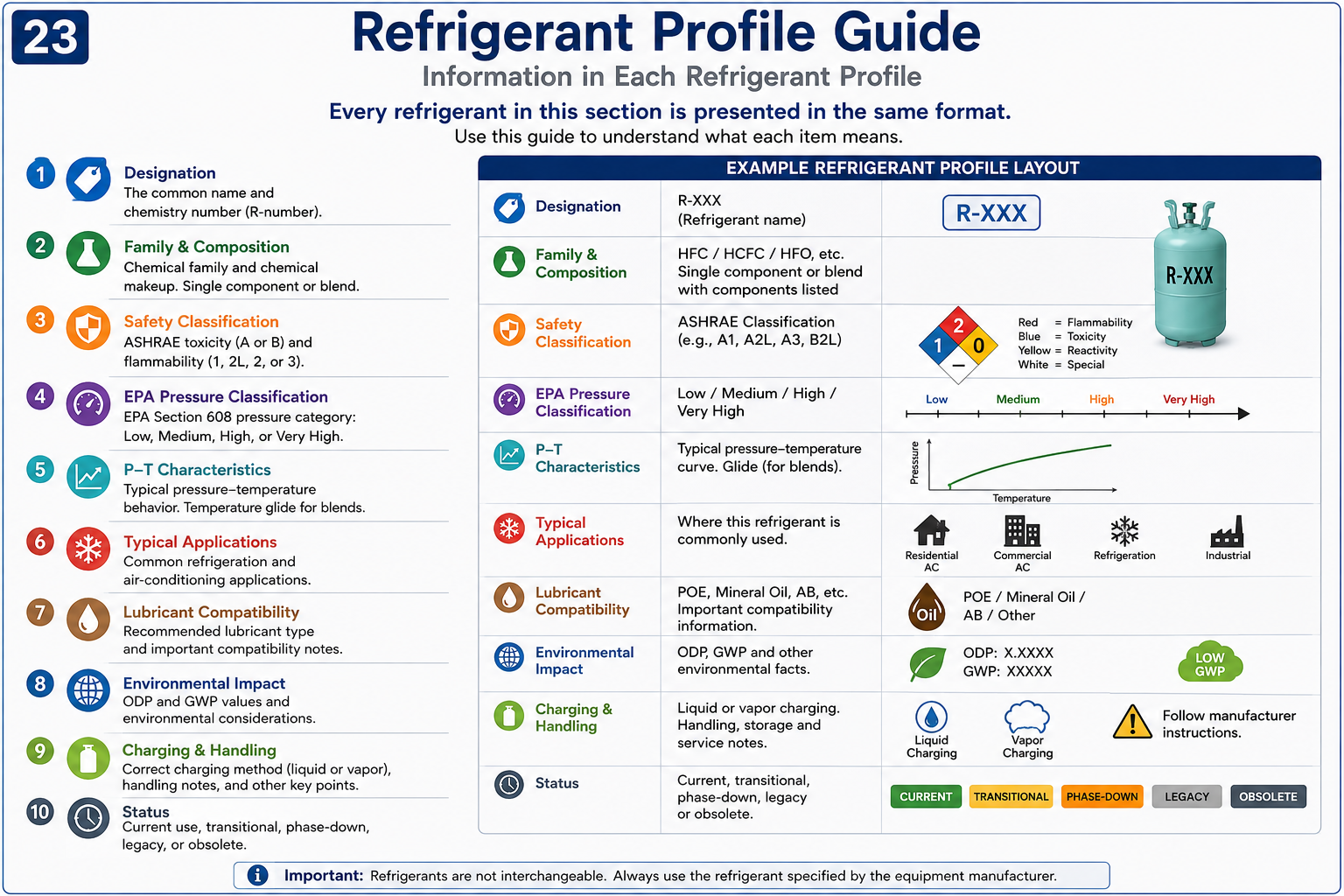
Do not treat each profile as an isolated collection of numbers to memorize. Look for relationships. Ask why the refrigerant is used in a particular application, how its properties affect service procedures, and which characteristics create special safety or handling requirements.
Refrigerant Designation
The refrigerant designation is the standardized identifier used to distinguish one refrigerant from another. Examples include R-22, R-134a, R-410A, R-32, R-454B, R-290, R-717, and R-744.
The designation must be read accurately. Letters following a refrigerant number are part of the designation and can identify a different refrigerant composition.
Refrigerant Numbering and Identification
The refrigerant-numbering system, 400- and 500-series blends, cylinder identification, and ASHRAE safety classifications were introduced in Refrigerant Numbers, Identification, and Safety Classifications.
Family and Chemical Composition
A refrigerant profile identifies the refrigerant family and whether the refrigerant is a single chemical or a mixture of several components.
This can tell us whether we are dealing with a CFC, HCFC, HFC, HFO, hydrocarbon, inorganic refrigerant, or a mixture involving more than one family.
Single Component
Refrigerants such as R-32, R-134a, R-290, R-717, and R-744 consist of a single refrigerant component.
Blend
Refrigerants such as R-404A, R-407C, R-410A, and R-454B contain multiple components mixed in specified proportions.
Blend Behavior
For a review of single-component refrigerants, azeotropic and zeotropic blends, fractionation, bubble point, dew point, and temperature glide, return to Refrigerant Families, Types, and Blends.
ASHRAE Safety Classification
Each profile identifies the refrigerant’s ASHRAE safety classification. This combines toxicity and flammability characteristics into designations such as A1, A2L, A3, or B2L.
The classification immediately alerts the technician to important safety considerations, but it does not replace the refrigerant Safety Data Sheet, equipment instructions, codes, or required service procedures.
A1
Lower-toxicity classification with no flame propagation under the classification test conditions.
A2L
Lower-toxicity refrigerant with lower flammability and limited burning velocity.
A3
Lower-toxicity refrigerant in the highest ASHRAE flammability category.
B2L
Higher-toxicity refrigerant with lower-flammability characteristics.
Safety classifications should never be interpreted as meaning that one refrigerant is simply “safe” and another is “unsafe.” Each refrigerant has hazards that must be controlled appropriately.
Pressure Characteristics
The profile identifies the general pressure characteristics of the refrigerant and, where useful, provides pressure-temperature information.
Pressure affects equipment construction, compressors, tubing, valves, gauges, hoses, recovery equipment, cylinders, and service procedures. Refrigerants used for similar cooling applications can operate at very different pressures.
Refrigerant Pressure
For a review of refrigerant properties and the distinction among low-, medium-, high-, and very-high-pressure equipment, return to Refrigerant Properties and EPA Pressure Classifications.
Pressure-Temperature Behavior
Each refrigerant has its own relationship between saturation pressure and saturation temperature. The individual profiles may therefore include typical P-T information or comparisons when those differences are important to service work.
For blends with meaningful temperature glide, pressure-temperature information may include separate bubble-point and dew-point values.
Never use the pressure-temperature chart for one refrigerant to evaluate another refrigerant. Always know which refrigerant is present before interpreting gauge readings.
Saturation, Superheat, and Subcooling
The individual refrigerant profiles assume that you already understand saturation and refrigerant condition. For deeper review of refrigerant state, pressure, temperature, and enthalpy, revisit Introduction to the Pressure-Enthalpy Diagram.
Typical Applications
A refrigerant profile identifies the types of equipment in which the refrigerant has commonly been used. This provides important context because refrigerants are selected as part of an equipment design rather than independently from the equipment.
Applications may include residential comfort cooling, heat pumps, commercial refrigeration, industrial refrigeration, chillers, household appliances, or specialized systems.
Two refrigerants may both be used for comfort cooling or commercial refrigeration and still have very different pressure, lubricant, safety, charging, equipment, and regulatory requirements.
Lubricant Compatibility
The refrigerant profile identifies the lubricant relationships technicians should understand. Depending on the refrigerant and equipment, this may involve mineral oil, alkylbenzene, POE, or another lubricant specified by the manufacturer.
Refrigerant-oil compatibility affects lubrication, oil return, compressor reliability, retrofit decisions, and contamination control.
Refrigerants and Lubricants
Mineral oil, alkylbenzene, POE, oil circulation, migration, moisture absorption, and compressor burnout were covered in Refrigerants and Lubricants.
Environmental Characteristics
The profiles identify environmental characteristics such as ozone depletion potential and global warming potential when they are relevant to understanding the refrigerant.
These characteristics help explain why some refrigerants have been phased out, why others are being phased down, and why equipment manufacturers are transitioning toward different refrigerants.
ODP
Ozone Depletion Potential describes a substance’s potential contribution to depletion of stratospheric ozone relative to a reference substance.
GWP
Global Warming Potential provides a means of comparing the climate impact of greenhouse gases relative to carbon dioxide over a specified time horizon.
Stratospheric ozone, ODP, GWP, refrigerant phaseouts, HFC phasedown requirements, and environmental regulation will receive dedicated treatment later in this course.
Charging and Handling Characteristics
The refrigerant profile identifies service characteristics that can affect charging and handling. These may include whether the refrigerant is single component or blended, whether liquid withdrawal is necessary, whether temperature glide is significant, and whether special safety procedures apply.
A2L and A3 refrigerants, for example, introduce flammability considerations that affect tools, ventilation, leak detection, ignition-source control, and service procedures.
The profiles teach general refrigerant characteristics. The actual charging procedure and required charge must still come from the equipment manufacturer’s service information.
Current, Transitional, or Legacy Status
Refrigerant technology changes over time. Some refrigerants in this course are primarily associated with older equipment, some remain common in existing systems, and others are increasingly being used in newly manufactured equipment.
A refrigerant’s regulatory or market status does not automatically mean existing equipment containing that refrigerant must be immediately removed from service. The individual profiles will distinguish between new-equipment transitions and the continued servicing of existing equipment where appropriate.
A technician needs to know not only what a refrigerant is, but also whether it is commonly found in legacy equipment, current equipment, new equipment, or specialized applications.
Pressure Alone Is Never Enough
One of the most dangerous shortcuts in refrigerant service is assuming that a replacement is acceptable simply because its pressures appear similar to the original refrigerant.
Pressure is important, but it is only one part of refrigerant selection. A replacement refrigerant can affect capacity, compressor loading, lubricant return, discharge temperature, metering-device operation, seals, safety controls, charge quantity, flammability, and equipment listing or approval.
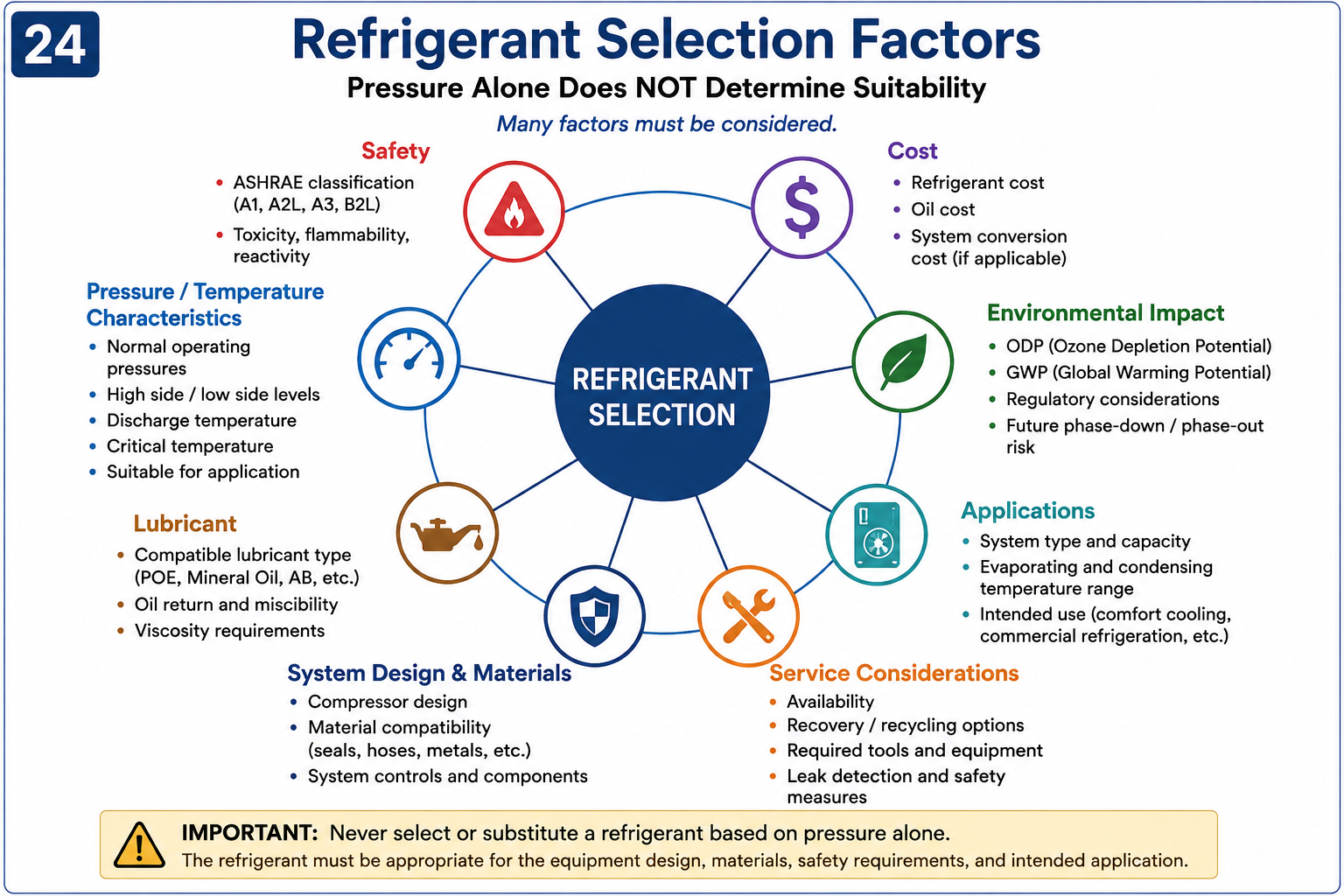
Do not assume that a replacement refrigerant is a true “drop-in.” Proper refrigerant selection requires consideration of equipment compatibility, approved applications, service procedures, refrigerant handling requirements, and applicable regulations.
Ask the Same Questions Every Time
When evaluating an unfamiliar refrigerant, use a consistent sequence rather than focusing immediately on gauge pressures.
Identify It
What is the complete refrigerant designation, and is the identification reliable?
Classify It
What family, composition, safety classification, and pressure characteristics apply?
Know the Application
What type of equipment was designed to use this refrigerant?
Check Compatibility
What lubricant, materials, tools, recovery equipment, and service procedures are required?
Understand the Hazards
What pressure, toxicity, flammability, atmospheric, or handling hazards must be controlled?
Follow Approved Information
Use equipment manufacturer instructions, refrigerant documentation, SDS information, and applicable regulations.
Everything Else Depends on Knowing What Is in the System
A technician cannot select the correct pressure-temperature information, recovery equipment, charging method, lubricant guidance, leak detector, or safety procedure without knowing which refrigerant is being serviced.
Incorrect identification can also contaminate recovery cylinders and recovery machines if unknown or mixed refrigerant is introduced into equipment intended for a known refrigerant.
Identify first. Service second. Positive refrigerant identification is the foundation for the decisions that follow.
Learn the Patterns Before the Numbers
The individual profiles will contain many numbers: pressures, boiling points, GWP values, blend percentages, temperature glide, and other data. Some values are important for certification preparation, but trying to memorize every number immediately is not the goal.
First learn the larger patterns. Know which refrigerants are blends, which are A2L or A3, which operate at unusually high or low pressures, which require special lubricant considerations, and which are associated primarily with legacy or newer equipment.
Once you understand why a characteristic matters, remembering the important values becomes easier than memorizing an isolated table.
Avoid These Refrigerant-Profile Errors
“If pressures are similar, the refrigerants are interchangeable.”
No. Pressure is only one characteristic among many that affect equipment compatibility and safe operation.
“If two refrigerants are A1, they can use the same equipment.”
No. Safety classification does not establish pressure, lubricant, capacity, metering, or equipment compatibility.
“All HFC refrigerants use the same oil.”
No. The correct lubricant depends on the refrigerant, compressor, equipment, and manufacturer specification.
“A modern refrigerant is automatically safer in every way.”
No. A newer refrigerant may improve one environmental characteristic while introducing different pressure, flammability, or service considerations.
“The refrigerant cylinder color identifies the refrigerant.”
Not reliably. Positive identification comes from labels and markings, not paint color alone.
“A refrigerant profile replaces manufacturer information.”
No. Profiles explain refrigerant characteristics; actual equipment service must follow the equipment manufacturer’s requirements.
Refrigerant Characteristics Affect Regulatory Service Procedures
Section 608 certification requires technicians to recognize refrigerant characteristics and apply appropriate recovery and service practices. Knowing the refrigerant is therefore necessary before deciding which procedures and requirements apply.
As you study the individual refrigerants, pay particular attention to refrigerant family, blend behavior, pressure characteristics, safety, lubricant compatibility, environmental characteristics, recovery considerations, and proper identification. These concepts will reappear throughout Section 608 preparation.
Can You Read a Refrigerant Profile?
- Why are all refrigerants in this section presented using a standardized profile?
- What does the refrigerant designation identify?
- Why is it important to know whether a refrigerant is single component or a blend?
- What two characteristics are described by an ASHRAE safety classification?
- Why is refrigerant pressure important when selecting service equipment?
- Can the same pressure-temperature chart be used for different refrigerants?
- Why are bubble and dew values important for some refrigerant blends?
- Why should the typical application of a refrigerant be included in its profile?
- Why is refrigerant-lubricant compatibility important?
- What do ODP and GWP describe?
- Why can charging procedures differ among refrigerants?
- What does legacy refrigerant status generally tell a technician?
- Why is similar operating pressure not enough to justify refrigerant substitution?
- What is the first step before servicing an unfamiliar refrigeration system?
- Does a refrigerant profile replace the equipment manufacturer’s service information?
What You Should Have Learned
Profiles Provide Consistency
Using the same categories for every refrigerant makes meaningful comparisons easier.
Designation Is Only the Beginning
The refrigerant number identifies the product, but additional information is required for safe service.
Composition Affects Behavior
Single-component refrigerants and blends can require different P-T interpretation and charging practices.
Safety Classification Matters
Toxicity and flammability classifications affect equipment design and service precautions.
Pressure Is Refrigerant Specific
Refrigerants have different P-T characteristics and require appropriately rated equipment.
Lubricant Compatibility Matters
The correct refrigerant and oil must operate together within the compressor and refrigeration system.
Application Does Not Equal Interchangeability
Two refrigerants used for similar applications may still be completely unsuitable as direct substitutes.
Identify Before Servicing
Correct identification is required before selecting service information, tools, recovery equipment, or charging procedures.