R-12 and R-22: Legacy Refrigerants
R-12 and R-22 are two of the most historically important refrigerants in refrigeration and air conditioning. Neither represents the direction of new equipment, but technicians still need to recognize them, understand why they were phased out, and know how existing systems containing these refrigerants must be handled.
R-12 receives relatively brief treatment because equipment using it has become increasingly uncommon. R-22 deserves considerably more attention because a large installed base of R-22 air-conditioning and refrigeration equipment can still be encountered in service.
What You Will Learn
After completing this lesson, you should be able to:
Identify R-12
Recognize R-12 as a CFC refrigerant formerly used extensively in refrigeration and air-conditioning applications.
Identify R-22
Recognize R-22 as an HCFC refrigerant widely used in residential, commercial, and refrigeration equipment.
Explain the Phaseouts
Explain why chlorine-containing R-12 and R-22 were targeted for phaseout because of their effects on stratospheric ozone.
Recognize Existing R-22 Systems
Understand that R-22 equipment remains in service even though production and import of R-22 have been phased out in the United States.
Evaluate Replacement Options
Recognize why refrigerant replacement requires consideration of equipment, lubricant, capacity, controls, and manufacturer requirements.
Apply Proper Service Practices
Recognize the importance of recovery, proper identification, leak repair, and avoiding refrigerant mixing when servicing legacy equipment.
Old Refrigerants Do Not Immediately Disappear
A refrigerant phaseout stops or restricts production and import according to a regulatory schedule. It does not cause every piece of equipment containing that refrigerant to disappear on the phaseout date.
Air-conditioning and refrigeration equipment can remain operational for many years. As a result, technicians often work on several generations of refrigerant technology at the same time.
Legacy does not mean irrelevant. A technician may encounter equipment containing a refrigerant that has not been manufactured for years. The refrigerant must still be correctly identified, recovered, handled, and serviced.
R-12 — Dichlorodifluoromethane
R-12 is a chlorofluorocarbon, or CFC, refrigerant. For decades it was one of the most widely used refrigerants in the world.
R-12 was used in applications including domestic refrigerators and freezers, automotive air conditioning, commercial refrigeration, and other medium-temperature refrigeration equipment.
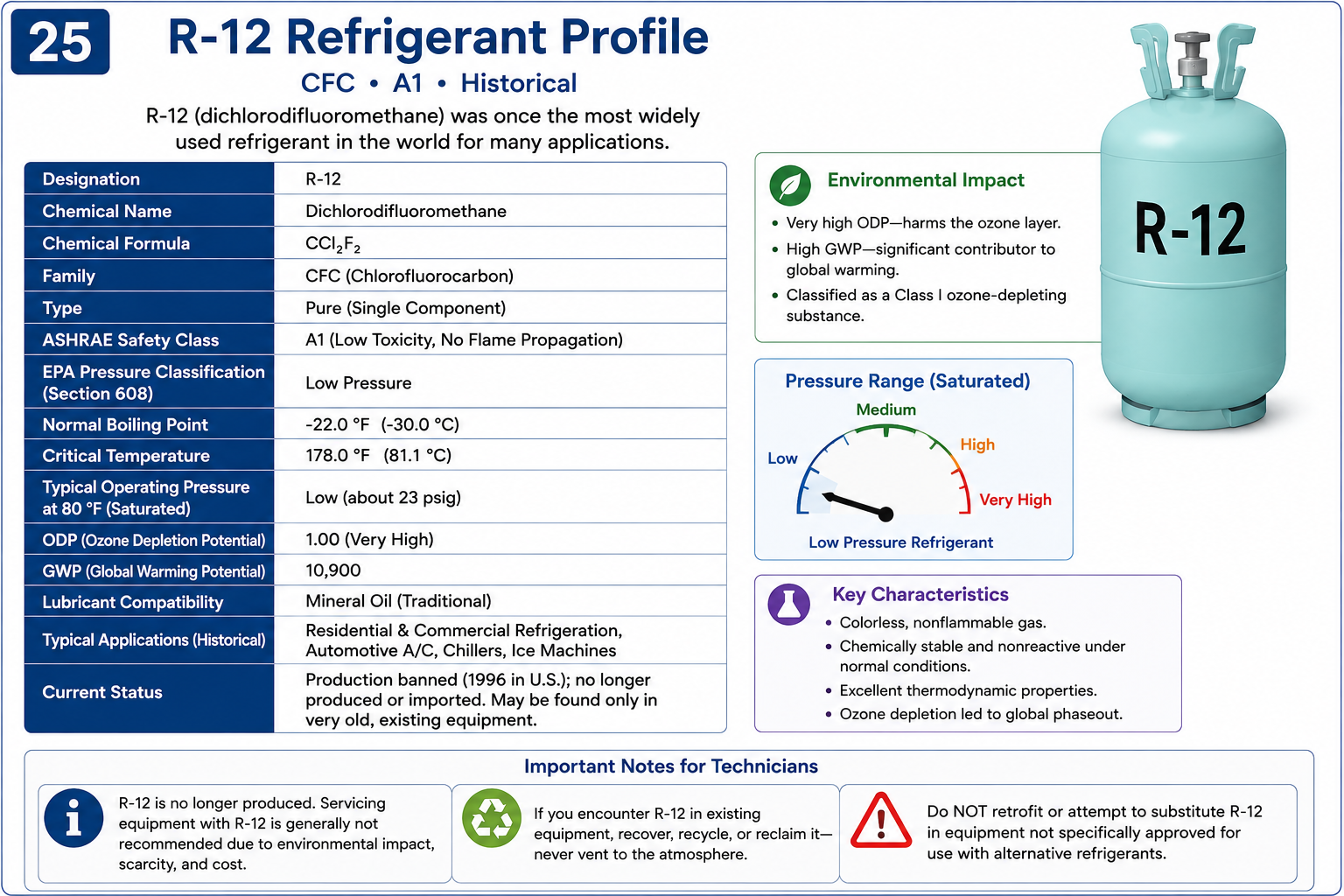
Designation
R-12
Refrigerant Family
CFC — chlorofluorocarbon.
Composition
Single-component refrigerant.
Safety Classification
ASHRAE A1.
Traditional Lubricant
Commonly associated with mineral oil in traditional refrigeration systems.
Current Status
Legacy refrigerant associated primarily with older equipment.
Why R-12 Was Phased Out
CFC refrigerants are extremely stable compounds. That stability was useful inside refrigeration systems, but it also allowed released CFC molecules to remain in the atmosphere long enough to reach the stratosphere.
There, ultraviolet radiation can break chlorine-containing compounds apart and release chlorine atoms. Those chlorine atoms participate in reactions that destroy stratospheric ozone.
R-12 contains chlorine and has significant ozone depletion potential. Its effect on stratospheric ozone was the primary reason for its phaseout.
What Technicians Need to Know Today
R-12 equipment is much less common than it once was, but technicians may still encounter older refrigeration equipment containing R-12 or equipment that was originally designed for it.
When working on older equipment, never assume that the refrigerant currently inside the system is the refrigerant listed on the original nameplate. Older systems may have been retrofitted during their service life.
An old R-12 nameplate tells you what the equipment was designed to use. It does not guarantee that R-12 is still inside the system. Look for retrofit labels and service documentation and use refrigerant identification procedures when necessary.
There Is No Universal Replacement Refrigerant
Various refrigerants and retrofit products have been used to keep older R-12 equipment operating. Some are marketed as replacements or service alternatives for particular applications.
Terms such as replacement refrigerant or drop-in replacement should never be interpreted to mean that every refrigerant can simply be installed in every R-12 system without further consideration.
Before using an alternative refrigerant, determine whether it is acceptable for the application and whether the equipment, compressor, lubricant, seals, metering device, and service procedures are compatible with the proposed refrigerant.
R-22 — Chlorodifluoromethane
R-22 is a hydrochlorofluorocarbon, or HCFC. It became one of the dominant refrigerants used in comfort cooling and was also widely used in refrigeration applications.
Compared with CFC refrigerants such as R-12, HCFCs were transitional refrigerants with lower ozone depletion potential. However, R-22 still contains chlorine and therefore still contributes to stratospheric ozone depletion when released.
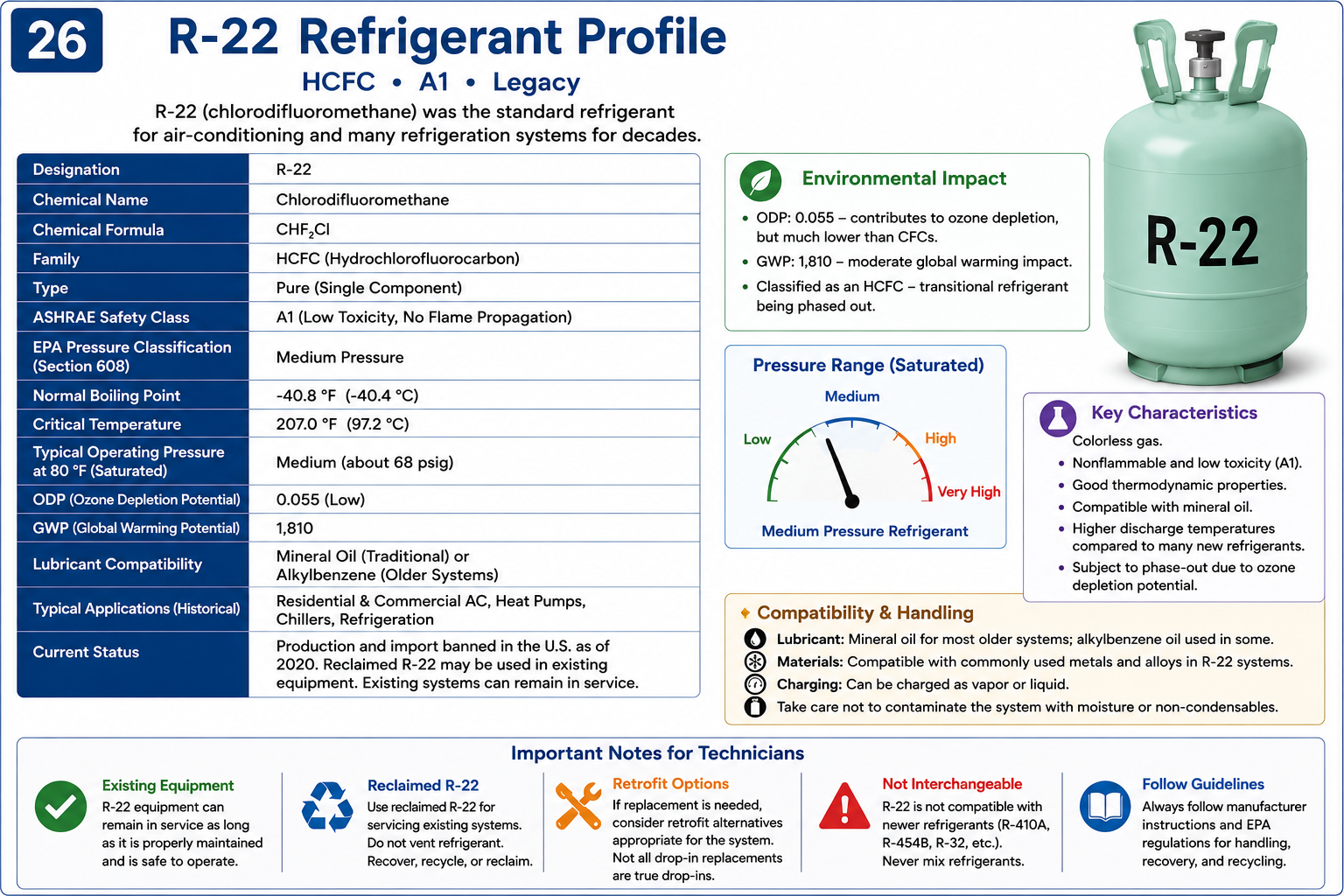
Designation
R-22
Refrigerant Family
HCFC — hydrochlorofluorocarbon.
Composition
Single-component refrigerant.
Safety Classification
ASHRAE A1.
Traditional Lubricants
Mineral oil was widely used, with alkylbenzene used in some applications.
Current Status
Legacy refrigerant still encountered in existing equipment.
Where Technicians Encounter R-22
R-22 was used across an enormous range of refrigeration and air-conditioning equipment. Its installed base was particularly large in residential and light-commercial comfort cooling.
Comfort Cooling
Residential split systems, packaged air conditioners, heat pumps, and light-commercial air-conditioning equipment.
Commercial Refrigeration
Walk-in coolers, reach-in equipment, condensing units, and other refrigeration applications.
Because HVAC equipment can remain operational for many years, technicians should expect R-22 equipment to remain part of the service market even though new production and import of R-22 for servicing ended in the United States in 2020.
Existing Systems Can Continue to Operate
The phaseout of R-22 production did not make existing R-22 equipment illegal to own or operate. Existing equipment can continue to be maintained and repaired.
Available R-22 for servicing can come from refrigerant produced before the phaseout and from recovered or reclaimed supplies.
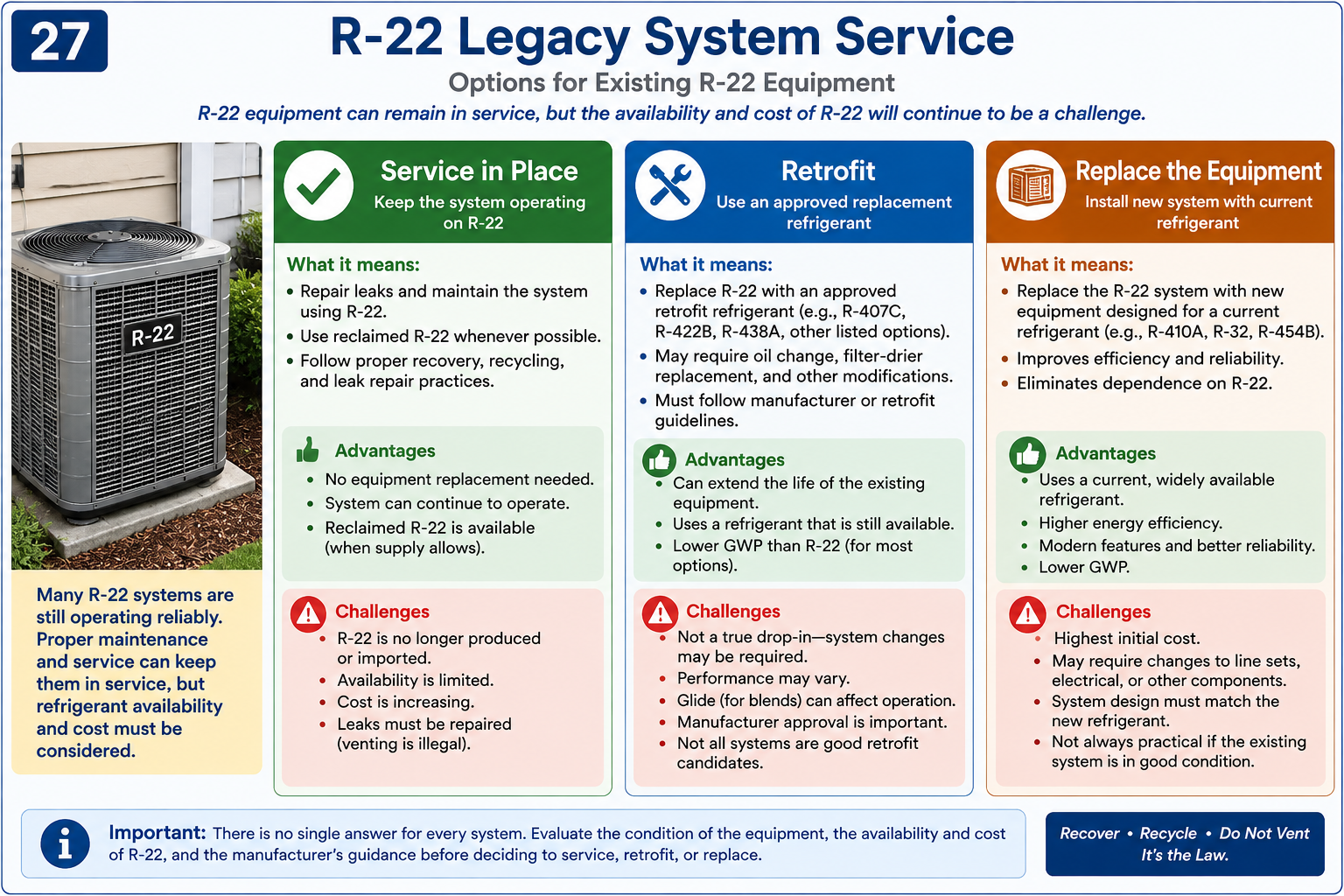
Production phaseout is not an equipment ban. Existing R-22 equipment does not have to be automatically replaced merely because R-22 production and import have ended.
Know the Difference
Legacy refrigerants make the distinction between recovered, recycled, and reclaimed refrigerant especially important.
Recovered
Refrigerant has been removed from an appliance and stored in an external container without necessarily being processed or tested.
Recycled
Recovered refrigerant has been cleaned for reuse, generally through processes such as oil separation and filtering.
Reclaimed
Refrigerant has been processed to meet the applicable reclamation purity standard and can be returned to the refrigerant market under EPA requirements.
Recovered refrigerant may be reused in equipment belonging to the same owner under applicable Section 608 rules. Refrigerant being sold to another owner for use as a refrigerant must be reclaimed by an EPA-certified reclaimer.
Repair, Retrofit, or Replace?
When an R-22 system requires major service, there are generally several possible paths. The appropriate choice depends on the condition and age of the equipment, refrigerant availability, repair cost, efficiency, compatibility with alternatives, and the owner’s needs.
Repair and Continue Using R-22
If the equipment remains serviceable, the system may be repaired and returned to operation using an appropriate available R-22 supply.
Retrofit
Some equipment may be suitable for conversion to an approved alternative refrigerant when the equipment and application support the retrofit.
Replace the Equipment
Older or extensively damaged equipment may be better replaced with equipment designed specifically for a current refrigerant.
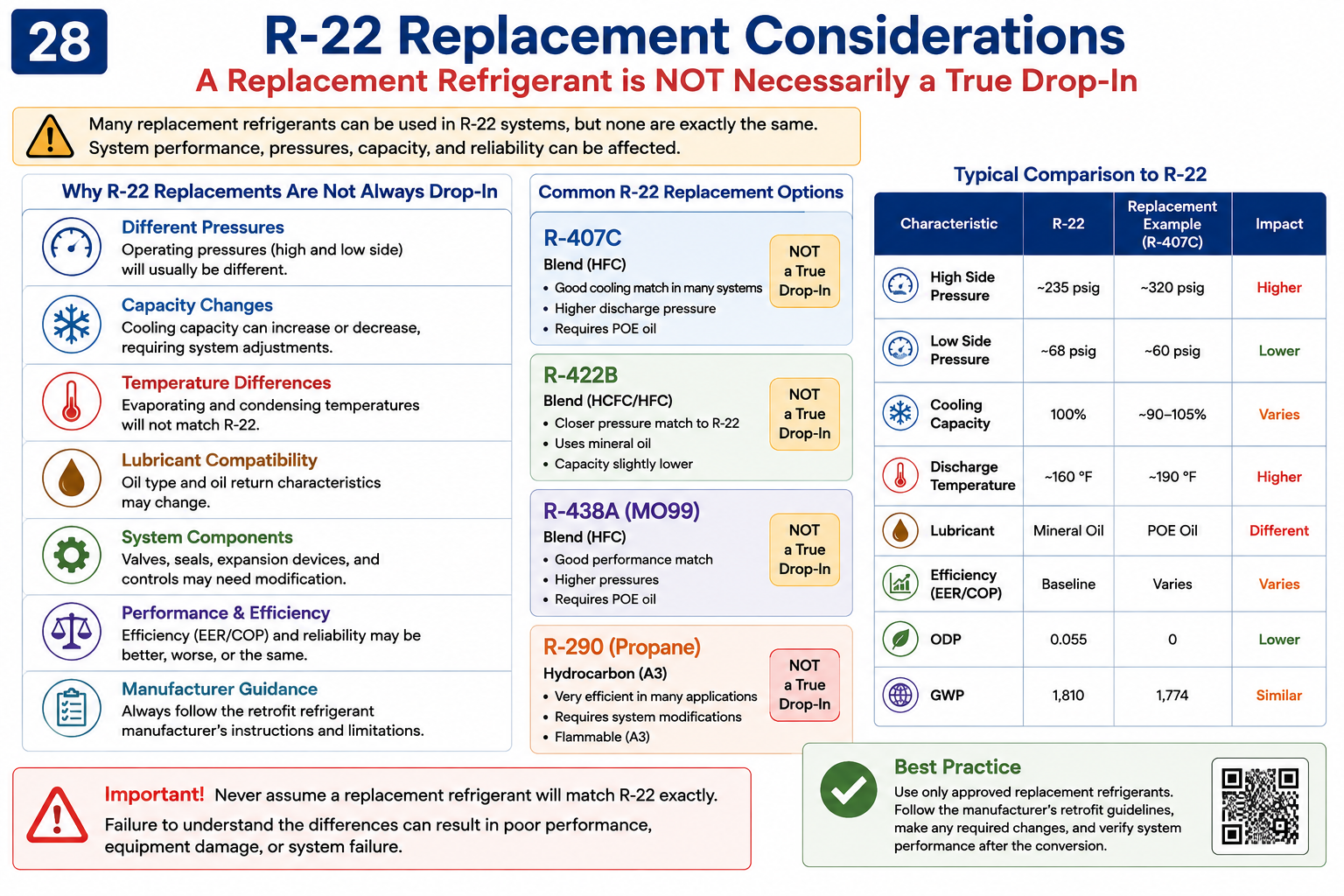
A Replacement Refrigerant Changes More Than Pressure
A refrigerant retrofit should never be approached as simply removing one refrigerant and adding another. Refrigerants differ in thermodynamic characteristics, mass flow, lubricant compatibility, capacity, discharge temperature, temperature glide, and other properties.
Lubricant
Determine whether the existing lubricant is compatible with the replacement refrigerant and compressor.
Capacity
The replacement may change system cooling capacity and compressor performance.
Metering Device
Different refrigerant characteristics can affect expansion-device operation and required adjustments.
Pressure
Verify that system components and service equipment are appropriate for the replacement refrigerant’s operating pressures.
Charging Method
A blended replacement may require liquid withdrawal and may exhibit temperature glide even though R-22 itself is single component.
System Identification
A retrofitted system must be clearly identified so the next technician knows which refrigerant and lubricant are actually present.
Adding an Alternative to R-22 Is Not a Retrofit
One of the most important service rules is that a replacement refrigerant should not simply be added on top of the existing R-22 charge.
Mixing refrigerants creates an unknown mixture with pressure-temperature characteristics that do not correspond to either refrigerant’s published P-T chart. It can also create recovery, reclamation, troubleshooting, and lubricant problems.
Do not top off R-22 with another refrigerant. A legitimate retrofit follows an established procedure that includes recovery of the original refrigerant and proper conversion of the system.
Never Substitute R-410A Into an R-22 System
R-410A became a common successor refrigerant in newly designed comfort-cooling equipment, but it is not a direct replacement for R-22.
R-410A operates at substantially higher pressures and requires equipment specifically designed for those pressures. Lubricant and component requirements also differ.
Never charge R-410A into equipment designed for R-22. Similar application does not mean refrigerant interchangeability.
R-22 Remains an Important Reference Refrigerant
Many experienced technicians learned refrigeration diagnostics using R-22 systems. As a result, R-22 pressures often became an informal reference point for discussing other refrigerants.
That familiarity can be useful, but it can also create a bad habit: expecting other refrigerants to behave like R-22.
Every refrigerant must be evaluated using its own pressure-temperature information. Do not diagnose R-410A, R-407C, R-454B, or another refrigerant by mentally substituting familiar R-22 pressures.
Older Systems Require Lubricant Awareness
Traditional R-22 equipment commonly used mineral oil, although alkylbenzene and other lubricants can be found depending on the application and equipment.
This becomes particularly important during retrofit work because many alternative refrigerants have different lubricant requirements or oil-return characteristics.
Refrigerants and Lubricants
For a review of mineral oil, alkylbenzene, POE, oil circulation, moisture contamination, and lubricant compatibility, return to Refrigerants and Lubricants.
Two Generations of Ozone-Depleting Refrigerants
| Characteristic | R-12 | R-22 |
|---|---|---|
| Family | CFC | HCFC |
| Contains Chlorine | Yes | Yes |
| Composition | Single component | Single component |
| ASHRAE Safety Class | A1 | A1 |
| Ozone Depletion | Significant | Lower than R-12, but still present |
| Historic Applications | Refrigeration and automotive A/C | Comfort cooling and refrigeration |
| Current Technician Exposure | Relatively uncommon | Still encountered in existing equipment |
| General Status | Legacy CFC | Legacy HCFC |
Why These Refrigerants Matter on the EPA Exam
R-12 and R-22 are important examples of the refrigerant transitions created by ozone-protection requirements. They illustrate the distinction between CFC and HCFC refrigerants and reinforce the reasons refrigerant recovery is required.
Remember these relationships: R-12 is a CFC. R-22 is an HCFC. Both contain chlorine and contribute to ozone depletion. R-22 is classified as a high-pressure refrigerant for Section 608 recovery requirements. Existing R-22 equipment may continue to be serviced even though production and import of R-22 have been phased out.
Avoid These Legacy-Refrigerant Errors
“R-22 is illegal.”
No. Production and import have been phased out, but existing R-22 equipment can continue to be operated and serviced.
“An R-22 system must be replaced.”
No. The phaseout itself does not require automatic replacement of existing equipment.
“R-410A is a replacement for R-22.”
R-410A replaced R-22 in many new-equipment applications, but it is not a direct retrofit refrigerant for R-22 equipment.
“Any R-22 substitute can be added to R-22.”
No. Refrigerants should not be mixed. A retrofit requires an appropriate conversion procedure.
“The original nameplate proves what is inside.”
No. Older equipment may have been retrofitted. Always check service labels and documentation.
“Legacy refrigerant can be vented because it is obsolete.”
No. Refrigerant recovery and applicable EPA requirements still apply.
R-12 and R-22
- What refrigerant family does R-12 belong to?
- What refrigerant family does R-22 belong to?
- What element in R-12 and R-22 contributes to stratospheric ozone depletion?
- What is the ASHRAE safety classification of R-12?
- What is the ASHRAE safety classification of R-22?
- Why is R-12 encountered less frequently today than R-22?
- What types of equipment commonly used R-22?
- Does the R-22 phaseout require existing R-22 equipment to be replaced?
- Can existing R-22 equipment continue to be serviced?
- What is the difference between recovered and reclaimed refrigerant?
- What three general options may be considered when major repairs are needed on an R-22 system?
- Why is R-410A not a direct replacement for R-22?
- Why should a replacement refrigerant not simply be added to an existing R-22 charge?
- Why is lubricant compatibility important during an R-22 retrofit?
- Why should technicians verify the refrigerant in older equipment rather than relying only on the original nameplate?
What You Should Have Learned
R-12 Is a CFC
R-12 is a chlorine-containing CFC refrigerant historically used in refrigeration and automotive air conditioning.
R-22 Is an HCFC
R-22 is a chlorine-containing HCFC refrigerant widely used in comfort cooling and refrigeration.
Both Affect Stratospheric Ozone
The presence of chlorine is the major reason both refrigerants became subjects of international and U.S. phaseout programs.
R-22 Equipment Still Exists
Existing R-22 equipment can continue operating and can be maintained and repaired.
Phaseout Does Not Mean Equipment Ban
The end of R-22 production and import does not automatically require existing equipment to be replaced.
Retrofits Require Planning
A replacement refrigerant must be evaluated for equipment, lubricant, pressure, capacity, charging, and application compatibility.
Do Not Mix Refrigerants
Adding another refrigerant to an existing R-22 charge creates an unknown mixture and is not a proper retrofit.
Identify Before Servicing
Older systems may have been converted during their service life, so the technician must determine what refrigerant is actually present.