R-404A and R-507A Refrigerants
R-404A and R-507A became important HFC refrigerants in commercial refrigeration during the transition away from ozone-depleting refrigerants such as R-502. They have been widely used in supermarket refrigeration, walk-in and reach-in equipment, ice machines, refrigerated transport, and other medium- and low-temperature applications.
Although R-404A and R-507A have zero ozone depletion potential and an A1 safety classification, both have very high global warming potential. As a result, the refrigeration industry is moving toward lower-GWP alternatives for many new applications while technicians continue to encounter substantial amounts of existing R-404A and R-507A equipment.
What You Will Learn
After completing this lesson, you should be able to:
Identify R-404A
Recognize R-404A as an HFC refrigerant blend historically important in commercial refrigeration.
Identify R-507A
Recognize R-507A as an HFC blend used in many applications similar to those historically served by R-404A.
Compare Blend Behavior
Distinguish the zeotropic behavior of R-404A from the essentially azeotropic behavior of R-507A.
Recognize Common Applications
Identify medium- and low-temperature commercial refrigeration applications in which these refrigerants have been used.
Apply Proper Service Practices
Recognize the importance of liquid charging, correct P-T information, POE lubricant handling, recovery, and refrigerant identification.
Explain the Current Transition
Explain why the high GWP of R-404A and R-507A is driving movement toward lower-GWP refrigerants.
From R-502 to HFC Refrigerants
Commercial refrigeration historically relied on several chlorine-containing refrigerants. R-502, an azeotropic blend containing CFC-115 and HCFC-22, became particularly important for low-temperature refrigeration.
As ozone-depleting refrigerants were phased out, R-404A and R-507A became widely used alternatives in newly designed commercial refrigeration equipment.
R-404A and R-507A solved the ozone-depletion problem associated with older chlorine-containing refrigerants, but they introduced another environmental concern: very high global warming potential.
R-404A — A Three-Component HFC Blend
R-404A is a blend of three HFC refrigerants: R-125, R-143a, and R-134a. It was developed for commercial refrigeration applications and became especially common in medium- and low-temperature systems.
R-404A is a zeotropic blend, although its temperature glide is relatively small compared with blends such as R-407C. Because it is a blend, technicians must still apply proper blend-handling procedures.
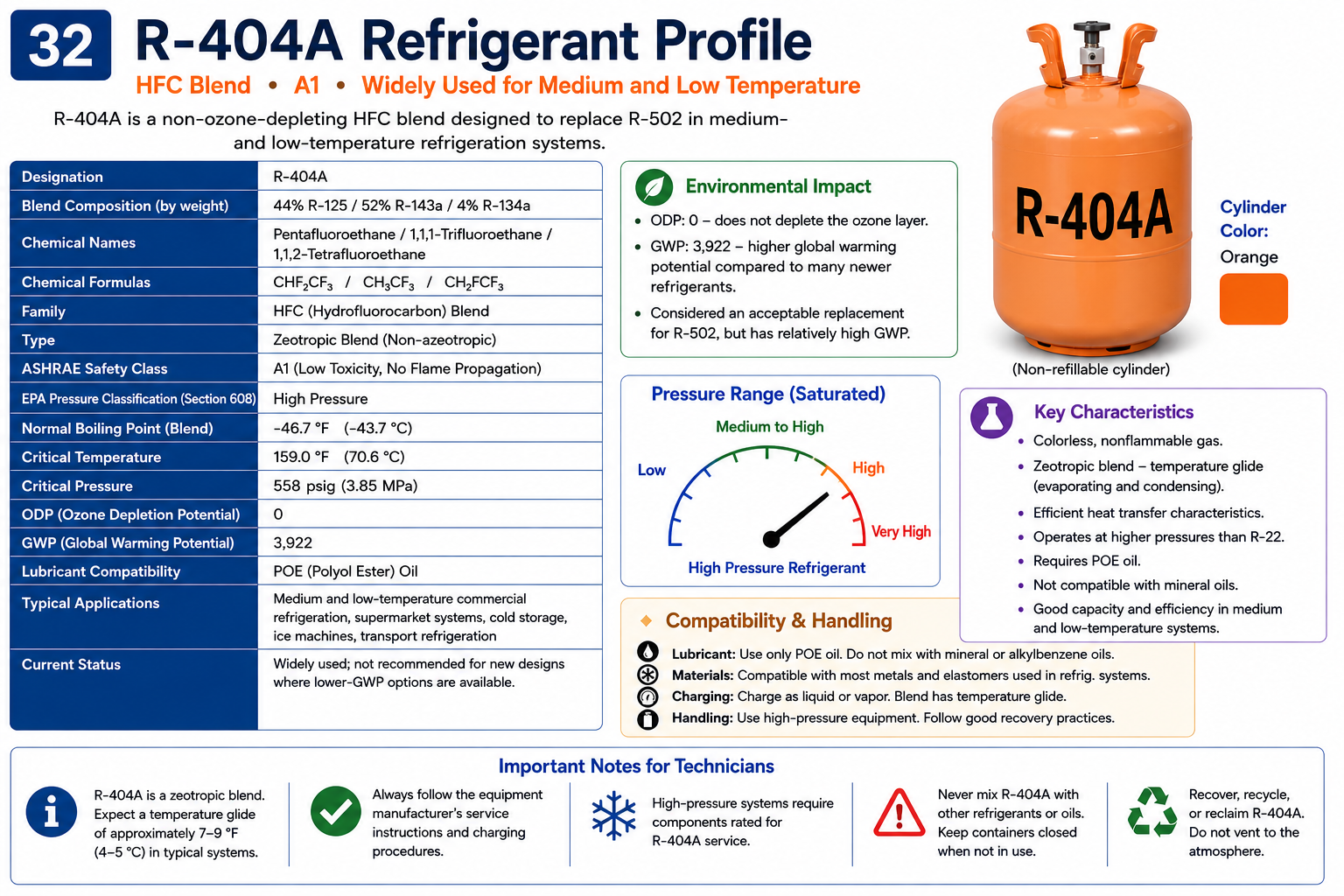
Designation
R-404A
Family
HFC blend
Composition
R-125 / R-143a / R-134a.
Blend Type
Zeotropic blend with relatively small temperature glide.
Safety Classification
ASHRAE A1.
Typical Lubricant
Commonly associated with POE lubricant in equipment designed for R-404A.
Three Refrigerants in One Refrigerant Blend
The components of R-404A have different physical properties and boiling characteristics. The blend proportions are carefully controlled to produce the desired refrigeration performance.
Because the refrigerant is a blend, technicians should not intentionally change its composition during storage, charging, or service.
Withdraw and charge R-404A as liquid when necessary to preserve blend composition. If liquid refrigerant must be introduced into an operating system through the suction side, it must be controlled so that liquid refrigerant does not enter the compressor.
Zeotropic Refrigerant Blends
Fractionation, bubble point, dew point, and temperature glide were introduced in Refrigerant Families, Types, and Blends.
R-507A — A Two-Component HFC Blend
R-507A is a blend of R-125 and R-143a. It has been used in many of the same commercial refrigeration applications as R-404A.
Unlike R-404A, R-507A behaves essentially as an azeotropic blend. Its components behave much more like a single refrigerant during phase change, producing essentially no meaningful temperature glide for normal field service.
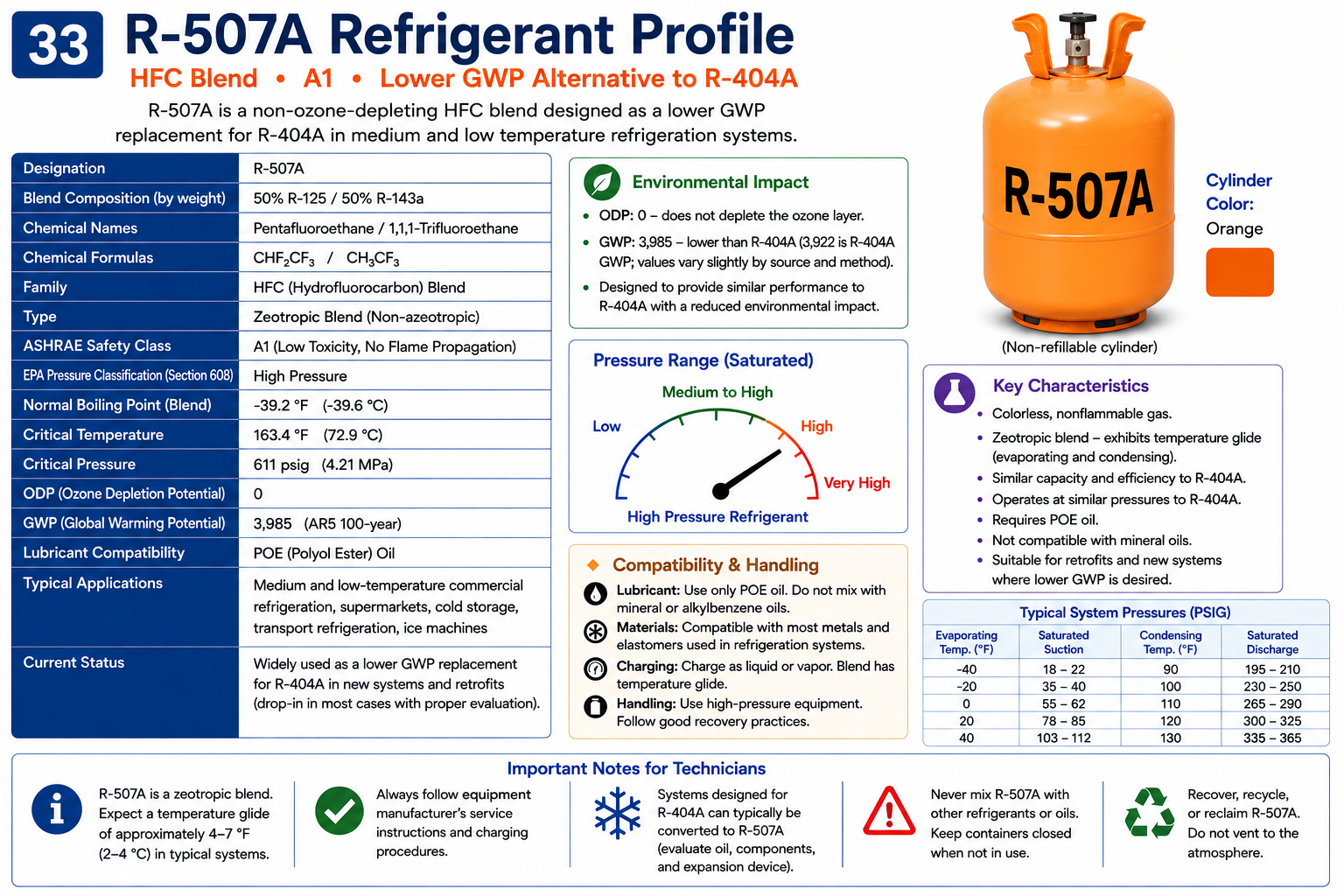
Designation
R-507A
Family
HFC blend
Composition
R-125 / R-143a.
Blend Behavior
Essentially azeotropic.
Safety Classification
ASHRAE A1.
Typical Lubricant
Commonly associated with POE lubricant in equipment designed for R-507A.
Similar Applications, Different Blend Characteristics
R-404A and R-507A have often been discussed together because their refrigeration applications and operating characteristics overlap. However, they are not the same refrigerant and should never be treated as though their designations are interchangeable.
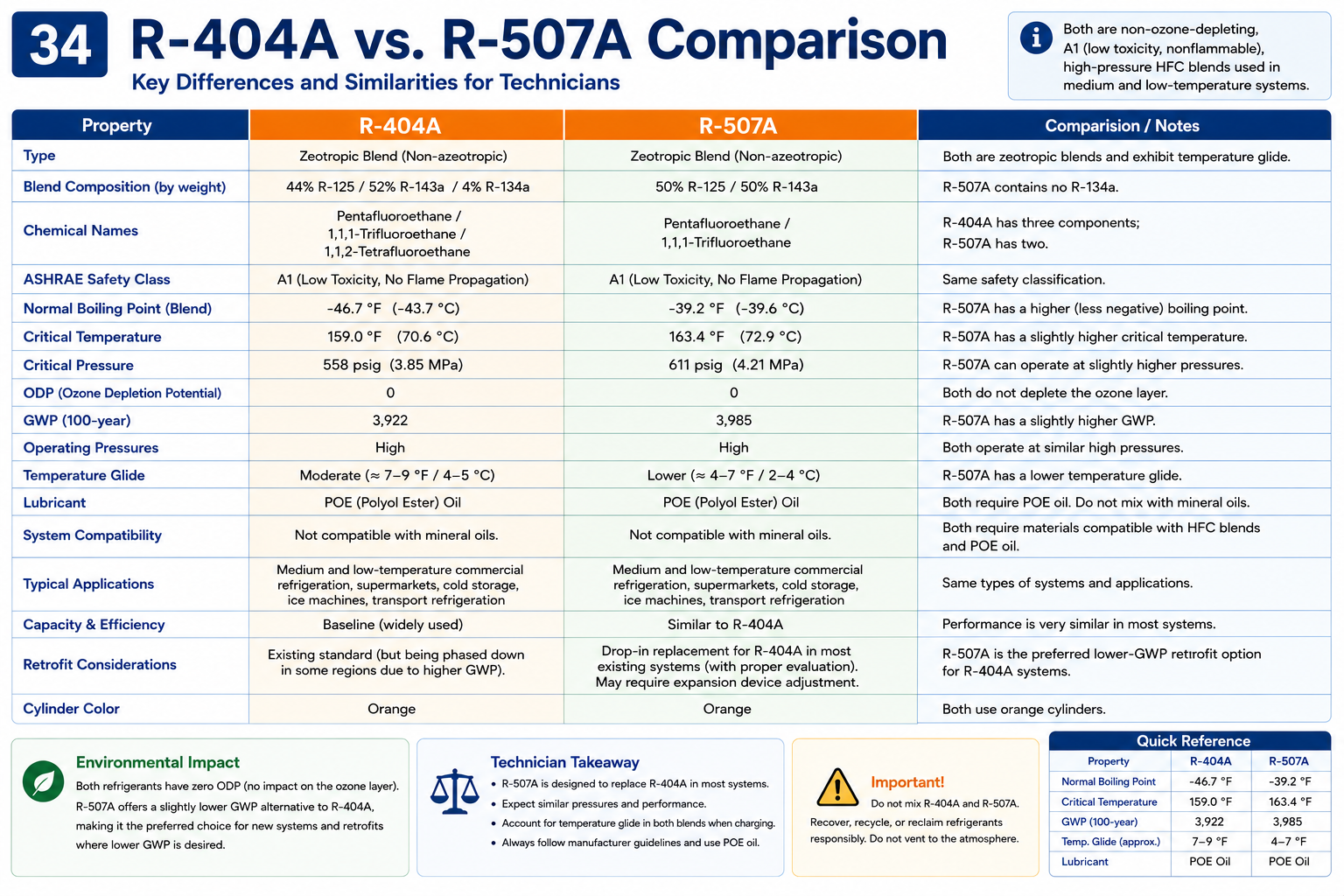
| Characteristic | R-404A | R-507A |
|---|---|---|
| Family | HFC blend | HFC blend |
| Components | R-125 / R-143a / R-134a | R-125 / R-143a |
| Blend Behavior | Zeotropic, very low glide | Essentially azeotropic |
| ASHRAE Safety Class | A1 | A1 |
| ODP | 0 | 0 |
| Typical Lubricant | POE | POE |
| Historic Use | Medium- and low-temperature refrigeration | Medium- and low-temperature refrigeration |
| Environmental Concern | Very high GWP | Very high GWP |
Where Technicians Encounter These Refrigerants
R-404A and R-507A became closely associated with commercial refrigeration. Technicians may encounter them in systems ranging from small stand-alone units to large supermarket refrigeration installations.
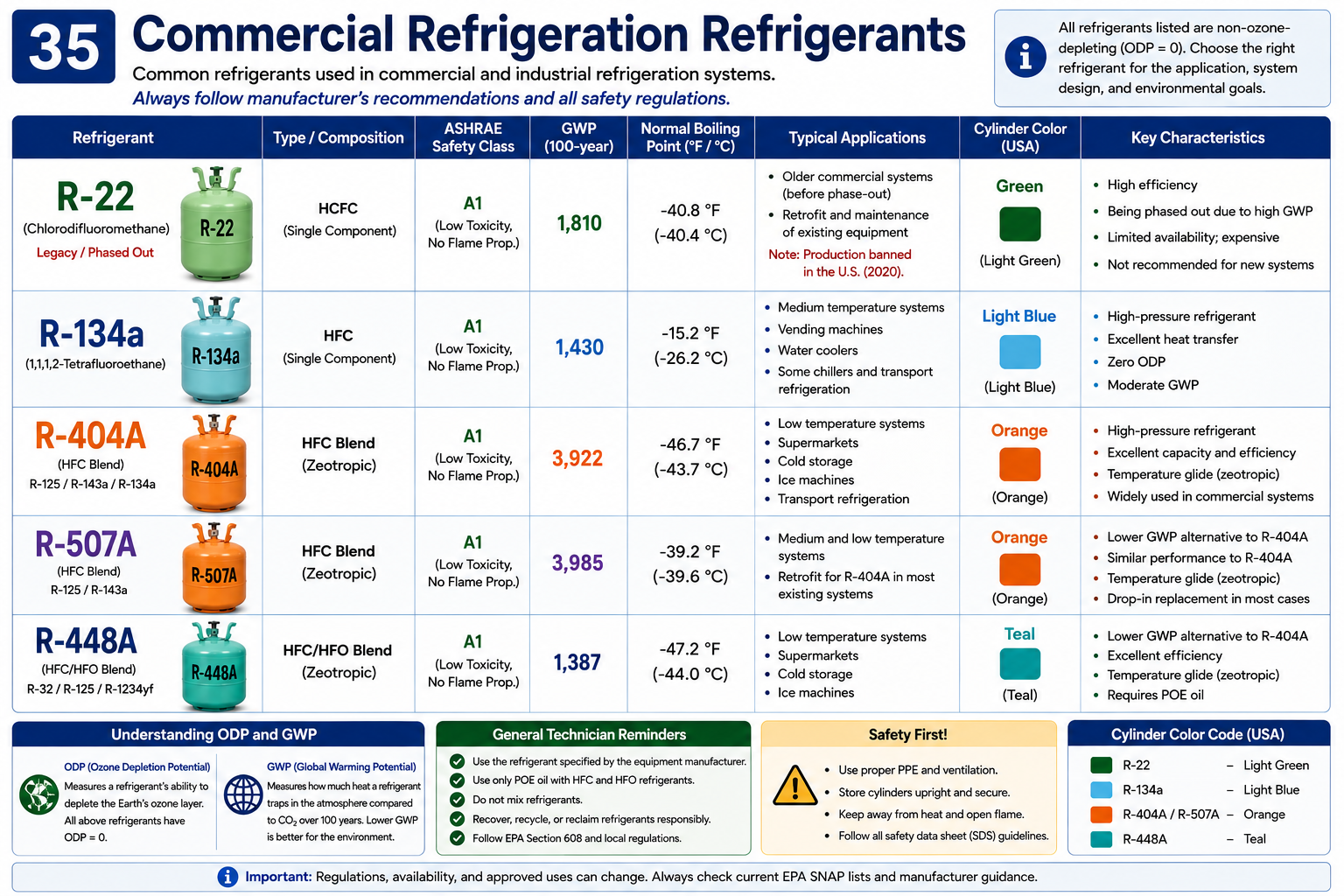
Supermarkets
Display cases, refrigerated cases, compressor racks, and other centralized refrigeration systems.
Walk-In Equipment
Walk-in coolers and freezers using remote condensing units or packaged refrigeration equipment.
Reach-In Equipment
Commercial refrigerators and freezers used in restaurants, convenience stores, and food-service facilities.
Ice Machines
Some generations of commercial ice-making equipment have used R-404A.
Low-Temperature Systems
Freezer and frozen-food applications where low evaporating temperatures are required.
Refrigerated Transport
Refrigeration systems used on some refrigerated trucks, trailers, and transport equipment.
Commercial Refrigeration Is Not Comfort Cooling
Technicians entering commercial refrigeration from residential air conditioning need to recognize an important difference: refrigeration systems frequently operate with evaporator temperatures far below those normally encountered in comfort cooling.
A walk-in freezer, for example, may require an evaporating temperature well below 0°F. The suction pressure expected in such a system will therefore be very different from the suction pressure expected in an air-conditioning system.
Do not diagnose a refrigeration system by comparing its pressures with familiar air-conditioning pressures. Determine the refrigerant, application, required box temperature, expected evaporator temperature, condenser conditions, and system design first.
Always Use the Correct Refrigerant P-T Data
R-404A and R-507A each have their own pressure-temperature relationship. Their pressures may appear similar in many operating conditions, but the refrigerants are not identical.
Use the P-T data for the refrigerant actually contained in the equipment. Never substitute an R-404A chart for R-507A or vice versa simply because the pressures appear close.
Check the equipment nameplate, refrigerant labels, retrofit markings, and service records before interpreting system pressures. If refrigerant identity is uncertain, determine the refrigerant before proceeding with normal diagnostic calculations.
R-404A Has a Small Temperature Glide
Because R-404A is a zeotropic blend, its liquid and vapor saturation conditions can be represented by bubble-point and dew-point temperatures.
The temperature glide of R-404A is small, but the underlying principle remains important because technicians will soon encounter refrigerants such as R-407C where glide is much more noticeable.
Bubble Point
The saturation temperature associated with saturated liquid beginning to boil at a given pressure.
Dew Point
The saturation temperature associated with saturated vapor beginning to condense at a given pressure.
For a zeotropic blend, technicians generally use dew-point temperature when calculating superheat and bubble-point temperature when calculating subcooling.
Preserve the Blend Composition
When refrigerant is removed from a cylinder containing a zeotropic blend, withdrawing liquid helps maintain the intended blend composition.
This is particularly important when charging R-404A. The technician should follow the refrigerant manufacturer’s and equipment manufacturer’s charging instructions.
Liquid from the cylinder does not mean uncontrolled liquid into the compressor. If refrigerant must be introduced through the low side of an operating system, use an appropriate charging method to meter or vaporize the liquid and prevent compressor damage.
Moisture Control Is Especially Important
R-404A and R-507A systems commonly use POE lubricant. As discussed previously, POE is hygroscopic and can absorb moisture rapidly when exposed to atmospheric air.
Commercial refrigeration repairs may involve substantial piping systems and long periods of service work, making contamination control particularly important.
Keep the System Closed
Minimize the amount of time refrigeration piping and components remain open to atmospheric air.
Protect the Oil
Keep POE lubricant containers sealed and prevent unnecessary exposure to moisture.
Replace Filter-Driers
Install appropriate filter-driers when required after opening or repairing the refrigeration circuit.
Evacuate Properly
Use proper evacuation procedures to remove air and moisture before returning the system to operation.
Refrigerants and Lubricants
POE moisture absorption, oil circulation, contamination, and compressor protection were covered in Refrigerants and Lubricants.
Zero ODP, But Very High GWP
Neither R-404A nor R-507A contains chlorine, so both have an ozone depletion potential of zero. This was an important advantage over older CFC and HCFC refrigerants.
However, their global warming potentials are very high. EPA SNAP tables use a GWP of approximately 3,920 for R-404A and 3,990 for R-507A.
R-404A
ODP: 0
GWP: approximately 3,920
R-507A
ODP: 0
GWP: approximately 3,990
The high GWP of these refrigerants is the primary environmental reason the industry is moving away from them in many new commercial refrigeration applications.
Existing Equipment Remains in Service
R-404A and R-507A remain present in a large amount of existing commercial refrigeration equipment. Technicians will therefore continue to recover, charge, diagnose, repair, and maintain equipment containing these refrigerants.
At the same time, their use has been restricted in various categories of newly manufactured equipment and certain retrofit applications. The exact regulatory status depends on the end use.
It is inaccurate to say simply that “R-404A is banned” or “R-507A is banned.” Refrigerant acceptability depends on the particular application, whether the equipment is new or existing, and applicable EPA requirements.
EPA maintains current refrigerant status by application through its SNAP program. When making an actual refrigerant-selection or retrofit decision, verify the current requirements for the specific end use rather than relying on a general refrigerant statement.
The Commercial Refrigeration Market Is Changing
Lower-GWP refrigerants are increasingly being used in applications that historically relied on R-404A and R-507A. The alternatives vary according to equipment design, application, temperature range, charge size, safety requirements, and regulatory requirements.
Examples encountered in the industry include lower-GWP HFC/HFO blends, carbon dioxide systems, and hydrocarbon refrigerants in equipment specifically designed for their use.
There is no single refrigerant that replaces R-404A or R-507A in every application. Refrigerant selection must be based on the equipment and application.
Do Not Select a Replacement by Pressure Alone
Several refrigerants have been developed for use in applications historically served by R-404A and R-507A, but a retrofit requires much more than comparing operating pressures.
Equipment Approval
Determine whether the proposed refrigerant is appropriate for the equipment and application.
Capacity
A different refrigerant can change compressor capacity and overall refrigeration performance.
Discharge Temperature
Some alternatives can produce different compressor discharge temperatures.
Temperature Glide
A replacement blend may have significantly more glide than R-404A or R-507A.
Expansion Device
Metering devices may require adjustment or replacement depending on the retrofit procedure.
Controls
Pressure controls, electronic controllers, and other system settings may need to be changed.
A Retrofit Requires Recovery of the Existing Charge
Do not add a different refrigerant on top of an existing R-404A or R-507A charge. Doing so creates an uncontrolled mixture with unknown pressure-temperature characteristics.
Mixed refrigerants can also contaminate recovery cylinders, complicate reclamation, and make normal system diagnosis impossible.
Recover the existing refrigerant before performing an approved retrofit. Follow the refrigerant and equipment manufacturer’s retrofit procedure and clearly relabel the equipment when the conversion is complete.
High GWP Makes Preventing Releases Especially Important
R-404A and R-507A must be properly recovered during service of stationary refrigeration equipment. Their zero ozone depletion potential does not make intentional venting acceptable.
Because these refrigerants have very high GWP, preventing unnecessary releases also has significant climate benefits.
Use appropriate recovery equipment and cylinders, minimize hose losses, avoid unnecessary purging, repair equipment carefully, and keep recovered refrigerants separated whenever practical.
Large Refrigerant Charges Increase the Consequences of Leakage
Commercial refrigeration systems can contain much larger refrigerant charges than small residential air-conditioning systems. Supermarket rack systems and other centralized systems may also contain extensive networks of refrigerant piping and numerous fittings.
A small percentage leak from a large system can therefore represent a substantial quantity of refrigerant.
Leak prevention is not only a regulatory issue. Refrigerant loss affects operating cost, system capacity, compressor operation, food preservation, environmental impact, and customer reliability.
What to Remember About R-404A and R-507A
These refrigerants connect several major Section 608 concepts: refrigerant blends, recovery, environmental effects, commercial refrigeration, leak management, and the transition toward lower-GWP refrigerants.
Remember that R-404A and R-507A are HFC blends with zero ODP and A1 safety classifications. Both have very high GWP and have been widely used in commercial refrigeration. R-404A is a zeotropic blend with a small temperature glide, while R-507A behaves essentially azeotropically.
Avoid These R-404A and R-507A Errors
“R-404A is a single refrigerant.”
No. R-404A is a three-component HFC blend.
“R-507A and R-404A are identical.”
No. Their applications and pressures can be similar, but their compositions and blend characteristics differ.
“A1 means environmentally safe.”
No. A1 is a toxicity and flammability classification. It says nothing about global warming potential.
“Zero ODP means low GWP.”
No. Both refrigerants have zero ODP but very high GWP.
“Any lower-GWP refrigerant can replace R-404A.”
No. Equipment, application, capacity, lubricant, controls, glide, safety, and regulatory requirements must be considered.
“Existing R-404A equipment is illegal.”
No. Existing equipment remains in service. Restrictions on new equipment and particular end uses should not be confused with an automatic ban on existing systems.
R-404A and R-507A Refrigerants
- What refrigerant family does R-404A belong to?
- What three refrigerants make up R-404A?
- Is R-404A a single-component refrigerant or a blend?
- What type of blend is R-404A?
- What two refrigerants make up R-507A?
- How does the blend behavior of R-507A differ from R-404A?
- What is the ASHRAE safety classification of R-404A and R-507A?
- What is the ozone depletion potential of these refrigerants?
- Why are R-404A and R-507A environmental concerns despite having zero ODP?
- In what general type of refrigeration equipment have these refrigerants been widely used?
- Why should R-404A normally be withdrawn from a cylinder as liquid?
- Which saturation temperature is generally used to calculate superheat with a zeotropic blend?
- Which saturation temperature is generally used to calculate subcooling?
- What lubricant is commonly associated with R-404A and R-507A systems?
- Why should a different refrigerant never simply be added to an existing R-404A or R-507A charge?
What You Should Have Learned
R-404A Is an HFC Blend
It contains R-125, R-143a, and R-134a and behaves as a zeotropic blend with relatively small glide.
R-507A Is an HFC Blend
It contains R-125 and R-143a and behaves essentially azeotropically.
Both Are A1
Both refrigerants are in the lower-toxicity, no-flame-propagation ASHRAE classification.
Both Have Zero ODP
Neither refrigerant contains chlorine.
Both Have Very High GWP
Their climate impact is driving the transition toward lower-GWP commercial refrigeration technologies.
Commercial Refrigeration Is the Major Application
These refrigerants have been particularly important in medium- and low-temperature refrigeration.
Blend Handling Matters
R-404A should be handled using appropriate blend charging procedures and correct bubble/dew P-T information.
Existing Equipment Remains Important
Technicians will continue servicing installed R-404A and R-507A equipment during the transition to lower-GWP refrigerants.