Refrigerant Line Sets in Split Systems
Refrigerant line sets connect the indoor and outdoor portions of split air-conditioning, heat-pump, and refrigeration systems. Correct tubing size, routing, support, insulation, cleanliness, refrigerant charge, and installation practices are essential to reliable system operation.
In this subsection you will study conventional liquid and suction lines, oil return, vertical risers, ACR tubing sizes, A2L identification, fittings, filter-driers, refrigerant charge, insulation, ductless systems, brazing, evacuation, and complete line-set installation practices.
What You Will Learn
Refrigerant piping is part of the refrigeration system, not simply a pair of copper tubes connecting two pieces of equipment. Every tubing size, bend, support, elevation change, restriction, insulation joint, and service procedure can affect how the system operates.
Refrigerant Flow
Understand the purpose of conventional liquid and suction lines and the refrigerant conditions normally found in each during cooling operation.
Tubing Size and Length
Learn ACR tubing sizing, actual versus equivalent length, vertical separation, and why larger tubing is not automatically better.
Oil Return and Support
Understand refrigerant velocity, vertical suction risers, oil traps, proper supports, and the problems caused by sagging tubing.
Refrigerant Identification
Compare R-410A and A2L refrigerant piping requirements, identification, labeling, and mechanical protection.
System Protection and Charging
Study filter-driers, moisture indicators, restrictions, factory refrigerant charge, line-length adjustments, and manufacturer charging procedures.
Installation Workmanship
Apply correct insulation, ductless piping practices, nitrogen purging, leak testing, evacuation, drainage, routing, and mechanical protection.
The Line Set Connects the Refrigeration System
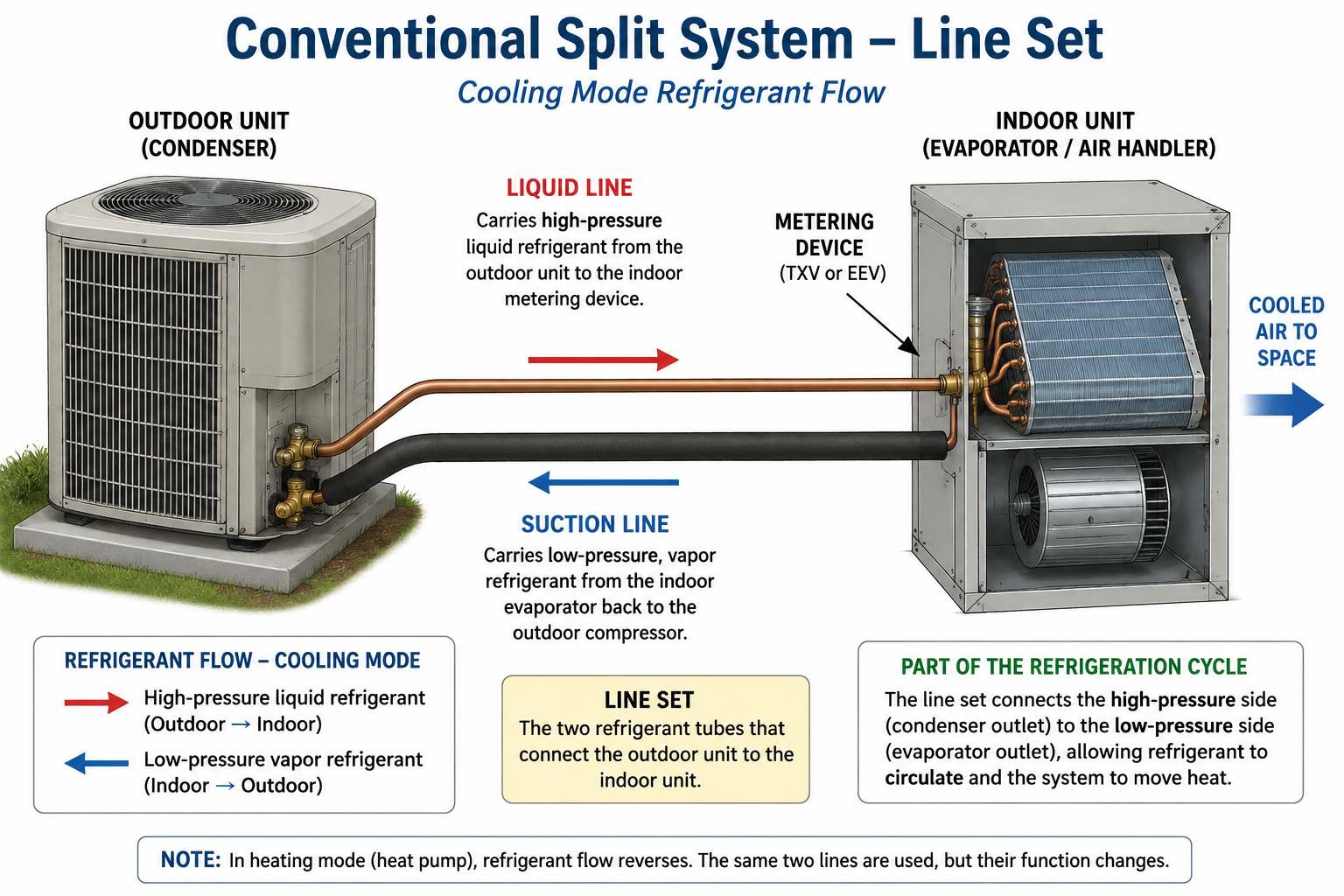
During conventional cooling operation, the smaller liquid line carries high-pressure liquid refrigerant from the condenser toward the indoor metering device.
The larger suction line returns low-pressure refrigerant vapor from the evaporator toward the compressor.
Heat pumps, ductless mini-splits, VRF systems, and other equipment can place metering devices in different locations or reverse refrigerant flow. Technicians must understand the actual refrigerant state and operating mode rather than relying only on pipe names.
Refrigerant Line Set Lessons
Complete the lessons in order. Each lesson builds on the refrigeration-cycle, metering-device, evaporator, and compressor concepts covered earlier in the HVAC/R training manual.
Introduction to Refrigerant Line Sets
Learn the purpose of conventional liquid and suction lines, ACR tubing sizing, actual line length, equivalent length, and vertical separation.
ACR Tubing
Line Length
Oil Return, Vertical Risers, and Refrigerant Line Support
Study compressor oil return, refrigerant velocity, vertical suction risers, oil traps, proper support, and prevention of unintended low spots.
Vertical Risers
IMC Support
R-410A and A2L Refrigerant Piping Requirements
Compare A1 and A2L refrigerant systems and learn refrigerant identification, pipe labeling, mechanical protection, and line-set reuse considerations.
A2L
Identification
Bends, Fittings, and Equivalent Length
Learn how bends and fittings create resistance, why sweeping turns are preferred, and how equivalent length affects refrigerant piping design.
Pressure Drop
Equivalent Length
Filter-Driers and Moisture-Indicating Sight Glasses
Study contamination control, moisture indication, restricted filter-drier diagnosis, and why sight glasses are not refrigerant charging tools.
Moisture
Restrictions
Factory Refrigerant Charge and Line-Set Length
Learn how factory refrigerant charge relates to installed tubing length and why additional refrigerant must follow manufacturer-specific calculations.
Additional Refrigerant
Charge Verification
Suction-Line Insulation and Condensation Prevention
Understand dew point, suction-line condensation, property damage, heat gain, insulation workmanship, and why conventional liquid lines are normally uninsulated.
Condensation
Dew Point
Ductless and Variable-Capacity Refrigerant Piping
Learn why ductless systems do not always have conventional liquid and suction lines and how EEV location, compressor capacity, and operating mode affect piping.
EEVs
Variable Capacity
Brazing, Nitrogen Purging, Leak Testing, and Evacuation
Study clean brazing practices, nitrogen purging, pressure testing, leak detection, evacuation, micron gauges, and preparation of the sealed refrigerant circuit.
Leak Testing
Evacuation
Line-Set Routing, Protection, and Installation Review
Bring the complete subsection together by reviewing routing, protection, support, insulation, drainage, serviceability, charging, and final system inspection.
Protection
Final Review
From Refrigerant Flow to Complete Installation
Understand the Refrigerant Path
Begin with conventional liquid and suction lines, tubing sizing, line length, and vertical separation.
Control Oil and Pressure Drop
Study refrigerant velocity, oil return, vertical risers, supports, bends, fittings, and equivalent length.
Protect and Identify the System
Learn A2L identification, filter-drier operation, moisture monitoring, and restriction diagnosis.
Charge and Insulate Correctly
Connect factory charge to installed line length and protect the cold suction line from heat gain and condensation.
Apply Modern Installation Practices
Finish with ductless systems, nitrogen purging, leak testing, evacuation, drainage, protection, and complete installation review.
Five Rules to Carry Into the Field
Use the Manufacturer’s Tubing Sizes
Do not resize refrigerant lines by habit. Correct diameter balances pressure drop, refrigerant velocity, system capacity, and oil return.
Support the Tubing Properly
Prevent sagging, unintended oil traps, vibration, abrasion, and excessive mechanical stress on equipment connections.
Keep the Refrigerant Circuit Clean and Dry
Protect open tubing, purge with nitrogen while brazing, leak test, and evacuate correctly before refrigerant operation.
Charge by the Published Procedure
Account for actual piping length and use the manufacturer’s charging procedure rather than pressure alone or sight-glass appearance.
Know the System You Are Working On
Conventional splits, heat pumps, ductless systems, variable-capacity equipment, and A2L systems can have different piping and installation requirements.
Conventional Split-System Line Set
| Item | Conventional Cooling-System Practice | Important Qualification |
|---|---|---|
| Liquid Line | Smaller tube carrying high-pressure liquid toward the indoor metering device | May not describe actual refrigerant state on ductless or other equipment |
| Suction Line | Larger tube carrying low-pressure vapor toward the compressor | Heat-pump operating mode can change refrigerant direction and condition |
| ACR Tubing Size | Specified by actual outside diameter | Do not confuse with nominal plumbing copper sizes |
| Suction Insulation | Normally required | Prevents condensation and reduces unwanted heat gain |
| Liquid-Line Insulation | Normally not used | Follow manufacturer requirements; ductless systems commonly differ |
| Line Length | Must remain within manufacturer limits | Can affect refrigerant charge, pressure drop, and oil return |
| Supports | Prevent sagging, vibration, and mechanical damage | Closer support may be needed than the maximum code interval |
| Filter-Drier | Protects system from moisture and contamination | A significant temperature drop can indicate restriction |
| Sight Glass | Used primarily for moisture/system-condition indication | Not a refrigerant charging tool |
| Refrigerant Charge | Adjusted according to manufacturer instructions | No universal ounces-per-foot charging rule |
R-410A, A2L, and Ductless Equipment
R-410A Systems
Use tubing, components, service procedures, and charging requirements suitable for the system’s pressure and equipment design.
A2L Systems
Require attention to refrigerant safety classification, identification, labeling, mechanical protection, approved service equipment, and locally adopted code requirements.
Ductless Systems
May place the metering device outdoors, so the smaller tube does not necessarily function as a conventional high-pressure liquid line.
Variable-Capacity Equipment
Changes refrigerant mass flow over a wide operating range, increasing the importance of manufacturer-approved tubing size and oil-return provisions.
Good Refrigerant Piping Is More Than Copper Tubing
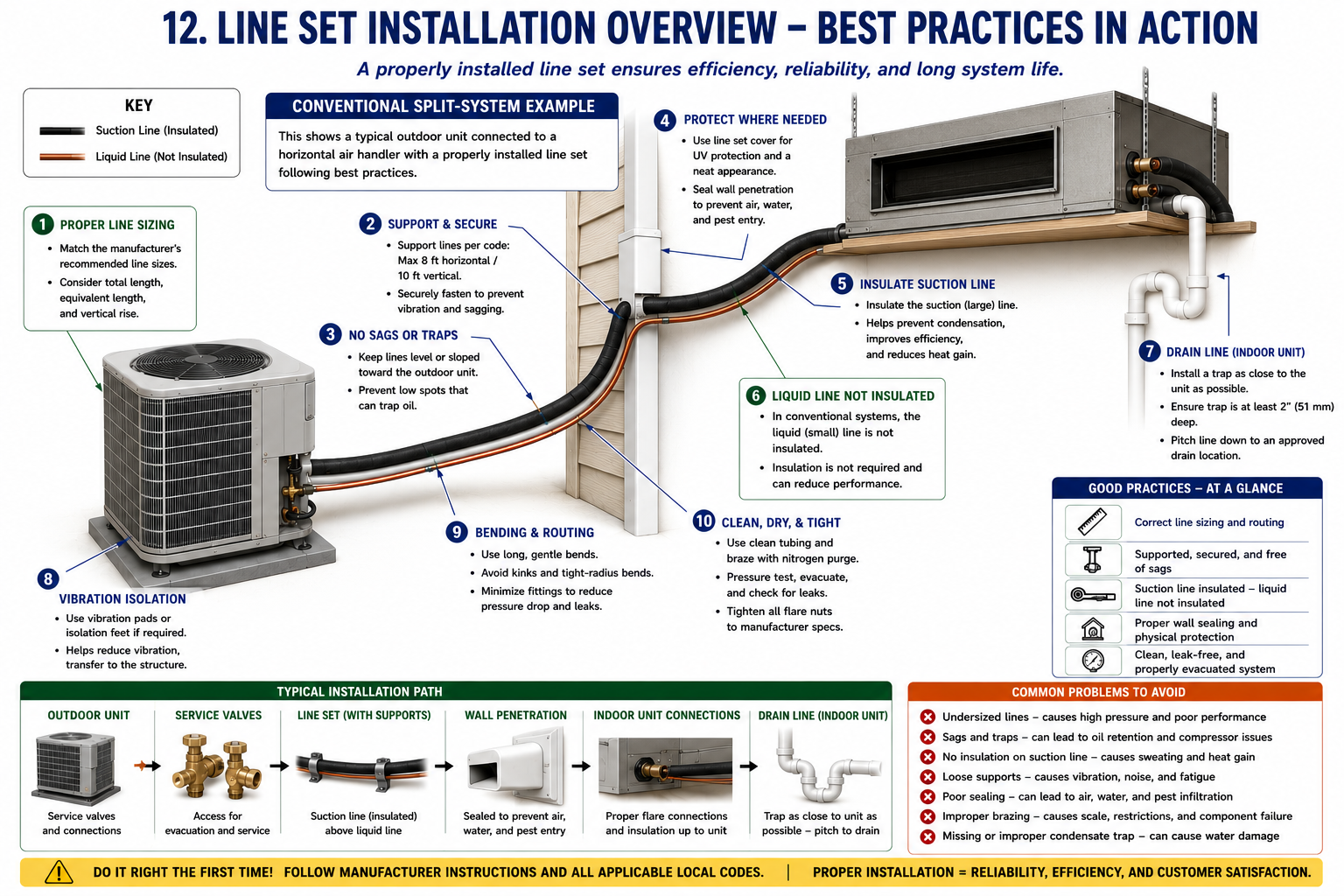
Correct Tubing
Proper ACR diameter, total length, equivalent length, and vertical separation.
Correct Routing
Smooth bends, few unnecessary fittings, adequate support, and no unintended low spots.
Correct Protection
Insulation, mechanical protection, sealed penetrations, refrigerant identification, and protected outdoor runs.
Correct Commissioning
Nitrogen brazing purge, leak testing, evacuation, refrigerant charge adjustment, and final operational inspection.
Start With the Conventional Split-System Line Set
Begin with Lesson 1 to establish how refrigerant travels between the indoor and outdoor equipment and why tubing size, length, and vertical separation matter.