R-410A and A2L Refrigerant Piping Requirements
Refrigerant piping requirements depend on more than tubing diameter and line length. The refrigerant itself, its safety classification, the equipment listing, the manufacturer’s installation instructions, and the locally adopted mechanical or residential code can all affect how refrigerant piping is installed, protected, and identified.
The transition from R-410A equipment to systems using A2L refrigerants such as R-32 and R-454B makes proper refrigerant identification especially important. A technician must know what refrigerant is in the system before installation, service, recovery, evacuation, charging, or repair begins.
What You Will Learn
By the end of this lesson you should be able to:
Explain refrigerant safety classifications.
Recognize the difference between an A1 refrigerant such as R-410A and A2L refrigerants such as R-32 and R-454B.
Identify refrigerant piping correctly.
Explain why refrigerant designation and safety classification must be clearly identified where required by the applicable code.
Explain the 2024 IMC pipe-identification requirements.
Recognize the maximum identification interval, minimum lettering height, and additional warning required for A2L refrigerant piping where the section applies.
Recognize A2L piping-protection requirements.
Understand why concealed refrigerant tubing may require additional mechanical protection.
Evaluate an existing line set before reuse.
Explain why an existing R-410A line set should not automatically be assumed acceptable for replacement A2L equipment.
Use manufacturer and locally adopted requirements.
Recognize that code edition, local amendments, equipment listing, and manufacturer instructions determine the actual installation requirements.
Know What Refrigerant Is in the System
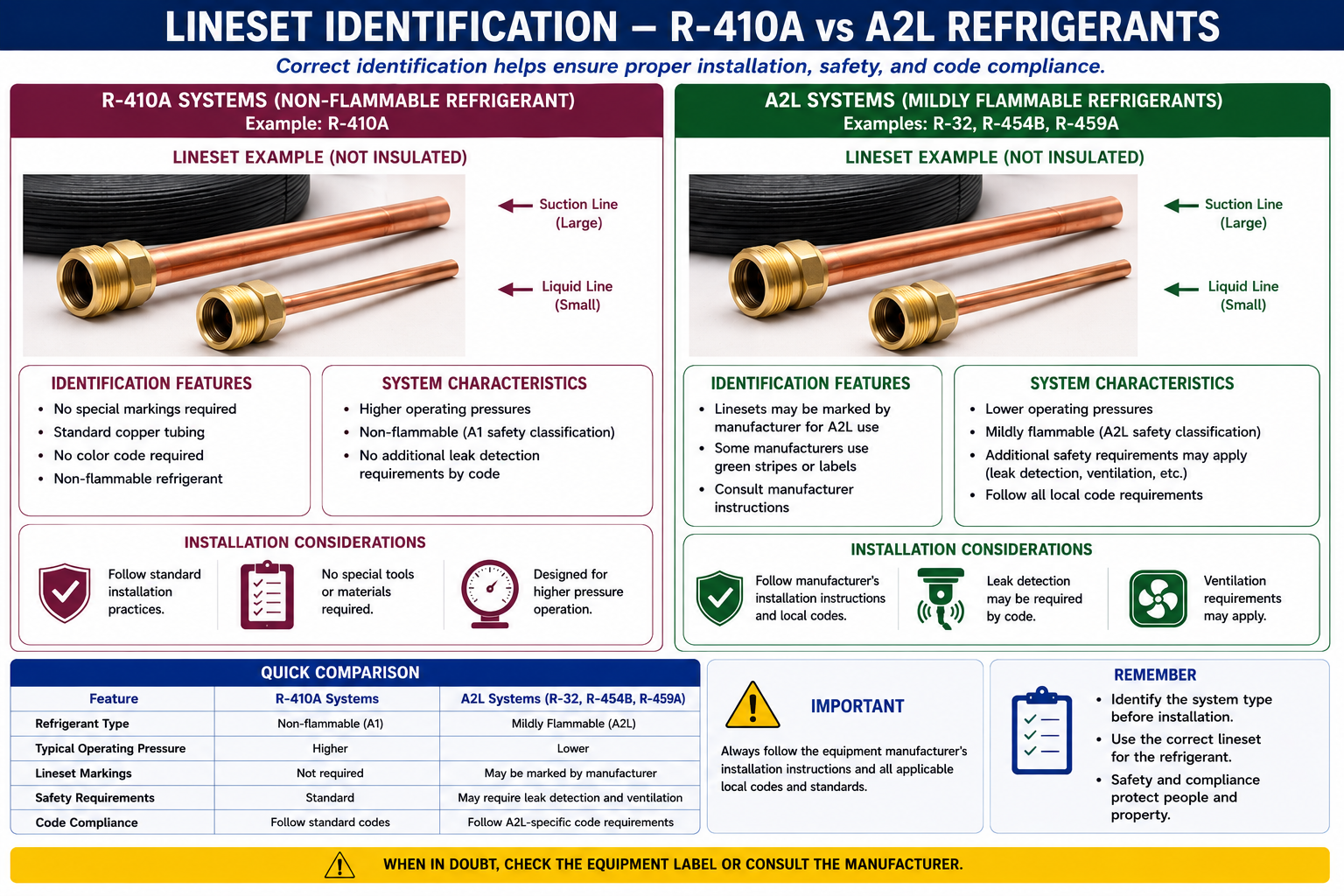
Refrigerants are assigned safety classifications based on toxicity and flammability characteristics. These classifications are established through ANSI/ASHRAE Standard 34.
R-410A
R-410A is classified as an A1 refrigerant. The letter A identifies the lower-toxicity category, while the number 1 identifies the lowest flammability classification.
R-32 and R-454B
R-32 and R-454B are examples of A2L refrigerants. A2L refrigerants have lower toxicity and lower flammability characteristics with a limited burning velocity compared with higher-flammability refrigerant classes.
The letter L in A2L does not mean that the refrigerant is nonflammable. It identifies the lower-burning-velocity subdivision of the Class 2 flammability category. A2L equipment and piping must therefore be installed and serviced using procedures appropriate for that refrigerant and the equipment listing.
The Copper Tubing May Look Similar, but the Requirements Can Differ
A conventional R-410A split system and an A2L split system may both use copper refrigerant tubing. This does not mean that the tubing installation requirements are automatically identical.
A1 Refrigerant
Refrigerant piping must be suitable for the operating pressure, tubing size, total length, vertical separation, and other requirements specified for the particular equipment.
A2L Refrigerant
In addition to ordinary refrigerant-piping requirements, the equipment listing, applicable code, identification requirements, mechanical protection, charge limitations, and other A2L provisions may apply.
The copper tubing itself may not tell you whether it contains R-410A, R-32, R-454B, or another refrigerant. Refrigerant identification must come from equipment markings, piping identification, service information, and other reliable system documentation.
Refrigerant Piping Must Be Identified Where the Code Requires It
Where 2024 International Mechanical Code Section 1109.2.7 applies, refrigerant piping located outside the room or space containing the refrigerating equipment must be identified.
Maximum Identification Interval
Identification is placed on the refrigerant piping or pipe insulation at intervals not exceeding 20 feet.
Minimum Letter Height
The identification lettering must be at least 1/2 inch high.
Refrigerant Designation
The identification states the refrigerant used in the piping system, such as R-410A, R-32, or R-454B.
Safety Group Classification
The identification also states the refrigerant safety group, such as A1 or A2L.
A2L Additional Warning
For Group A2L and B2L refrigerants, the identification includes the code-required fire warning.
The 2024 IMC requirement should not be treated as a universal rule for every jurisdiction or every installation. States and local jurisdictions may use an earlier code edition, adopt later provisions, create exceptions, or make local amendments. Verify the code that actually applies to the project.
Identification Is a Service-Safety Tool
Proper refrigerant piping identification gives technicians important information before they cut, braze, recover refrigerant from, pressure test, evacuate, or otherwise open the refrigeration system.
Refrigerant Type
The technician knows which refrigerant is expected in the piping system.
Safety Classification
The technician can recognize whether the refrigerant is A1, A2L, or another safety classification.
Tool Selection
Recovery equipment, leak detectors, vacuum pumps, and other service tools must be suitable for the refrigerant and application.
Work Practices
The refrigerant classification affects ignition-source control, ventilation considerations, recovery procedures, and other service practices.
Do not connect recovery equipment or begin opening the system simply because the equipment resembles a familiar R-410A installation. Verify the refrigerant designation before service begins.
A2L Refrigerant Tubing Can Require Additional Mechanical Protection
The 2024 IMC contains additional protection requirements for tubing carrying Group A2L and other flammable refrigerants when the tubing is concealed in framing spaces.
Inside Studs, Joists, or Rafters
Refrigerant tubing concealed within structural framing can be vulnerable to screws, nails, and other fasteners installed after the HVAC work is complete.
Shield Plates Where Required
Where the tubing is located close enough to the edge of the framing member to fall within the applicable code provision, mechanical protection is required.
A concealed refrigerant line may remain in service for many years. Mechanical protection helps prevent a later screw or nail from penetrating the tubing and releasing refrigerant into the building.
Can an R-410A Line Set Be Reused With A2L Equipment?
An existing copper line set should not automatically be reused simply because its connections appear to match the replacement equipment.
The equipment manufacturer’s installation instructions determine whether an existing line set is acceptable and what conditions must be met before reuse.
Correct Tubing Diameter
Verify that both lines are the size required by the new indoor and outdoor equipment combination.
Acceptable Total Length
Confirm that the actual and equivalent piping lengths fall within the manufacturer’s requirements.
Acceptable Vertical Separation
Verify the elevation difference between the indoor and outdoor equipment.
Pressure Suitability
The tubing, fittings, and joints must be suitable for the pressures of the new refrigeration system.
Clean and Dry Piping
The line set must be free of contamination, moisture, debris, and unacceptable oil or refrigerant residues as required by the manufacturer.
Physical Condition
Inspect for kinks, corrosion, abrasion, damaged insulation, improper joints, leaks, and other defects.
The fact that an existing line set held R-410A does not by itself prove that it meets the new equipment’s tubing-size, cleanliness, pressure, routing, protection, or installation requirements.
A2L Equipment Is Installed as a Listed System
Modern A2L air-conditioning and heat-pump equipment is designed and listed with specific installation requirements. These requirements can include allowable refrigerant charge, room-volume considerations, refrigerant-detection or mitigation features, piping limitations, and installation procedures.
Equipment Manufacturer
Provides the approved refrigerant, piping sizes, line-length limits, installation details, and charging procedures.
Equipment Listing
Establishes safety provisions associated with the listed equipment design and refrigerant.
Mechanical or Residential Code
Provides minimum installation and safety requirements adopted by the jurisdiction.
Local Authority
Determines which code edition and amendments apply to the actual installation location.
A technician should not substitute a generic A2L practice for the equipment manufacturer’s instructions. Requirements can differ between equipment designs even when both systems use the same refrigerant.
The Equipment Itself Also Carries Important Information
A2L equipment includes manufacturer-provided identification and warning information. Residential-code provisions can also require installation information to be recorded on the system label.
Refrigerant Number
The equipment identifies the refrigerant for which the system is designed.
System Refrigerant Charge
Where required, the final system refrigerant charge is recorded after installation and field adjustment.
Installer Information
Applicable residential-code provisions can require identification of the company responsible for the installation.
Safety Warnings
Required refrigerant and A2L safety markings must remain visible and legible for future service personnel.
Equipment and piping identification serves future technicians as well as the original installer. Required labels and warnings should remain visible and legible after installation.
Similar Refrigeration Cycle, Additional Safety Considerations
The basic vapor-compression refrigeration cycle does not change because the refrigerant is classified A2L. The compressor still compresses vapor, the condenser rejects heat, the metering device reduces pressure, and the evaporator absorbs heat.
What changes are some of the safety and installation requirements associated with the refrigerant and equipment design.
| Item | R-410A / A1 | A2L System |
|---|---|---|
| Refrigeration Cycle | Vapor-compression cycle | Vapor-compression cycle |
| Copper Line Set | Common | Common on many systems |
| Manufacturer Line Sizing | Required | Required |
| Maximum Line Length | Manufacturer specified | Manufacturer specified |
| Refrigerant Identification | Required where applicable | Required where applicable, including A2L warning |
| Ignition / Flammability Considerations | A1 procedures | A2L-specific procedures and listed-equipment requirements |
| Service Equipment | Must be suitable for R-410A | Must be suitable for the A2L refrigerant and task |
R-32 and R-454B Are Both A2L, but the Equipment Can Still Differ
A2L is a refrigerant safety classification, not a complete set of installation instructions.
Two pieces of equipment using A2L refrigerants may have different permissible line lengths, tubing sizes, charge limits, detection systems, mitigation controls, joint requirements, and installation procedures.
Knowing that a refrigerant is A2L tells the technician important safety information, but it does not tell the technician everything needed to install or service the equipment.
Before Working on Refrigerant Piping
Read the Equipment Nameplate
Identify the refrigerant and verify that the indoor and outdoor equipment are intended to operate together.
Read Refrigerant Piping Labels
Confirm that the piping identification matches the installed equipment and refrigerant.
Identify the Safety Classification
Determine whether the refrigerant is A1, A2L, or another classification before beginning service.
Check the Installation Manual
Verify tubing, service, recovery, leak-test, evacuation, and charging procedures for the equipment.
Verify the Adopted Code
Determine which mechanical or residential code edition and local amendments apply.
Use Appropriate Tools
Confirm that recovery equipment, leak-detection equipment, vacuum equipment, and other service tools are approved for the refrigerant and procedure being performed.
Refrigerant Identification Is Part of Proper Line-Set Installation
R-410A is an A1 refrigerant, while refrigerants such as R-32 and R-454B are classified A2L.
A2L identifies a refrigerant with lower toxicity and lower flammability characteristics with limited burning velocity.
Where 2024 IMC Section 1109.2.7 applies, refrigerant piping identification includes the refrigerant designation and safety classification.
Under that section, identification is placed at intervals not exceeding 20 feet and uses lettering at least 1/2 inch high.
A2L refrigerant piping subject to that section also carries the prescribed flammable-refrigerant warning.
A2L piping can require additional mechanical protection where concealed tubing is vulnerable to fastener penetration.
An existing R-410A line set should not automatically be assumed acceptable for new A2L equipment.
The locally adopted code, equipment listing, and manufacturer’s installation instructions determine the actual requirements for the installation.
Can You Explain R-410A and A2L Piping Requirements?
You should be able to answer these questions before continuing.
- What refrigerant safety classification is R-410A?
- What safety classification is commonly associated with R-32 and R-454B?
- What does the A in A2L identify?
- Why should A2L not be interpreted as nonflammable?
- What information must refrigerant piping identification include where 2024 IMC Section 1109.2.7 applies?
- What is the maximum identification interval specified by that section?
- What is the minimum lettering height?
- What additional warning is required for A2L piping under that provision?
- Why can concealed A2L tubing require mechanical protection?
- Why should an existing R-410A line set not automatically be reused with new A2L equipment?
- What factors should be checked before an existing line set is reused?
- Why must the technician verify the locally adopted code rather than assuming the 2024 IMC applies everywhere?
- Why is equipment labeling important to future service technicians?
- Why does knowing the A2L classification not replace reading the manufacturer’s installation instructions?
What You Should Have Learned
ASHRAE safety classifications identify refrigerants according to toxicity and flammability characteristics.
R-410A is classified A1, while modern refrigerants such as R-32 and R-454B are classified A2L.
A2L refrigerants require additional consideration because they have lower flammability rather than being classified as nonflammable.
Where 2024 IMC Section 1109.2.7 applies, refrigerant piping identification includes refrigerant designation and safety group at intervals not exceeding 20 feet with lettering at least 1/2 inch high.
A2L piping subject to that provision also carries the prescribed warning identifying the risk of fire and flammable refrigerant.
Concealed A2L refrigerant tubing can require additional protection against penetration by screws, nails, or other fasteners.
Existing line sets must be evaluated for size, length, vertical separation, pressure suitability, cleanliness, physical condition, and manufacturer approval before reuse.
The locally adopted code, equipment listing, and manufacturer’s instructions must be used to determine the requirements for the actual A2L installation.