Introduction to Refrigerant Line Sets
In a conventional split air-conditioning or refrigeration system, refrigerant must travel between the outdoor and indoor portions of the equipment. The copper tubing that connects these components is commonly called the refrigerant line set.
Correct line-set sizing and routing are important because the tubing must carry refrigerant with acceptable pressure drop, maintain system capacity, allow compressor oil to return properly, and remain within the equipment manufacturer’s installation limits.
What You Will Learn
By the end of this lesson you should be able to:
Explain the purpose of a refrigerant line set.
Describe how the line set connects the indoor and outdoor portions of a split refrigeration system.
Identify the liquid and suction lines.
Describe the normal refrigerant condition and direction of flow in each line during conventional cooling operation.
Distinguish ACR tubing sizes from plumbing tubing sizes.
Explain why ACR tubing is identified by actual outside diameter while plumbing copper uses nominal sizing.
Explain why line size matters.
Recognize the effects that incorrect tubing diameter can have on pressure drop, refrigerant velocity, capacity, and oil return.
Distinguish line length from straight-line distance.
Recognize that actual tubing path, fittings, and changes in direction contribute to the effective length of a refrigerant line.
Explain why vertical rise matters.
Understand why manufacturers specify maximum line lengths and vertical separations between indoor and outdoor equipment.
Connecting the Indoor and Outdoor Equipment
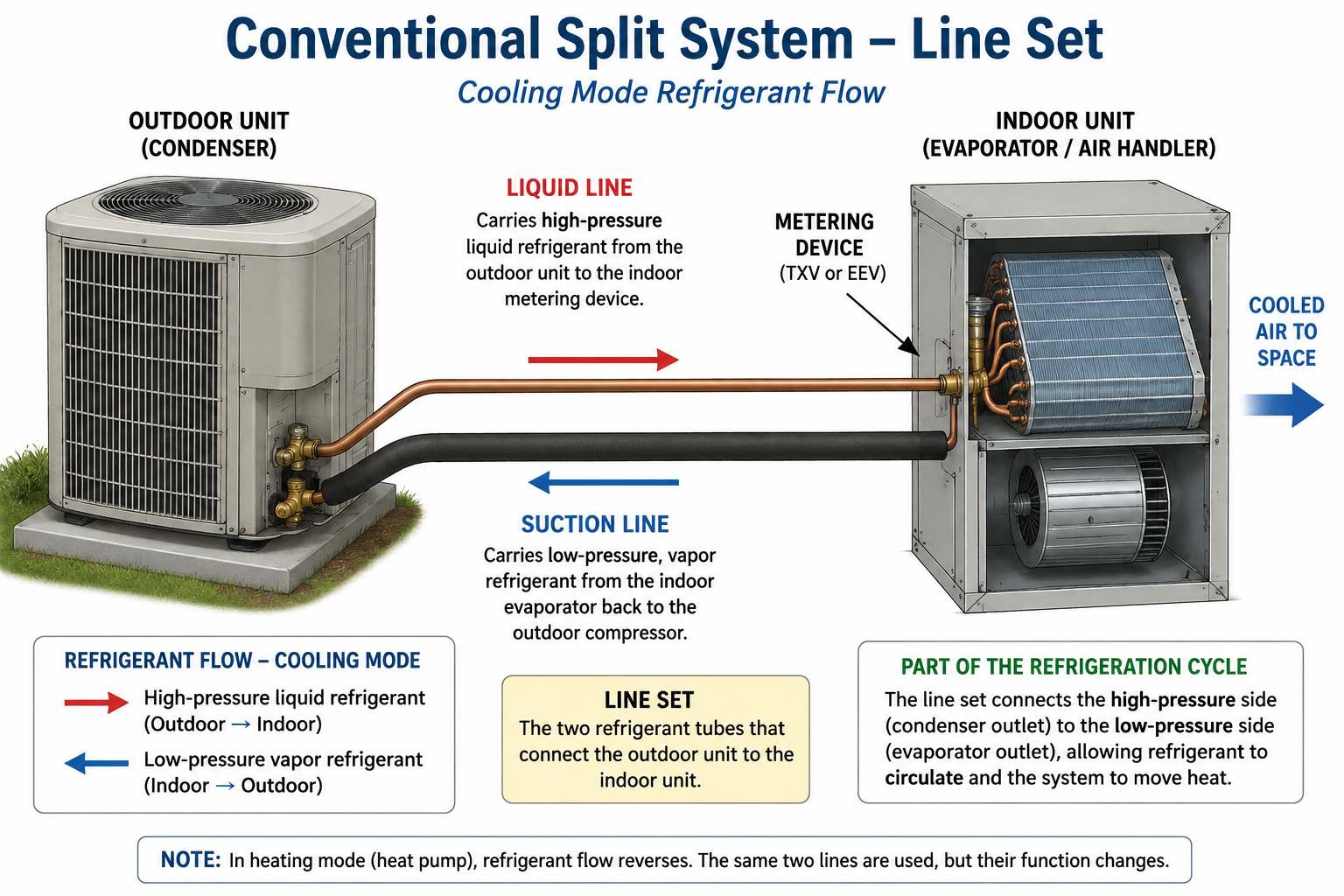
A conventional split air-conditioning system places major refrigeration components in two different locations. The compressor and condenser are normally located outdoors, while the evaporator is located indoors. Refrigerant tubing connects these components so refrigerant can circulate through the complete refrigeration cycle.
The refrigerant tubing that connects the indoor and outdoor portions of a split refrigeration or air-conditioning system.
In a conventional cooling-only split system, the line set normally contains two copper tubes: a smaller liquid line and a larger suction line.
Liquid refrigerant is much denser than refrigerant vapor. The liquid line can therefore carry the required refrigerant mass through a relatively small tube. Low-pressure suction vapor requires a larger tube to maintain acceptable refrigerant velocity and pressure drop.
High-Pressure Liquid Travels Toward the Metering Device
Liquid Line
During conventional cooling operation, the liquid line carries high-pressure liquid refrigerant from the outdoor condensing unit toward the indoor metering device.
The liquid line is located on the high-pressure side of the refrigeration system. Refrigerant leaving the condenser has rejected heat and condensed from vapor to liquid before entering this tubing.
In a conventional system where the metering device is located at the indoor evaporator, the refrigerant remains on the high-pressure side until it reaches that metering device.
The term liquid line in this lesson refers to the conventional arrangement where high-pressure liquid refrigerant travels from the outdoor unit to a metering device located at or near the indoor evaporator. Later lessons will examine ductless and other systems where this terminology does not always describe the actual refrigerant state in the smaller tube.
Low-Pressure Vapor Returns to the Compressor
Suction Line
During conventional cooling operation, the suction line carries low-pressure refrigerant vapor from the evaporator back to the compressor.
By the time refrigerant reaches the evaporator outlet, the remaining liquid refrigerant should have boiled. The suction line therefore returns vapor to the compressor.
The suction line should normally carry refrigerant vapor back to the compressor. Liquid refrigerant returning through the suction line can damage the compressor and indicates that system operation should be investigated.
A small amount of compressor oil circulates with the refrigerant. The suction line must be sized and routed so refrigerant velocity can help carry that oil back to the compressor. Oil return will be covered in detail in a later lesson.
Line Functions Can Change When Refrigerant Flow Reverses
A heat pump uses the same interconnecting refrigerant tubing, but a reversing valve changes refrigerant-flow direction when the system changes between cooling and heating modes.
Because of this, the simple terms liquid line and suction line do not always describe the refrigerant state in a particular tube during every heat-pump operating mode.
When servicing a heat pump, determine the operating mode and refrigerant-flow direction before assuming that a particular tube contains liquid or suction vapor.
Refrigeration Tubing Is Sized by Actual Outside Diameter
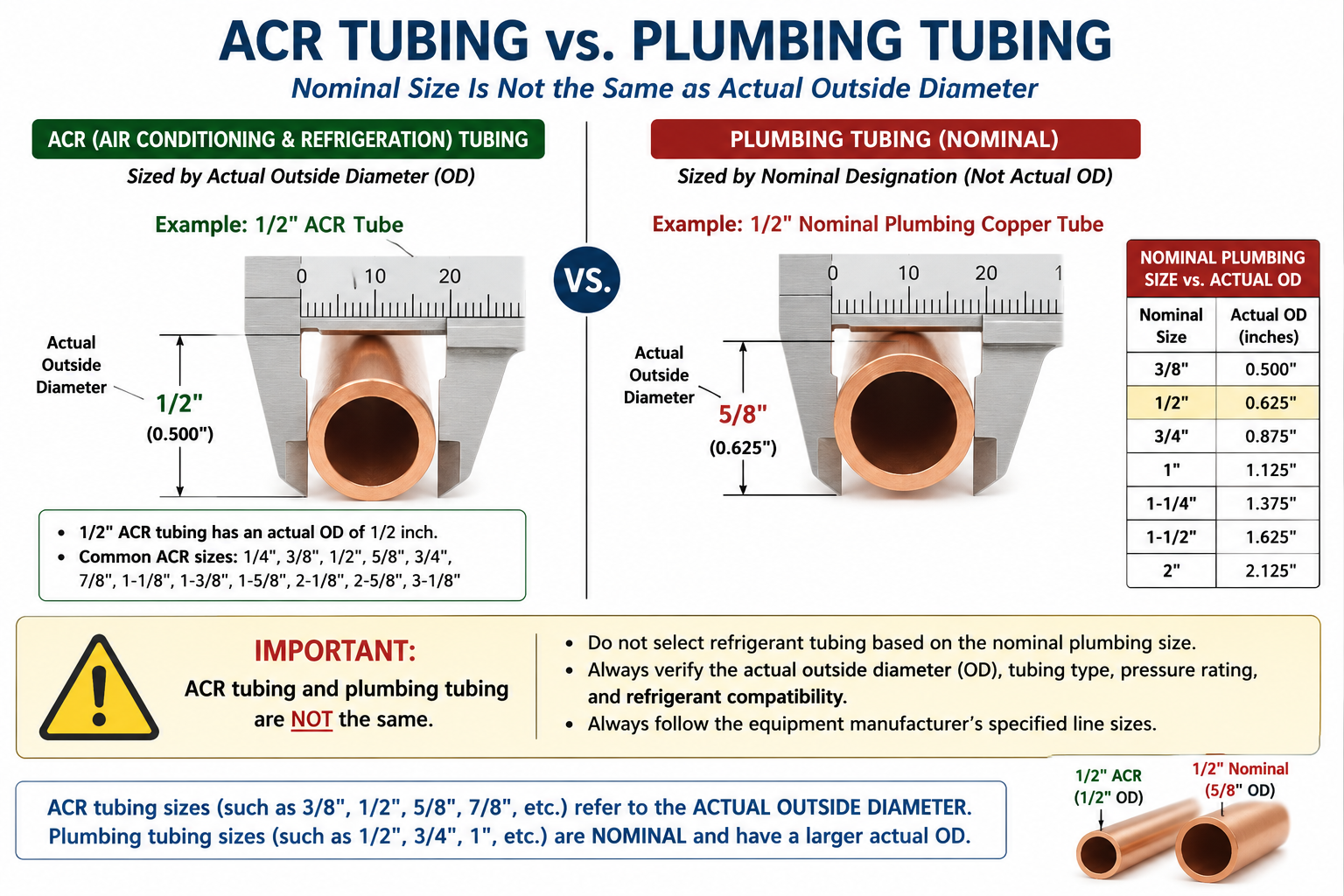
Air-conditioning and refrigeration tubing is commonly called ACR tubing. One of the most important sizing differences technicians must understand is that ACR tubing and plumbing copper tubing are described differently.
Actual Outside Diameter
A 1/2-inch ACR tube has an actual outside diameter of 1/2 inch.
Nominal Size
A nominal 1/2-inch plumbing copper tube has an actual outside diameter of 5/8 inch.
If equipment instructions specify a 1/2-inch refrigerant line, the technician must verify that the requirement refers to the actual ACR tubing outside diameter. Selecting nominal 1/2-inch plumbing copper would provide a different actual diameter.
Bigger Is Not Automatically Better
Refrigerant tubing diameter affects pressure drop and refrigerant velocity. Equipment manufacturers therefore specify acceptable line sizes for each system.
Line Too Small
Excessive restriction can create excessive pressure drop, reduce capacity, and increase the amount of work required from the compressor.
Line Too Large
Refrigerant velocity can become too low, particularly in suction risers or during reduced-capacity operation, making reliable oil return more difficult.
Correct Line Size
The manufacturer-selected size balances pressure drop, refrigerant velocity, capacity, and oil-return requirements.
A larger tube may reduce pressure drop, but it also reduces refrigerant velocity. Refrigerant piping should be sized from the equipment manufacturer’s requirements rather than from the assumption that larger tubing must be better.
The Units’ Straight-Line Distance Is Not the Tubing Length
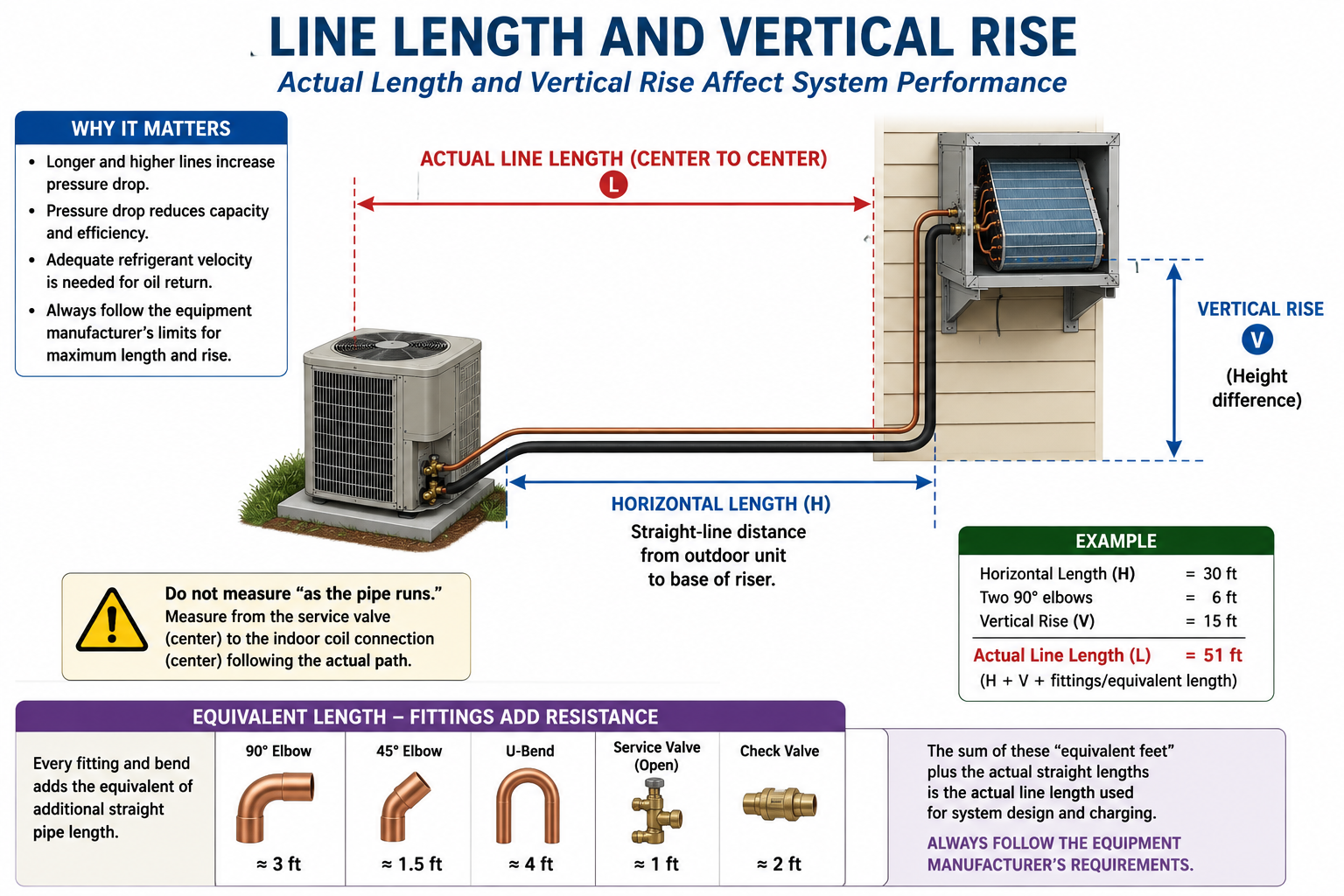
A technician may look at an outdoor unit and indoor unit and estimate that they are only a short distance apart. The refrigerant tubing, however, rarely travels in a perfectly straight line between them.
Horizontal Distance
The horizontal separation between the indoor and outdoor equipment is only one part of the installation.
Vertical Rise
The height difference between the indoor and outdoor equipment can affect pressure relationships and oil return.
Actual Tubing Length
The actual tubing path includes all horizontal and vertical portions of the refrigerant line.
Equivalent Length
Bends and fittings create additional resistance and may be treated as additional equivalent straight tubing when the manufacturer requires that calculation.
Every Fitting Adds Resistance
A straight piece of tubing creates pressure drop because refrigerant must overcome friction as it moves through the line. Bends and fittings add additional resistance.
A tight 90-degree fitting generally creates more resistance than a gradual sweeping bend. Later in this subsection we will examine why sweeping turns and minimizing unnecessary fittings improve refrigerant piping performance.
Equivalent-length values depend on tubing size, fitting design, and manufacturer piping procedures. Use the equipment manufacturer’s installation information when line-length calculations include fittings.
Indoor and Outdoor Units Are Not Always at the Same Height
Split-system components may be installed on different floors, on a roof, in an attic, below grade, or at other elevations. This creates vertical separation between the indoor and outdoor equipment.
Manufacturers commonly specify both a maximum total refrigerant-line length and a maximum allowable vertical separation. These limitations may differ depending on whether the compressor is above or below the evaporator.
Pressure Drop
Longer tubing and greater elevation changes affect refrigerant pressures throughout the line set.
Oil Return
Vertical suction risers require adequate refrigerant velocity to carry compressor oil upward.
System Capacity
Excessive piping length or pressure drop can reduce available system capacity and efficiency.
Manufacturer Limits
The equipment manufacturer’s allowable line length and elevation requirements determine whether an installation is acceptable.
The Equipment Determines the Correct Line Set
Refrigerant line-set requirements are equipment-specific. Two systems using the same refrigerant and having similar nominal capacity may still have different allowable tubing sizes, maximum lengths, vertical-rise limits, refrigerant-charge requirements, and oil-return provisions.
Required Tubing Sizes
Verify both liquid-line and suction-line outside diameter.
Maximum Line Length
Confirm the maximum tubing length allowed for the equipment combination.
Maximum Vertical Separation
Determine whether additional restrictions apply when the indoor and outdoor equipment are at different elevations.
Special Piping Requirements
Check requirements for oil return, line sizing changes, traps, accessories, and variable-capacity operation.
Do not select line-set size solely from refrigerant type, equipment tonnage, or an old rule of thumb. Use the installation instructions for the actual indoor and outdoor equipment combination.
Follow the Line Set Through a Conventional Cooling System
The condenser delivers high-pressure liquid refrigerant to the smaller liquid line.
The liquid line carries refrigerant toward the indoor metering device during conventional cooling operation.
The metering device reduces refrigerant pressure before the refrigerant enters the evaporator.
Refrigerant absorbs heat and the remaining liquid boils in the evaporator.
The larger suction line carries low-pressure refrigerant vapor back toward the compressor.
Correct tubing diameter, actual line length, vertical rise, and piping configuration allow the system to operate within its design limits.
Can You Explain the Refrigerant Line Set?
You should be able to answer these questions before continuing.
- What is a refrigerant line set?
- What are the two refrigerant lines in a conventional split air-conditioning system?
- What refrigerant state normally travels through the liquid line during cooling?
- In what direction does refrigerant travel through the liquid line during conventional cooling operation?
- What refrigerant state normally travels through the suction line?
- Why is the suction line normally larger than the liquid line?
- Why can heat-pump operation make the terms liquid line and suction line less precise?
- How is ACR tubing sized?
- What is the difference between 1/2-inch ACR tubing and nominal 1/2-inch plumbing copper?
- Why is a larger refrigerant line not automatically better?
- What is the difference between horizontal distance and actual refrigerant-line length?
- What is equivalent length?
- Why does vertical separation matter?
- Where should the technician obtain the required refrigerant-line sizes and maximum piping lengths?
What You Should Have Learned
A refrigerant line set connects the indoor and outdoor portions of a split air-conditioning or refrigeration system.
In conventional cooling operation, the smaller liquid line carries high-pressure liquid toward the indoor metering device, while the larger suction line returns low-pressure vapor to the compressor.
Heat pumps and some modern equipment can change refrigerant-flow direction or place the metering device in a different location, so technicians must understand refrigerant state rather than relying only on pipe names.
ACR tubing is identified by actual outside diameter, while plumbing copper tubing uses nominal sizes that do not directly represent actual outside diameter.
Incorrect refrigerant-line diameter can cause excessive pressure drop or inadequate refrigerant velocity and oil return.
Actual line length includes the tubing path, while bends and fittings can add equivalent length and additional resistance.
Vertical separation affects refrigerant piping performance and is limited by the equipment manufacturer’s requirements.
Refrigerant-line size, maximum length, vertical rise, and special piping requirements must be verified from the manufacturer’s installation information for the specific equipment.