Back to: NASCLA Master Electrical Contractor Exam Preparation
Exam-day performance depends on more than technical knowledge. A successful candidate must combine careful reading, efficient reference use, accurate calculations, good judgment, and disciplined time management across the full 100-question NASCLA Electrical Contractor examination.
The goal is not to rush. The goal is to move deliberately through the examination, protect time from unusually difficult questions, use approved references only when needed, and make the best supported decision on every question before the 270-minute examination period ends.
Bring the Entire Part I Strategy Together
The previous Part I lessons developed the individual skills needed for the examination: understanding the exam structure, recognizing the content domains, preparing the approved reference library, navigating those references efficiently, and reading examination questions carefully.
Exam-day strategy combines those skills into one repeatable process. Each question should be read completely, classified by subject, evaluated for whether a reference is needed, solved or verified, and then answered without allowing one difficult item to consume an unreasonable portion of the available time.
The examination currently allows 270 minutes for 100 scored questions, which produces an overall average of approximately 2.7 minutes per question. Some questions will require far less time and others will require more, so the candidate must manage the examination as a whole rather than treating every question identically.
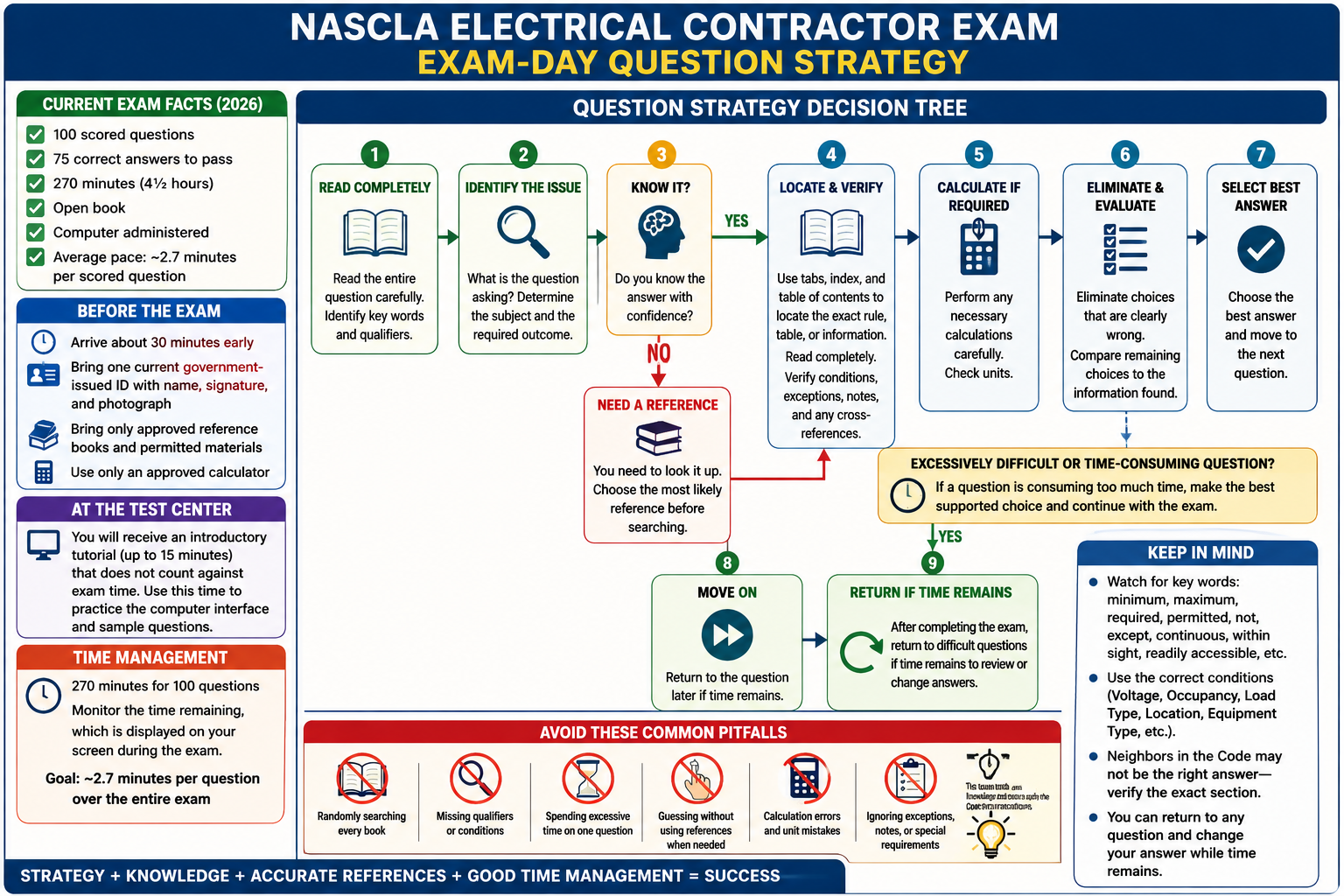
Know the Limits You Are Working Within
100 Scored Questions
The current NASCLA Electrical Contractor examination contains 100 scored questions distributed across the published examination domains.
75 Correct to Pass
A candidate currently needs at least 75 correct answers to achieve a passing score.
270 Minutes
The examination currently allows four hours and thirty minutes for the scored examination.
Open Book
Approved references may be used during the examination under the current testing rules.
Computer Administered
The examination is delivered on a computer, and candidates should follow the interface instructions provided by the testing administrator.
2.7-Minute Average Pace
Dividing 270 minutes by 100 scored questions produces an overall average of approximately 2.7 minutes per question.
2.7 Minutes Is an Average, Not a Stopwatch Limit
A familiar definition or direct NEC lookup may require less than one minute. A motor calculation, conductor-sizing problem, project-management lookup, or complex special-occupancy question may require considerably longer.
The objective is to answer straightforward questions efficiently so additional time remains available for the difficult ones.
Reduce Avoidable Problems Before the Clock Starts
Exam-day strategy begins before the candidate sits at the computer. Approved books, identification, calculators, and other permitted materials should already be organized and checked before arriving at the test center.
Verify Your Appointment
Confirm the scheduled examination location, date, reporting time, and any current testing-center instructions before travel.
Bring the Required Identification
Bring the current identification required by the examination administrator and make certain the information matches the registration record.
Inspect Your References
Verify that the books, editions, tabs, highlighting, indexing, and other preparation comply with the current Candidate Information Bulletin.
Bring Only Permitted Materials
Do not risk problems at check-in by bringing temporary tabs, loose notes, attached study sheets, unauthorized electronics, or other prohibited material.
Arrive With Time to Check In
Avoid creating unnecessary pressure by arriving at the test center at the last possible moment.
Use the Introductory Tutorial
PSI currently provides an introductory computer tutorial before the examination. The tutorial period does not count against the scored examination time.
Use this opportunity to become familiar with the screen layout, mouse and keyboard operation, answer-selection process, movement between questions, and other controls presented by the testing system.
Exam-day point: Do not rush through the tutorial simply because the electrical material is familiar. Understanding the interface prevents avoidable navigation errors after the scored examination begins.
Use One Repeatable Process
Read Completely
Read the entire question before beginning a lookup or calculation. Identify qualifiers such as voltage, occupancy, conductor type, equipment type, minimum, maximum, required, permitted, continuous, not, or except.
Identify the Issue
Determine what subject is being tested and exactly what result the question requests.
Decide Whether You Know the Answer
If the answer is known confidently and does not require verification of a specific Code value or reference requirement, answer it efficiently and continue.
Select a Reference When Needed
If verification is necessary, choose the most likely approved reference before beginning the search.
Locate and Verify
Use permanent tabs, the index, table of contents, Article structure, tables, or other permitted navigation methods to locate the exact requirement. Confirm conditions, exceptions, notes, and cross-references.
Calculate When Required
Perform any necessary arithmetic carefully, track units, and determine whether a Code rule must be applied after the calculation.
Evaluate the Choices
Eliminate choices that conflict with the verified requirement, use incorrect units, represent the wrong condition, or reflect an incomplete calculation.
Select the Best Answer
Choose the response that answers the specific question under the stated conditions and move forward.
Return Later When Necessary
If a difficult question is consuming excessive time, make the best supported selection and continue through the exam. Return to earlier questions later when permitted by the testing interface and when sufficient examination time remains.
Do I Know It, or Do I Need a Reference?
This simple decision can save substantial examination time.
If you confidently know a fundamental electrical-theory answer, do not automatically perform a lengthy book search merely because the examination is open book.
If the question asks for a specific Code dimension, conductor requirement, safety boundary, project-management concept, or other exact requirement, verify it in the appropriate approved reference.
Protect the Questions You Can Answer Efficiently
Early in the examination, the candidate should avoid allowing one difficult problem to delay access to many questions that may be answered more efficiently.
A reasonable first-pass objective is to move steadily through the examination while answering questions that can be resolved with confident knowledge, focused lookups, or manageable calculations.
Known Answer
Answer carefully and continue.
Quick Lookup
Verify the requirement efficiently and continue.
Manageable Calculation
Complete the calculation carefully while monitoring the overall pace.
Excessively Difficult Item
Make the best supported selection and continue rather than sacrificing several other potential points.
One Difficult Question Is Still One Question
A difficult question may feel more important because it has already consumed several minutes, but it is still worth one examination item.
Continuing to invest time simply because time has already been spent can create a second problem: several easier questions may remain unseen at the end of the examination.
Time-management principle: Protect the opportunity to reach every question before spending excessive time trying to make one answer completely certain.
Use Remaining Time Strategically
The current PSI testing information allows candidates to return to earlier questions and change their responses while examination time remains.
After reaching the end of the examination, use remaining time first on questions where additional reference work, calculation review, or careful rereading has a realistic chance of changing the answer.
Uncertain Code Lookup
Return when you believe you know the correct reference but did not have enough time to verify the exact condition earlier.
Complex Calculation
Recheck arithmetic, multipliers, units, conductor sizes, standard ratings, and the final quantity requested.
Negative Question
Re-read questions containing NOT, EXCEPT, INCORRECT, or similar wording to confirm that the selected choice matches the negative condition.
Close Answer Choices
When two choices remain plausible, use the additional time to verify the applicable requirement or calculation rather than guessing based on familiarity.
Do Not Change an Answer Without a Reason
Returning to a question does not mean the original answer was wrong. Change a response when additional evidence supports the change: a verified Code requirement, corrected calculation, overlooked qualifier, wrong table column, or another identifiable error.
A vague feeling that another answer “looks better” is less reliable than the technical reasoning used to make the original selection.
Do Not Search Every Book
The approved reference library is large enough that random searching can quickly consume examination time. Reference selection should follow the subject being tested.
NEC
Installation requirements, wiring, protection, grounding, bonding, equipment, special systems, and communication systems.
OSHA
Construction or general-industry workplace-safety requirements.
NFPA 70E
Electrical safety-related work practices, shock hazards, arc-flash hazards, and electrically safe work conditions.
Theory / Field References
Electrical formulas, conversions, circuit relationships, transformer theory, and other calculation support.
Project References
Estimating, scheduling, project management, documentation, contracts, and contractor responsibilities.
Energy Reference
Building energy requirements and electrical controls governed by the applicable energy standard.
Do Not Let the Calculator Decide What the Problem Is
Calculation questions should follow the same exam-day sequence as reference questions: identify what is being asked, identify the given information, select the correct formula or procedure, perform the calculation, verify the units, and then apply any final Code requirement.
Requested Quantity
Identify whether the final answer must be amperes, watts, conductor size, voltage drop, overcurrent rating, box volume, raceway size, or another quantity.
Required Inputs
Extract only the voltage, load, length, conductor material, phase, efficiency, power factor, or other values needed for the problem.
Correct Formula or Code Method
Determine whether the problem uses Ohm’s law, power equations, a three-phase formula, transformer ratio, a demand factor, Code percentage, or another procedure.
Check Units
Confirm volts, amperes, watts, kilowatts, feet, inches, percentages, and any required conversions.
Apply Final Selection Rules
A calculated value may still require selection of a standard conductor, fuse, breaker, raceway, box, or other component under the applicable Code rules.
Avoid the Errors That Cost Both Time and Points
Random Reference Searching
Searching several books before identifying the subject consumes time and increases the chance of finding unrelated information.
Missing Qualifiers
Voltage, occupancy, load type, equipment type, condition number, location, and other qualifiers can change the applicable answer.
Excessive Time on One Question
One unresolved item should not prevent the candidate from reaching several other questions.
Guessing Without References
If the question tests a specific requirement and time permits, verify it in the appropriate approved reference rather than relying on an uncertain memory.
Calculation Errors
Incorrect formulas, missed factors, wrong units, and arithmetic mistakes can turn a correct method into the wrong choice.
Ignoring Exceptions
Nearby Code language may appear correct until an exception or special condition changes the general rule.
Use the Remaining-Time Display as a Diagnostic Tool
PSI displays the remaining examination time on the computer screen. Periodically compare your question progress with the amount of time remaining.
About 25 Questions
An even overall pace corresponds to approximately 67 to 68 minutes of elapsed examination time.
About 50 Questions
An even overall pace reaches the halfway point near 135 minutes.
About 75 Questions
An even overall pace reaches approximately three quarters of the test near 202 to 203 minutes.
100 Questions
The preferred outcome is to reach every question with enough remaining time to revisit selected difficult items.
These are pacing references rather than mandatory checkpoints. Different portions of the examination will naturally require different amounts of time.
Protect the Points You Can Earn
The current passing requirement is 75 correct answers. That does not mean candidates should intentionally leave 25 questions unresolved, but it does reinforce an important strategy: secure as many straightforward and moderate-difficulty points as possible before allowing unusually difficult questions to consume substantial time.
You do not need a perfect examination. You need enough correct answers across the entire test.
Use Remaining Time Deliberately
Confirm Every Question Has a Selection
If the testing interface permits review of unanswered items, use the available tools and remaining time to make certain no question has been unintentionally left without a response.
Return to High-Value Uncertainty
Prioritize questions where another lookup or calculation check has a realistic chance of changing the answer.
Recheck Complex Calculations
Verify units, arithmetic, factors, table values, and final selection requirements.
Recheck Negative Questions
Review items containing NOT, EXCEPT, INCORRECT, or other wording that can easily be misread.
Do Not Create New Doubt Without Evidence
Do not change correctly reasoned answers merely because there is time remaining. Use technical evidence to justify a change.
Check Your Understanding
Average Pace
The current examination allows 270 minutes for 100 scored questions. What is the approximate overall average time available per question?
A. 1.7 minutes
B. 2.0 minutes
C. 2.7 minutes
D. 4.5 minutes
Difficult Question Strategy
Early in the examination, a candidate has spent a substantial amount of time on one difficult question without reaching a confident answer. What is generally the best strategy?
A. Continue indefinitely because every question must be solved with certainty.
B. Make the best supported selection, continue through the examination, and return later if time remains.
C. Skip all remaining calculation questions.
D. Restart the examination from Question 1.
Reference Selection
A question asks about the minimum working-space depth in front of electrical equipment. What is the most efficient first step?
A. Search every approved reference.
B. Identify it as an NEC installation requirement and navigate toward the applicable working-space provision.
C. Begin with the project-management reference.
D. Use an electrical-theory formula.
Changing an Answer
During final review, when is changing an earlier response most justified?
A. Whenever another answer looks different.
B. When a verified Code requirement, corrected calculation, or overlooked qualifier shows that the earlier answer was wrong.
C. Every time the candidate returns to a question.
D. Whenever the first answer was selected quickly.
Passing Strategy
What is the most useful interpretation of the current 75-correct passing requirement?
A. Intentionally ignore exactly 25 questions.
B. Only study enough to answer 75 predetermined questions.
C. Protect opportunities to earn points throughout the examination instead of allowing a small number of difficult questions to consume excessive time.
D. Stop the examination immediately after answering 75 questions.
Review the Reasoning
Question 1 — C
270 minutes divided by 100 questions equals approximately 2.7 minutes per question over the examination as a whole.
Question 2 — B
A difficult question is still one item. Moving forward protects the time needed to reach other questions and allows the candidate to return later when time remains.
Question 3 — B
Working space is an electrical installation requirement, so the NEC is the appropriate starting reference rather than searching every book.
Question 4 — B
An answer should be changed when new technical evidence shows the original response was incorrect, not simply because the candidate is reviewing the question again.
Question 5 — C
The passing score reinforces the importance of maximizing correct answers across the entire examination and avoiding inefficient use of time on a small number of unusually difficult items.
Verify the Candidate Information Bulletin Before Exam Day
The examination format and exam-day guidance in this lesson reflect current published NASCLA and PSI information available when this lesson was prepared. The current NASCLA Electrical Contractor examination contains 100 scored questions, requires 75 correct answers to pass, allows 270 minutes, is open book, and is administered by computer.
Testing-center procedures, permitted materials, approved references, identification requirements, calculator rules, computer-interface features, and administrative requirements can change. Review the current Candidate Information Bulletin before reporting to the examination center.
What You Should Take From This Lesson
Use a Consistent Process
Read, identify, decide whether a reference is needed, locate and verify, calculate if necessary, evaluate the choices, and answer.
Manage the Entire 270 Minutes
The overall average is approximately 2.7 minutes per question, but individual questions will naturally require different amounts of time.
Do Not Search Every Book
Identify the subject first and choose the reference most likely to contain the applicable information.
Protect Time From Difficult Questions
Make the best supported selection and move forward when one question begins consuming an unreasonable amount of examination time.
Return When Time Remains
Use remaining examination time to revisit uncertain Code lookups, difficult calculations, negative questions, and other items where additional work may improve the answer.
Change Answers for a Reason
A verified rule, corrected calculation, or overlooked condition justifies a change more than simple second-guessing.
Exam Strategy Supports Technical Knowledge
Strong electrical knowledge is essential, but good time management and reference discipline help ensure that knowledge can be applied across the entire examination.
Leave a Reply
You must be logged in to post a comment.