Back to: NASCLA Master Electrical Contractor Exam Preparation
Electrical Quantities and Ohm’s Law
Electrical calculations begin with a small group of fundamental quantities: voltage, current, resistance, and power. Understanding how these quantities relate allows an electrician to analyze circuits, determine unknown values, evaluate loads, troubleshoot electrical problems, and prepare for more advanced calculations involving transformers, motors, conductors, and voltage drop.
Ohm’s Law provides the basic mathematical relationship between voltage, current, and resistance. For NASCLA examination preparation, the important skill is not simply memorizing a formula. You must recognize which quantity is unknown, select the correct form of the relationship, keep the units consistent, and determine whether the resulting answer makes electrical sense.
Begin the Technical Portion of the Course
Part I concentrated on preparing for the NASCLA Electrical Contractor examination and efficiently navigating an open-book test. Part II begins the technical electrical-theory and calculation material that supports many of the examination’s calculation-based questions.
The NASCLA Electrical Contractors job analysis specifically includes knowledge of electrical units, Ohm’s Law, basic Ohm’s Law formulas, and skills involving calculations for resistance, current, voltage, power, and voltage drop. These relationships therefore form an important foundation for the electrical-theory portion of the examination.
In this lesson, you will review voltage, current, resistance, and power; learn the three basic forms of Ohm’s Law; use the Ohm’s Law and power formula wheel; and work through calculation examples similar to the reasoning needed for later NASCLA topics.
The Four Electrical Quantities You Must Recognize
Voltage — V
Voltage is electrical potential difference. It represents the electrical potential available to move charge through a circuit and is measured in volts, symbol V.
Current — I
Current is the rate of electric charge flow through a circuit. Current is measured in amperes, symbol A, and the variable commonly used in electrical formulas is I.
Resistance — R
Resistance describes opposition to current flow. Electrical resistance is measured in ohms, symbol Ω, and is represented by the variable R.
Power — P
Electrical power is the rate at which electrical energy is transferred or converted. Power is measured in watts, symbol W, and is represented by the variable P.
Keep the Quantity, Variable, and Unit Separate
Calculation errors frequently occur because the electrical quantity, its formula variable, and its measurement unit are treated as though they are the same thing. Keep them distinct when reading and solving a problem.
Voltage
Quantity: Voltage or potential difference
Formula variable: V
Unit: volt
Unit symbol: V
Current
Quantity: Electric current
Formula variable: I
Unit: ampere
Unit symbol: A
Resistance
Quantity: Electrical resistance
Formula variable: R
Unit: ohm
Unit symbol: Ω
Power
Quantity: Electrical power
Formula variable: P
Unit: watt
Unit symbol: W
Exam habit: Write the unit beside every important value while working a calculation. Tracking V, A, Ω, W, kW, and other units helps reveal incorrect formulas and conversion mistakes before you select an answer.
Voltage, Current, and Resistance Are Mathematically Related
For an ohmic circuit element operating under conditions where resistance can be treated as constant, Ohm’s Law relates voltage, current, and resistance through the equation V = I × R.
The same relationship can be rearranged depending on which quantity is unknown.
Solve for Voltage
V = I × R
Multiply current in amperes by resistance in ohms to determine voltage in volts.
Solve for Current
I = V ÷ R
Divide voltage in volts by resistance in ohms to determine current in amperes.
Solve for Resistance
R = V ÷ I
Divide voltage in volts by current in amperes to determine resistance in ohms.
See the Relationship in a Simple DC Circuit
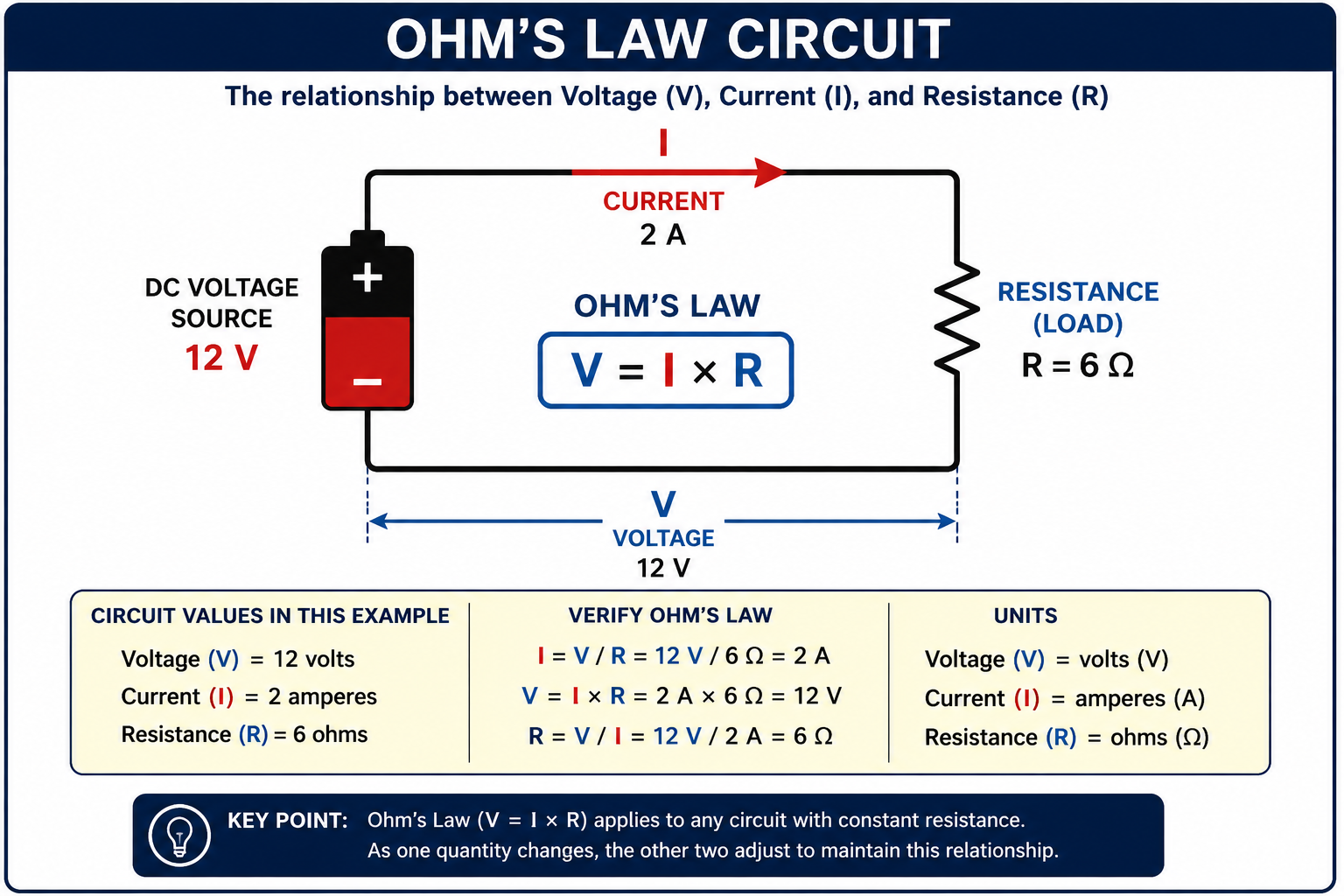
Consider a simple circuit containing a 12-volt DC source and a 6-ohm resistive load. Ohm’s Law determines that the circuit current is 2 amperes.
Determine Circuit Current
Given: Voltage = 12 V and resistance = 6 Ω
Unknown: Current
Formula: I = V ÷ R
Calculation: I = 12 V ÷ 6 Ω = 2 A
Answer: The circuit current is 2 amperes.
Ohm’s Law Is Not a Statement That Every Electrical Load Has Constant Resistance
Ohm’s Law is extremely useful, but real electrical equipment can contain resistance, inductance, capacitance, semiconductor components, temperature-dependent elements, and other characteristics that make circuit behavior more complex than a single constant-resistance calculation.
The simple V = I × R relationship should therefore be applied to the appropriate circuit condition rather than assumed to completely describe every electrical load under every operating condition.
Know What Happens When One Quantity Changes
Understanding the direction of the relationship helps you detect unreasonable calculator results and answer conceptual examination questions.
Voltage Increases, Resistance Constant
If resistance remains constant and applied voltage increases, current increases proportionally.
Voltage Decreases, Resistance Constant
If resistance remains constant and applied voltage decreases, current decreases proportionally.
Resistance Increases, Voltage Constant
If applied voltage remains constant and resistance increases, current decreases.
Resistance Decreases, Voltage Constant
If applied voltage remains constant and resistance decreases, current increases.
Start With the Unknown Quantity
The fastest way to select the correct form of Ohm’s Law is to identify what the question asks you to determine.
Identify the Requested Quantity
Determine whether the question asks for voltage, current, resistance, power, energy, or another quantity.
List the Known Values
Write down the values given in the question and include their units.
Select a Formula Containing the Unknown
Choose a relationship that contains the quantity being solved for and values that are already known.
Convert Units When Necessary
Convert milliamperes to amperes, kilowatts to watts, kilohms to ohms, or other prefixed units before substitution when the selected equation requires consistent units.
Substitute and Calculate
Insert the known values, perform the arithmetic, and retain the correct unit with the calculated result.
Check Whether the Result Makes Sense
Use the physical relationship among voltage, current, and resistance to determine whether the direction and approximate magnitude of the answer are reasonable.
Calculate Voltage
A resistive load draws 5 amperes and has a resistance of 24 ohms. Determine the voltage across the load.
Identify the Unknown
The requested quantity is voltage.
Identify the Known Values
Current is 5 A and resistance is 24 Ω.
Select the Formula
V = I × R
Calculate
V = 5 A × 24 Ω = 120 V
Answer: The voltage across the load is 120 volts.
Calculate Resistance
A resistive load is connected to 240 volts and draws 20 amperes. Determine its resistance.
Identify the Unknown
The requested quantity is resistance.
Select the Formula
R = V ÷ I
Substitute
R = 240 V ÷ 20 A
Calculate
R = 12 Ω
Answer: The resistance is 12 ohms.
Recognize Common Electrical Multipliers
Electrical questions often present quantities using prefixes rather than base units. Convert carefully before entering values into a formula.
Milli — m
Milli represents 10−3, or one thousandth. For example, 500 mA = 0.500 A.
Kilo — k
Kilo represents 103, or one thousand. For example, 2 kΩ = 2,000 Ω and 5 kW = 5,000 W.
Mega — M
Mega represents 106, or one million. For example, 2 MΩ = 2,000,000 Ω.
Micro — µ
Micro represents 10−6, or one millionth. The prefix appears frequently with quantities such as capacitance and electronic measurements.
Convert Before You Calculate
A formula may be correct while the answer is wrong because one value was entered in milliamperes and another was treated as amperes, or because kilowatts were entered as though they were watts.
When prefixes are present, convert them deliberately and write the converted value before performing the main calculation.
Milliamperes Versus Amperes
A 120-volt circuit has a current of 250 milliamperes. Determine the equivalent current in amperes before performing any further electrical calculations.
1 ampere = 1,000 milliamperes
I = 250 mA ÷ 1,000 = 0.250 A
The correct base-unit value is therefore 0.250 A.
Add Electrical Power to the Calculation Toolkit
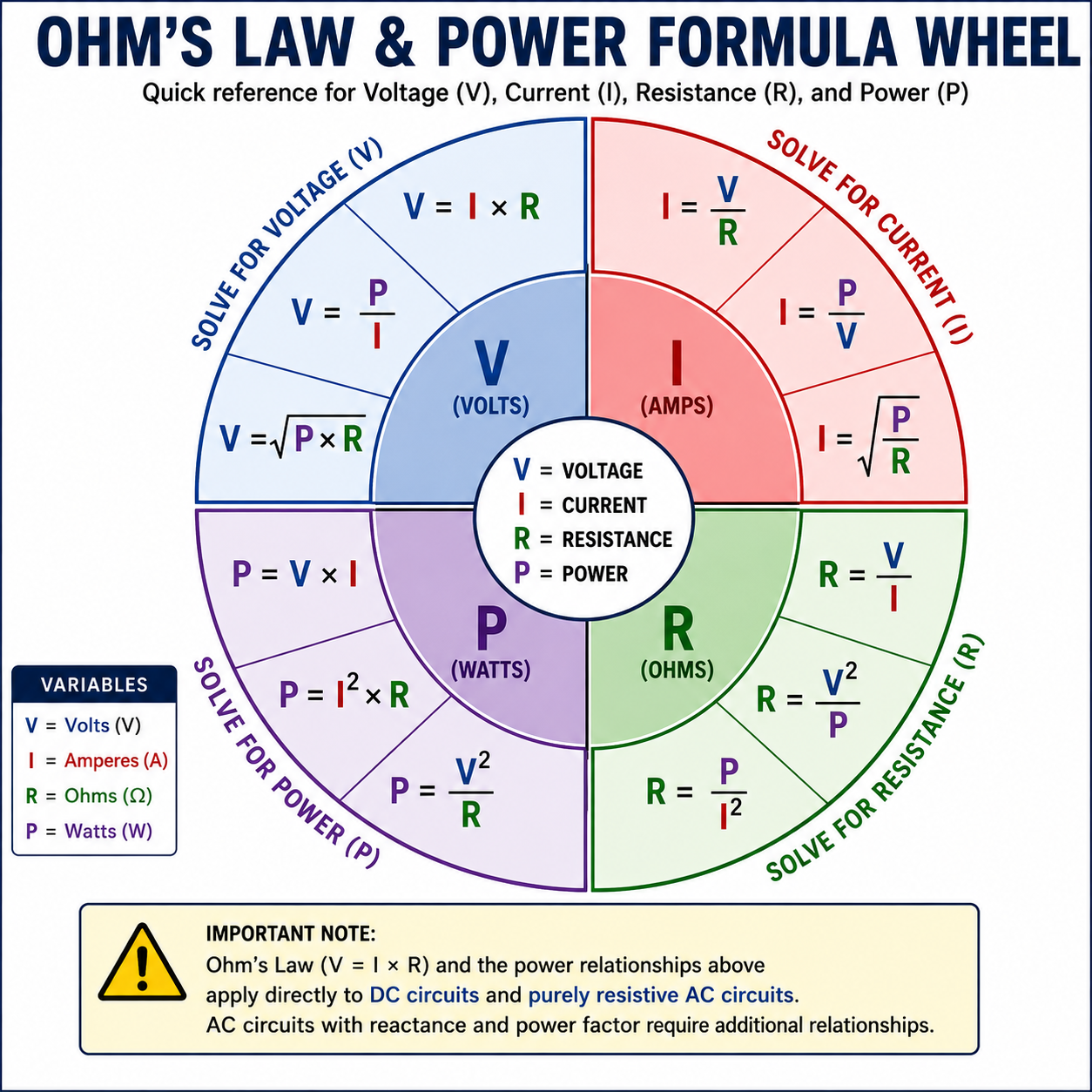
Electrical power introduces a fourth important quantity. For appropriate DC or purely resistive AC calculations, power can be determined from voltage and current using P = V × I.
Combining the electrical power relationship with Ohm’s Law produces additional useful equations involving power, voltage, current, and resistance.
Know the Relationships Behind the Formula Wheel
Power From Voltage and Current
P = V × I
Power From Current and Resistance
P = I2 × R
Power From Voltage and Resistance
P = V2 ÷ R
Current From Power and Voltage
I = P ÷ V
Resistance From Voltage and Power
R = V2 ÷ P
Resistance From Power and Current
R = P ÷ I2
Do Not Apply Resistive Power Formulas Blindly to Reactive AC Loads
The formula wheel is directly useful for DC circuits and purely resistive AC circuits. Alternating-current systems containing inductance or capacitance introduce additional relationships involving impedance, phase angle, reactive power, apparent power, and power factor.
Those concepts will be introduced later in Part II. When solving an examination question, use the formula appropriate to the electrical conditions stated in the problem rather than assuming every AC load behaves like a pure resistance.
Determine Power From Voltage and Current
A purely resistive 120-volt load draws 10 amperes. Determine the electrical power.
Identify the Unknown
The requested quantity is power.
Select the Formula
P = V × I
Substitute
P = 120 V × 10 A
Calculate
P = 1,200 W
Answer: The load consumes 1,200 watts, which is equal to 1.2 kilowatts.
Use the Wheel as a Reference, Not as a Substitute for Understanding
A formula wheel can reduce memorization, but it is most useful when you understand why the relationships work. If you know the fundamental equations V = I × R and P = V × I, the remaining resistive formulas can be developed algebraically when necessary.
Know the Variables
Recognize immediately that V represents voltage, I represents current, R represents resistance, and P represents power.
Find the Unknown
Locate the section of the formula wheel corresponding to the quantity the question asks you to calculate.
Choose Known Inputs
Select the equation that uses the values supplied in the question rather than creating unnecessary intermediate calculations.
Check Units
Confirm that the inputs and final result use appropriate units before selecting an examination answer.
Use Electrical Relationships to Check Calculator Results
The calculator performs arithmetic but does not know whether the formula or entered values are correct. A quick reasonableness check can identify many mistakes.
Higher Voltage
With resistance unchanged, higher voltage should produce higher current.
Higher Resistance
With voltage unchanged, higher resistance should produce lower current.
Higher Current
For a fixed resistance, increasing current requires an increased voltage and produces substantially greater resistive power because the I2R relationship contains current squared.
Wrong Order of Magnitude
An answer that differs by a factor of 1,000 often indicates a missed milli-, kilo-, or other unit-prefix conversion.
Avoid Mistakes Before They Become Exam Answers
Using the Wrong Formula
Do not begin calculations until you have identified the unknown quantity and the known values.
Dropping the Units
Numbers without units make it easier to confuse amperes, volts, watts, ohms, and prefixed quantities.
Missing a Prefix
Entering 500 mA as 500 A changes the value by a factor of 1,000.
Reversing Division
For current, divide voltage by resistance. For resistance, divide voltage by current.
Squaring the Wrong Quantity
In P = I2R, current is squared. In P = V2/R, voltage is squared.
Ignoring Circuit Conditions
Do not use a purely resistive relationship when the question supplies additional AC quantities such as power factor or impedance that require a different calculation method.
Write the Formula Before Entering Numbers
When a calculation question appears, resist the urge to immediately enter every number into the calculator. First identify the requested quantity, write the applicable relationship, convert the units, and then substitute the values.
This short process reduces calculator-entry errors and helps distinguish useful information from distractors included in the question.
Check Your Understanding
Determine Current
A 120-volt source is connected across a 30-ohm resistive load. What current flows through the load?
A. 0.25 A
B. 4 A
C. 30 A
D. 3,600 A
Determine Resistance
A resistive load connected to 240 volts draws 8 amperes. What is the resistance of the load?
A. 8 Ω
B. 30 Ω
C. 120 Ω
D. 1,920 Ω
Determine Voltage
A current of 3 amperes flows through a 40-ohm resistor. What voltage is applied across the resistor?
A. 13.3 V
B. 37 V
C. 120 V
D. 240 V
Determine Power
A purely resistive 240-volt load draws 15 amperes. What is the electrical power?
A. 16 W
B. 255 W
C. 3,600 W
D. 57,600 W
Convert Current
A circuit current is listed as 750 milliamperes. What is the equivalent value in amperes?
A. 0.075 A
B. 0.75 A
C. 7.5 A
D. 750 A
Relationship Between Resistance and Current
If the voltage applied to a resistive circuit remains constant and the resistance doubles, what happens to the current?
A. It doubles.
B. It remains unchanged.
C. It decreases to one-half of its original value.
D. It increases by four times.
Review the Reasoning
Question 1 — B
Use I = V ÷ R. Therefore, I = 120 V ÷ 30 Ω = 4 A.
Question 2 — B
Use R = V ÷ I. Therefore, R = 240 V ÷ 8 A = 30 Ω.
Question 3 — C
Use V = I × R. Therefore, V = 3 A × 40 Ω = 120 V.
Question 4 — C
For the stated purely resistive load, use P = V × I. Therefore, P = 240 V × 15 A = 3,600 W.
Question 5 — B
There are 1,000 milliamperes in one ampere. Therefore, 750 mA ÷ 1,000 = 0.75 A.
Question 6 — C
With voltage constant, I = V ÷ R. Doubling the resistance therefore reduces current to one-half of its previous value.
Understand the Formula Even When a Reference Is Available
The NASCLA Electrical Contractor examination is open book, but successful calculation work still depends on recognizing the required relationship quickly. Looking up every elementary equation consumes examination time that may be needed for Code searches and more complex problems.
Use your approved reference material when needed, but practice the basic voltage, current, resistance, and power relationships until the variables and units are immediately recognizable.
What You Should Take From This Lesson
Recognize the Four Core Quantities
Voltage is measured in volts, current in amperes, resistance in ohms, and power in watts.
Know the Basic Ohm’s Law Relationship
V = I × R, I = V ÷ R, and R = V ÷ I are equivalent forms of the same relationship.
Identify the Unknown First
Formula selection becomes much easier when you first determine exactly what quantity the question asks you to calculate.
Track Units Carefully
Convert milli-, kilo-, mega-, and other prefixed quantities before performing calculations when necessary.
Add Power Relationships
For appropriate DC and purely resistive AC calculations, P = V × I can be combined with Ohm’s Law to solve additional voltage, current, resistance, and power problems.
Check the Result
Use the relationships among voltage, current, and resistance to determine whether a calculated answer is electrically reasonable.
Recognize the Limits of the Simple Model
Reactive AC circuits introduce impedance, phase angle, and power factor relationships that require additional formulas beyond the basic resistive equations.
Leave a Reply
You must be logged in to post a comment.