Back to: NASCLA Master Electrical Contractor Exam Preparation
Electrical Power and Energy Calculations
Electrical power describes the rate at which electrical energy is transferred or converted, while electrical energy describes the total amount of work performed over time. These two quantities appear throughout electrical work in equipment ratings, branch-circuit loads, motors, heating equipment, lighting systems, utility consumption, and many other applications.
For NASCLA examination preparation, you must be able to recognize the difference between power and energy, select the correct electrical power relationship, convert watts and kilowatts correctly, calculate kilowatt-hours, and determine whether a calculated answer is reasonable for the equipment and operating time described in the question.
From Electrical Quantities to Electrical Work
Lesson 9 introduced voltage, current, resistance, Ohm’s Law, and the basic power relationship. This lesson expands those concepts by concentrating on electrical power and electrical energy.
Power tells us how rapidly electrical energy is being transferred or converted. Energy tells us how much electrical work occurs over a period of time. A 2-kilowatt heater is therefore described by its power rating, while operating that heater for three hours results in an energy use of 6 kilowatt-hours.
The ability to distinguish these quantities is important because watts and kilowatts are units of power, while watt-hours and kilowatt-hours are units of energy.
Power Is the Rate of Energy Transfer
Electrical power represents the rate at which electrical energy is supplied, transferred, converted, or dissipated. Power is represented by the variable P and is measured in watts.
Power
Variable: P
Unit: watt
Unit symbol: W
Kilowatt
One kilowatt equals 1,000 watts.
1 kW = 1,000 W
Megawatt
One megawatt equals 1,000 kilowatts, or 1,000,000 watts.
1 MW = 1,000 kW
Power Is a Rate
A power rating tells how rapidly energy is being used or delivered. It does not by itself tell how long the equipment operates.
Voltage and Current Determine Electrical Power
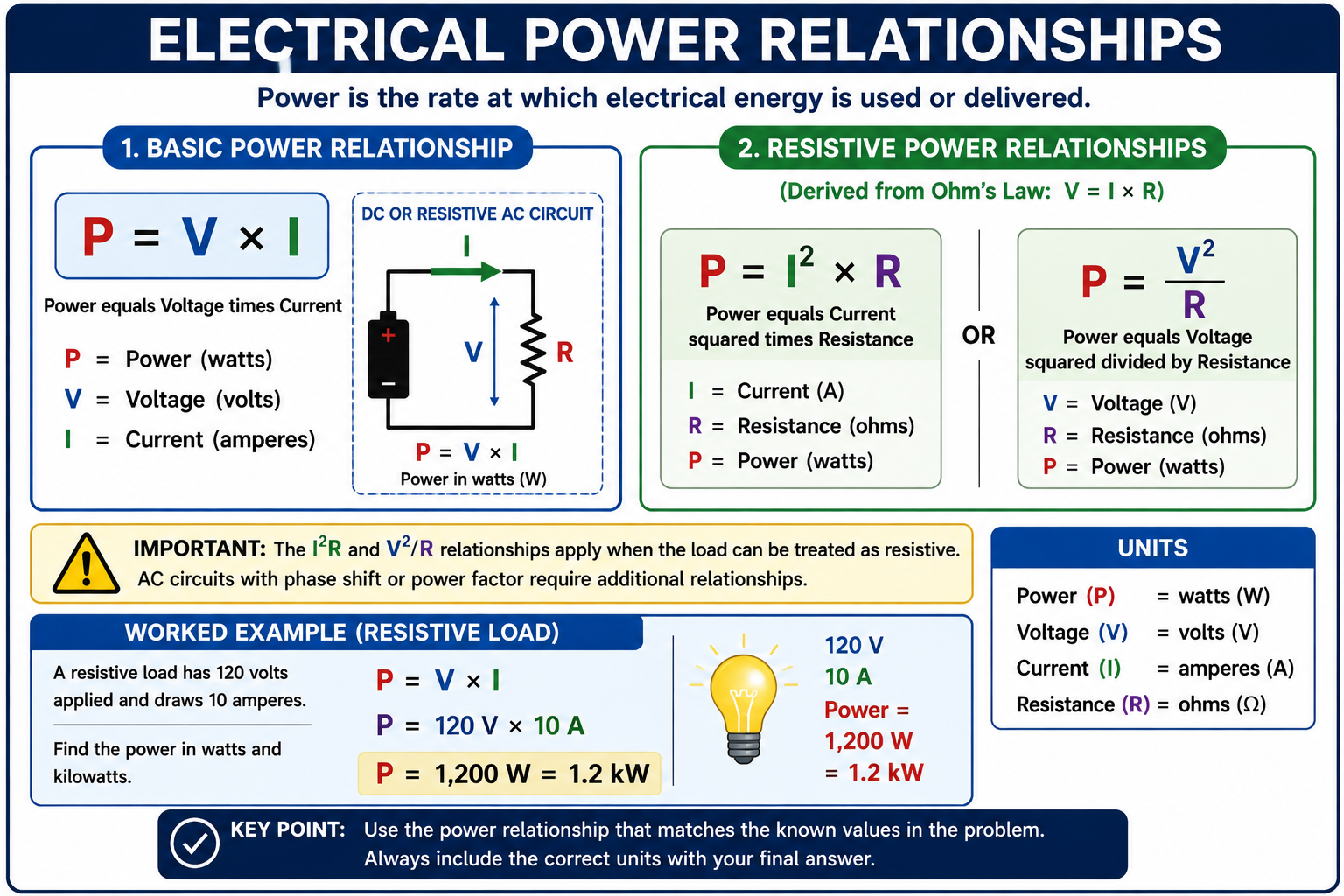
The basic electrical power relationship is P = V × I. When voltage and current are known under the appropriate circuit conditions, multiplying volts by amperes determines electrical power.
P = V × I
P = power
V = voltage
I = current
For a 120-volt resistive load drawing 10 amperes:
P = 120 V × 10 A
P = 1,200 W
P = 1.2 kW
Combine Power With Ohm’s Law
For a resistive element, the basic electrical power relationship can be combined with Ohm’s Law to produce two additional useful formulas.
Voltage and Current Known
P = V × I
Current and Resistance Known
P = I2 × R
Voltage and Resistance Known
P = V2 ÷ R
Use the Resistive Formulas Under the Correct Conditions
The expressions P = I2R and P = V2/R are obtained by combining the basic power equation with Ohm’s Law and therefore apply when the load can be treated as resistive.
Alternating-current loads containing significant inductance or capacitance can introduce phase angle, impedance, reactive power, apparent power, and power factor. Those relationships require additional calculations and should not be replaced automatically with purely resistive formulas.
Calculate Power From Voltage and Current
A purely resistive heating element operates at 240 volts and draws 20 amperes. Determine its electrical power.
Identify the Unknown
The requested quantity is power.
Select the Formula
P = V × I
Substitute
P = 240 V × 20 A
Calculate
P = 4,800 W
Convert to Kilowatts
4,800 W ÷ 1,000 = 4.8 kW
Answer: The heating element uses 4,800 watts, or 4.8 kilowatts.
Calculate Power From Current and Resistance
A resistive element has a resistance of 12 ohms and carries 5 amperes. Determine the power dissipated by the element.
Select the Formula
P = I2 × R
Square the Current
52 = 25
Multiply by Resistance
P = 25 × 12 Ω = 300 W
Answer: The resistive element dissipates 300 watts.
Calculate Power From Voltage and Resistance
A 120-volt source is connected across a 30-ohm resistive load. Determine the power dissipated by the load.
Select the Formula
P = V2 ÷ R
Square the Voltage
1202 = 14,400
Divide by Resistance
P = 14,400 ÷ 30 Ω = 480 W
Answer: The load dissipates 480 watts.
Power and Voltage Can Determine Current
If power and voltage are known for an appropriate circuit condition, rearrange the basic power equation to solve for current.
I = P ÷ V
A 2,400-watt resistive load operates at 240 volts.
I = 2,400 W ÷ 240 V
I = 10 A
This relationship becomes increasingly useful when later lessons address load current, branch circuits, feeders, equipment, and conductor calculations.
Do Not Confuse Kilowatts With Kilowatt-Hours
Power — kW
Power describes how rapidly electrical energy is being transferred or used.
Example: A heater rated 2 kW.
Energy — kWh
Energy describes the total electrical work over a period of time.
Example: A 2 kW heater operating for 3 hours uses 6 kWh.
Important distinction: A kilowatt is a unit of power. A kilowatt-hour is a unit of energy.
Energy Depends on Both Power and Time
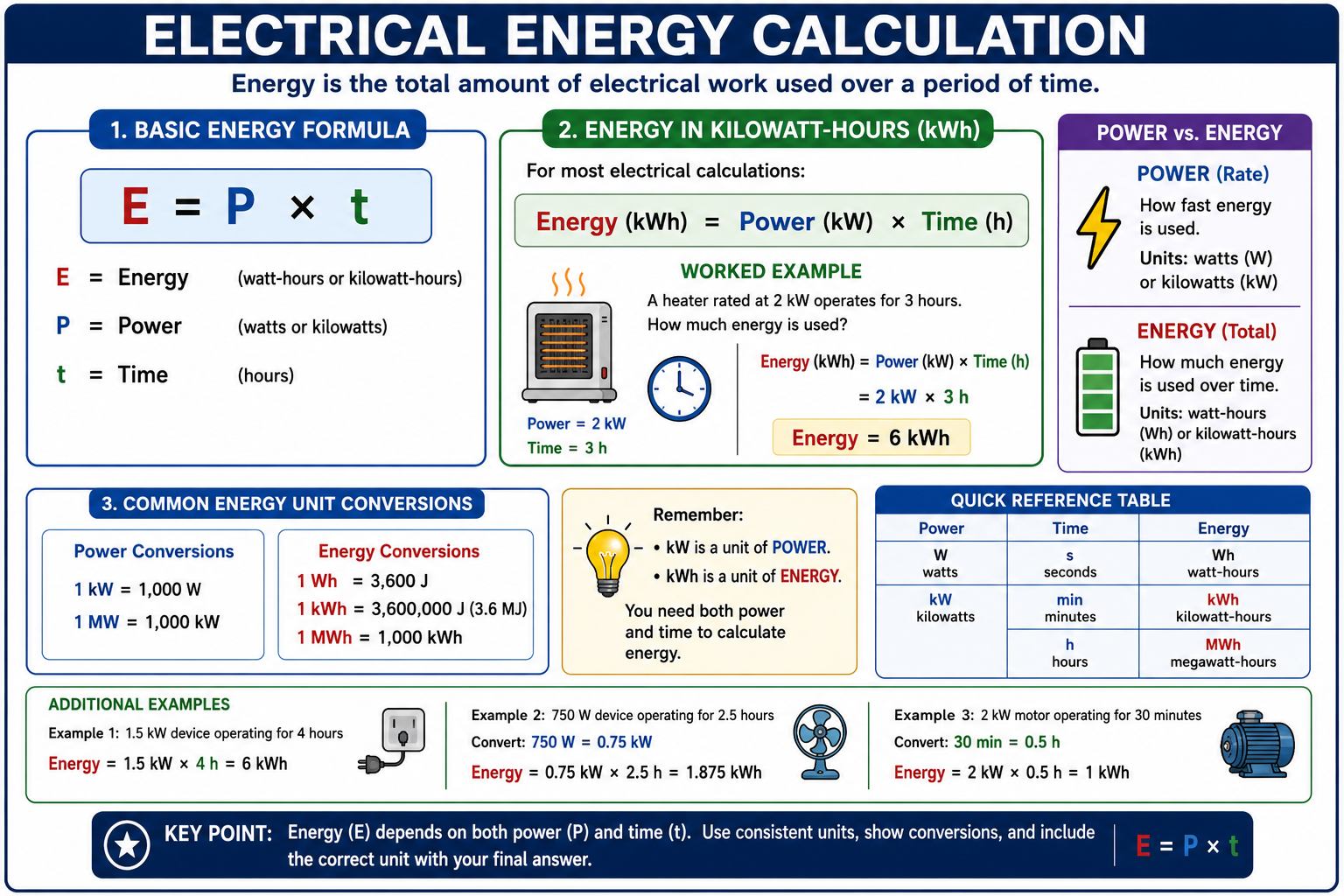
When power remains constant during the period being considered, electrical energy can be determined by multiplying power by time.
E = P × t
E = energy
P = power
t = time
If power is expressed in kilowatts and time is expressed in hours, the resulting energy is expressed in kilowatt-hours.
Energy (kWh) = Power (kW) × Time (h)
Follow the Power Through Time
Calculate Kilowatt-Hours
A 2-kilowatt heater operates continuously for 3 hours. Determine the energy consumed.
Identify Power
P = 2 kW
Identify Time
t = 3 h
Select the Formula
E = P × t
Calculate
E = 2 kW × 3 h = 6 kWh
Answer: The heater uses 6 kilowatt-hours of electrical energy.
Convert Minutes to Hours Before Calculating Kilowatt-Hours
When power is expressed in kilowatts and energy is required in kilowatt-hours, time must be expressed in hours.
A 2-kilowatt load operates for 30 minutes. Convert the operating time first.
30 minutes ÷ 60 = 0.5 hour
E = 2 kW × 0.5 h
E = 1 kWh
Exam habit: If the problem gives minutes but asks for kilowatt-hours, convert minutes to hours before multiplying.
Convert Watts to Kilowatts When Necessary
If a device rating is given in watts and the answer is required in kilowatt-hours, divide watts by 1,000 to convert the power to kilowatts.
A 750-watt device operates for 2.5 hours.
750 W ÷ 1,000 = 0.75 kW
E = 0.75 kW × 2.5 h
E = 1.875 kWh
Recognize Common Relationships
Watt-Hour
1 Wh = 3,600 J
Kilowatt-Hour
1 kWh = 3,600,000 J
Kilowatt-Hour in Megajoules
1 kWh = 3.6 MJ
Megawatt-Hour
1 MWh = 1,000 kWh
Look at the Unit Requested in the Answer
The requested unit often tells you what type of calculation the question expects. An answer in watts or kilowatts generally indicates power, while an answer in watt-hours or kilowatt-hours indicates energy.
Before entering numbers into a calculator, identify the quantity and unit required by the question.
Energy Consumption Can Be Converted Into Operating Cost
When an electricity rate is provided in dollars per kilowatt-hour, the cost of operating equipment can be estimated by multiplying energy consumption by the utility rate.
Cost = Energy (kWh) × Rate ($/kWh)
Assume an electrical load uses 20 kWh and electricity costs $0.15 per kilowatt-hour.
Cost = 20 kWh × $0.15/kWh
Cost = $3.00
When performing this type of calculation, the kilowatt-hour units cancel and the result is expressed in dollars.
The Same Power Can Produce Different Energy Consumption
Two identical loads can have the same power rating but consume different amounts of energy if they operate for different lengths of time.
2 kW for 1 Hour
2 kW × 1 h = 2 kWh
2 kW for 4 Hours
2 kW × 4 h = 8 kWh
2 kW for 10 Hours
2 kW × 10 h = 20 kWh
The power remains 2 kW in every example. Only the operating time changes, and therefore the total energy consumption changes.
Energy and Time Can Determine Average Power
The energy equation can also be rearranged when energy consumption and operating time are known.
P = E ÷ t
A constant load uses 12 kWh during a 4-hour operating period.
P = 12 kWh ÷ 4 h
P = 3 kW
Energy and Power Can Determine Operating Time
If energy use and constant power are known, rearrange the energy equation to determine operating time.
t = E ÷ P
A 2-kilowatt load consumes 10 kWh.
t = 10 kWh ÷ 2 kW
t = 5 h
Voltage Times Current Is Not Always the Same as Real AC Power
In a DC circuit, or in a purely resistive AC circuit where voltage and current are effectively in phase, the familiar voltage-current power relationship can be applied directly using the appropriate values.
Many AC loads such as motors, transformers, and other inductive equipment introduce a phase difference between voltage and current. Real power calculations for those circuits may require power factor in addition to voltage and current.
Power factor, apparent power, reactive power, and three-phase relationships will be addressed later in Part II. Do not assume that every AC load behaves as a pure resistance.
Use a Repeatable Method
Identify the Requested Quantity
Determine whether the problem asks for watts, kilowatts, amperes, kilowatt-hours, operating time, cost, or another quantity.
Identify the Known Values
Extract the voltage, current, resistance, power, time, rate, or other information actually needed for the calculation.
Select the Correct Formula
Choose the relationship that contains the requested quantity and the known values.
Convert Units
Convert watts to kilowatts, minutes to hours, or other units before performing the main calculation when necessary.
Calculate
Substitute the known values carefully and retain the units throughout the calculation.
Check the Result
Determine whether the magnitude and units of the result are reasonable for the equipment and operating conditions given.
Avoid Power and Energy Calculation Mistakes
Confusing kW and kWh
Kilowatts measure power. Kilowatt-hours measure energy.
Forgetting to Convert Watts
A value in watts must normally be divided by 1,000 before multiplying by hours to obtain kilowatt-hours directly.
Using Minutes as Hours
Thirty minutes is 0.5 hour, not 30 hours.
Using the Wrong Power Formula
Determine whether the problem provides voltage and current, current and resistance, or voltage and resistance before selecting a relationship.
Applying Resistive Formulas to Every Load
Real AC loads may require impedance and power-factor relationships rather than purely resistive formulas.
Ignoring the Requested Unit
A numerically correct answer can still be wrong if the question asks for kilowatts and the answer remains in watts, or asks for kilowatt-hours and the answer is given in kilowatts.
Let the Units Help You Choose the Formula
If an examination question asks for watts, look for a power relationship. If it asks for kilowatt-hours, you need both power and time. If it asks for amperes and gives watts and volts, rearrange the power equation to solve for current.
Reading the requested unit before calculating is one of the fastest ways to identify the intended calculation method.
Check Your Understanding
Electrical Power
A purely resistive 240-volt load draws 12 amperes. What is the electrical power?
A. 20 W
B. 252 W
C. 2,880 W
D. 28,800 W
Power From Resistance
A resistive load operates at 120 volts and has a resistance of 24 ohms. What power does it dissipate?
A. 5 W
B. 120 W
C. 600 W
D. 2,880 W
Energy Consumption
A 3-kilowatt resistive heater operates for 4 hours. How much electrical energy is used?
A. 0.75 kWh
B. 7 kWh
C. 12 kWh
D. 3,000 kWh
Time Conversion
A 1.5-kilowatt load operates for 30 minutes. How much energy does it use?
A. 0.5 kWh
B. 0.75 kWh
C. 1.5 kWh
D. 45 kWh
Current From Power
A 4,800-watt resistive load operates at 240 volts. What current does the load draw?
A. 5 A
B. 20 A
C. 240 A
D. 1,152 A
Power Versus Energy
Which quantity represents electrical energy rather than electrical power?
A. 2 kW
B. 15 W
C. 7.5 kWh
D. 600 MW
Review the Reasoning
Question 1 — C
Use P = V × I. Therefore, P = 240 V × 12 A = 2,880 W.
Question 2 — C
Use P = V2 ÷ R. Therefore, P = 1202 ÷ 24 = 14,400 ÷ 24 = 600 W.
Question 3 — C
Use E = P × t. Therefore, E = 3 kW × 4 h = 12 kWh.
Question 4 — B
Thirty minutes equals 0.5 hour. Therefore, E = 1.5 kW × 0.5 h = 0.75 kWh.
Question 5 — B
Rearrange the power equation as I = P ÷ V. Therefore, I = 4,800 W ÷ 240 V = 20 A.
Question 6 — C
A kilowatt-hour is a unit of energy. Watts, kilowatts, and megawatts are units of power.
Power and Energy Calculations Build Into Later Electrical Topics
The relationships developed in this lesson will appear repeatedly throughout electrical calculations. Load current, conductor sizing, transformer calculations, motors, voltage drop, energy consumption, and other topics frequently begin with the same fundamental relationships among voltage, current, resistance, power, and time.
Practice these calculations until identifying the unknown quantity, selecting a formula, converting units, and checking the result become a routine process.
What You Should Take From This Lesson
Power Is a Rate
Electrical power describes how rapidly energy is transferred or converted and is measured in watts or kilowatts.
Know the Basic Power Relationship
P = V × I relates electrical power to voltage and current.
Use Resistive Power Relationships Correctly
P = I2R and P = V2/R are useful when the load can be treated as resistive.
Energy Depends on Time
For constant power, E = P × t. Energy therefore increases when either power or operating time increases.
Know the Difference Between kW and kWh
Kilowatts measure power. Kilowatt-hours measure energy.
Convert Units Before Calculating
Convert watts to kilowatts and minutes to hours when required before calculating kilowatt-hours.
Watch for AC Power Factor
Do not assume every alternating-current load behaves as a pure resistance. Reactive AC loads can require additional power relationships.
Leave a Reply
You must be logged in to post a comment.