Back to: NASCLA Master Electrical Contractor Exam Preparation
Introduction to the NASCLA Electrical Contractor Exam
The NASCLA Accredited Trade Examination for Electrical Contractors is designed for candidates seeking contractor-level or master/unlimited electrician credentials in participating jurisdictions. The examination evaluates electrical theory, code knowledge, wiring methods, equipment, safety, project management, and the ability to apply those subjects to electrical work.
Preparing for this examination requires more than memorizing individual National Electrical Code requirements. A successful candidate must understand electrical concepts, recognize what a question is asking, know which approved reference contains the necessary information, locate that information efficiently, perform calculations accurately, and manage limited examination time.
Preparing for a Contractor-Level Electrical Examination
The NASCLA Electrical Contractor examination covers a broad range of electrical work. Candidates are expected to understand fundamental electrical principles while also being able to apply electrical codes, safety requirements, installation rules, equipment requirements, and project-management concepts.
The examination is open book, but that does not make it a simple reference lookup test. There is not enough time to begin every question by searching through several books without first understanding the subject. Effective preparation combines technical knowledge with fast and accurate reference navigation.
This first lesson introduces the examination, its purpose, its major content areas, and the study approach that will be used throughout this course.
What the NASCLA Electrical Examination Is Designed to Measure
The NASCLA Accredited Electrical Examination Program provides standardized trade examinations that participating licensing agencies may accept as part of their electrical licensing process. The Electrical Contractor examination applies to the contractor-level classification also described by NASCLA as Master Electricians or Unlimited Electricians.
NASCLA describes an Electrical Contractor within this examination program as one who conducts business involving the installation, maintenance, and repair of electrical work in accordance with applicable standards and codes.
Electrical Knowledge
Candidates must understand the electrical principles required to analyze circuits, loads, equipment, conductor requirements, and other electrical conditions.
Code Application
Candidates must be able to identify and apply requirements from the National Electrical Code and other approved references to specific installations.
Safe Electrical Work
The examination includes electrical and jobsite safety subjects that require familiarity with applicable safety standards and regulations.
Contractor Responsibilities
The examination extends beyond installation work to include project design, planning, management, estimating, coordination, and other contractor-level responsibilities.
The NASCLA Examination Is Not a National Electrical License
Passing the NASCLA examination does not by itself create a national electrical license. Individual state and local licensing agencies retain authority over their own licensing requirements.
A participating jurisdiction may accept a passing NASCLA examination result in place of its own trade examination, but the candidate may still need to satisfy additional requirements such as experience, applications, fees, business and law examinations, financial requirements, background requirements, or other state-specific conditions.
Candidate point: Before beginning the licensing process, verify that the jurisdiction where you intend to become licensed currently accepts the NASCLA Electrical Contractor examination for the license classification you need.
Know the Basic Examination Structure
The current NASCLA-accredited Electrical Contractor examination contains 100 questions. Candidates must answer at least 75 questions correctly to pass and are allowed 270 minutes to complete the examination.
100 Questions
The examination contains 100 scored multiple-choice questions distributed among the published examination content domains.
75 Correct to Pass
The current minimum passing score requires 75 correct answers out of the 100 examination questions.
270 Minutes
Candidates currently have 270 minutes, or four hours and thirty minutes, to complete the examination.
Open Book
The examination permits approved reference materials under the rules established for the examination. Candidates are responsible for bringing permitted references and preparing them according to the applicable rules.
Always verify the current Candidate Information Bulletin before testing. Examination procedures, approved references, editions, testing rules, fees, and administrative requirements can change.
Nine Domains Make Up the Electrical Contractor Examination
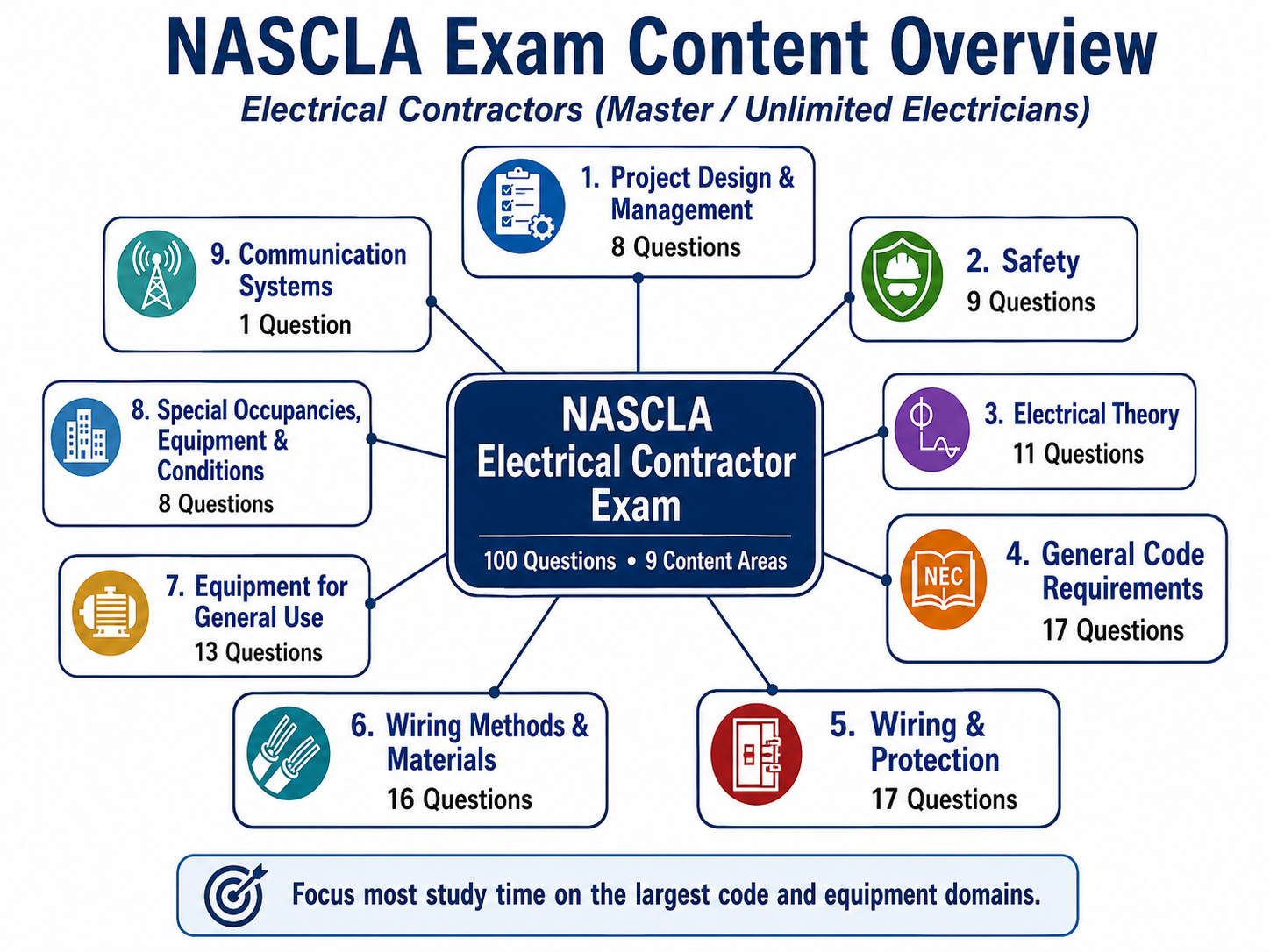
The 100 examination questions are distributed among nine major subject areas. These domains are not weighted equally, which is important when deciding how much study and practice time to devote to each subject.
Project Design and Management — 8 Questions
This domain addresses contractor-level project activities such as planning, design information, estimating, coordination, scheduling, documentation, and management responsibilities.
Safety — 9 Questions
Safety questions address electrical hazards, workplace safety requirements, safe-work practices, and other conditions associated with electrical construction and maintenance.
Electrical Theory — 11 Questions
Electrical theory includes the principles and calculations required to understand voltage, current, resistance, power, circuits, transformers, motors, and related electrical relationships.
General Code Requirements — 17 Questions
This major examination domain addresses general National Electrical Code requirements, definitions, installation rules, equipment requirements, working spaces, and other broadly applicable code provisions.
Wiring and Protection — 17 Questions
This domain includes branch circuits, feeders, services, overcurrent protection, grounding, bonding, and other fundamental requirements associated with electrical distribution and protection.
Wiring Methods and Materials — 16 Questions
Questions in this area address conductors, raceways, cables, boxes, enclosures, conductor ampacity, fill calculations, installation methods, and related requirements.
Equipment for General Use — 13 Questions
This subject area includes electrical equipment such as switches, receptacles, panelboards, transformers, motors, appliances, HVAC equipment, lighting equipment, generators, and other commonly installed equipment.
Special Occupancies, Equipment, and Conditions — 8 Questions
This domain covers installations that require specialized electrical rules, including selected hazardous locations, health care environments, pools and similar locations, emergency and standby systems, renewable-energy equipment, and other special installations.
Communication Systems — 1 Question
Communication-system requirements represent a small portion of the examination but remain part of the published test specification and should not be ignored completely.
Not Every Subject Deserves Equal Study Time
General Code Requirements, Wiring and Protection, Wiring Methods and Materials, and Equipment for General Use account for 63 of the 100 examination questions.
These four domains therefore deserve substantial preparation time. A candidate who spends the same amount of study time on the one-question Communication Systems domain as on the 17-question Wiring and Protection domain is not allocating preparation time efficiently.
The smaller domains should still be studied, but the examination weighting should influence the depth of review, the number of practice questions completed, and the amount of reference-navigation practice devoted to each area.
Open Book Does Not Mean Unlimited Time to Search
An open-book examination rewards candidates who already understand the subject well enough to know where the answer is likely to be found. A candidate who must search the entire reference library for every question will consume too much examination time.
Recognize the Subject
Determine whether the question concerns a service, feeder, branch circuit, grounding requirement, motor, transformer, wiring method, calculation, safety requirement, or another identifiable subject.
Choose the Reference
Determine which approved reference is most likely to contain the applicable requirement instead of searching every book.
Locate the Rule
Use the table of contents, index, article organization, tabs, tables, and other permitted navigation aids to reach the relevant material quickly.
Apply the Requirement
Read enough surrounding material to determine whether definitions, conditions, exceptions, notes, tables, or related requirements affect the answer.
Learn Where Information Lives
One of the most important skills developed throughout this course will be reference recognition. Before opening a book, identify the category of information being requested.
Identify the Topic
Read the question and determine the electrical, safety, project-management, or regulatory subject being tested.
Select the Most Likely Reference
Decide whether the answer is most likely found in the NEC, a safety reference, project-management material, electrical calculation reference, or another approved examination source.
Navigate to the Requirement
Use the reference’s organizational system instead of searching randomly. In the NEC, this may involve an Article, Part, Section, table, definition, or index entry.
Verify the Conditions
Confirm that the requirement applies to the voltage, occupancy, wiring method, conductor, equipment, location, or other condition described in the question.
Select the Best Answer
Answer the question that was actually asked rather than selecting a familiar value or rule that applies to a different condition.
The Code Book Does Not Replace Electrical Understanding
A candidate should not approach the examination as though every answer can be found by recognizing a keyword and locating a number in a table. Electrical theory and practical understanding are necessary to determine which rules apply and how they should be used.
For example, a conductor-sizing problem may require the candidate to determine the load, recognize whether it is continuous, determine conductor ampacity, apply temperature or conductor-count adjustments, consider terminal limitations, and then evaluate overcurrent protection. Looking at only one table may not be enough.
Exam principle: The reference provides the rule. Electrical understanding tells you which rule to use.
Small Words Can Change the Correct Answer
Electrical examination questions frequently contain words that define exactly what is being requested. Missing one of these words can lead to an incorrect answer even when the candidate understands the underlying electrical topic.
Minimum
The question is asking for the smallest value or least requirement that satisfies the applicable rule.
Maximum
The question is asking for the largest value or limit permitted under the stated conditions.
Required
The applicable rule establishes an obligation rather than merely identifying something that may be permitted.
Permitted
The question may be testing an allowed method or condition rather than a mandatory requirement.
Continuous
The duration or classification of a load can affect conductor sizing, overcurrent protection, and other calculations.
Not Permitted
A negative question changes the task completely. Read carefully before selecting an otherwise familiar code-compliant condition.
Answer the Question That Was Asked
A common examination mistake is solving a related electrical problem instead of the problem actually presented.
Before beginning a calculation or opening a reference, identify exactly what the final answer must represent. Is the question asking for conductor ampacity, conductor size, overcurrent-device size, raceway size, box volume, grounding conductor size, working clearance, load, voltage drop, or another quantity?
This habit becomes especially important when several answer choices represent legitimate electrical values but only one answers the specific question.
Build Knowledge and Navigation Skills Together
This course will not treat exam preparation as a sequence of facts to memorize. Each major subject will combine technical instruction with practical reference navigation and examination-style application.
Understand the Concept
Learn the electrical principle, equipment relationship, installation method, calculation, or safety concept before trying to memorize code locations.
Connect the Concept to the Reference
Identify where the applicable information is located in the approved examination references.
Work an Example
Apply the concept to a realistic electrical problem, installation condition, calculation, plan, or scenario.
Practice the Lookup
Repeat the reference search until the applicable article, table, section, or reference location can be found efficiently.
Answer Exam-Style Questions
Use practice questions to reinforce both technical understanding and the ability to distinguish the best answer from plausible distractors.
Check Your Understanding
What Does Passing the NASCLA Exam Accomplish?
A candidate passes the NASCLA Electrical Contractor examination. Which statement is most accurate?
A. The candidate automatically receives a national electrical contractor license.
B. The candidate may use the passing examination result with participating licensing agencies, subject to each jurisdiction’s licensing requirements.
C. The candidate may perform unlimited electrical work in every state immediately.
D. The candidate no longer needs to comply with state electrical licensing laws.
Which Subjects Carry the Most Examination Weight?
Which two individual content domains currently contain the greatest number of examination questions?
A. Safety and Electrical Theory
B. Project Design and Communication Systems
C. General Code Requirements and Wiring and Protection
D. Equipment for General Use and Communication Systems
What Is the Best Open-Book Strategy?
Which approach is most effective for an open-book electrical examination?
A. Begin every question by searching every reference book.
B. Memorize the page number of every electrical requirement.
C. Identify the subject, select the likely reference, locate the applicable requirement, and apply it to the question.
D. Answer only the questions that do not require a reference lookup.
Review the Reasoning
Question 1 — B
A NASCLA passing result can be used with participating jurisdictions that accept the examination, but each licensing agency retains its own licensing authority and additional requirements.
Question 2 — C
General Code Requirements and Wiring and Protection each currently account for 17 questions, making them the largest individual content domains.
Question 3 — C
Efficient open-book testing depends on first recognizing the subject and then navigating directly to the appropriate reference instead of beginning every question with an unrestricted search.
Always Check the Candidate Information Bulletin
The examination structure and domain distribution used in this lesson reflect the current NASCLA and PSI examination information available when this lesson was prepared. Testing procedures, reference editions, fees, examination rules, and administrative requirements can change.
Before purchasing references, permanently tabbing books, scheduling the examination, or reporting to a testing center, verify the current requirements through NASCLA, the examination provider, and the licensing jurisdiction where you intend to use the examination result.
What You Should Take From This Lesson
The NASCLA Exam Is a Contractor-Level Trade Examination
It evaluates electrical knowledge, code application, safety, installation requirements, equipment, and contractor-level project responsibilities.
It Does Not Create a National License
Participating jurisdictions may accept the examination result, but each licensing agency maintains its own licensing requirements.
The Examination Contains 100 Questions
The current examination requires 75 correct answers to pass and provides 270 minutes for completion.
Nine Domains Are Tested
The largest domains are General Code Requirements, Wiring and Protection, Wiring Methods and Materials, and Equipment for General Use.
Open Book Still Requires Preparation
The candidate must be able to recognize the topic, select the correct reference, find the applicable information quickly, and apply it correctly.
Study Knowledge and Navigation Together
Technical understanding, calculation ability, code navigation, reference familiarity, and examination strategy should develop together throughout the course.
Leave a Reply
You must be logged in to post a comment.