Back to: NASCLA Master Electrical Contractor Exam Preparation
The NASCLA Accredited Trade Examination for Electrical Contractors contains 100 questions and currently allows 270 minutes for completion. Candidates must answer at least 75 questions correctly to pass, making both technical knowledge and effective use of examination time important parts of preparation.
Because the examination is open book, candidates must balance answering questions they know with efficiently locating information in approved references. The goal is not to rush through the examination, but to prevent difficult lookups or calculations from consuming time that could be used to answer several other questions correctly.
Know the Examination Before You Begin Studying for It
Good examination preparation includes understanding the testing environment itself. A candidate who knows how many questions must be answered, how much time is available, how the examination is scored, and how reference materials can be used can develop a study and testing strategy before arriving at the examination center.
The current NASCLA Electrical Contractor examination contains 100 questions, requires 75 correct answers to pass, and provides 270 minutes for completion. The examination is open book using approved reference materials and is administered by computer.
Those numbers establish an important constraint: the candidate has an average of only 2.7 minutes available for each question if time were divided equally across the examination. Some questions will require only seconds, while calculations and difficult reference lookups may require several minutes.
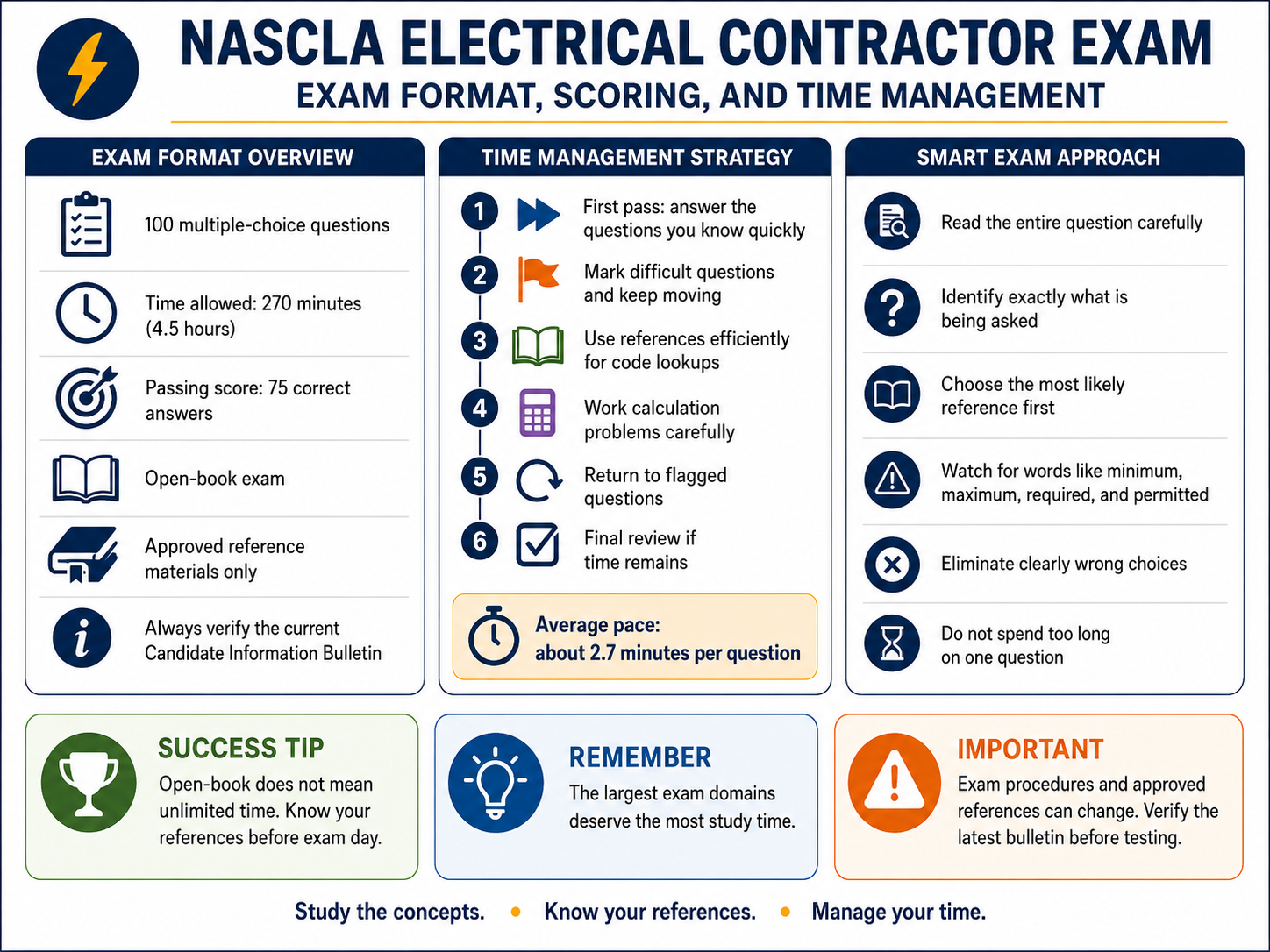
The Basic Numbers
100 Questions
The Electrical Contractor examination contains 100 scored questions distributed across the nine published examination content domains.
75 Correct to Pass
A candidate currently needs at least 75 correct answers out of the 100 examination questions to achieve a passing score.
270 Minutes
The examination time limit is 270 minutes, which is four hours and thirty minutes.
Open Book
Approved reference materials may be used during the examination, subject to the current rules established by NASCLA and the examination administrator.
Computer Administered
The examination is administered using a computer. Candidates should be comfortable reading questions, selecting answers, and navigating through a computer-based testing environment.
Approved References
Open book does not mean that any reference material may be brought into the examination. Candidates must use references and editions permitted under the current examination rules.
270 Minutes Divided by 100 Questions
If all 270 minutes were divided evenly across 100 questions, the average available time would be approximately 2.7 minutes per question.
270 minutes ÷ 100 questions = 2.7 minutes per question
That is approximately 2 minutes and 42 seconds per question. This does not mean every question should take exactly 2 minutes and 42 seconds. It establishes an average pace that helps the candidate recognize when too much time is being consumed by one problem.
Not Every Question Should Receive the Same Amount of Time
An examination question that asks for a familiar electrical definition may be answered very quickly. A conductor-sizing problem involving several code requirements may take considerably longer. An unfamiliar project-management question may require locating information in another reference book.
The objective is therefore not to force every question into the same time limit. The objective is to save time on straightforward questions so additional time remains available for calculations, code research, and difficult questions.
Quick Knowledge Question
If you understand the question and confidently know the answer, answer it and move forward instead of performing an unnecessary reference search.
Simple Code Lookup
If you recognize the applicable NEC Article or table, navigate directly to the requirement, verify it, and answer the question.
Calculation Question
Identify what must be calculated, collect the required information, perform the calculation carefully, check units, and select the matching answer.
Difficult Question
If the answer is not becoming clearer after a reasonable effort, make your best decision, flag the question when the testing system permits it, and continue.
Collect the Questions You Can Answer Efficiently
A useful testing strategy is to avoid allowing one difficult question to determine the pace of the entire examination. On an initial pass, answer questions you can solve confidently and efficiently while identifying questions that require more work.
Read the Entire Question
Do not assume you know what is being asked after reading only the first sentence. Important voltage, occupancy, equipment, conductor, location, or operating conditions may appear later in the question.
Identify the Subject
Determine whether the question involves electrical theory, a code requirement, wiring and protection, wiring methods, equipment, safety, project management, a special installation, or another identifiable domain.
Decide Whether You Know It
If you confidently know the answer and do not need to verify a specific code value, answer the question and preserve the time for questions that require research.
Perform a Focused Lookup When Necessary
If verification is required, select the most likely reference and navigate directly toward the applicable article, table, section, formula, or subject.
Recognize When to Move Forward
If the lookup expands into an extended search or a calculation becomes difficult to resolve, avoid sacrificing several easier questions to one problem.
Do Not Turn Every Question Into a Code Lookup
The examination is open book, but unnecessary reference searches consume valuable time.
If a question asks a basic electrical-theory concept that you know confidently, searching multiple books for confirmation may waste time without improving the answer. References are most valuable when you need to verify a specific requirement, number, table value, exception, definition, formula, or unfamiliar condition.
Recognize Three General Types of Questions
Answer Now
You understand the question, recognize the subject, and either know the answer or can locate it quickly.
Lookup Required
You understand what is being asked but need to verify a code section, table value, calculation rule, safety requirement, or other reference information.
Return Later
The question remains uncertain after a reasonable attempt or appears likely to require substantially more time than the average question.
Time-management principle: A difficult question is still worth only one question. Do not allow one point to consume the time needed to earn several other points.
Start With the Most Likely Book
A major source of wasted examination time is searching through references without first identifying what type of information is needed. The candidate should develop the habit of choosing the most likely reference before beginning the lookup.
Installation Requirement
Begin with the National Electrical Code when the question concerns electrical installation requirements, conductors, wiring methods, grounding, overcurrent protection, equipment, or other NEC subjects.
Workplace Safety
Begin with the applicable safety reference when the question concerns employee protection, safe work practices, electrical hazards, construction safety, or regulatory requirements.
Electrical Calculation
Determine whether the calculation can be completed from electrical principles or requires information from a code table or an approved calculation reference.
Project Management
Use the applicable project-management or contractor reference when the question addresses estimating, planning, documentation, scheduling, or project responsibilities.
Do Not Begin the Math Until You Know What Must Be Calculated
Electrical calculation questions can consume substantial examination time when candidates begin manipulating numbers before identifying the required result.
Identify the Requested Quantity
Determine whether the answer must be voltage, current, resistance, power, conductor size, ampacity, overcurrent protection, box volume, raceway area, voltage drop, or another quantity.
List the Information Given
Separate the useful electrical values and conditions from information that may not affect the calculation.
Select the Formula or Code Procedure
Determine whether the problem is solved by electrical theory, an NEC calculation method, a table, or a combination of those resources.
Calculate With Units
Carry units through the calculation when practical. Confusing volts, amperes, watts, volt-amperes, feet, circular mils, percentages, or other units can produce an otherwise avoidable error.
Check Whether the Answer Is Reasonable
Before selecting an answer choice, consider whether the result makes electrical sense and whether additional code requirements affect the final selection.
Slow Down When One Word Can Change the Answer
Managing examination time does not mean reading carelessly. A few additional seconds spent identifying an important qualifier can prevent an incorrect answer and the need to revisit the question later.
Minimum
Look for the smallest value that satisfies the applicable requirement.
Maximum
Look for the greatest value or limit permitted by the applicable requirement.
Required
Determine what the applicable rule mandates rather than what may optionally be installed.
Permitted
Determine what the applicable rule allows rather than assuming the condition is mandatory.
Continuous
Recognize that continuous-load classification may change conductor or overcurrent-protection calculations.
Except / Not
Negative wording reverses the question. Make certain you are selecting the exception or prohibited condition when that is what the question asks.
Use the Clock to Detect Problems Early
A candidate should periodically compare progress through the questions with the amount of examination time remaining. The objective is not to stare at the clock continuously, but to avoid discovering near the end of the examination that too much time was spent during the first half.
About 25 Questions
An even pace would place approximately one quarter of the examination near the 67- to 68-minute point.
About 50 Questions
An even pace would place the midpoint of the examination near 135 minutes, leaving approximately another 135 minutes.
About 75 Questions
An even pace would reach approximately three quarters of the examination near 202 to 203 minutes.
100 Questions
The goal is to reach every question with enough remaining time to return to difficult items and perform a final review where practical.
These are pacing references, not mandatory checkpoints. Candidates will naturally move faster through some sections and slower through others.
You Do Not Need Every Question Correct
The current passing requirement is 75 correct answers out of 100. That means a candidate does not need to solve every unusually difficult question to pass.
This should not be interpreted as permission to intentionally ignore 25 questions. Instead, it reinforces the importance of securing as many straightforward and moderate-difficulty questions as possible before allowing a small number of difficult questions to consume excessive examination time.
Protect the Points You Can Earn
Suppose a difficult calculation consumes 12 minutes. At the overall average pace of 2.7 minutes per question, those 12 minutes represent enough examination time for approximately four average questions.
Spending that much time may be reasonable if you have already completed the remainder of the examination. Early in the examination, however, it may be better to mark the question and return after securing easier points elsewhere.
Reference Familiarity Is Part of Time Management
The difference between finding an NEC requirement in 30 seconds and finding the same requirement in four minutes can become significant across a 100-question examination.
For that reason, reference preparation should include repeated timed lookup practice. Candidates should become familiar with the table of contents, index, chapter organization, Article structure, common tables, and any permitted tabs or reference-navigation aids.
Study habit: When you answer a practice question by looking something up, do not stop after finding the answer. Notice how you found it and determine whether there is a faster route you can use next time.
Practice the Testing Process, Not Just the Electrical Material
The examination is administered by computer, so preparation should include comfort with computer-based multiple-choice testing. Candidates should expect to read the question on screen, select an answer, move between questions using the examination interface, and follow the instructions presented by the test administrator.
Do not assume that the controls, review features, or navigation options will be identical to another examination platform you have used. Read the instructions provided at the examination site and use available tutorial or introductory screens to understand the testing interface before beginning the scored portion.
A Practical Testing Sequence
Start Deliberately
Read the instructions and become familiar with the computer interface rather than beginning the examination in a rush.
Answer Efficient Questions
Collect straightforward points while maintaining careful reading and accurate work.
Use References Selectively
Perform focused lookups when verification is needed rather than automatically opening a book for every question.
Protect Time From Difficult Questions
Recognize when continued searching or recalculation is no longer an efficient use of the available examination time.
Return to Uncertain Questions
After reaching the end of the examination, use remaining time to reconsider difficult or flagged questions when the examination system and remaining time permit.
Perform a Final Review
Use remaining time to check calculations, verify uncertain reference lookups, and confirm that answers reflect what each question actually asked.
Check Your Understanding
Average Examination Pace
A candidate has 270 minutes to complete 100 questions. Approximately how much time is available per question if the time is divided evenly?
A. 1.7 minutes
B. 2.0 minutes
C. 2.7 minutes
D. 4.5 minutes
Handling a Difficult Question
Early in the examination, a candidate has already spent several minutes searching multiple references for one unfamiliar question and still does not have a confident answer. What is generally the most effective strategy?
A. Continue searching until the answer is certain regardless of time.
B. Stop the examination and restart from Question 1.
C. Make the best reasonable choice, mark the question for review when possible, and continue to other questions.
D. Leave all remaining questions unanswered until this question is solved.
Open-Book Strategy
Which approach generally uses the open-book format most efficiently?
A. Search the NEC for every question regardless of subject.
B. Identify the subject first and then select the most likely approved reference.
C. Read every approved reference before answering the first question.
D. Avoid using references because the examination is timed.
Passing Requirement
Under the current published examination specifications, how many of the 100 NASCLA Electrical Contractor examination questions must be answered correctly to pass?
A. 60
B. 70
C. 75
D. 80
Review the Reasoning
Question 1 — C
Dividing 270 minutes by 100 questions gives an average of 2.7 minutes per question, or approximately 2 minutes and 42 seconds.
Question 2 — C
Continuing to spend excessive time on one difficult question can reduce the opportunity to answer several easier questions. Make the best reasonable selection, flag the item when possible, and return later if time remains.
Question 3 — B
Efficient reference navigation begins by identifying the subject and selecting the reference most likely to contain the applicable information.
Question 4 — C
The current published passing requirement for the 100-question NASCLA Electrical Contractor examination is 75 correct answers.
Verify the Candidate Information Bulletin Before Testing
The 100-question format, 75-correct passing requirement, 270-minute examination period, and open-book format described in this lesson reflect the current published NASCLA and PSI examination information available when this lesson was prepared.
Examination procedures, reference editions, permitted materials, fees, testing-center requirements, and other administrative rules can change. Always verify the current Candidate Information Bulletin and the requirements of the licensing jurisdiction before scheduling and taking the examination.
What You Should Take From This Lesson
The Examination Contains 100 Questions
The questions are distributed across the nine NASCLA Electrical Contractor examination domains.
75 Correct Answers Are Currently Required
A candidate should try to maximize every available point while recognizing that a perfect score is not required to pass.
You Have 270 Minutes
The overall average is approximately 2.7 minutes per question, although individual questions will naturally require different amounts of time.
Do Not Let One Question Control the Exam
When a question becomes excessively time-consuming, preserve the opportunity to earn points elsewhere and return later when possible.
Open Book Requires Fast Navigation
Reference familiarity is part of exam preparation because repeated slow lookups can consume a substantial portion of the available time.
Practice With a Clock
Timed practice questions and reference lookups help develop the pace, accuracy, and decision-making required for the actual examination.
Leave a Reply
You must be logged in to post a comment.