Back to: NASCLA Master Electrical Contractor Exam Preparation
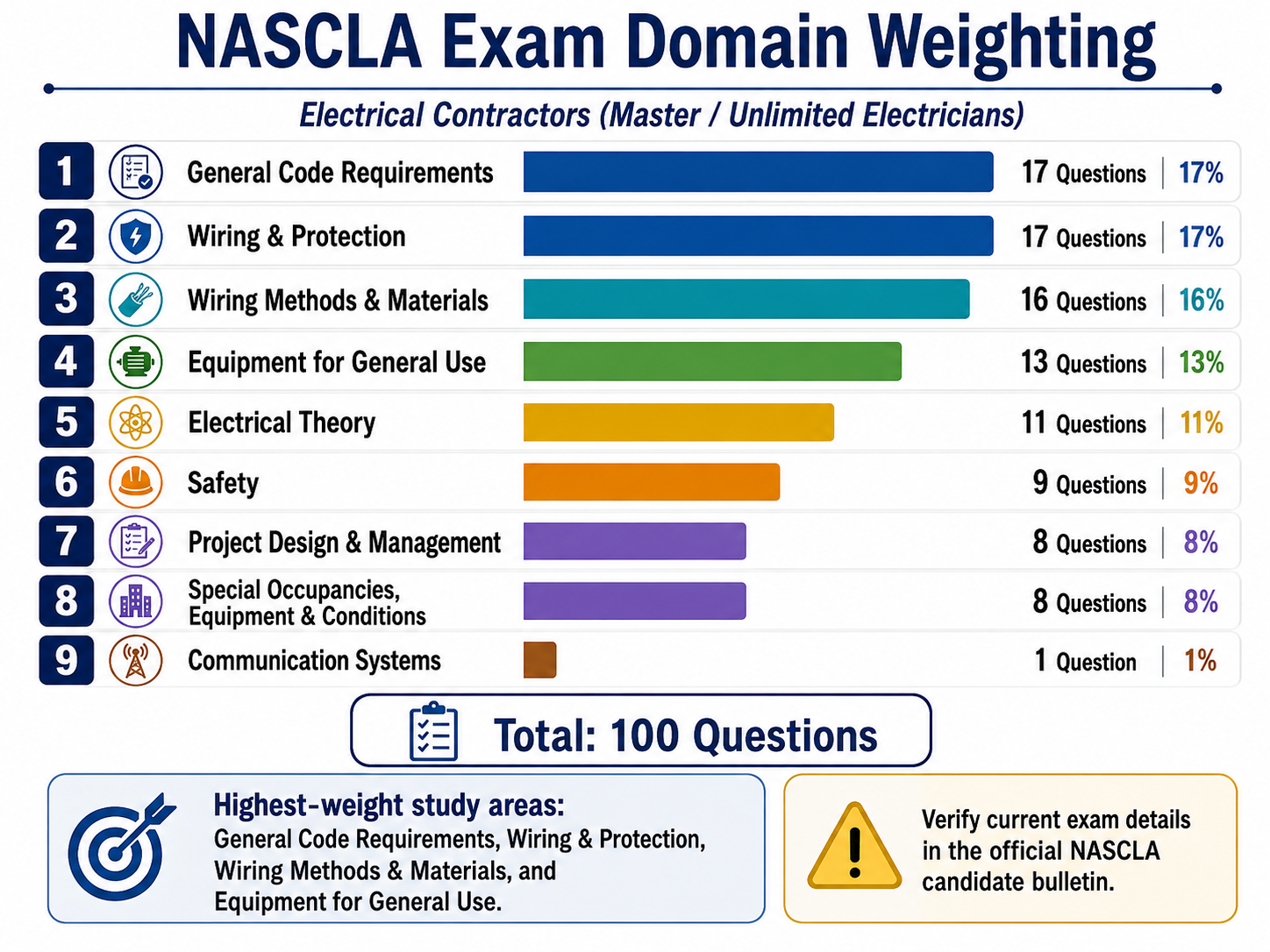
The NASCLA Electrical Contractor examination does not distribute its 100 questions equally among all electrical subjects. Some content domains account for a much larger portion of the examination, which means an effective study plan should give those subjects more attention while still preparing for the smaller domains.
Understanding the examination blueprint helps candidates decide where to spend study time, how much reference-navigation practice each subject deserves, and which technical areas should receive the greatest number of practice questions before exam day.
The Exam Blueprint Should Shape Your Study Plan
The NASCLA Electrical Contractor examination is organized into nine content domains. Each domain represents a different area of knowledge and is assigned a specific number of examination questions.
The largest individual domains are General Code Requirements and Wiring and Protection, with 17 questions each. Wiring Methods and Materials follows with 16 questions, while Equipment for General Use accounts for another 13 questions.
Together, those four areas represent 63 of the 100 examination questions. That does not mean the remaining subjects can be ignored, but it does mean study time should not be divided equally among all nine domains.
The Nine Content Domains
The current NASCLA Electrical Contractor examination distributes 100 questions across the following nine content domains.
Project Design and Management — 8 Questions
This domain addresses contractor-level activities associated with planning, interpreting project information, estimating, scheduling, coordination, documentation, and management of electrical work.
Safety — 9 Questions
Safety questions address electrical hazards, workplace-safety requirements, employee protection, safe electrical work practices, and other safety responsibilities associated with construction and maintenance work.
Electrical Theory — 11 Questions
This domain tests the electrical principles and calculations needed to understand voltage, current, resistance, power, alternating-current systems, transformers, motors, conductors, loads, and related electrical relationships.
General Code Requirements — 17 Questions
This is one of the two largest examination domains. It includes broadly applicable National Electrical Code requirements, definitions, general installation rules, equipment requirements, working space, identification, ratings, and other general code provisions.
Wiring and Protection — 17 Questions
This domain includes branch circuits, feeders, services, overcurrent protection, grounding, bonding, grounded conductors, equipment grounding, and other requirements associated with electrical distribution and protection.
Wiring Methods and Materials — 16 Questions
Questions in this domain address conductors, ampacity, insulation, raceways, cables, boxes, enclosures, conductor adjustment and correction, box fill, raceway fill, pull boxes, underground wiring, and related installation methods.
Equipment for General Use — 13 Questions
This domain covers commonly installed electrical equipment such as switches, receptacles, panelboards, transformers, motors, motor controllers, HVAC equipment, appliances, lighting equipment, generators, and related equipment requirements.
Special Occupancies, Equipment, and Conditions — 8 Questions
This domain addresses electrical installations that require specialized rules, including hazardous locations, health care facilities, places of assembly, pools and similar installations, emergency and standby systems, fire pumps, photovoltaic systems, energy storage, electric vehicle charging, and other special conditions.
Communication Systems — 1 Question
Communication systems represent the smallest individual domain. Although only one question is assigned to this subject, candidates should still understand the basic organization and application of the applicable communication-system requirements.
Four Domains Account for 63% of the Exam
General Code Requirements, Wiring and Protection, Wiring Methods and Materials, and Equipment for General Use contain a combined 63 questions.
17 + 17 + 16 + 13 = 63 questions
These subjects represent nearly two thirds of the entire examination. Candidates should therefore expect a substantial portion of their preparation to involve the National Electrical Code, conductor and wiring requirements, protection methods, grounding and bonding, and commonly installed electrical equipment.
17 Questions — One of the Largest Domains
General Code Requirements is broader than any single NEC Article. The domain tests requirements that apply across many types of electrical installations and equipment.
Definitions
Understanding NEC terminology is essential because terms such as service, feeder, branch circuit, outlet, equipment, device, grounded conductor, and grounding conductor have specific meanings.
General Installation Rules
Article 110 and other general provisions establish requirements for installation, listing, labeling, ratings, environmental suitability, mechanical execution, and equipment use.
Working Space
Electrical equipment access, working clearance, dedicated equipment space, illumination, and egress can all become examination subjects.
Equipment Ratings
Interrupting ratings, short-circuit current ratings, voltage ratings, temperature limitations, and equipment markings require careful interpretation.
Study implication: Become comfortable navigating NEC Articles 90, 100, and 110 and recognizing when a broadly applicable rule controls the installation before moving to a more equipment-specific Article.
17 Questions — Core Electrical Distribution Knowledge
Wiring and Protection is tied with General Code Requirements as the largest examination domain. This area contains some of the most fundamental electrical installation requirements encountered by master and unlimited electricians.
Branch Circuits
Understand branch-circuit ratings, required circuits, conductor requirements, load limitations, and protection requirements.
Feeders
Be prepared to determine feeder loads, conductor requirements, overcurrent protection, grounding, and other feeder conditions.
Services
Service conductors, disconnecting means, service equipment, sizing, ratings, and installation requirements represent important contractor-level subjects.
Grounding and Bonding
Grounding electrode systems, equipment grounding, bonding, grounded conductors, fault-current paths, and conductor sizing require both conceptual understanding and code-navigation skill.
16 Questions — Know the Installation Details
Wiring Methods and Materials accounts for 16 percent of the examination. Candidates need to understand not only which wiring methods exist, but where they may be installed and how conductors, raceways, cables, boxes, and enclosures are selected and sized.
Conductors
Ampacity, conductor material, insulation type, terminal temperature limitations, adjustment factors, and correction factors can all affect conductor selection.
Raceways
Metallic, nonmetallic, rigid, flexible, underground, and other raceway systems each have installation requirements and permitted uses.
Boxes and Enclosures
Box fill, conductor allowances, device allowances, clamps, grounding conductors, pull boxes, and junction boxes are common calculation and code-lookup subjects.
Raceway Fill
Conductor areas, raceway dimensions, allowable fill percentages, and the number and size of conductors must be evaluated correctly.
13 Questions — Apply General Rules to Actual Equipment
Equipment for General Use accounts for another 13 questions. This domain requires candidates to apply electrical principles and code requirements to equipment encountered in actual installations.
Transformers
Understand conductor sizing, overcurrent protection, secondary requirements, grounding, and common transformer electrical relationships.
Motors
Motor questions may involve conductors, short-circuit and ground-fault protection, overload protection, controllers, disconnects, and motor calculations.
HVAC Equipment
Air-conditioning and refrigeration equipment introduces specialized nameplate values and branch-circuit requirements such as minimum circuit ampacity and maximum overcurrent protection.
General Equipment
Switches, receptacles, appliances, panelboards, lighting equipment, electric heat, generators, and other equipment remain important examination subjects.
11 Questions — The Code Book Cannot Do the Math for You
Electrical Theory accounts for 11 questions. Although this is fewer questions than the largest code domains, theory knowledge supports many other examination areas as well.
A candidate who understands voltage, current, resistance, power, alternating-current systems, transformers, motors, conductor relationships, and load calculations will also be better prepared to understand why many NEC requirements exist and how they should be applied.
Study implication: Electrical theory has value beyond its 11 direct questions because theory skills are frequently required to solve code-based calculations and equipment problems.
9 Questions — Know Which Safety Reference Applies
The Safety domain contains nine questions. These questions may require candidates to distinguish electrical installation requirements from workplace-safety rules and safe electrical work practices.
Electrical Hazards
Shock, arc-flash, energized conductors, fault energy, and other electrical hazards require appropriate recognition and control.
Safe Work Practices
Deenergization, lockout/tagout, establishing an electrically safe work condition, testing, PPE, and approach boundaries are important safety concepts.
Construction Safety
Ladders, excavations, overhead electrical hazards, fall protection, tools, and general jobsite conditions can fall under applicable workplace-safety requirements.
Reference Recognition
One of the exam skills is recognizing whether the answer belongs in the NEC, NFPA 70E, OSHA material, or another approved reference.
8 Questions — This Is a Contractor Examination
The Project Design and Management domain distinguishes this examination from a test focused only on installation-level electrical knowledge. A master or unlimited electrical contractor is expected to understand how electrical work is planned, coordinated, estimated, documented, and managed.
Plans and Specifications
Electrical drawings, specifications, schedules, symbols, one-line diagrams, and other contract information must be interpreted correctly.
Estimating
Quantity takeoffs, labor, material, equipment, overhead, and other estimating concepts can affect project planning and bidding.
Scheduling
Electrical work must be coordinated with construction sequencing, inspections, equipment delivery, other trades, and project milestones.
Documentation
Contracts, changes, RFIs, submittals, records, inspection information, and closeout documentation are part of contractor-level project management.
8 Questions — Broad Subject, Limited Question Count
Special Occupancies, Equipment, and Conditions also accounts for eight questions. This domain presents an important study challenge because a relatively small number of questions can be drawn from a very broad portion of the electrical code.
The goal should not be to memorize every special Article. Candidates should learn to recognize the type of installation and navigate quickly to the appropriate NEC Article when a question involves a special occupancy, special equipment, or special condition.
Special Occupancies
Hazardous locations, commercial garages, health care facilities, assembly occupancies, marinas, pools, and similar locations can require specialized installation rules.
Emergency and Standby
Emergency systems, legally required standby systems, optional standby systems, and fire pumps require different electrical arrangements and priorities.
Renewable Energy
Photovoltaic systems and battery energy storage systems introduce additional power sources, disconnecting requirements, conductors, protection, and system configurations.
Electric Vehicles
Electric vehicle power transfer equipment introduces specialized branch-circuit, load, equipment, and installation requirements.
1 Question — Small Weight Does Not Mean Zero Preparation
Communication Systems accounts for only one question on the current examination. It would be inefficient to devote the same study time to this domain as to a 17-question domain, but completely ignoring it gives away a potential examination point.
A practical preparation strategy is to understand the general organization of communication-system requirements and know where to begin looking when a communication-system question appears.
Use Question Weighting to Allocate Study Time
A reasonable study plan should devote the greatest amount of technical review and practice to the largest examination domains while still maintaining enough coverage to recognize and navigate questions from every domain.
That does not mean study percentages must exactly match examination percentages. Some subjects require more preparation because they involve complex calculations or unfamiliar references, while other subjects may already be areas of professional strength.
The exam blueprint should be treated as a starting point for allocating study effort, not as an inflexible schedule.
Study by Priority, Then Adjust for Weaknesses
Start With the Highest-Weight Domains
Build strong competency in General Code Requirements, Wiring and Protection, Wiring Methods and Materials, and Equipment for General Use because these subjects account for 63 questions.
Strengthen Electrical Theory
Electrical theory represents 11 direct questions and supports calculations and problem solving throughout several other domains.
Prepare Thoroughly for Safety
Nine questions can significantly affect the final score, and candidates must learn which safety reference contains the applicable requirement.
Cover the Contractor and Special-System Domains
Project Design and Management and Special Occupancies, Equipment, and Conditions contain eight questions each and should receive meaningful preparation.
Do Not Give Away the Communication Question
Learn enough Chapter 8 organization and communication-system navigation to make the single question a reasonable opportunity for another correct answer.
Adjust Based on Practice Results
As practice examinations reveal weak areas, shift study time toward subjects where additional preparation can produce the greatest improvement in the final score.
Your Practice Questions Should Also Reflect the Blueprint
If a candidate completes 100 mixed practice questions, it is useful for the approximate distribution to resemble the actual examination rather than containing the same number of questions from every subject.
A practice set that contains only a few conductor, grounding, service, wiring-method, or equipment questions would not realistically represent the current NASCLA Electrical Contractor examination.
Practice principle: The examination blueprint should influence not only what you read, but also what you repeatedly solve, calculate, and look up under time pressure.
High-Weight Domains Need Fast Reference Navigation
Because many of the highest-weight domains are closely tied to the National Electrical Code, becoming faster at NEC navigation can improve performance across a large portion of the examination.
Know the NEC Structure
Understand how Chapters, Articles, Parts, Sections, tables, definitions, informational notes, exceptions, and annexes are organized.
Use the Index Strategically
The index can help when you know the electrical concept but do not remember the applicable Article or Section.
Recognize Common Articles
Repeated practice should make major subjects such as branch circuits, feeders, services, grounding and bonding, conductors, wiring methods, motors, transformers, and special systems increasingly familiar.
Practice Tables
Ampacity, grounding, raceway fill, conductor dimensions, motor information, and other table-based questions require familiarity with finding and interpreting tabular information.
Do Not Confuse Familiarity With Mastery
A candidate may work with motors every day and still miss an examination question because the NEC sizing procedure is different from the rule remembered from field experience.
Likewise, a candidate may rarely work with a particular special occupancy but still answer the examination question correctly by recognizing the topic and quickly locating the applicable Article.
Use professional experience as a foundation, but verify examination answers against the applicable approved reference when a specific requirement is being tested.
Check Your Understanding
Largest Examination Domains
Which two NASCLA Electrical Contractor content domains currently contain 17 questions each?
A. Electrical Theory and Safety
B. General Code Requirements and Wiring and Protection
C. Wiring Methods and Materials and Equipment for General Use
D. Project Design and Management and Special Occupancies
The Big Four
How many examination questions are represented by General Code Requirements, Wiring and Protection, Wiring Methods and Materials, and Equipment for General Use combined?
A. 47
B. 53
C. 63
D. 73
Smallest Domain
Which domain currently contains only one examination question?
A. Safety
B. Project Design and Management
C. Communication Systems
D. Electrical Theory
Study Allocation
Which study strategy best reflects the current NASCLA examination blueprint?
A. Spend exactly the same amount of time on every content domain.
B. Study only the four largest domains and ignore the others.
C. Emphasize the higher-weight domains while maintaining preparation across all domains and adjusting for personal weaknesses.
D. Spend the most time on Communication Systems because it is the smallest domain.
Review the Reasoning
Question 1 — B
General Code Requirements and Wiring and Protection each contain 17 questions, making them the two largest individual domains.
Question 2 — C
The four largest code and equipment domains contain 17 + 17 + 16 + 13 questions, for a total of 63.
Question 3 — C
Communication Systems currently accounts for one question out of the 100-question examination.
Question 4 — C
The exam blueprint should influence study priorities, but candidates should still prepare for every domain and increase study time for subjects where practice reveals weakness.
Use the Current NASCLA Content Outline
The nine-domain distribution described in this lesson reflects the current published NASCLA Electrical Contractor/Master-Unlimited Electrician examination outline available when this lesson was prepared.
Examination content outlines, reference editions, administrative procedures, and other testing requirements may change. Verify the current NASCLA Candidate Information Bulletin and examination information before testing.
What You Should Take From This Lesson
The Examination Has Nine Content Domains
The 100 questions are distributed among contractor management, safety, theory, general code requirements, wiring and protection, wiring methods, equipment, special installations, and communication systems.
The Domains Are Not Weighted Equally
The largest domains contain as many as 17 questions, while Communication Systems contains only one.
Four Domains Represent 63 Questions
General Code Requirements, Wiring and Protection, Wiring Methods and Materials, and Equipment for General Use should receive substantial preparation time.
Electrical Theory Supports Other Domains
Theory knowledge is tested directly but also improves calculation, equipment, conductor, and code-application performance elsewhere on the examination.
Smaller Domains Still Matter
Eight or nine questions can substantially influence a passing score, and even the single communication-system question represents an available point.
Let Practice Results Refine the Blueprint
Use domain weighting to establish study priorities, then adjust those priorities as timed practice identifies individual strengths and weaknesses.
Leave a Reply
You must be logged in to post a comment.