Back to: NASCLA Master Electrical Contractor Exam Preparation
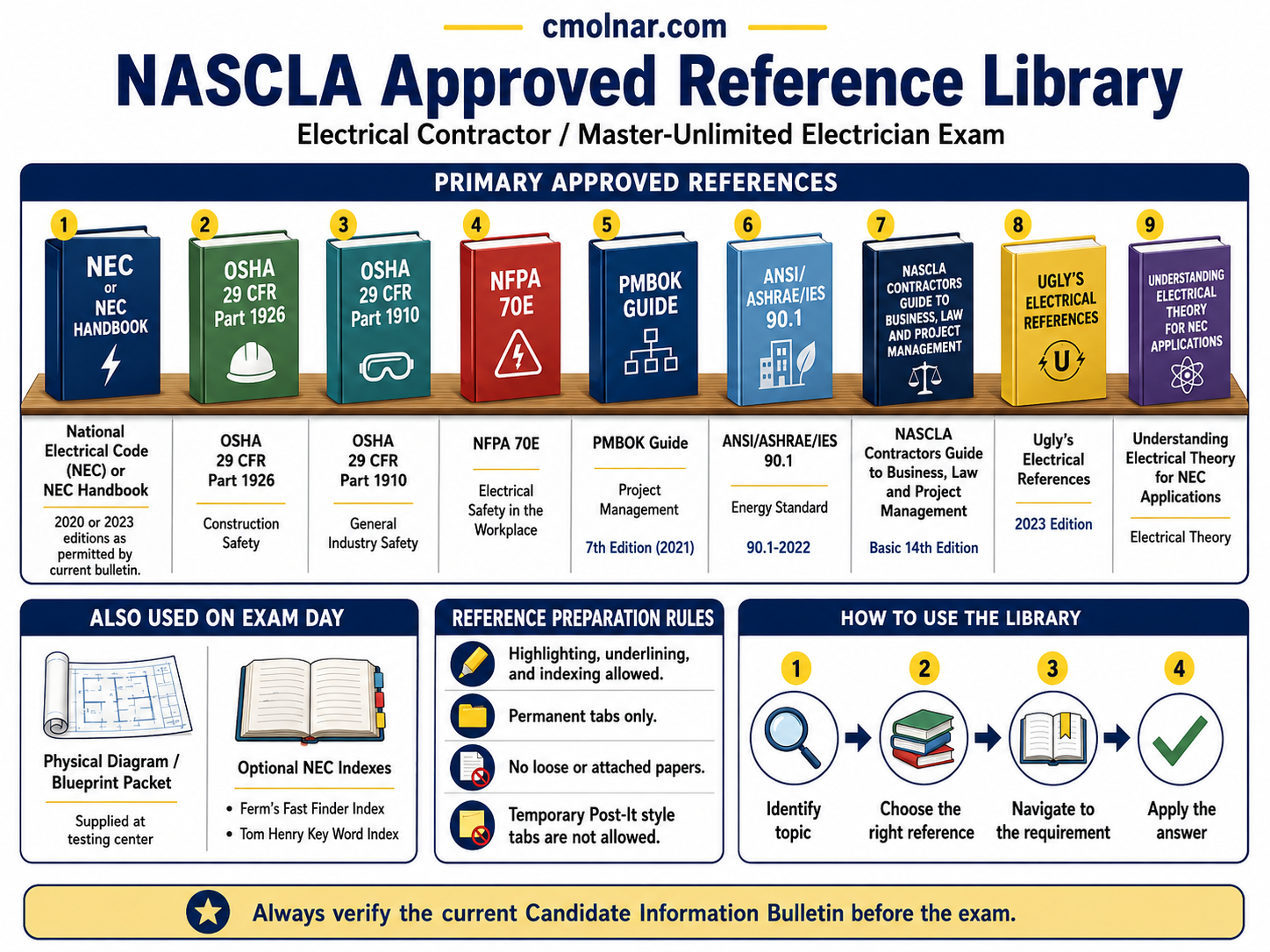
The NASCLA Electrical Contractor examination is open book, but candidates may not simply bring any electrical reference they choose. The examination is developed from a defined reference library, and the permitted books, editions, markings, tabs, and other materials are controlled by the current examination rules.
Successful preparation therefore requires two related skills: understanding the technical material and recognizing which approved reference is most likely to contain the answer. The faster a candidate can move from question to the correct reference, the more useful the open-book format becomes.
The Books Are Part of Your Exam Strategy
The NASCLA Electrical Contractor examination covers electrical theory, code requirements, safety, project management, energy requirements, wiring methods, equipment, special installations, and other contractor-level subjects. No single book contains all of that information.
The approved reference library divides those subjects among several publications. The National Electrical Code is the primary installation reference, OSHA regulations address workplace requirements, NFPA 70E addresses electrical safe-work practices, project-management and contractor references address planning and administration, and other publications support calculations, energy requirements, and electrical theory.
The examination skill is not merely knowing that the information exists somewhere in the reference library. The candidate should recognize the subject quickly enough to begin the search in the correct book.
Use the Candidate Information Bulletin as the Final Authority
Reference lists and permitted editions can change. A book that was permitted for an earlier version of the examination may not be the correct edition for a future examination.
Before purchasing books, tabbing them, highlighting them, or reporting to the testing center, verify the current reference list and examination rules provided for the NASCLA Electrical Contractor examination you are scheduled to take.
National Electrical Code or National Electrical Code Handbook
The National Electrical Code, NFPA 70, is the primary installation reference for a large portion of the NASCLA Electrical Contractor examination. The current reference list permits the listed editions of either the National Electrical Code or the National Electrical Code Handbook.
The NEC is especially important because General Code Requirements, Wiring and Protection, Wiring Methods and Materials, Equipment for General Use, Special Occupancies and Equipment, and Communication Systems together represent most of the examination.
General Requirements
Use the NEC for definitions, general installation requirements, working space, equipment ratings, identification, listing, and other broadly applicable electrical requirements.
Wiring and Protection
Branch circuits, feeders, services, overcurrent protection, grounding, bonding, and related distribution requirements are primarily NEC subjects.
Wiring Methods
Conductors, raceways, cables, boxes, enclosures, conductor ampacity, adjustment factors, correction factors, and fill calculations rely heavily on NEC requirements and tables.
Electrical Equipment
Transformers, motors, HVAC equipment, appliances, luminaires, generators, and other electrical equipment are addressed in equipment-specific NEC Articles.
Exam habit: When a question asks what an electrical installation is required or permitted to do, the NEC should usually be one of the first references you consider.
29 CFR 1926 — Construction Industry Regulations
OSHA 29 CFR Part 1926 contains federal workplace-safety requirements applicable to construction activities. Electrical contractors work in environments involving temporary power, ladders, excavations, fall hazards, tools, personal protective equipment, material handling, and other construction-related hazards.
Construction Electrical Safety
Use this reference when a question involves workplace requirements for electrical construction rather than the installation requirements of the completed electrical system.
Ladders and Access
Construction safety questions may involve ladder selection, use, access, positioning, or other jobsite conditions.
Excavation
Underground electrical work can involve excavation and trenching requirements that extend beyond NEC burial-depth requirements.
Jobsite Hazards
Construction work can introduce fall, tool, equipment, material-handling, and other occupational hazards that are addressed by OSHA rather than the NEC.
29 CFR 1910 — Occupational Safety and Health Standards
The approved reference library also includes OSHA 29 CFR Part 1910. These regulations address occupational-safety requirements associated with general industry and contain electrical-safety provisions that may apply outside the construction-specific environment covered by Part 1926.
Candidates should learn to distinguish the context of a safety question before opening an OSHA reference. A question involving construction work may lead toward Part 1926, while a general-industry workplace question may lead toward Part 1910.
Reference-navigation point: Do not treat “OSHA” as one book or one subject. First determine whether the question concerns construction or general-industry requirements.
NFPA 70E — Standard for Electrical Safety in the Workplace
NFPA 70E addresses electrical safety-related work practices. This is different from the National Electrical Code, which primarily establishes requirements for electrical installations.
NFPA 70E becomes important when a question asks how electrical work should be performed safely rather than how the electrical system itself must be installed.
Electrically Safe Work Condition
NFPA 70E addresses establishing and verifying an electrically safe work condition before work begins.
Shock Protection
Approach boundaries, exposure to energized conductors, voltage conditions, and shock-risk controls are electrical safe-work subjects.
Arc-Flash Risk
Arc-flash hazard assessment, boundaries, protective measures, and related safe-work practices are addressed in NFPA 70E.
Personal Protective Equipment
Electrical PPE selection and use may depend on the hazard, task, equipment condition, and applicable safe-work requirements.
NEC, OSHA, and NFPA 70E Answer Different Questions
The National Electrical Code primarily tells you how electrical systems and equipment must be installed.
OSHA regulations establish employer and workplace-safety requirements.
NFPA 70E provides electrical safety-related work-practice requirements intended to protect workers from electrical hazards.
A candidate who understands these different purposes can often eliminate several minutes of unnecessary searching before opening a book.
A Guide to the Project Management Body of Knowledge
The Project Management Institute’s PMBOK Guide supports the Project Design and Management domain of the examination. The current reference list identifies the seventh edition.
This reference moves the examination beyond electrical installation rules and into the process of organizing and managing project work.
Project Planning
Projects require defined objectives, organized work, resources, responsibilities, and a method for delivering the required result.
Stakeholders
Electrical contractors work with owners, designers, general contractors, suppliers, inspectors, employees, subcontractors, and other project participants.
Risk and Uncertainty
Project management includes recognizing uncertainty, evaluating risks, and responding to conditions that can affect cost, schedule, quality, or delivery.
Project Performance
Planning, execution, measurement, communication, coordination, and corrective action are all part of managing project performance.
NASCLA Contractors Guide to Business, Law and Project Management
The NASCLA Contractors Guide to Business, Law and Project Management provides contractor-oriented material involving project and business responsibilities. The current reference list specifies the Basic 14th Edition.
Although the NASCLA electrical examination is primarily a trade examination, the Electrical Contractor classification includes responsibilities that extend beyond physically installing electrical equipment.
Contracts
Contract documents establish obligations, scope, responsibilities, compensation, changes, and other project requirements.
Estimating
Material quantities, labor, equipment, overhead, project conditions, and other costs must be considered when preparing an estimate.
Scheduling
Electrical work must be coordinated with procurement, inspections, other trades, project milestones, and completion requirements.
Documentation
RFIs, change orders, project records, submittals, correspondence, and closeout information are important contractor responsibilities.
ANSI/ASHRAE/IES Standard 90.1
The current reference list includes ANSI/ASHRAE/IES Standard 90.1, Energy Standard for Sites and Buildings Except Low-Rise Residential Buildings. This reference addresses energy-efficiency requirements applicable to covered buildings and sites.
Electrical examination questions may involve subjects such as electrical power, lighting, controls, automatic control requirements, energy monitoring, or other provisions affected by building-energy requirements.
Reference-recognition point: A question involving required energy controls may not be answered by the NEC even though the equipment itself is electrical.
Ugly’s Electrical References
Ugly’s Electrical References is a compact field reference containing commonly used electrical information. The current reference list identifies the 2023 edition.
This type of reference can be useful for rapidly locating electrical formulas, conversions, conductor information, motor information, and other practical trade data.
Electrical Formulas
Common voltage, current, resistance, power, and alternating-current formulas can support theory and calculation questions.
Conversions
Unit conversions and commonly used electrical relationships can be located quickly when a calculation requires them.
Trade Information
Compact tables and practical field information can support questions that are based on trade knowledge or general industry practice.
Quick Reference
The value of a compact field reference is speed, provided the candidate already knows how the book is organized.
Understanding Electrical Theory for NEC Applications
The approved reference list includes Understanding Electrical Theory for NEC Applications by Mike Holt. This reference supports the Electrical Theory domain and helps connect basic electrical relationships with practical code applications.
Voltage and Current
Understand the relationships between electrical potential, current flow, resistance, and circuit conditions.
Power
Electrical power calculations may involve watts, volt-amperes, single-phase systems, three-phase systems, and power-factor relationships.
Transformers
Turns ratio, voltage, current, power, and transformer operating principles support both theory and equipment questions.
Motors
Motor theory supports understanding of current, power, phase relationships, motor operation, and code-based motor calculations.
A Physical Diagram or Blueprint Packet Is Supplied Onsite
The current reference information identifies a physical diagram or blueprint packet that is handed out at the testing center. Candidates should therefore be prepared to interpret electrical drawings and diagrams in addition to using their own reference books.
Plans and diagrams may contain symbols, equipment locations, conductor information, panel information, dimensions, notes, schedules, one-line relationships, or other data needed to answer a question.
Preparation point: Do not limit exam preparation to reading books. Practice extracting useful information from electrical floor plans, schedules, diagrams, and one-line drawings.
Indexes Can Improve NEC Navigation
The current bulletin also identifies optional NEC-navigation references. These provide additional methods for locating NEC subjects when the candidate knows the terminology but does not immediately know the applicable Article or Section.
Ferm’s Fast Finder Index
This optional index provides another route for locating NEC subjects when the candidate knows the topic but not the exact code location.
Tom Henry Key Word Index
A keyword index can help candidates move from terminology used in an examination question toward the corresponding NEC location.
Important: Optional references are not the source of examination questions. Verify their permitted condition and edition under the current bulletin before bringing them to the test center.
Your Books Must Meet Examination Rules
The current examination rules permit approved reference material to be highlighted, underlined, and indexed, but the books must otherwise remain unmarked and may not contain additional loose or attached papers.
References may be tabbed or indexed with permanent tabs. Temporary tabs such as Post-It notes are not permitted and must be removed before the examination begins.
Highlighting
Permitted highlighting can make frequently used requirements, tables, headings, and important conditions easier to find.
Underlining
Underlining can emphasize important words or requirements when performed within the limits of the examination rules.
Permanent Tabs
Permanent tabs can provide rapid access to major Articles, tables, safety subjects, or project-management sections.
No Added Papers
Loose notes, inserted study sheets, and attached additional papers are not permitted as substitutes for organizing the approved reference itself.
Know Which Book to Open Before You Open It
Imagine a question asks about the minimum working clearance in front of electrical equipment. That should immediately suggest the National Electrical Code.
A question about an arc-flash boundary should suggest NFPA 70E.
A construction trenching question should point toward OSHA construction regulations.
A project stakeholder or project-delivery question should suggest the project-management reference.
An energy-control requirement may lead to ASHRAE 90.1.
This reference-recognition skill can save more time than simply adding more tabs to every book.
Use the Same Sequence for Every Lookup
Identify What the Question Is About
Determine whether the subject is installation code, workplace safety, electrical safe work, project management, energy requirements, electrical theory, or another identifiable category.
Select the Most Likely Reference
Choose the book most closely associated with that subject before beginning to search.
Use the Book’s Organization
Navigate with the table of contents, index, Article structure, chapter organization, permanent tabs, or other permitted navigation methods.
Read the Complete Requirement
Do not stop when the first familiar number or phrase appears. Read enough surrounding material to identify conditions, exceptions, definitions, tables, and limitations.
Apply It to the Question
Confirm that the requirement you found actually addresses the voltage, occupancy, equipment, work condition, or project situation presented.
Check Your Understanding
Installation Requirement
A question asks for the minimum required working space in front of electrical equipment. Which reference should generally be considered first?
A. PMBOK Guide
B. National Electrical Code
C. OSHA 29 CFR 1926
D. ASHRAE 90.1
Electrical Safe-Work Practice
A question concerns an electrical worker’s shock-approach boundary while performing work involving exposed energized conductors. Which reference is most directly associated with this subject?
A. NFPA 70E
B. PMBOK Guide
C. Ugly’s Electrical References
D. ASHRAE 90.1
Construction Safety
A question addresses safety requirements associated with an excavation on an active construction project. Which reference category should generally be considered first?
A. OSHA 29 CFR 1926
B. NEC Article 100
C. Electrical theory reference
D. ASHRAE 90.1
Reference Preparation
Which statement best reflects the current published examination rules for approved references?
A. Temporary removable tabs are preferred.
B. Loose handwritten calculation sheets may be inserted in any reference.
C. Approved references may be highlighted, underlined, and indexed within the published restrictions, and permanent tabs may be used.
D. Candidates may bring any electrical textbook they find useful.
Review the Reasoning
Question 1 — B
Working-space requirements for electrical equipment are installation requirements addressed by the National Electrical Code.
Question 2 — A
NFPA 70E addresses electrical safety-related work practices, including shock-risk considerations and approach boundaries.
Question 3 — A
Excavation safety on a construction project is a workplace construction-safety issue, making OSHA 29 CFR 1926 the most likely starting reference.
Question 4 — C
The current published rules permit highlighting, underlining, indexing, and permanent tabs subject to the examination restrictions. Temporary tabs and added papers are not permitted.
Confirm Your Exact Editions Before the Examination
The reference titles and editions described in this lesson reflect current published NASCLA and PSI examination information available when this lesson was prepared. The permitted NEC edition, safety-reference edition, other publications, optional indexes, and examination-room rules may be revised.
Use the current Candidate Information Bulletin associated with your scheduled NASCLA Electrical Contractor examination as the final authority before purchasing, preparing, or bringing references to the testing center.
What You Should Take From This Lesson
The Exam Uses a Defined Reference Library
Open book does not mean unrestricted books. Candidates must use references permitted under the current examination rules.
The NEC Is the Primary Installation Reference
A substantial portion of the examination involves electrical installation requirements contained in NFPA 70.
Safety Is Split Among Different References
OSHA construction requirements, OSHA general-industry requirements, and NFPA 70E electrical safe-work practices serve different purposes.
Contractor Questions Require Contractor References
Project management, estimating, documentation, contracts, and project administration extend beyond the National Electrical Code.
Theory and Field References Support Calculations
Electrical theory and quick-reference material help candidates solve electrical relationships and practical trade questions efficiently.
Reference Recognition Saves Time
The candidate should identify the subject and select the most likely book before beginning a reference search.
Leave a Reply
You must be logged in to post a comment.