Back to: NASCLA Master Electrical Contractor Exam Preparation
The NASCLA Electrical Contractor examination is open book, but an approved reference is useful only when the candidate can locate information efficiently. A properly organized code book or technical reference can save valuable examination time, while an unfamiliar or poorly prepared book can turn even a straightforward lookup into a lengthy search.
Reference preparation must also remain within the current examination rules. Candidates should organize, highlight, underline, index, and permanently tab approved books before exam day without adding prohibited notes, loose papers, temporary tabs, or other materials that could prevent a reference from being admitted to the examination room.
Prepare Your References for Speed, Not Decoration
The purpose of preparing an examination reference is to reduce the time required to move from a question to the applicable information. Tabs, highlighting, underlining, and indexing should help the candidate navigate the reference rather than simply make the book look organized.
A useful tab should lead to information the candidate expects to use repeatedly. Effective highlighting should emphasize important requirements, conditions, exceptions, or table headings without covering so much material that nothing stands out.
Reference preparation becomes most effective when it is combined with practice. Candidates should repeatedly use their prepared books while answering questions so the locations of important Articles, tables, safety requirements, formulas, and project-management subjects become increasingly familiar.
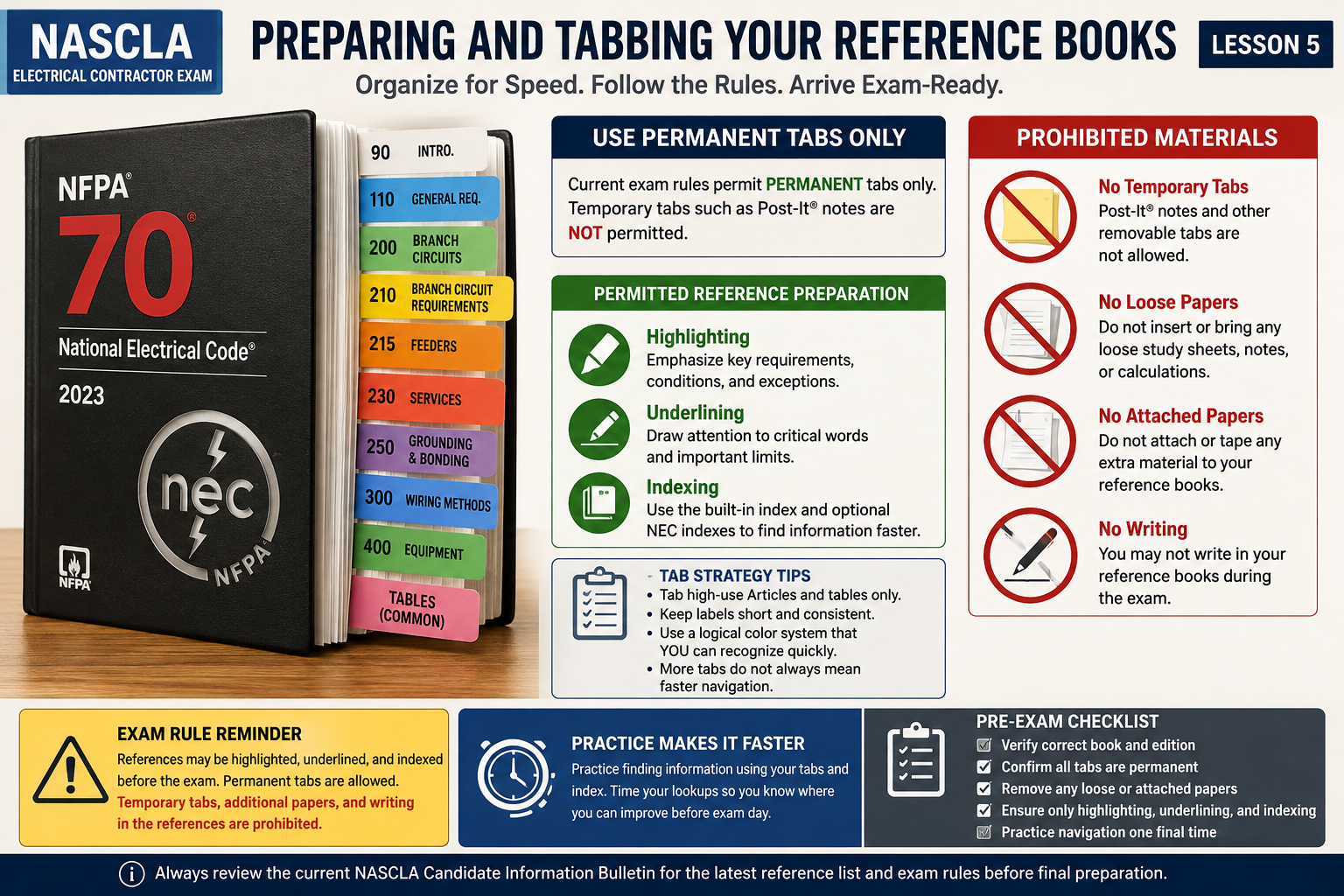
Know What Is Permitted Before Modifying a Reference
Current examination guidance permits approved references to be highlighted, underlined, and indexed before the examination session. References may also be tabbed or indexed using permanent tabs.
Temporary tabs such as Post-It-style notes are not permitted. Approved references may not contain additional loose or attached papers, and candidates must follow the current rules concerning markings in the books.
Always verify the current Candidate Information Bulletin before final preparation because reference lists, editions, and examination-room rules can change.
Tabs Should Take You Somewhere Useful
A tab is valuable only when it reduces navigation time. Placing a tab on every Article, every table, or every chapter can create so many choices that the edge of the book becomes more difficult to navigate than the index itself.
The objective is to create a limited and logical navigation system that reflects the subjects most likely to be used during the examination.
Major NEC Articles
Permanent tabs can provide quick access to high-use Articles involving general requirements, branch circuits, feeders, services, grounding and bonding, wiring methods, motors, transformers, and other major examination subjects.
Frequently Used Tables
Tables used for conductor ampacity, conductor dimensions, grounding conductors, raceway fill, motor information, and similar calculations may justify direct access.
Reference Divisions
Large safety, project-management, or technical references may benefit from tabs identifying major chapters or subject divisions rather than every individual topic.
Personal Weak Areas
A subject that repeatedly requires a slow lookup during practice may deserve a tab even when another candidate would not consider it a high-priority location.
Build a Logical Navigation System
The National Electrical Code will likely receive repeated use because a large portion of the NASCLA Electrical Contractor examination involves electrical installation requirements. Effective NEC tabs should reflect both the organization of the Code and the major examination domains.
General Requirements
Consider direct access to Articles 90, 100, and 110 because scope, definitions, and general installation requirements affect a wide range of examination questions.
Branch Circuits, Feeders, and Services
The 200-series Articles address major Wiring and Protection subjects and deserve strong familiarity even when every individual Article is not separately tabbed.
Grounding and Bonding
Article 250 contains important requirements involving grounding electrodes, bonding, grounded conductors, equipment grounding, fault-current paths, and conductor sizing.
Wiring Methods
Chapter 3 contains conductor, raceway, cable, box, enclosure, and wiring-method requirements that account for a substantial portion of the examination.
Equipment
Chapter 4 includes switches, receptacles, transformers, motors, appliances, HVAC equipment, luminaires, generators, and other commonly tested equipment.
Special Articles
Organize enough navigation aids to reach hazardous locations, health care facilities, emergency systems, photovoltaic systems, energy storage, electric vehicle equipment, and other special subjects efficiently.
More Tabs Do Not Automatically Mean Faster Navigation
A book with an excessive number of tabs can become difficult to scan because every label competes for attention. The best tab system is one the candidate recognizes immediately under examination conditions.
Begin with major high-use locations. Add another tab when repeated practice shows that direct access would save meaningful time.
Use Short, Recognizable Labels
A candidate should be able to identify a tab without stopping to read a long description. The label should trigger recognition of the subject and lead quickly to the applicable location.
Article Number
A label such as “250” can be useful when the candidate already associates Article 250 with grounding and bonding.
Subject Name
A label such as “GROUNDING” may work better for a candidate who remembers topics more easily than Article numbers.
Table Number
A frequently used table may be identified by its table number when the candidate has practiced what information that table contains.
Consistent System
Whichever method is selected should remain consistent throughout the reference so the candidate does not have to interpret different labeling systems during the examination.
Color Can Help Categorize Information
A consistent color system can make permanent tabs easier to scan when it is simple enough to remember. Color should reinforce the organization rather than become another system the candidate must decode.
General Code
One color can identify definitions, general requirements, and other broad NEC subjects.
Wiring and Protection
A second color can identify branch circuits, feeders, services, grounding, bonding, and overcurrent protection.
Wiring Methods
Another color can identify conductors, raceways, cables, boxes, and related Chapter 3 material.
Equipment and Special Systems
Additional colors can identify major equipment Articles and special installations when doing so remains easy to recognize.
Keep it simple: If you need a separate legend to remember what every tab color means, the system is probably too complicated for fast examination use.
Highlight the Requirement, Not the Entire Page
Highlighting can help the eye locate an important requirement quickly, but excessive highlighting removes the contrast that makes highlighting useful.
Emphasize the part of the text that helps answer the question: the requirement, qualifier, condition, exception, percentage, distance, rating, or other significant information.
Key Requirement
Highlight language that states what is required, permitted, limited, or prohibited.
Important Conditions
Conditions involving voltage, occupancy, location, conductor type, equipment rating, or other limits can completely change the applicable answer.
Exceptions
When an exception materially changes a frequently tested rule, make the exception easy to notice without obscuring the surrounding requirement.
Table Headings
Important headings and column labels can be more useful to highlight than individual table values because the applicable values depend on the conditions in the question.
Use Underlining to Emphasize Critical Words
Underlining can draw attention to individual words without filling the page with color. This can be especially useful when a rule changes according to terms such as minimum, maximum, continuous, accessible, readily accessible, within sight, grounded, or separately derived.
The purpose is to improve recognition during a lookup rather than add explanatory commentary to the reference.
The Built-In Index Is Still One of Your Most Powerful Tools
Tabs cannot anticipate every examination question. When a subject is unfamiliar or the Article number is not immediately known, the reference index can provide a route from the terminology in the question to the applicable requirement.
Candidates should practice using the index rather than treating it as a last resort.
Identify the Main Subject
Reduce the examination question to the electrical concept you need to locate.
Choose a Likely Index Term
Look for the technical term used by the Code rather than attempting to search an entire sentence from the question.
Follow the Subentries
Many index subjects contain several subtopics. Use the conditions in the question to narrow the search.
Go to the Actual Code Section
The index directs you toward the requirement; it does not replace reading and applying the actual Code language.
An Additional Index Is Useful Only When It Makes You Faster
The approved-reference information may identify optional NEC-navigation tools. These can provide another route when terminology in the built-in NEC index is unfamiliar or when a candidate finds a particular alternate index more intuitive.
Any optional reference should be practiced before the examination. Bringing another unfamiliar book can increase the number of places being searched without improving navigation speed.
Practice first: Do not add another reference to your exam-day library unless it consistently helps you find information faster.
Do Not Risk Losing Access to a Reference
Reference preparation must remain within the current examination rules. A highly organized book is not useful if the testing center determines that it contains prohibited material.
No Temporary Tabs
Temporary Post-It-style tabs and other removable markers are not permitted under the current published rules. Use permanent tabs that comply with the examination requirements.
No Loose Papers
Additional loose study sheets, formulas, notes, or calculation pages may not be inserted into the approved references.
No Attached Added Papers
Taping or otherwise attaching personal study sheets, photocopies, notes, or supplemental material to an approved book does not make that material permitted.
Follow Marking Restrictions
Prepare the reference only in the ways currently permitted by the Candidate Information Bulletin and avoid adding handwritten study material that could violate the examination rules.
Prepare the Books Before the Final Weeks
Do not wait until immediately before the examination to install tabs and organize references. Preparation should occur early enough that the candidate can use the finished books repeatedly during practice.
The objective of the preparation process is familiarity. By exam day, opening a reference and navigating toward a major subject should feel routine rather than experimental.
Measure Whether Your Preparation Actually Saves Time
The easiest way to determine whether a tab or indexing system works is to test it. Choose common examination subjects and measure how long it takes to reach the applicable requirement.
Choose a Subject
Select a realistic examination topic such as working space, feeder requirements, grounding electrodes, conductor ampacity, motor protection, box fill, or a safety requirement.
Start With the Book Closed
Simulate the actual examination condition rather than beginning with the reference already open to the correct chapter.
Locate the Applicable Requirement
Use the same tab, index, table of contents, or navigation sequence you expect to use during the examination.
Verify the Entire Requirement
Do not stop when you reach the page. Read the applicable conditions, exceptions, tables, or related language necessary to answer the question correctly.
Record the Time
If a common lookup repeatedly takes several minutes, improve the navigation method or practice that portion of the reference until the search becomes more efficient.
Practice Finding Information Without Solving a Full Question
Reference-navigation drills can be performed separately from complete practice exams. The objective is simply to identify the correct reference and locate the applicable information accurately and quickly.
NEC Drill
Choose a randomly selected electrical installation topic and locate the Article or Section that governs it.
Table Drill
Select a conductor, raceway, grounding, or motor subject and navigate directly to the appropriate table.
Safety Drill
Identify whether a selected safety topic belongs primarily in OSHA construction, OSHA general industry, or NFPA 70E, then locate the applicable material.
Project Drill
Select a project-management term and locate the appropriate subject in the applicable contractor or project-management reference.
Your Hands Should Learn the Books Too
Repeated physical use of the same references develops familiarity that cannot be created simply by reading a study guide. Candidates begin to remember where major chapters are located, which portion of a book contains a commonly used table, and which tab leads toward a repeated subject.
This familiarity reduces the amount of conscious decision-making required during the examination and leaves more attention available for reading and solving the actual question.
Preparation principle: Practice with the same permitted references you intend to use on exam day whenever practical.
Inspect Every Reference Before Test Day
Well before the examination, inspect each book as though you were the testing-center staff member deciding whether it complies with the current published rules.
Confirm the Reference and Edition
Verify that the book and applicable code edition remain permitted under the current Candidate Information Bulletin.
Check Every Tab
Confirm that all tabs comply with the current permanent-tab requirement and remove prohibited temporary markers.
Remove Added Papers
Check between pages and inside covers for loose sheets, inserted notes, attached papers, or other material that is not part of the approved publication.
Inspect the Markings
Ensure that highlighting, underlining, indexing, and other preparation remain within the current examination rules.
Practice One Final Navigation Session
Perform several timed lookups with the references in their final exam-ready condition.
Check Your Understanding
Permitted Tabs
Which tabbing method is consistent with the current published examination guidance?
A. Removable Post-It flags
B. Temporary paper tabs attached the morning of the exam
C. Permanent tabs installed before the examination
D. Loose index cards inserted between important pages
Reference Preparation
Which preparation method is consistent with the current published examination guidance?
A. Inserting loose handwritten formulas into the book
B. Highlighting, underlining, and indexing the approved reference before the examination
C. Taping personal study sheets inside the cover
D. Using removable Post-It notes to mark important Articles
Effective Tab Strategy
Which approach generally produces the most useful exam-reference tab system?
A. Tab every page so every page has direct access.
B. Use a limited, consistent system emphasizing frequently used and difficult-to-find information.
C. Change the tab colors and labels every week.
D. Avoid practicing with the tabs until exam day so they remain clean.
Improving Lookup Speed
A candidate repeatedly requires four minutes to locate a commonly tested grounding requirement. What is the best preparation response?
A. Assume the question will not appear on the examination.
B. Add more unrelated reference books.
C. Improve the navigation method and repeat timed lookup practice until the location becomes familiar.
D. Memorize one answer value without understanding where it came from.
Review the Reasoning
Question 1 — C
Current guidance permits permanent tabs. Temporary Post-It-style tabs and loose inserted materials are not permitted.
Question 2 — B
Current guidance permits approved references to be highlighted, underlined, and indexed before the examination, while added loose or attached papers and temporary tabs are prohibited.
Question 3 — B
An effective tab system should reduce lookup time. A limited and consistent set of useful tabs is generally easier to navigate than an overcrowded edge containing unnecessary labels.
Question 4 — C
Repeatedly slow lookups identify a preparation weakness. Improving the navigation method and practicing the lookup directly addresses that weakness.
Verify Reference Rules Before Final Preparation
The reference-preparation guidance described in this lesson reflects the current published information available when the lesson was prepared. Approved references may be highlighted, underlined, and indexed, and permanent tabs may be used. Temporary tabs and additional loose or attached papers are prohibited under the published guidance.
Testing rules and approved references can change. Always review the current NASCLA Candidate Information Bulletin before purchasing, permanently modifying, or bringing references to the examination center.
What You Should Take From This Lesson
Reference Preparation Is About Speed
Tabs, highlighting, underlining, and indexing should help you reach useful information more efficiently during the examination.
Use Permanent Tabs
Current published guidance permits permanent tabs and prohibits temporary Post-It-style tabs.
Do Not Over-Tab the Books
A limited, recognizable tab system is generally faster to scan than an overcrowded system containing unnecessary labels.
Highlight Selectively
Highlight important requirements and conditions rather than turning entire pages into highlighted text.
Practice the Index
Tabs cannot cover every possible subject, so efficient use of the built-in index remains an important open-book examination skill.
Time Your Lookups
Use timed navigation drills to determine whether your reference preparation actually improves examination speed.
Inspect the Books Before Exam Day
Verify editions, tabs, markings, and inserted material before arriving at the testing center so a preventable reference problem does not interfere with the examination.
Leave a Reply
You must be logged in to post a comment.