Back to: NASCLA Master Electrical Contractor Exam Preparation
The NASCLA Electrical Contractor examination is open book, but the ability to use approved references efficiently is a separate examination skill. Candidates who understand the electrical subject, identify the most likely reference, and navigate directly toward the applicable requirement have a significant advantage over candidates who begin every question by searching randomly through several books.
Effective open-book navigation follows a repeatable process: read the question carefully, identify the subject, choose the best reference, locate the applicable rule or information, verify the conditions, perform any necessary calculation, and select the answer that responds to the question actually asked.
Open Book Does Not Mean Search Every Book
An open-book examination rewards candidates who understand enough about the subject to know where an answer is likely to be found. The approved references support the candidate’s knowledge; they do not replace the ability to recognize the electrical concept, safety issue, project-management subject, or code requirement being tested.
A focused lookup begins before a book is opened. The candidate should first determine what the question is asking and which reference is most likely to contain the applicable information.
This lesson develops a consistent navigation process that can be practiced until selecting and using the correct reference becomes routine.
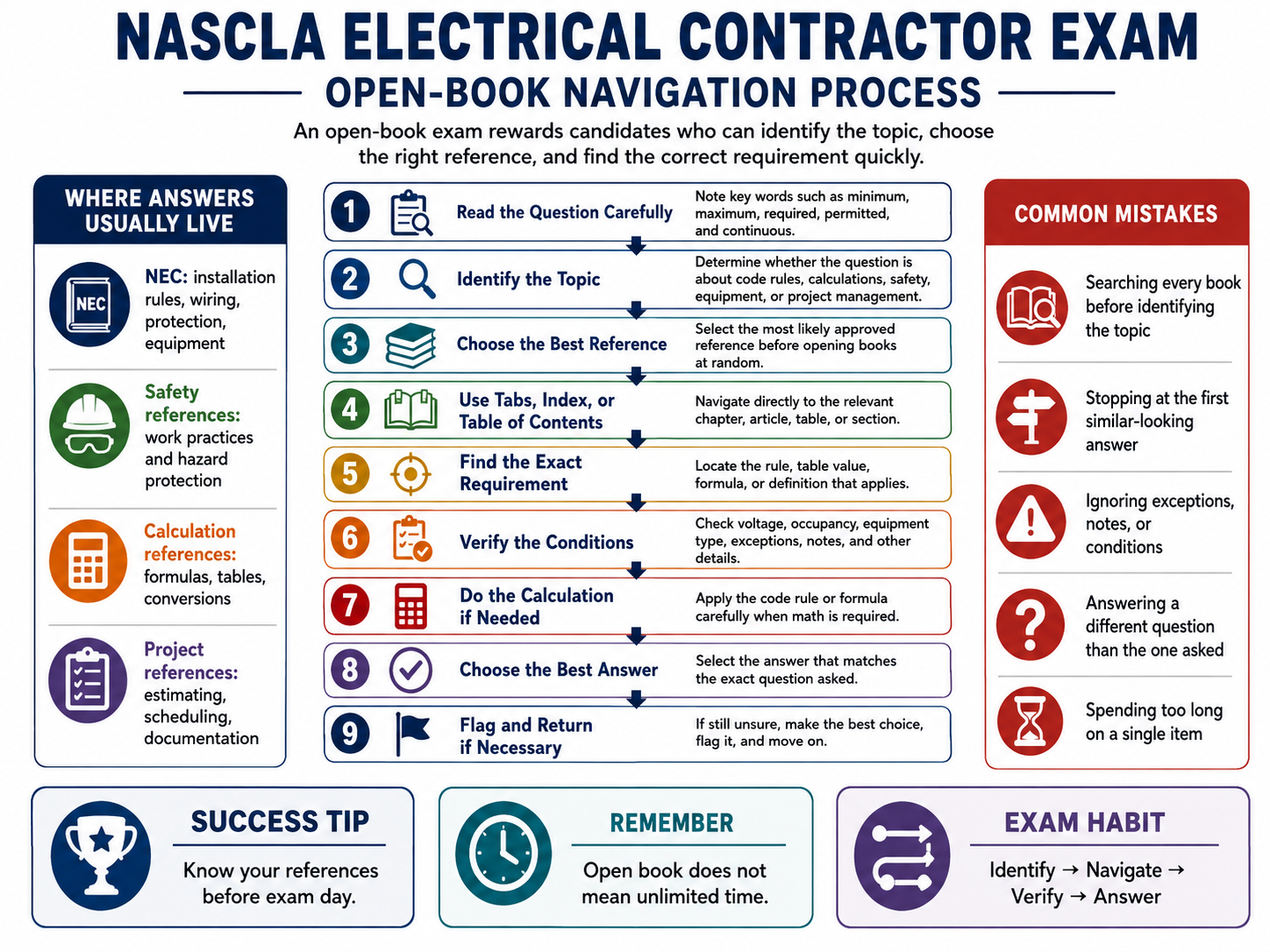
Use the Same Basic Sequence for Every Reference Question
A repeatable process reduces wasted movement between references and helps prevent candidates from locating a familiar rule that does not actually apply to the condition described in the question.
Read the Question Carefully
Read the complete question before opening a reference. Identify important words such as minimum, maximum, required, permitted, continuous, readily accessible, within sight, service, feeder, branch circuit, dwelling, or other terms that define the problem.
Identify the Topic
Determine whether the question is primarily about an NEC installation requirement, electrical theory, safety, project management, energy requirements, equipment, calculations, or another identifiable subject.
Choose the Best Reference
Select the approved reference most likely to contain the answer before opening books at random.
Use Tabs, Indexes, or the Table of Contents
Navigate directly toward the relevant chapter, Article, Section, table, formula, or subject using the organization of the reference and the permitted preparation completed before the exam.
Find the Exact Requirement
Locate the specific rule, definition, table value, formula, or technical information needed to answer the question rather than stopping at the first similar-looking statement.
Verify the Conditions
Confirm that the requirement applies to the voltage, occupancy, conductor, equipment, wiring method, location, system type, or other conditions stated in the question.
Perform the Calculation When Required
When the rule provides information needed for a calculation, apply the appropriate formula or Code procedure carefully and keep track of units.
Choose the Best Answer
Select the answer choice that correctly responds to the question after the applicable information has been verified.
Move Forward When Necessary
If a question remains difficult after a reasonable effort, make the best supported choice and continue. Return to earlier questions later when permitted by the testing interface and when examination time remains.
Identify → Navigate → Verify → Answer
The most useful open-book habit can be reduced to four actions: identify the subject, navigate to the likely source, verify that the information applies, and answer the actual question.
Skipping the first step leads to random searching. Skipping verification leads to using rules that look familiar but apply to different conditions.
Know Where Different Types of Answers Usually Live
Reference recognition should become automatic enough that certain question types immediately suggest a likely starting book.
NEC
Begin with the National Electrical Code when the question asks about installation requirements, wiring, conductors, protection, grounding, bonding, equipment, special systems, or communication-system requirements.
OSHA 29 CFR 1926
Use the construction-safety reference when the question involves workplace safety during construction activities such as excavations, ladders, temporary work, employee protection, or related jobsite hazards.
OSHA 29 CFR 1910
Use the general-industry OSHA reference when the safety question concerns workplace requirements outside the construction-specific context.
NFPA 70E
Use NFPA 70E when the question concerns electrical safety-related work practices, shock protection, arc-flash hazards, electrically safe work conditions, or related worker-protection requirements.
Electrical Theory References
Use approved electrical-theory or field references when the question requires formulas, electrical relationships, conversions, transformer calculations, three-phase calculations, or similar technical information.
Project References
Use the applicable project-management or contractor reference when the question addresses estimating, scheduling, documentation, contracts, stakeholders, project controls, or related management responsibilities.
Recognize the Code Structure Before Using the Index
Many examination questions can be located more efficiently when the candidate understands the general organization of the National Electrical Code. Knowing approximately where a subject belongs can be faster than beginning every search at the back of the book.
Chapters 1–4
These chapters generally contain broad rules that apply to electrical installations, including general requirements, wiring and protection, wiring methods, and equipment for general use.
Chapters 5–7
These chapters address special occupancies, special equipment, and special conditions that modify or supplement the general requirements.
Chapter 8
Chapter 8 addresses communication systems and has a somewhat different relationship to the preceding chapters than ordinary power-wiring Articles.
Chapter 9 and Annexes
Chapter 9 contains tables used for conductor and raceway calculations, while informational annexes provide supporting information where applicable.
Go Directly to the Article When You Recognize the Subject
Repeated study should make several major NEC Articles familiar enough that the candidate can navigate directly to them without using the index for every question.
Article 100
Definitions used throughout the Code.
Article 110
General requirements for electrical installations, including equipment installation and working-space subjects.
Article 210
Branch circuits and many branch-circuit installation requirements.
Article 215
Feeders and feeder-related requirements.
Article 230
Services, service conductors, and service equipment.
Article 250
Grounding and bonding requirements.
Chapter 3
Wiring methods, conductors, raceways, cables, boxes, and related installation requirements.
Article 430
Motors, motor branch circuits, overload protection, controllers, disconnects, and related requirements.
Do Not Memorize Page Numbers
Page numbers can change between the NEC and NEC Handbook and between different editions or printings. Article numbers, table numbers, subjects, and Code structure are more durable navigation tools.
Train yourself to think “grounding and bonding — Article 250” rather than “grounding is on page 168.”
Search for the Code Term, Not the Entire Question
The NEC index is most effective when the candidate reduces a question to one or two technical concepts rather than attempting to find the complete wording of the question.
Identify the Object or Condition
Determine whether the question concerns a motor, transformer, service, receptacle, grounding electrode, conductor, raceway, working space, swimming pool, photovoltaic system, or another identifiable subject.
Choose the Technical Term
Use terminology likely to appear in the Code rather than conversational wording that may have been used in the question.
Read the Subentries
Look for the specific condition being tested, such as sizing, location, disconnecting means, overcurrent protection, bonding, working clearance, or permitted wiring method.
Go to the Referenced Section
Use the index only as a navigation tool. The actual answer should be based on the Code Section, table, or other applicable requirement.
Use the Table of Contents for Broad Subjects
The table of contents can be faster than the index when the candidate knows the general Article or chapter but needs to locate a specific Part within it.
This is particularly useful in large Articles such as grounding and bonding, motors, hazardous locations, or photovoltaic systems where multiple Parts divide the subject into distinct requirements.
Finding the Correct Table Is Only the First Step
Electrical examinations frequently use tables for conductor ampacity, grounding-conductor sizing, conductor dimensions, raceway fill, motor values, and other calculations.
A candidate can reach the correct table quickly and still answer incorrectly by selecting the wrong column or failing to apply conditions that appear elsewhere in the Code.
Verify the Table Purpose
Read the title and confirm that the table addresses the quantity being requested.
Identify the Correct Column
Check conductor material, temperature rating, insulation, voltage, motor type, raceway condition, or other factors that determine which column applies.
Read Applicable Notes
Notes associated with a table may establish important limitations or direct the candidate to another requirement.
Apply Other Required Rules
A table value may be only one step in the final answer. Adjustment factors, correction factors, terminal limitations, load multipliers, or other Code provisions may still apply.
The First Similar-Looking Rule May Not Be the Correct Rule
One of the most important open-book skills is recognizing that Code requirements frequently depend on specific conditions. Two questions that appear similar may have different answers because one important fact has changed.
Voltage
Working space, equipment requirements, insulation, clearances, and other provisions may change according to system voltage.
Occupancy
Dwellings, health care facilities, hazardous locations, assembly areas, marinas, and other occupancies can have specialized requirements.
Equipment Type
Motors, transformers, HVAC equipment, generators, photovoltaic systems, batteries, and other equipment may each have specialized Articles.
Location
Wet, damp, dry, corrosive, underground, hazardous, readily accessible, within sight, or exposed conditions can affect the applicable rule.
Read Beyond the First Sentence
A candidate who stops reading as soon as a familiar phrase appears can miss an exception, condition, cross-reference, or table that changes the answer.
When a Code Section appears to answer the question, read enough surrounding material to determine whether the rule has exceptions or qualifications that apply to the stated installation.
Exam habit: Finding the right Article is not the same as finding the right answer. Verify the complete applicable requirement.
Separate the Reference Search From the Math
Calculation questions often combine a Code lookup with an electrical calculation. Treating these as separate steps helps prevent mistakes.
Determine What Must Be Calculated
Identify the final quantity required by the question before searching for numbers or formulas.
Locate Required Reference Values
Find conductor ampacity, motor current, grounding-conductor size, allowable raceway area, demand factor, or other required information.
Perform the Calculation
Apply the appropriate equation or Code procedure using the verified reference information.
Return to the Code if Necessary
Confirm whether rounding rules, minimum sizes, maximum sizes, standard overcurrent-device ratings, or other requirements affect the final answer.
Open Book Does Not Mean Unlimited Lookup Time
The current Electrical Contractor examination allows 270 minutes for 100 questions, an overall average of approximately 2.7 minutes per question.
Some questions can be answered quickly, allowing additional time for difficult reference searches and calculations. A candidate should nevertheless recognize when one question is consuming too much time compared with its value as a single examination item.
If a question remains unresolved after a reasonable effort, make the best supported selection, continue through the exam, and return later when the computer-based testing interface and remaining time permit.
Recognize the Behaviors That Waste Time
Searching Every Book
Opening several references before identifying the subject wastes time and increases the chance of using information from the wrong source.
Stopping at the First Similar Answer
A familiar value may apply to another voltage, conductor, occupancy, equipment type, or installation condition.
Ignoring Exceptions
Exceptions and special conditions can change what would otherwise appear to be the general rule.
Answering a Different Question
Finding technically correct information does not help if it answers a related question rather than the specific quantity or condition requested.
Using Field Memory Instead of the Reference
Professional experience is valuable, but examination questions may test exact Code requirements that differ from a remembered rule of thumb or common field practice.
Spending Too Long on One Item
A difficult lookup is still associated with one examination question. Protect enough time to reach the remainder of the test.
Practice Navigation Separately From Practice Exams
Open-book navigation can be trained as a separate skill. A candidate does not need to complete a full 100-question examination every time reference speed is practiced.
Select Ten Random Topics
Choose subjects from different examination domains such as services, grounding, motors, working space, arc-flash safety, project management, conductor ampacity, photovoltaic systems, and energy controls.
Identify the Reference First
Before opening any book, state which reference you believe contains the applicable information.
Start With All Books Closed
Simulate the physical navigation required during the actual open-book examination.
Time the Lookup
Measure how long it takes to reach and verify the correct information, not merely how long it takes to reach the correct page.
Review Slow Searches
Determine whether a better index term, permanent tab, table-of-contents route, or stronger understanding of the reference structure would make the search faster next time.
Practice Until Reference Selection Becomes Automatic
The greatest time savings occur before the lookup begins. If the candidate immediately recognizes “working space” as an NEC subject, “arc-flash boundary” as an NFPA 70E subject, and “construction excavation safety” as an OSHA construction subject, several unnecessary searches have already been eliminated.
Repeated practice should make the first question increasingly automatic: Which reference is most likely to contain this answer?
Check Your Understanding
First Step in a Lookup
A candidate encounters an unfamiliar open-book question. What should generally happen before searching the reference library?
A. Open every approved book to its index.
B. Identify what the question is asking and determine the likely subject.
C. Begin with the largest reference book.
D. Search every permanent tab until familiar wording appears.
Selecting the Reference
A question asks about an arc-flash hazard associated with electrical work. Which approved reference category should generally be considered first?
A. NFPA 70E
B. PMBOK Guide
C. ASHRAE 90.1
D. NEC Chapter 8
Using the NEC Index
What is the best use of the NEC index during an examination lookup?
A. Treat the index entry itself as the final Code requirement.
B. Use the index to identify a likely Code location and then read the actual applicable Section.
C. Search complete sentences from the examination question.
D. Use the index only after searching every tab in the book.
Verifying a Table Value
A candidate reaches a conductor ampacity table and sees a value matching one of the answer choices. What should happen next?
A. Select the matching answer immediately.
B. Verify that the correct conductor material, temperature column, and other applicable conditions have been used.
C. Ignore the table and use memory.
D. Select the largest conductor shown anywhere on the page.
Managing a Difficult Lookup
A question remains unresolved after a lengthy reference search and substantial examination time remains. Which general approach is most appropriate?
A. Continue searching indefinitely until completely certain.
B. Make the best supported choice, continue through the exam, and return later if the testing interface and remaining time permit.
C. Leave the examination immediately.
D. Skip all remaining reference questions.
Review the Reasoning
Question 1 — B
Efficient navigation begins by understanding what the question asks and identifying the subject. Only then can the most likely reference be selected.
Question 2 — A
NFPA 70E addresses electrical safety-related work practices and arc-flash hazards, making it the appropriate starting reference for this type of question.
Question 3 — B
The index is a navigation tool. The candidate should follow the index entry to the applicable Code Section and base the answer on the actual requirement.
Question 4 — B
A matching table value is not enough. The candidate must verify that the correct material, column, temperature rating, and other required conditions apply.
Question 5 — B
One unresolved question should not consume the time required to reach several other questions. Make the best supported choice and return later when permitted and practical.
Use the Current Candidate Information Bulletin
The open-book testing format and reference-navigation guidance in this lesson reflect the current published NASCLA and PSI examination information available when this lesson was prepared. The current Electrical Contractor examination is open book and computer administered.
Testing procedures, reference lists, permitted materials, computer-interface features, and administrative requirements can change. Review the current Candidate Information Bulletin before taking the examination.
What You Should Take From This Lesson
Identify the Subject Before Opening a Book
Understanding what the question asks is the first and most important step in an efficient reference lookup.
Choose the Most Likely Reference
NEC installation questions, OSHA workplace-safety questions, NFPA 70E safe-work questions, electrical-theory calculations, and project-management subjects generally lead toward different references.
Use the Reference Structure
Permanent tabs, the table of contents, indexes, Articles, Parts, Sections, and tables should work together as a navigation system.
Verify the Complete Requirement
Check conditions, exceptions, table headings, notes, voltage, occupancy, equipment type, and other details before selecting the answer.
Separate Lookups From Calculations
Locate and verify the required reference information first, then perform the electrical calculation using the correct values and procedures.
Protect Examination Time
A difficult question is still one question. Move forward when necessary and return later when permitted and when time remains.
Practice Navigation as a Separate Skill
Timed reference drills develop the speed and familiarity needed to take advantage of the open-book examination format.
Leave a Reply
You must be logged in to post a comment.