Back to: NASCLA Master Electrical Contractor Exam Preparation
Many electrical examination errors occur even when the candidate understands the technical subject. A missed qualifier, incorrect voltage range, overlooked condition, wrong unit, or misunderstanding of what the question actually asks can turn correct electrical knowledge into an incorrect answer.
Successful NASCLA exam preparation therefore includes learning how to dissect a question before beginning a Code lookup or calculation. The candidate should identify the subject, isolate the given conditions, determine exactly what information is being requested, evaluate the answer choices, and then use the appropriate reference or calculation process to select the best answer.
Read the Question Before Trying to Solve It
Electrical exam questions often contain several pieces of information, but not every word serves the same purpose. Some words identify the electrical subject, some establish the operating conditions, some define exactly what quantity is being requested, and others distinguish the correct answer from several plausible distractors.
A candidate who immediately starts searching the Code after recognizing one familiar term may miss another condition that changes the applicable rule. Likewise, beginning a calculation before determining what the final answer must represent can waste time and lead to solving the wrong problem.
The most reliable approach is to separate the question into its component parts before selecting a reference or formula.
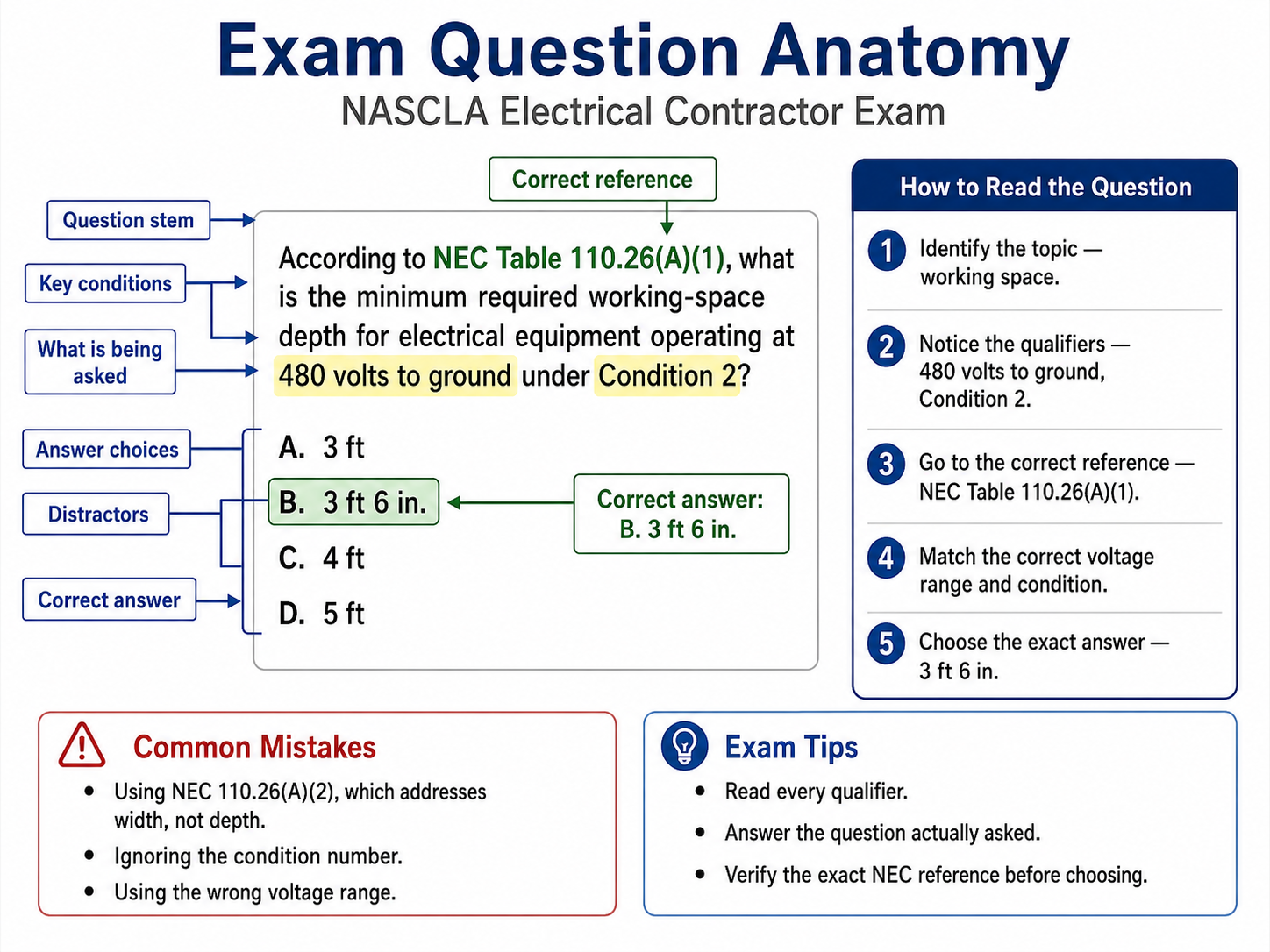
Every Question Contains Several Different Pieces
Question Stem
The stem presents the electrical, safety, project, or calculation problem that must be solved.
Given Information
Voltage, current, conductor size, equipment rating, occupancy, location, number of conductors, system configuration, or other facts establish the conditions under which the answer must be determined.
What Is Being Asked
The question may request a conductor size, overcurrent-device rating, working-space dimension, calculated load, voltage drop, box volume, raceway size, safety requirement, or another specific result.
Answer Choices
Several choices may represent legitimate electrical values, but only one should correctly answer the question under the stated conditions.
Distractors
Incorrect choices may represent common mistakes such as using the wrong table column, overlooking a multiplier, choosing a nearby standard size, confusing minimum with maximum, or applying a rule from a similar installation.
Reference Location
When a specific requirement is being tested, the candidate should identify and verify the exact Code Section, table, safety reference, or other approved source that supports the answer.
Identify the Subject
Before searching a reference, determine what general subject the question concerns. The subject determines which book, Code Article, chapter, table, or calculation method is most likely to be useful.
Working Space
A question about clearance around electrical equipment should suggest the general NEC installation requirements rather than motor, transformer, or conductor Articles.
Motor Protection
A question involving motor conductors, overloads, controllers, or disconnects should direct attention toward motor requirements.
Arc-Flash Safety
A question involving electrical safe-work practices or arc-flash hazards should suggest NFPA 70E rather than an NEC installation rule.
Project Scheduling
A contractor-management question may require a project-management reference rather than any electrical Code book.
Identify the Qualifiers and Conditions
Qualifiers are words or values that determine which requirement applies. Two questions may appear nearly identical but have different correct answers because one important condition changes.
Voltage
A working-space, conductor, equipment, or insulation requirement may change depending on the applicable voltage range.
Condition Number
Some NEC tables contain different values according to installation conditions. Selecting the correct voltage range without selecting the correct condition can still produce the wrong answer.
Occupancy
Dwelling units, health care facilities, hazardous locations, assembly occupancies, marinas, and similar installations can have specialized requirements.
Equipment Type
Motors, transformers, HVAC equipment, generators, photovoltaic systems, batteries, and other equipment can have specialized Articles or sizing procedures.
Location
Wet, damp, dry, hazardous, underground, accessible, readily accessible, or within-sight conditions can affect what is permitted or required.
Load Classification
Continuous and noncontinuous loads may require different treatment when determining conductor or overcurrent-device sizing.
Highlight the Qualifiers Mentally Before You Look Anything Up
In the example image, “480 volts to ground” and “Condition 2” are not background information. They are the facts needed to select the correct row and column of NEC Table 110.26(A)(1).
Ignoring either qualifier can produce a different working-space value even though the candidate found the correct table.
Determine Exactly What the Question Wants
Before performing a lookup or calculation, state the requested result in simple terms. This prevents solving a related problem that the question never asked.
Minimum
The question asks for the smallest value that satisfies the applicable requirement.
Maximum
The question asks for the greatest value or limit allowed under the stated conditions.
Required Size
Determine whether the requested size applies to a conductor, raceway, box, grounding conductor, overcurrent device, disconnect, or another component.
Calculated Value
The question may ask for amperes, watts, volt-amperes, voltage drop, resistance, demand load, or another calculated quantity rather than a final equipment selection.
Exam habit: Before touching the calculator or opening a reference, complete the sentence: “This question wants me to find ______.”
Small Words Can Completely Change the Answer
Minimum
Look for the least value that satisfies the Code or applicable reference.
Maximum
Look for the greatest permitted value, rating, size, distance, or other limit.
Required
The question asks what must be provided rather than what may optionally be used.
Permitted
The question asks what is allowed, which may not be the same as what is mandatory.
Shall
Mandatory Code language normally establishes a requirement that must be satisfied unless another applicable provision modifies it.
Not / Except
Negative wording reverses the task. The candidate may be looking for the one choice that is prohibited, incorrect, or excluded rather than the normally compliant choice.
Slow Down When You See NOT, EXCEPT, or INCORRECT
A candidate who knows the material well can still miss a negative question because the familiar correct condition attracts attention first.
When a question asks which condition is not permitted, which statement is incorrect, or which item is an exception, mentally repeat the negative wording before selecting an answer.
Use the Choices as Information, but Do Not Let Them Control the Problem
Answer choices can help reveal the type of mistake the question is testing. Closely spaced conductor sizes, similar working-space dimensions, or different percentages may indicate that the candidate must apply a specific table, multiplier, or Code condition carefully.
However, beginning with the choices and trying to force one of them to work can lead away from the proper solution. Whenever practical, determine the requirement or calculation first and then compare the result with the choices.
Wrong Answers Are Often Based on Predictable Mistakes
A distractor is an incorrect answer that appears plausible because it corresponds to a common misunderstanding or calculation error.
Wrong Voltage Range
The answer may be correct for a different system voltage but not for the voltage stated in the question.
Wrong Table Column
A candidate may correctly locate the table but use the wrong conductor material, temperature column, condition number, or equipment classification.
Missing Multiplier
An answer may represent the unadjusted load or conductor value before a required percentage or factor is applied.
Wrong Code Subsection
A nearby subsection may address width instead of depth, rating instead of sizing, or a related but different requirement.
Wrong Unit
Feet, inches, millimeters, volts, kilovolts, amperes, milliamperes, watts, kilowatts, and other unit differences can produce plausible but incorrect choices.
Field Rule of Thumb
An answer may resemble a common field practice even though the question asks for the exact Code requirement.
The Exact Section Matters
The corrected Lesson 7 image demonstrates an important point: NEC 110.26(A)(1) addresses working-space depth, while 110.26(A)(2) addresses width.
The two provisions are located next to one another and concern the same general subject, but they answer different questions. Correct navigation therefore requires more than reaching Article 110 or even Section 110.26. The candidate must confirm the subsection or table that addresses the specific quantity requested.
Reference rule: Nearby Code language may be related without being interchangeable. Match the reference to the exact question.
Working-Space Question
Consider the question shown in the lesson image:
According to NEC Table 110.26(A)(1), what is the minimum required working-space depth for electrical equipment operating at 480 volts to ground under Condition 2?
Identify the Topic
The subject is electrical equipment working space.
Identify the Requested Quantity
The question asks for minimum working-space depth, not width, height, dedicated space, or equipment-room access.
Identify the Voltage
The equipment operates at 480 volts to ground, placing the question in the applicable voltage range of Table 110.26(A)(1).
Identify the Condition
The question explicitly specifies Condition 2, so the Condition 2 column must be used rather than Condition 1 or Condition 3.
Read the Correct Table Intersection
The applicable row and Condition 2 column provide a minimum working-space depth of 3 feet 6 inches.
Select the Matching Choice
The correct answer is 3 feet 6 inches.
Confirm the Units Before Selecting an Answer
Electrical examination calculations can be mathematically correct and still produce the wrong answer when units are not converted correctly.
Feet and Inches
A dimension of 3.5 feet is equivalent to 3 feet 6 inches, not 3 feet 5 inches.
Watts and Kilowatts
1 kilowatt equals 1,000 watts. Confirm whether the answer choices use the same unit as the calculation.
Amperes and Milliamperes
Current values can differ by a factor of 1,000 when amperes and milliamperes are confused.
Single-Phase and Three-Phase
The same voltage and load can require different current calculations depending on the electrical system configuration.
Do Not Calculate Until the Problem Is Defined
Calculation questions should be interpreted before numbers are entered into a calculator. Identify the requested quantity, separate useful information from unrelated information, select the appropriate formula or Code method, and confirm whether additional requirements must be applied after the arithmetic is complete.
Write Down What You Need
Identify the final requested quantity, such as amperes, conductor size, voltage drop, box volume, or overcurrent-device rating.
Extract the Given Values
Identify only the voltage, load, length, conductor material, phase, power factor, or other values required for the calculation.
Select the Method
Determine whether the problem uses electrical theory, a Code multiplier, a table, a demand factor, or a combination of several steps.
Calculate
Perform the arithmetic carefully and retain meaningful units throughout the calculation when practical.
Apply Final Code Rules
Determine whether standard sizes, minimum conductor requirements, maximum protection limits, or another Code rule changes the final selection.
Not Every Number in a Question Must Be Used
Some exam questions may contain information that establishes context but does not affect the requested answer. Candidates should avoid assuming that every number must appear somewhere in the calculation.
The safest method is to determine what information is logically necessary to solve the requested problem and then verify whether each given value affects that process.
Do Not Invent a Use for an Unneeded Number
If the applicable Code table requires only voltage and installation condition, another equipment rating included in the scenario may not affect that particular question.
Using every number simply because it appears in the stem can create an unnecessary calculation and move the candidate away from the applicable requirement.
Eliminate Answers for a Technical Reason
When the correct answer is not immediately obvious, eliminating choices can improve the probability of selecting the correct response. Elimination should be based on technical reasoning rather than appearance.
Wrong Unit
Eliminate an answer expressed in a unit that cannot represent the requested quantity unless conversion makes it equivalent.
Impossible Value
An answer that violates a known physical or electrical relationship can often be eliminated before a detailed lookup.
Wrong Condition
A value recognized from another table column or installation condition can be rejected when the question establishes different conditions.
Wrong Quantity
An answer may represent conductor ampacity when the question asks for overcurrent protection or represent connected load when the question asks for demand load.
Before Selecting an Answer, Ask Five Questions
Did I Answer the Quantity Requested?
Confirm that the result represents the specific dimension, rating, size, current, load, or requirement requested.
Did I Use the Correct Conditions?
Check voltage, occupancy, equipment type, location, load classification, conductor material, or other qualifiers.
Did I Use the Correct Reference?
Confirm that the applicable Code Section, table, safety reference, or technical source actually addresses the subject.
Are the Units Correct?
Verify that any conversions have been performed correctly and that the result matches the units used in the answer choices.
Does the Answer Make Sense?
Use electrical judgment to identify an obviously unreasonable result before committing to the answer.
Check Your Understanding
Recognizing the Qualifier
A Code table provides different values for Condition 1, Condition 2, and Condition 3. The examination question specifies Condition 2. What should the candidate do?
A. Use Condition 1 because it appears first.
B. Use the largest value in the table.
C. Use the Condition 2 value for the applicable voltage range.
D. Average all three conditions.
Negative Wording
A question asks which wiring method is NOT permitted under the stated conditions. What is the most important reading step?
A. Ignore the word NOT and choose the most familiar wiring method.
B. Recognize that the question is asking for the prohibited choice rather than a permitted choice.
C. Choose the first answer that is normally permitted.
D. Select the largest wiring method listed.
Exact Code Reference
A candidate finds NEC 110.26(A)(2) while answering a question about working-space depth. What should the candidate recognize?
A. The subsection is correct because every part of 110.26 addresses depth.
B. 110.26(A)(2) addresses width, so the candidate should verify 110.26(A)(1) for depth.
C. Working-space depth is located only in Chapter 9.
D. The reference does not matter if one answer looks familiar.
Distractor Recognition
A calculation produces 24 amperes before applying a required 125% factor. One answer choice is 24 amperes and another is 30 amperes. What is the likely purpose of the 24-ampere choice?
A. It may be a distractor representing failure to apply the required factor.
B. It must be correct because it is the first calculation result.
C. It should always be rounded down.
D. The factor should be ignored whenever the unadjusted value appears as an answer choice.
Units
A calculation produces 3.5 feet and the answer choices are listed in feet and inches. Which value is equivalent?
A. 3 ft 5 in.
B. 3 ft 6 in.
C. 3 ft 8 in.
D. 4 ft 5 in.
Review the Reasoning
Question 1 — C
The stated condition is part of the problem definition. The candidate must use Condition 2 together with the applicable voltage range.
Question 2 — B
The word NOT reverses the normal task. The correct response is the choice that is not permitted under the stated conditions.
Question 3 — B
NEC 110.26(A)(1) addresses working-space depth, while 110.26(A)(2) addresses working-space width.
Question 4 — A
A distractor frequently represents a predictable incomplete calculation. If 125% is required, 24 amperes is only an intermediate result, while 24 × 1.25 equals 30 amperes.
Question 5 — B
One-half foot equals 6 inches, so 3.5 feet equals 3 feet 6 inches.
Read the Current Candidate Information Bulletin
The question-reading strategies in this lesson are based on the current NASCLA Electrical Contractor examination framework, which uses a computer-administered, multiple-choice, open-book format.
Testing procedures and computer-interface features may change. Review the current NASCLA and PSI Candidate Information Bulletin before the examination and follow the instructions provided by the test administrator.
What You Should Take From This Lesson
Read the Entire Question
Do not begin the lookup or calculation until you understand the complete problem.
Identify the Qualifiers
Voltage, condition number, occupancy, equipment type, location, load classification, and other details can determine which rule applies.
Determine What Is Being Asked
Know whether the question wants a minimum, maximum, conductor size, overcurrent rating, calculated value, working-space dimension, or another specific result.
Watch Key Words
Minimum, maximum, required, permitted, not, except, continuous, accessible, and similar qualifiers can completely change the answer.
Recognize Distractors
Incorrect choices often represent the wrong voltage range, wrong table column, missing multiplier, wrong unit, or incomplete calculation.
Verify the Exact Reference
Reaching the correct Article is not enough when another subsection or table addresses the specific quantity being asked.
Check Units and Reasonableness
Before selecting the answer, verify the units and confirm that the result makes sense electrically.
Leave a Reply
You must be logged in to post a comment.