R-32 Refrigerant
R-32 is a single-component HFC refrigerant increasingly used in residential and light-commercial air-conditioning and heat-pump equipment. It has substantially lower global warming potential than R-410A while providing useful thermodynamic characteristics for modern high-efficiency systems.
R-32 is classified A2L, meaning that it combines lower toxicity with lower flammability. Its introduction therefore requires technicians to combine familiar refrigeration principles with the A2L service practices introduced in the previous lesson.
What You Will Learn
After completing this lesson, you should be able to:
Identify R-32
Recognize R-32 as a single-component HFC refrigerant with an A2L safety classification.
Explain Its Environmental Advantage
Compare the global warming potential of R-32 with R-410A and explain why R-32 is being used in newer equipment.
Recognize R-32 Operating Characteristics
Understand R-32 pressure-temperature behavior, discharge-temperature considerations, and its use in equipment specifically designed for the refrigerant.
Apply A2L Safety Practices
Recognize the importance of ventilation, ignition-source control, leak detection, recovery, and appropriate service tools.
Compare R-32 With R-410A
Explain why R-32 is chemically related to R-410A but is not a drop-in replacement for an R-410A system.
Service R-32 Correctly
Recognize refrigerant identification, lubricant, charging, recovery, and equipment-specific requirements for R-32 systems.
A Single-Component HFC Refrigerant
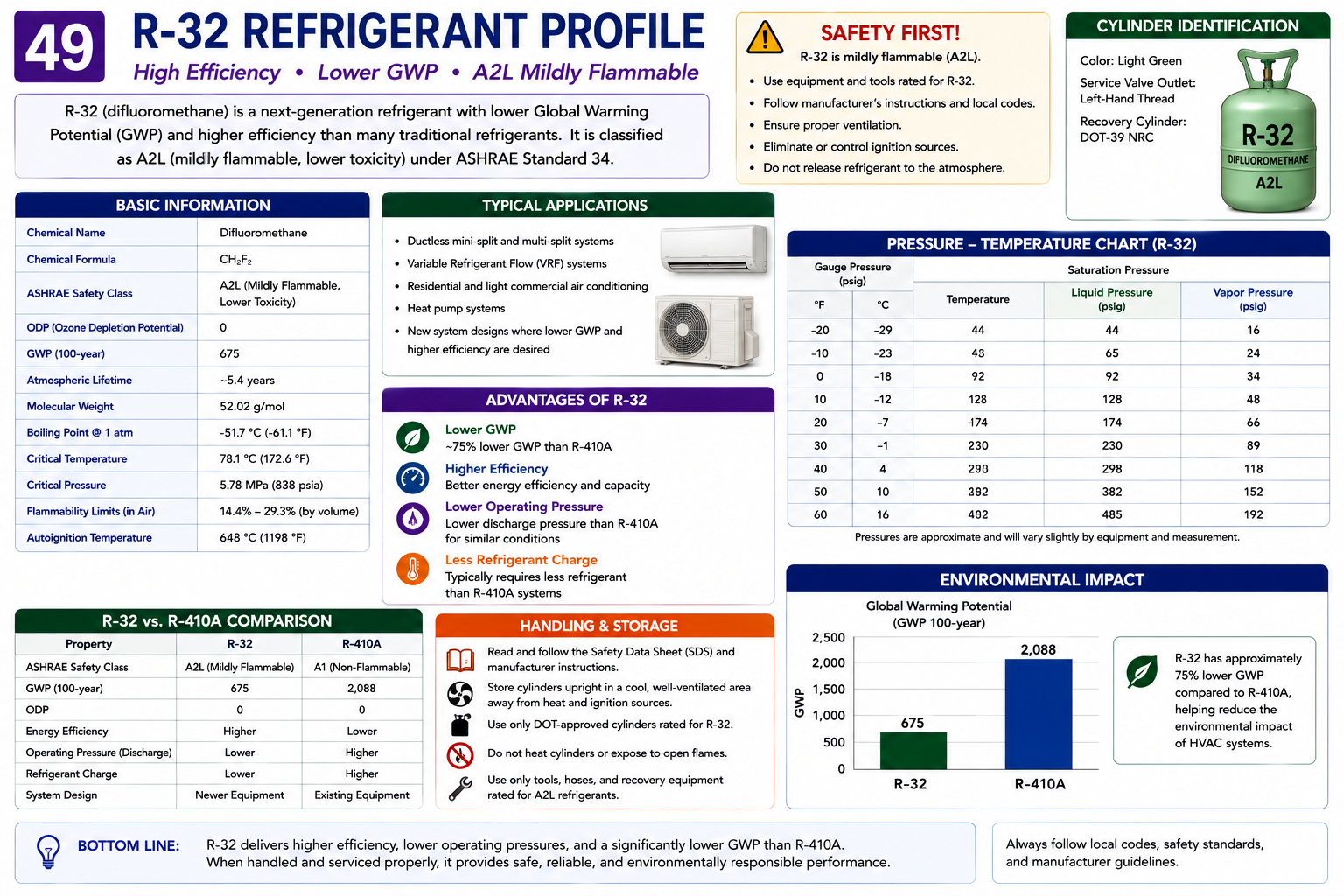
R-32 is the refrigerant designation for difluoromethane. It is an HFC containing hydrogen, fluorine, and carbon and does not contain chlorine.
Unlike R-410A and R-454B, R-32 is not a refrigerant blend. It is a single-component refrigerant and therefore does not experience blend fractionation or temperature glide.
Designation
R-32
Chemical Name
Difluoromethane
Family
HFC — hydrofluorocarbon.
Composition
Single-component refrigerant.
Safety Classification
ASHRAE A2L.
Typical Lubricant
POE lubricants are commonly used in equipment designed for R-32, according to manufacturer specifications.
Zero ODP and Lower GWP Than R-410A
R-32 contains no chlorine and therefore has an ozone depletion potential of zero.
Its 100-year global warming potential is 675 using the value applied by EPA in its current HFC Technology Transitions reference table. This is substantially below R-410A, whose GWP is approximately 2,088.
R-32
ODP: 0
GWP: 675
R-410A
ODP: 0
GWP: approximately 2,088
R-32 provides a substantial reduction in direct climate impact compared with R-410A while retaining useful performance characteristics for modern comfort-cooling equipment.
You Have Already Worked With R-32 — As Part of a Blend
R-32 is not new to the refrigeration industry. It is one of the two components used to make R-410A.
R-410A is composed of approximately equal proportions of R-32 and R-125. In R-410A, the R-125 component helps change the characteristics of the finished blend, including its flammability classification.
Pure R-32 and R-410A are different refrigerants. The fact that R-32 is a component of R-410A does not make the two products interchangeable.
Related Refrigerants With Important Differences
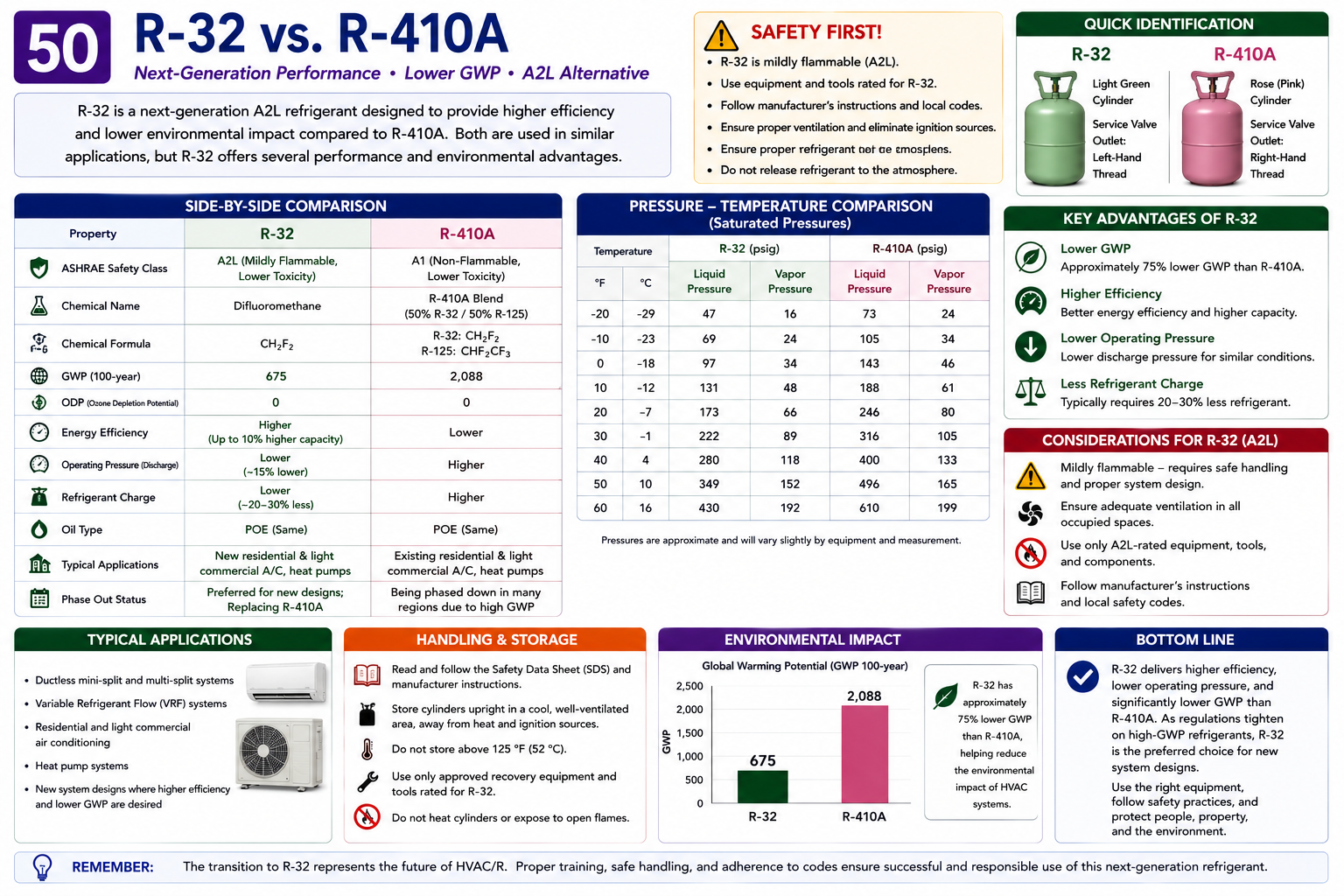
| Characteristic | R-32 | R-410A |
|---|---|---|
| Family | HFC | HFC blend |
| Composition | Single component | R-32 / R-125 |
| ASHRAE Safety Class | A2L | A1 |
| ODP | 0 | 0 |
| GWP | 675 | Approximately 2,088 |
| Temperature Glide | None | Very small |
| Flammability Consideration | Lower flammability | No flame propagation under classification test conditions |
| Equipment | Designed specifically for R-32 | Designed specifically for R-410A |
R-32 Is a High-Pressure Refrigerant
R-32 operates at pressures familiar in magnitude to technicians experienced with R-410A, but the pressure-temperature relationships are not identical.
Technicians must use R-32-specific P-T data when calculating saturation temperature, superheat, subcooling, or evaluating system operation.
Do not assume an R-32 system should show a particular pressure merely because the technician is familiar with R-410A. Equipment design, load, airflow, temperatures, and the actual R-32 P-T relationship must all be considered.
No Temperature Glide or Fractionation
One service advantage of R-32 is that it is a single-component refrigerant. Its chemical composition does not depend on maintaining proportions among multiple blend components.
R-32 therefore does not have the bubble/dew separation, temperature glide, or blend fractionation concerns encountered with a zeotropic refrigerant such as R-407C.
R-32
Single component.
One saturation temperature at a given saturation pressure.
R-407C
Zeotropic blend.
Separate bubble and dew saturation temperatures.
Blend Behavior
For a detailed example of temperature glide, bubble point, dew point, and fractionation, review R-407C Refrigerant.
Single Component Simplifies Composition — Not Safety
Because R-32 is a single-component refrigerant, withdrawing vapor or liquid from a cylinder does not alter its chemical composition through fractionation.
The actual charging procedure still depends on the equipment manufacturer’s instructions, system design, and whether the equipment is operating during charging.
Single-component refrigerant does not mean “charge any way you want.” Charge by the method and quantity specified by the equipment manufacturer and prevent uncontrolled liquid from entering the compressor.
R-32 Is Lower Flammability — Not Nonflammable
R-32 is classified A2L. The A indicates the lower-toxicity classification, while 2L identifies lower flammability with low burning velocity.
This is a fundamental difference from R-410A, which is classified A1.
R-410A = A1.
R-32 = A2L.
A2L Refrigerant Safety
Ignition sources, ventilation, leak detection, service tools, equipment design, and the difference between A1, A2L, and A3 refrigerants were covered in Introduction to A2L Refrigerants.
Service the Refrigerant According to Its A2L Classification
When a refrigeration circuit containing R-32 is opened or a leak is suspected, technicians must consider whether refrigerant could accumulate and whether potential ignition sources are present.
Open flames, smoking materials, sparks, electrical arcs, hot-work operations, and other potential ignition sources must be addressed according to the equipment manufacturer’s procedures and applicable safety requirements.
Identify the refrigerant, evaluate ventilation, control ignition sources, and use suitable equipment before opening an R-32 system.
A2L Procedures Apply Throughout the Service Process
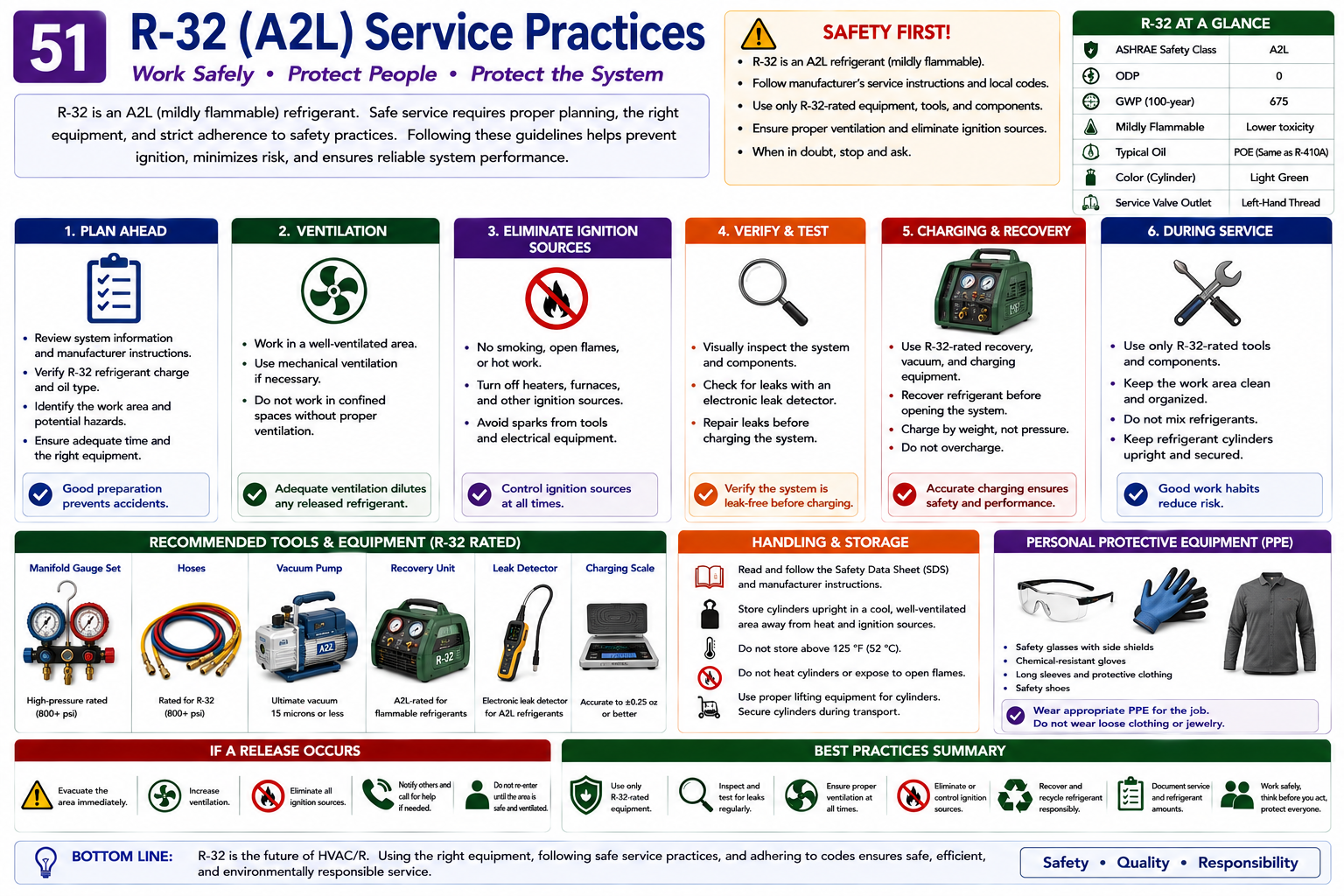
Verify R-32
Read the equipment nameplate and service labels before connecting equipment.
Evaluate the Work Area
Consider ventilation, possible refrigerant accumulation, and ignition sources.
Recover Properly
Use recovery equipment suitable for R-32 and its A2L classification.
Leak Test Correctly
Use approved methods and a leak detector suitable for R-32.
Evacuate and Charge
Follow manufacturer procedures using equipment suitable for R-32 service.
Verify Safe Operation
Check system operation, leak integrity, safety components, and required documentation before leaving the equipment.
Verify Tool Compatibility
Many ordinary hand tools used during HVAC service remain unchanged, but tools that contain refrigerant, handle refrigerant vapor, or contain electrical components require special attention.
Recovery Machine
Must be suitable for R-32 and A2L refrigerant service.
Leak Detector
Must be capable of detecting R-32 and suitable for the intended environment.
Vacuum Pump
Verify that the equipment and procedure are suitable for A2L service.
Manifold and Hoses
Use equipment with appropriate refrigerant compatibility and pressure ratings.
Recovery Cylinder
Use the appropriate cylinder and follow applicable filling and handling requirements.
Electronic Instruments
Use instruments appropriate for the service environment and refrigerant.
Lubricant Remains Equipment-Specific
R-32 air-conditioning equipment commonly uses POE lubricant formulations selected for the compressor and application.
As with other POE systems, moisture contamination must be minimized because POE readily absorbs atmospheric moisture.
Use the lubricant type and viscosity specified by the compressor or equipment manufacturer. Different R-32 compressors may require different approved lubricant formulations.
POE and Moisture
POE moisture absorption, oil circulation, refrigerant migration, and contamination control were covered in Refrigerants and Lubricants.
R-32 Can Produce High Compressor Discharge Temperatures
R-32 can produce relatively high compressor discharge temperatures under some operating conditions. Equipment manufacturers account for this characteristic through compressor selection, system design, controls, refrigerant charge, and operating limits.
A technician should not attempt to compensate for an abnormal discharge temperature by changing refrigerant charge without diagnosing the actual cause.
High discharge temperature can be influenced by operating conditions such as high compression ratio, low suction pressure, high condensing temperature, inadequate refrigerant flow, or other system problems. Diagnose the system rather than treating discharge temperature as an isolated refrigerant characteristic.
R-32 Equipment Is Designed for R-32
Equipment using R-32 is designed and evaluated around the refrigerant’s pressure, capacity, mass-flow, lubricant, flammability, and charge characteristics.
Depending on the application, equipment may incorporate markings, refrigerant-charge limitations, airflow requirements, leak-detection or mitigation provisions, and other safety features.
Safety components and installation requirements are part of the equipment’s refrigerant design. Do not bypass sensors, change approved charge quantities, or modify safety provisions outside the manufacturer’s instructions.
Do Not Convert an R-410A System to R-32 by Changing the Charge
R-32 is a component of R-410A and may operate within a generally familiar pressure range, but neither fact makes R-32 a field drop-in refrigerant for R-410A equipment.
The most obvious difference is safety classification: R-410A equipment was designed around an A1 refrigerant, while R-32 equipment is designed around an A2L refrigerant.
Do not charge R-32 into equipment designed for R-410A. Use R-32 only in equipment designed and approved for R-32 unless a specific approved conversion exists for the application.
Adding R-32 Does Not Restore R-410A
Because R-32 makes up part of R-410A, it can be tempting to think that R-32 could be used to replace refrigerant lost from an R-410A system. That is incorrect.
Adding pure R-32 changes the R-32/R-125 proportions of the remaining R-410A and creates an unknown mixture with different properties.
R-410A must be serviced with R-410A. R-32 systems must be serviced with R-32.
R-32 Must Be Recovered Properly
R-32 refrigerant removed during service should be recovered using equipment suitable for R-32 and A2L refrigerants.
Recovery both minimizes atmospheric release and removes refrigerant from the refrigeration circuit before procedures that could create an ignition hazard.
Do not contaminate a recovery cylinder containing another known refrigerant with R-32. Keep recovered refrigerants separated according to appropriate recovery procedures.
Acceptable Subject to Use Conditions
EPA lists R-32 as an acceptable substitute subject to use conditions for specified residential and light-commercial air-conditioning and heat-pump applications.
This wording is important. EPA’s acceptability determination applies to particular end uses and conditions; it is not blanket permission to install R-32 in any refrigeration or air-conditioning system.
“Acceptable subject to use conditions” means the required conditions are part of the refrigerant’s acceptable use. Equipment design, application, installation, markings, and other requirements must comply with the applicable listing.
Expect to See More R-32 Systems
R-32 is increasingly important in modern comfort-cooling equipment because its GWP is substantially below the limits that prevent continued use of high-GWP R-410A in many categories of newly manufactured equipment.
Technicians entering the trade should therefore treat R-32 knowledge as a current service skill rather than an unusual specialty.
R-32 is not the only A2L refrigerant being used as the industry transitions away from R-410A. The next lesson examines R-454B, a refrigerant blend containing R-32 and HFO-1234yf.
What to Remember About R-32
R-32 combines several concepts that appear throughout refrigerant and EPA Section 608 training: refrigerant identification, pressure-temperature relationships, safety classification, recovery, environmental impact, equipment compatibility, and proper service practices.
Remember that R-32 is a single-component HFC refrigerant with zero ODP, a GWP of 675, and an A2L safety classification. It does not have temperature glide or fractionation. It must be used in equipment designed for R-32, and technicians must apply appropriate A2L service procedures.
Avoid These R-32 Errors
“R-32 is a refrigerant blend.”
No. R-32 is a single-component refrigerant.
“R-32 has temperature glide.”
No. A single-component refrigerant has one saturation temperature at a given saturation pressure.
“R-32 is basically R-410A.”
No. R-410A is a blend of R-32 and R-125 and has different safety and operating characteristics.
“R-32 can top off R-410A.”
No. Doing so changes the composition of the refrigerant and creates an improper mixture.
“A2L means highly flammable like propane.”
No. R-32 is A2L; propane is A3. Their flammability characteristics are significantly different.
“EPA accepts R-32, so it can go into any A/C system.”
No. R-32 is acceptable for specified end uses subject to required use conditions.
R-32 Refrigerant
- What refrigerant family does R-32 belong to?
- What is the chemical name of R-32?
- Is R-32 a single-component refrigerant or a blend?
- What is the ASHRAE safety classification of R-32?
- What does the A in A2L indicate?
- What does the 2L portion indicate?
- What is the ozone depletion potential of R-32?
- What GWP value does EPA currently use for R-32?
- Does R-32 have temperature glide?
- Can R-32 fractionate?
- What relationship does R-32 have to R-410A?
- Why can R-32 not simply be charged into an R-410A system?
- Why must tools used to handle R-32 be appropriate for A2L service?
- Why is ventilation important when servicing R-32 equipment?
- What does EPA mean when R-32 is listed as acceptable subject to use conditions?
What You Should Have Learned
R-32 Is an HFC
R-32 is difluoromethane and contains no chlorine.
R-32 Is Single Component
It does not exhibit temperature glide or fractionation.
R-32 Is A2L
It combines lower toxicity with lower-flammability characteristics.
R-32 Has Zero ODP
It does not contribute to stratospheric ozone depletion.
R-32 Has Lower GWP Than R-410A
EPA uses a GWP of 675 for R-32, substantially below R-410A.
R-32 Is Part of R-410A
R-410A contains R-32, but the refrigerants are not interchangeable.
A2L Service Practices Apply
Ventilation, ignition control, refrigerant identification, compatible tools, and recovery procedures are important.
R-32 Equipment Is Purpose-Built
Use R-32 only in equipment designed and approved for that refrigerant and follow manufacturer requirements.