R-454B Refrigerant
R-454B is a lower-global-warming-potential refrigerant blend increasingly used in new residential and light-commercial air-conditioning and heat-pump equipment. It is one of the principal refrigerants being used as the HVAC industry transitions away from R-410A in newly manufactured equipment.
R-454B combines R-32 with the HFO refrigerant R-1234yf. The resulting blend provides substantially lower global warming potential than R-410A while retaining characteristics suitable for comfort-cooling applications. R-454B is classified A2L, so technicians must apply the lower-flammability service practices introduced in the previous lessons.
What You Will Learn
After completing this lesson, you should be able to:
Identify R-454B
Recognize R-454B as an A2L refrigerant blend containing R-32 and R-1234yf.
Understand Its Blend Composition
Explain how the HFC R-32 and HFO R-1234yf combine to form R-454B.
Compare R-454B With R-410A
Recognize important differences in global warming potential, safety classification, equipment design, and service procedures.
Recognize Blend Behavior
Understand that R-454B is a zeotropic blend with temperature glide and should be handled according to proper blend-charging procedures.
Apply A2L Safety Practices
Recognize ventilation, ignition-source control, leak detection, recovery, and tool requirements associated with R-454B equipment.
Recognize Equipment-Specific Requirements
Explain why R-454B must only be used in equipment designed and approved for that refrigerant.
A Lower-GWP A2L Refrigerant Blend
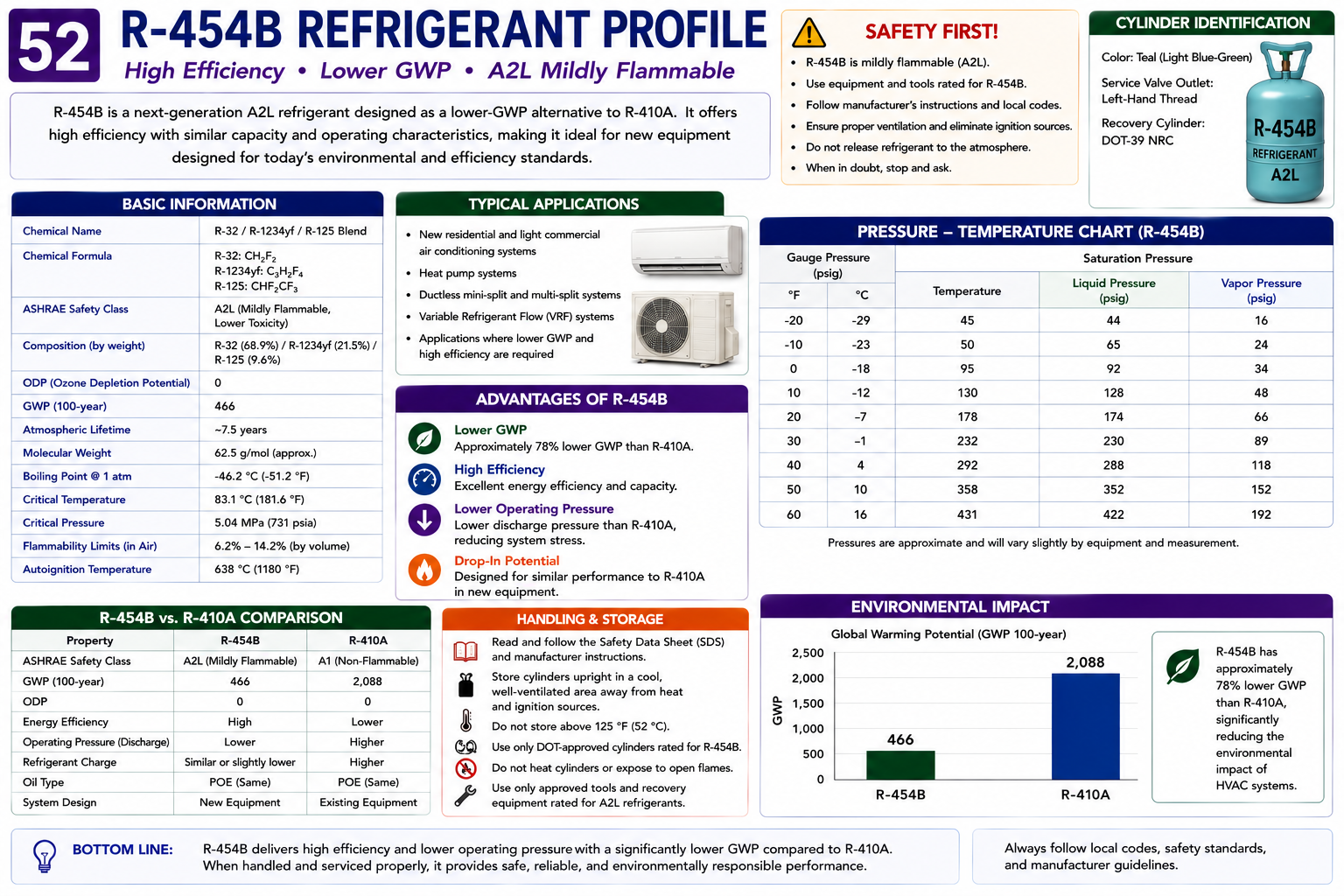
R-454B is a zeotropic refrigerant blend developed for use in applications including residential and light-commercial air conditioning and heat pumps. It combines an HFC refrigerant with an HFO refrigerant to obtain the desired balance of performance, environmental characteristics, and operating properties.
R-454B contains approximately 68.9% R-32 and 31.1% R-1234yf by mass.
Designation
R-454B
Refrigerant Type
Zeotropic HFC/HFO blend.
Components
R-32 and R-1234yf.
Composition
Approximately 68.9% R-32 and 31.1% R-1234yf by mass.
Safety Classification
ASHRAE A2L.
Typical Applications
New air-conditioning and heat-pump equipment designed specifically for R-454B.
R-32 Plus R-1234yf
Understanding the two components of R-454B helps explain why the finished refrigerant has the characteristics it does.
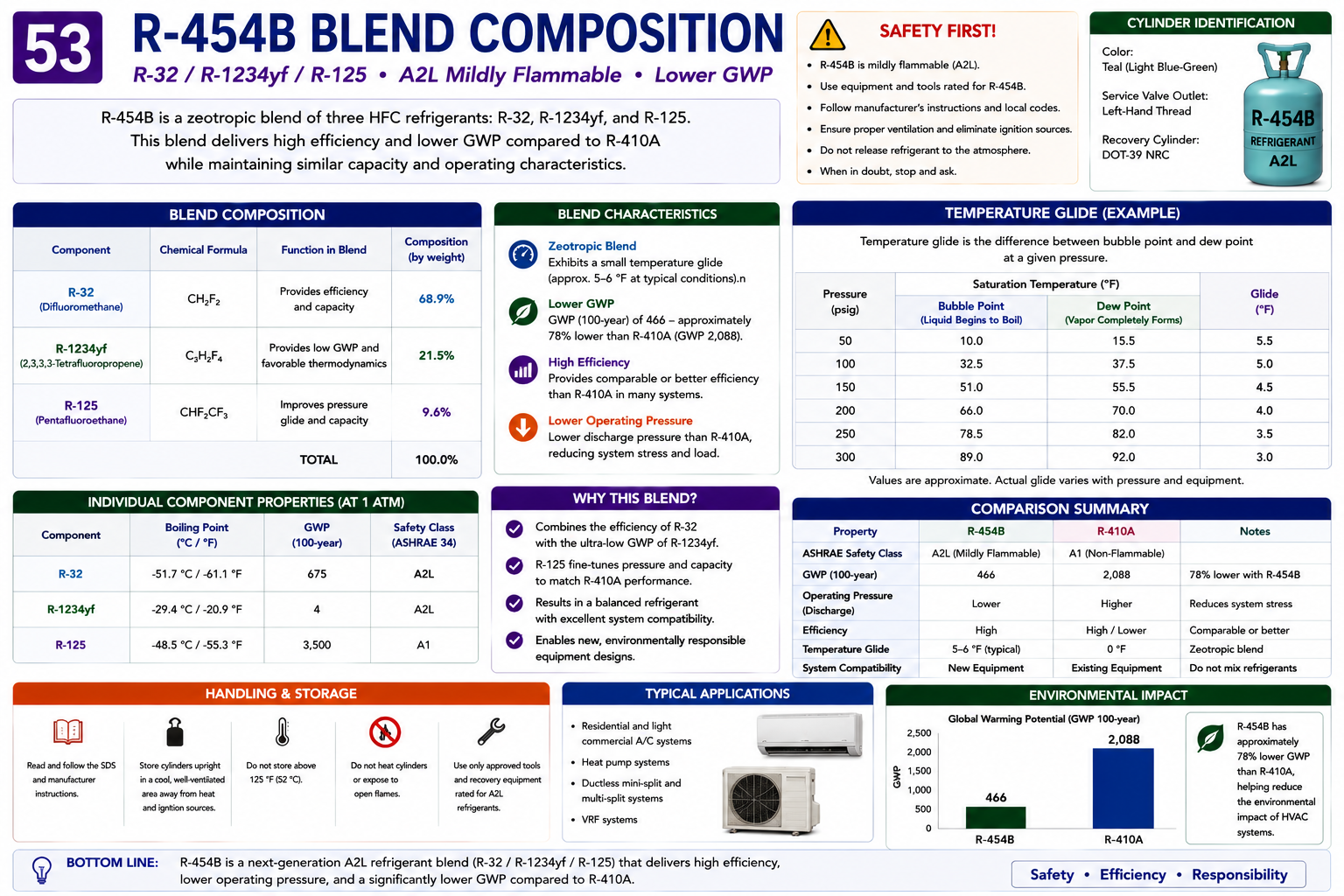
R-32 provides useful refrigeration capacity and thermodynamic performance but is an A2L HFC with a higher GWP than the finished R-454B blend. R-1234yf is an HFO refrigerant with very low GWP. Combining the two produces a refrigerant with substantially lower GWP than R-410A while maintaining properties useful for comfort-cooling equipment.
R-32 Component
An HFC refrigerant already familiar from the previous lesson and also used as a component of R-410A.
R-1234yf Component
An HFO refrigerant with very low global warming potential. HFO refrigerants will be examined more closely in the next lesson.
R-454B Has Temperature Glide
R-454B is a zeotropic refrigerant blend. Its components have different boiling characteristics, so the refrigerant does not maintain exactly one saturation temperature throughout the phase-change process.
This means R-454B has separate bubble-point and dew-point saturation temperatures and a temperature glide between them.
For a zeotropic blend, dew-point saturation temperature is used for vapor-side superheat calculations, while bubble-point saturation temperature is used for liquid-side subcooling calculations.
Bubble Point, Dew Point, and Temperature Glide
These service concepts were examined in detail using R-407C in R-407C Refrigerant.
Withdraw the Refrigerant as Liquid
Because R-454B is a refrigerant blend, it should normally be withdrawn from the supply cylinder as liquid. Liquid withdrawal helps maintain the intended proportions of R-32 and R-1234yf.
Repeatedly removing vapor from a blend cylinder can change the composition of the refrigerant remaining in the cylinder.
Withdrawing R-454B from the cylinder as liquid does not mean that uncontrolled liquid should be allowed to enter a running compressor. Follow the equipment manufacturer’s charging procedure and control refrigerant flow as required.
Blend Composition Matters
Because R-454B contains two refrigerants with different physical properties, fractionation can occur when the liquid and vapor portions of the refrigerant have different compositions.
Proper charging procedures help preserve the intended composition. When a system has suffered a significant refrigerant loss, follow the equipment and refrigerant manufacturer’s procedures for determining whether the remaining charge may be retained or whether recovery and complete recharging are appropriate.
If the composition of a remaining blend charge is uncertain, follow manufacturer guidance rather than assuming that simply adding refrigerant will restore the system to its original condition.
Designed for Similar Applications — But Not Interchangeable
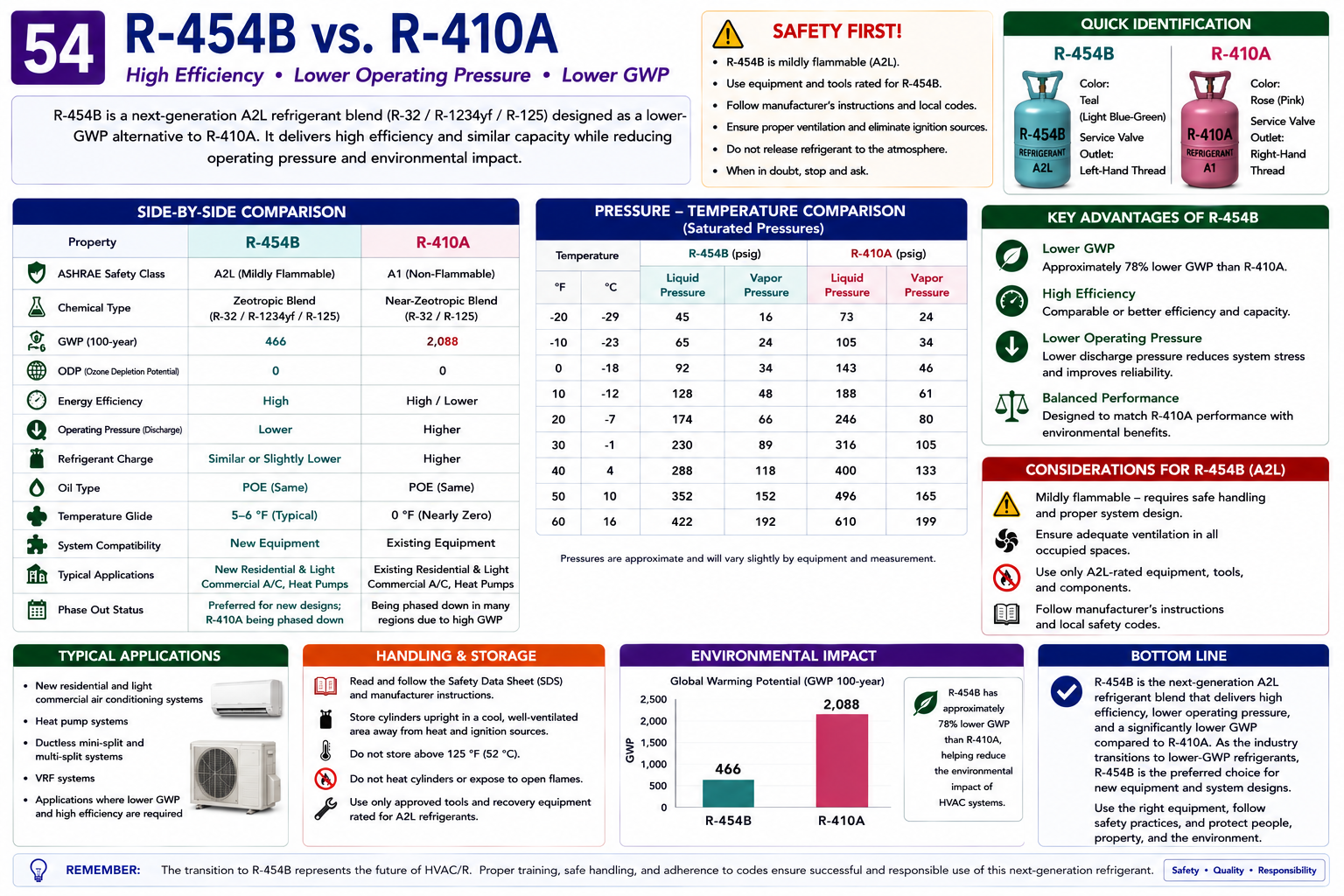
R-454B is being used in many of the same general comfort-cooling applications historically served by R-410A. That makes comparison useful, but it does not make the refrigerants interchangeable.
| Characteristic | R-454B | R-410A |
|---|---|---|
| Refrigerant Type | HFC/HFO blend | HFC blend |
| Components | R-32 / R-1234yf | R-32 / R-125 |
| ASHRAE Safety Class | A2L | A1 |
| Ozone Depletion Potential | 0 | 0 |
| Global Warming Potential | Much lower | Higher |
| Temperature Glide | Present | Very small |
| Flammability | Lower flammability | No flame propagation under classification test conditions |
| Equipment | Designed for R-454B | Designed for R-410A |
Lower Direct Climate Impact
One of the principal reasons for using R-454B is its substantially lower global warming potential compared with R-410A.
Both refrigerants have zero ozone depletion potential, so this transition differs from the earlier move away from R-22. The R-22 transition was driven heavily by ozone depletion. The transition away from high-GWP R-410A in new equipment is focused on reducing the climate impact of refrigerants.
R-22 → R-410A: primarily an ozone-protection transition.
R-410A → lower-GWP refrigerants: primarily a climate-impact transition.
Use R-454B-Specific P-T Data
Technicians familiar with R-410A may find some R-454B operating pressures familiar, but the two refrigerants do not have identical pressure-temperature relationships.
Always select R-454B on an electronic manifold or use an R-454B pressure-temperature reference when determining saturation temperature.
Because R-454B is zeotropic, verify whether your instrument is displaying bubble point, dew point, or both. Use the correct saturation reference for the measurement being made.
Use the Correct Side of the Saturation Range
Superheat
Use the dew-point saturation temperature corresponding to the measured vapor pressure.
Subcooling
Use the bubble-point saturation temperature corresponding to the measured liquid pressure.
Dew for superheat. Bubble for subcooling.
R-454B Is Lower Flammability
R-454B is classified A2L. The A identifies the lower-toxicity classification, while 2L identifies lower flammability with low burning velocity.
This is a major service difference from R-410A, which is classified A1.
A2L Refrigerant Safety
The meaning of A2L, comparison with A1 and A3 refrigerants, ventilation, ignition-source control, and service-tool considerations were covered in Introduction to A2L Refrigerants.
The Equipment Is Designed Around an A2L Refrigerant
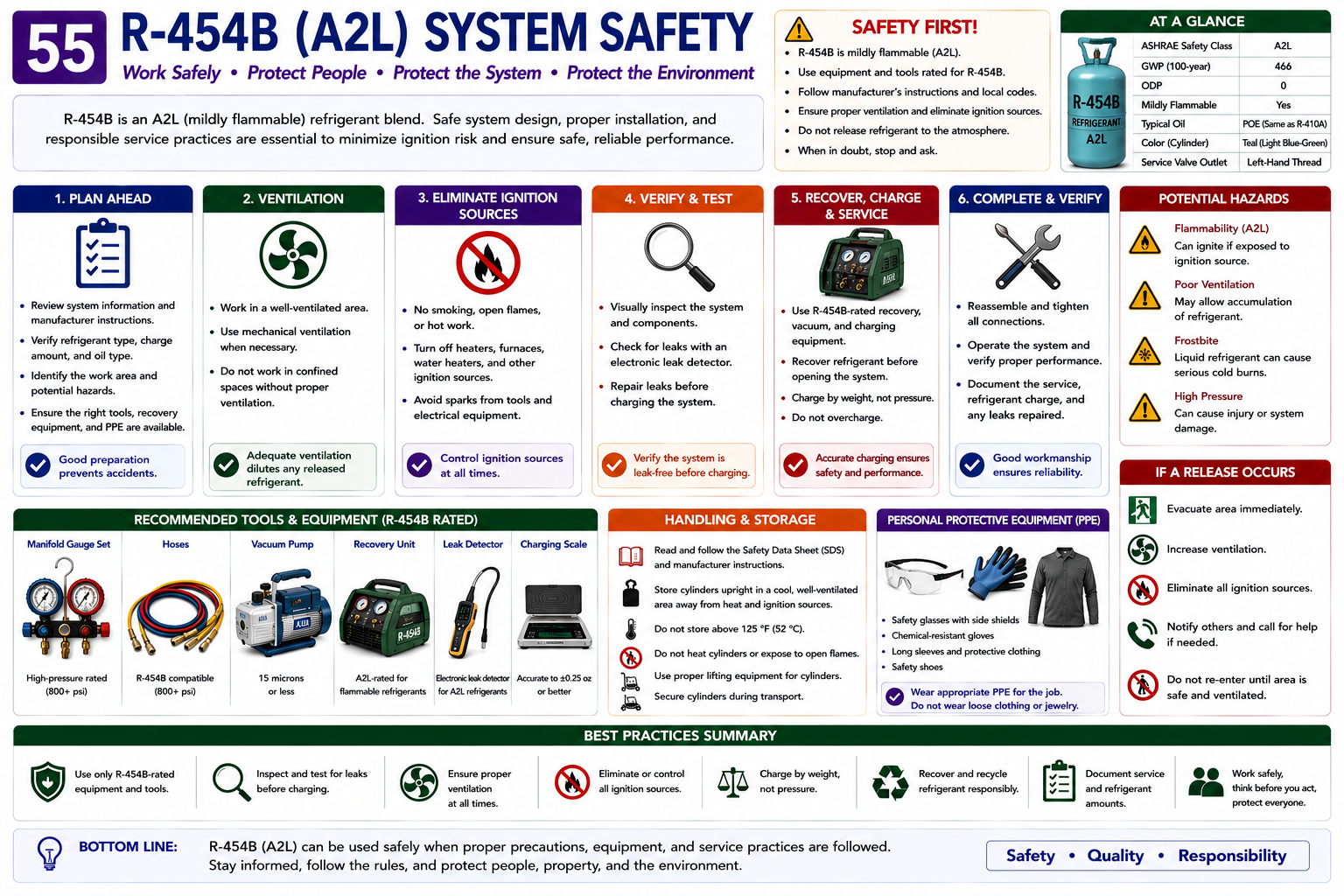
R-454B systems are designed and evaluated with the refrigerant’s lower-flammability characteristics in mind. Depending on the equipment, application, refrigerant charge, and installation, safety provisions may include refrigerant detection, airflow or mitigation requirements, charge limitations, warning labels, and other design features.
Do not bypass, disable, relocate, or substitute refrigerant detection or mitigation components except as specifically permitted by the equipment manufacturer.
Some Equipment Uses Leak Detection and Mitigation
Some A2L systems use refrigerant detection systems to identify a refrigerant concentration that requires a safety response.
Depending on the equipment design, detection may cause indoor fans or other mitigation equipment to operate, alter normal equipment operation, or initiate another manufacturer-designed response intended to disperse refrigerant and reduce accumulation.
A refrigerant detector or mitigation control is not an optional accessory when it is required by the equipment design. If a safety device fails, repair the safety system according to manufacturer procedures rather than bypassing it to restore operation.
Prevent Refrigerant Accumulation
When servicing R-454B equipment, evaluate whether a refrigerant release could accumulate in the work area. Enclosed spaces, low areas, equipment compartments, pits, and poorly ventilated locations deserve particular attention.
Appropriate ventilation reduces the potential for refrigerant to accumulate to an ignitable concentration and also helps control oxygen-displacement hazards.
Consider refrigerant quantity, room size, ventilation, possible accumulation areas, and potential ignition sources.
Control Ignition Sources During Service
Because R-454B is an A2L refrigerant, technicians must consider ignition sources whenever refrigerant could be released into the work area.
Open Flames
Control torches, burners, pilot flames, matches, and similar sources.
Smoking
Smoking materials should not be present in an A2L service area.
Electrical Arcs
Switching devices, damaged wiring, motors, relays, and other electrical equipment can potentially produce arcs.
Sparks
Grinding, cutting, some tools, and electrical connections can produce sparks.
Hot Work
Brazing and similar operations require the refrigeration circuit and work area to be made safe first.
Hot Surfaces
Consider sufficiently hot surfaces when evaluating potential ignition sources.
Recover Before Brazing or Cutting
Do not apply a torch to a refrigeration circuit containing R-454B. Properly recover the refrigerant and follow the manufacturer’s procedure before brazing, cutting, or performing other hot work.
A system being repaired with a torch must first be placed in the safe condition required by the equipment manufacturer’s A2L service procedure.
Verify A2L Compatibility
Technicians should not assume that every tool previously used for R-410A is automatically suitable for R-454B.
Equipment that handles refrigerant or contains potential ignition sources should be evaluated for suitability for R-454B and A2L service.
Recovery Machine
Use recovery equipment suitable for R-454B and A2L refrigerants.
Leak Detector
Verify that the detector is suitable for detecting R-454B.
Vacuum Pump
Follow the pump manufacturer’s A2L suitability and operating instructions.
Manifold and Hoses
Verify refrigerant compatibility and appropriate working-pressure ratings.
Recovery Cylinder
Use an appropriate refillable recovery cylinder and follow applicable handling requirements.
Refrigerant Scale
Use an accurate scale to control charge and recovery quantities.
Follow the Equipment Manufacturer’s Specification
R-454B equipment commonly uses synthetic lubricants such as POE formulations selected for the particular compressor and application.
Do not assume that an oil is correct merely because it is labeled POE. Lubricant chemistry and viscosity must meet the compressor or equipment manufacturer’s specification.
Where POE lubricant is used, minimize atmospheric exposure, keep lubricant containers sealed, use appropriate filter-driers, and evacuate the system correctly after service.
Do Not Put R-454B Into Existing R-410A Equipment
R-454B is being used in applications previously served by R-410A, but that does not make it a field retrofit refrigerant for existing R-410A systems.
R-410A equipment was designed around an A1 refrigerant. R-454B equipment is designed around an A2L refrigerant and may include safety provisions that do not exist in an older R-410A system.
Do not charge R-454B into equipment designed for R-410A. Use the refrigerant specified by the equipment manufacturer.
R-454B, R-32, and R-410A Are Separate Refrigerants
R-454B contains R-32. R-410A also contains R-32. That common component does not make any of these refrigerants interchangeable.
Adding R-32 or R-410A to R-454B changes the intended refrigerant composition and creates an improper mixture with an uncertain pressure-temperature relationship and other changed characteristics.
R-454B equipment gets R-454B. R-32 equipment gets R-32. R-410A equipment gets R-410A.
Recover R-454B With Appropriate Equipment
R-454B removed during service must be handled using proper recovery procedures and equipment suitable for the refrigerant and its A2L classification.
Keeping recovered refrigerants separated preserves refrigerant identity and prevents contamination of other recovered refrigerant.
Do not mix recovered R-454B with R-410A, R-32, or another refrigerant in a cylinder containing a known refrigerant.
Charge Quantity Is Part of the Safety Design
With A2L equipment, refrigerant charge is more than a performance consideration. The amount of refrigerant in a system can also be related to equipment safety requirements, occupied-space considerations, and mitigation provisions.
Do not intentionally overcharge an R-454B system or modify the approved refrigerant quantity outside the manufacturer’s instructions.
Use the equipment nameplate and manufacturer charging information. Do not substitute a familiar R-410A charge quantity for an R-454B system.
Use Is Application-Specific
EPA’s Significant New Alternatives Policy program evaluates refrigerant substitutes for specific end uses. R-454B has been listed as acceptable subject to use conditions for specified residential and light-commercial air-conditioning and heat-pump applications.
The required use conditions are part of the acceptable application of the refrigerant. A refrigerant’s presence on a SNAP list does not mean it can be installed in any HVAC/R appliance.
Refrigerant acceptability depends on the refrigerant, the end use, the equipment, and the applicable use conditions.
Read the Nameplate Before Connecting Your Tools
As R-32 and R-454B equipment becomes more common, technicians can no longer assume that a recently manufactured residential air conditioner or heat pump contains R-410A.
Two systems that look very similar externally may contain different refrigerants and have different service requirements.
Read the equipment nameplate and identify the refrigerant before beginning service.
What to Remember About R-454B
R-454B combines many concepts from earlier lessons: refrigerant blends, bubble and dew points, temperature glide, liquid charging, environmental impact, A2L safety, recovery, equipment compatibility, and refrigerant identification.
Remember that R-454B is a zeotropic A2L blend containing approximately 68.9% R-32 and 31.1% R-1234yf. It has zero ODP and substantially lower GWP than R-410A. Because it is a blend, technicians must understand bubble point, dew point, temperature glide, and proper liquid withdrawal. Because it is A2L, technicians must also apply appropriate ventilation, ignition-control, recovery, and service-tool practices.
Avoid These R-454B Errors
“R-454B is a single-component refrigerant.”
No. It is a blend of R-32 and R-1234yf.
“R-454B has no temperature glide.”
No. R-454B is zeotropic and has separate bubble and dew saturation temperatures.
“R-454B is just a lower-GWP R-410A.”
No. The refrigerants have different compositions, safety classifications, and equipment requirements.
“R-454B can replace R-410A in an existing unit.”
No. Existing R-410A equipment was not designed around the A2L characteristics and safety requirements of R-454B.
“Because R-454B contains R-32, R-32 can top it off.”
No. Adding R-32 changes the blend composition.
“Any R-410A tool is automatically suitable for R-454B.”
No. Refrigerant-handling equipment should be verified for R-454B and A2L service.
R-454B Refrigerant
- Is R-454B a single-component refrigerant or a blend?
- What two refrigerants make up R-454B?
- Approximately what percentage of R-454B is R-32?
- Approximately what percentage is R-1234yf?
- What is the ASHRAE safety classification of R-454B?
- Is R-454B azeotropic or zeotropic?
- Does R-454B have temperature glide?
- Which saturation value is used when calculating superheat?
- Which saturation value is used when calculating subcooling?
- Why should R-454B normally be withdrawn from a supply cylinder as liquid?
- What is fractionation?
- How does the safety classification of R-454B differ from R-410A?
- Why should R-454B not be charged into existing R-410A equipment?
- Why must service equipment be checked for A2L compatibility?
- Why is refrigerant identification increasingly important when servicing newer air-conditioning equipment?
What You Should Have Learned
R-454B Is a Blend
It contains approximately 68.9% R-32 and 31.1% R-1234yf by mass.
R-454B Is Zeotropic
It has temperature glide and separate bubble-point and dew-point saturation temperatures.
R-454B Is A2L
It combines lower toxicity with lower-flammability characteristics.
Its GWP Is Much Lower Than R-410A
Reducing direct climate impact is a major reason for its use in new comfort-cooling equipment.
Liquid Withdrawal Matters
R-454B should normally be withdrawn from its supply cylinder as liquid to maintain blend composition.
A2L Procedures Apply
Ventilation, ignition-source control, refrigerant identification, recovery, and compatible service tools are important.
R-454B Is Not R-410A
Similar applications do not make the two refrigerants interchangeable.
Equipment Is Refrigerant-Specific
R-454B should only be used in equipment designed and approved for R-454B.