Introduction to A2L Refrigerants
A2L refrigerants represent one of the most important changes currently occurring in residential and light-commercial HVAC service. Refrigerants such as R-32 and R-454B provide substantially lower global warming potential than R-410A, but they also introduce a characteristic many air-conditioning technicians have not routinely encountered: lower flammability.
A2L does not mean that these refrigerants behave like highly flammable fuels, nor does it mean that flammability can be ignored. Technicians must understand what the A2L classification means, how it differs from A1 and A3 refrigerants, how an ignitable concentration can develop, and how equipment design and service procedures control the associated risk.
What You Will Learn
After completing this lesson, you should be able to:
Explain the A2L Classification
Interpret the toxicity and flammability portions of the A2L refrigerant safety designation.
Compare A1, A2L, and A3
Distinguish non-flame-propagating A1 refrigerants from lower-flammability A2L refrigerants and higher-flammability A3 refrigerants.
Recognize Ignition Hazards
Identify conditions and ignition sources that can create a hazard when an A2L refrigerant is released.
Apply Safe Service Practices
Recognize the importance of ventilation, leak detection, refrigerant recovery, ignition-source control, and proper procedures.
Select Appropriate Tools
Recognize that recovery machines, leak detectors, vacuum pumps, and other service equipment must be suitable for the refrigerant being serviced.
Understand Equipment-Specific Use
Explain why an A2L refrigerant should only be used in equipment designed and approved for that refrigerant.
A New Refrigerant Classification for Many HVAC Technicians
For many years, technicians working primarily in residential comfort cooling commonly encountered A1 refrigerants such as R-22 and R-410A. These refrigerants do not propagate flame under the conditions used for their refrigerant safety classification.
The transition toward lower-global-warming-potential refrigerants has increased the use of refrigerants classified A2L. Common examples include R-32 and R-454B.
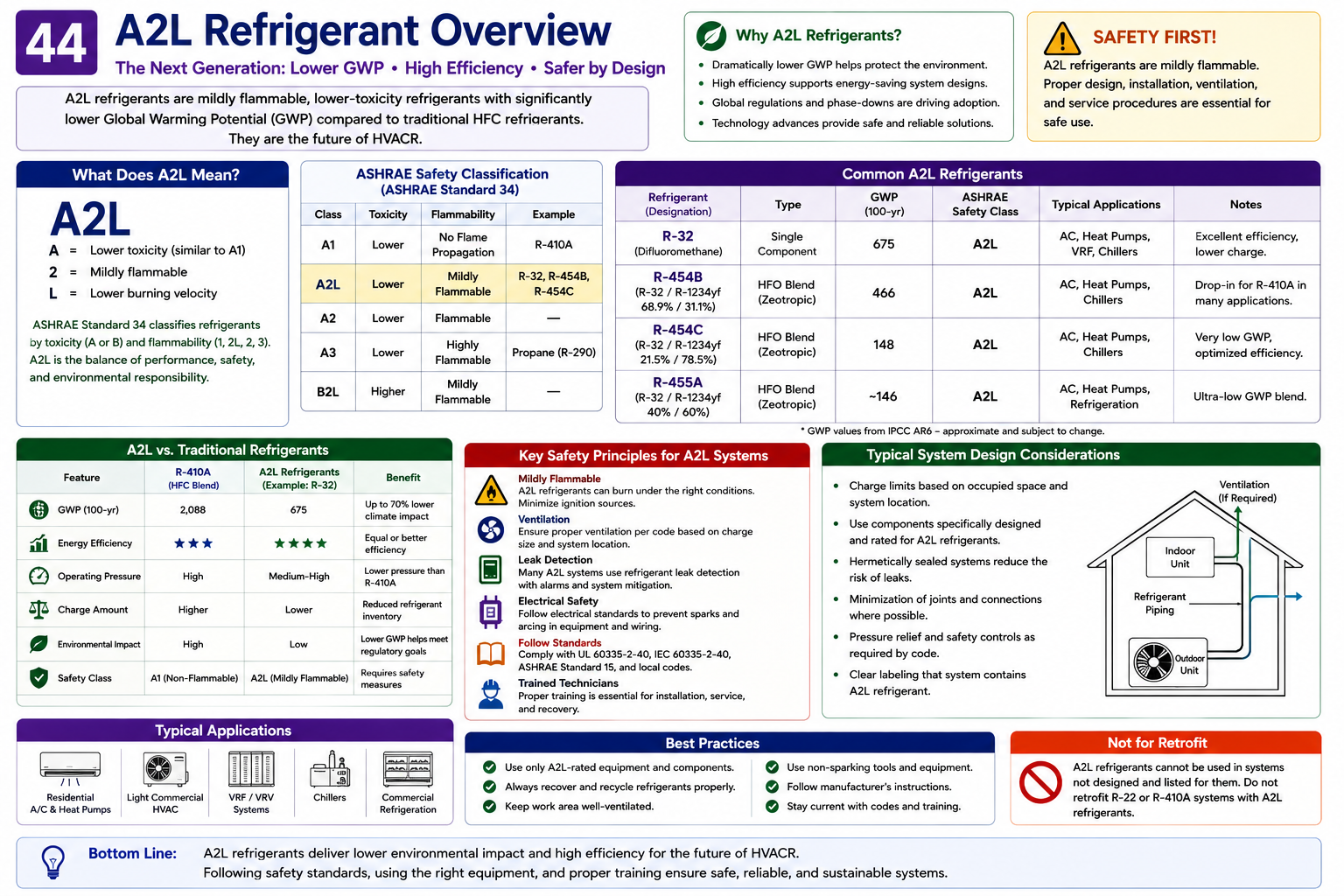
A2L is a refrigerant safety classification. It does not mean that all A2L refrigerants have identical pressures, compositions, applications, charge limits, or service requirements.
What Does A2L Mean?
Refrigerant safety classifications combine a letter representing toxicity with a number or number-and-letter combination representing flammability characteristics.
A — Lower Toxicity
The letter A places the refrigerant in the lower-toxicity classification under the applicable refrigerant safety standard.
2L — Lower Flammability
The 2L designation identifies refrigerants with lower flammability characteristics and relatively low burning velocity compared with more flammable refrigerant classes.
Lower toxicity does not mean nontoxic, and lower flammability does not mean nonflammable. The classification describes relative characteristics under standardized test conditions.
Three Classifications You Will Commonly Encounter
Understanding the difference between A1, A2L, and A3 refrigerants is increasingly important because technicians may encounter all three classifications in modern HVAC/R equipment.
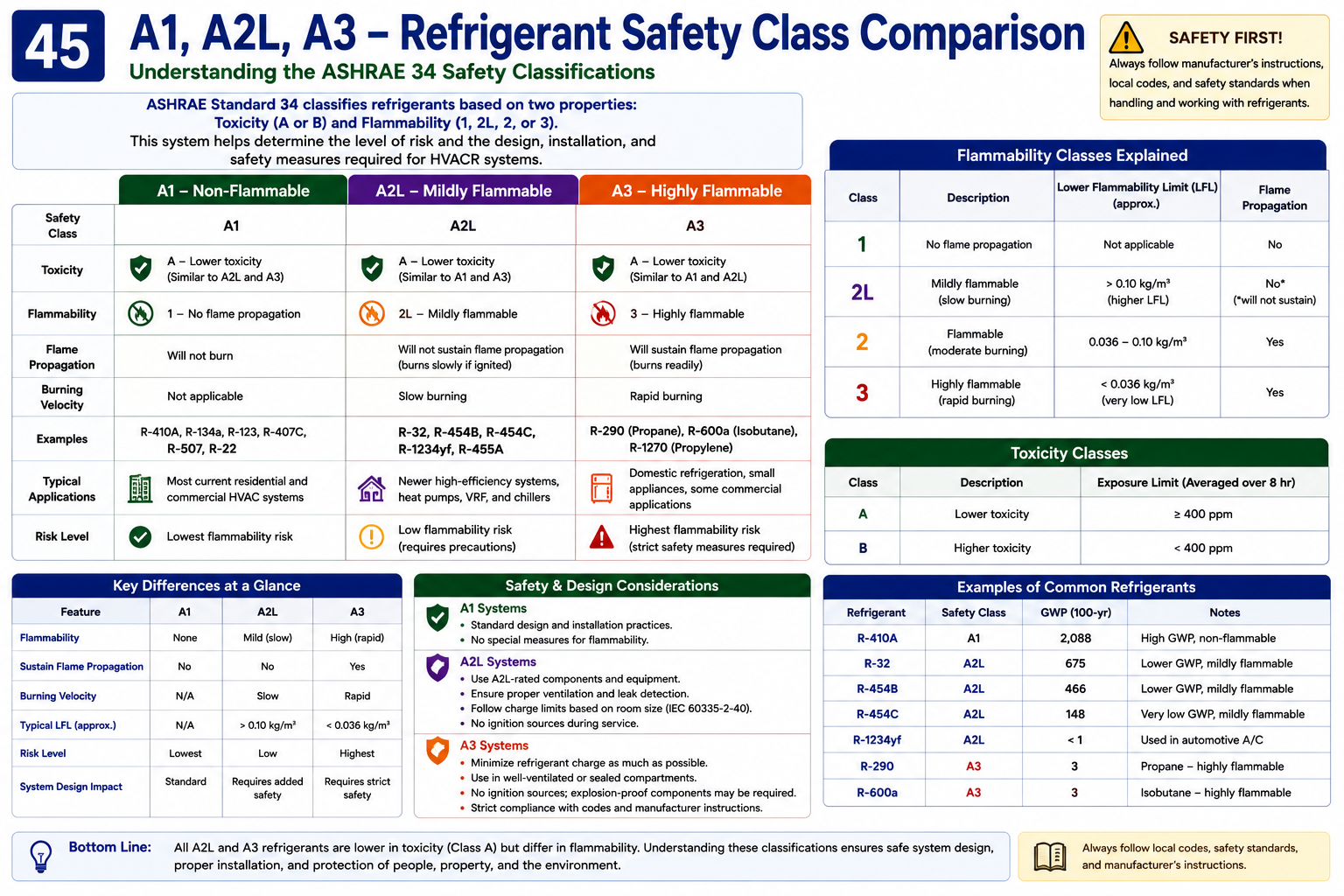
| Classification | General Characteristic | Examples |
|---|---|---|
| A1 | Lower toxicity; no flame propagation under classification test conditions | R-22, R-134a, R-404A, R-410A |
| A2L | Lower toxicity; lower flammability with low burning velocity | R-32, R-454B, R-1234yf, R-1234ze(E) |
| A3 | Lower toxicity; higher flammability | R-290 propane, R-600a isobutane |
A2L refrigerants are flammable, but their flammability characteristics are substantially different from A3 hydrocarbon refrigerants such as propane and isobutane. The classifications should not be treated as equivalent.
Reducing Global Warming Potential
The move toward A2L refrigerants is largely connected to the transition away from higher-GWP HFC refrigerants used in previous generations of equipment.
For example, R-410A has a much higher global warming potential than R-32 or R-454B. Lower-GWP refrigerants allow manufacturers to meet current environmental requirements while maintaining useful refrigeration performance.
The R-410A Transition
The reasons new comfort-cooling equipment is moving away from R-410A were introduced in R-410A Refrigerant.
A Refrigerant Release Alone Does Not Automatically Produce Ignition
For combustion to occur, several conditions must exist at the same time. There must be refrigerant present within an ignitable concentration range, sufficient oxygen, and an ignition source capable of igniting that mixture.
Refrigerant
A sufficient concentration of A2L refrigerant must be present.
Oxygen
Air must be present to support combustion.
Ignition Source
A source with sufficient ignition energy must be present.
Ignitable Concentration
The refrigerant concentration must fall within the range in which ignition can occur.
Safe equipment design and service practices reduce the likelihood that these conditions will occur together.
Control Sources That Could Ignite a Refrigerant-Air Mixture
When an A2L refrigerant could be present because of a leak or open refrigeration circuit, the technician must consider possible ignition sources in and around the work area.
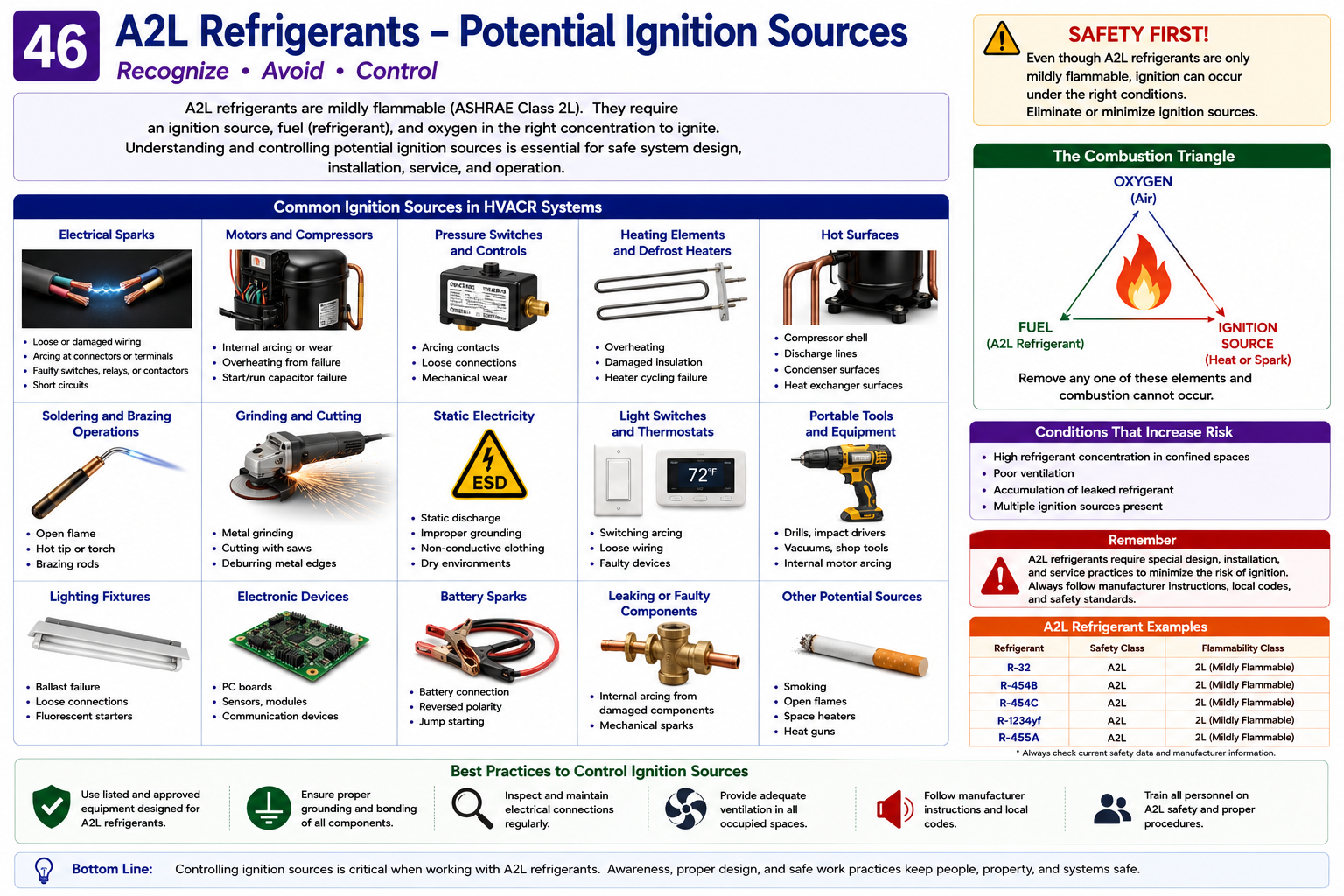
Open Flames
Torches, burners, pilot flames, and other open flames require particular attention.
Smoking Materials
Cigarettes, lighters, matches, and similar sources should not be present in the work area.
Electrical Arcing
Switches, relays, motors, damaged electrical equipment, and other devices can potentially produce arcs or sparks.
Sparks
Grinding, cutting, electrical connections, and some tools can produce sparks.
Hot Surfaces
Some sufficiently hot surfaces can present an ignition concern depending on the refrigerant and conditions.
Service Operations
Brazing, soldering, and other hot-work procedures require the refrigerant circuit and work area to be made safe first.
Prevent Refrigerant From Accumulating
Ventilation is an important control when working with A2L refrigerants. A refrigerant released into a sufficiently large, well-ventilated area can disperse rather than accumulating into a concentrated refrigerant-air mixture.
Enclosed or poorly ventilated spaces require additional attention because leaked refrigerant can accumulate.
Accumulated refrigerant can create both an oxygen-displacement hazard and, with an A2L refrigerant, a potential flammability hazard. Ventilation helps control both concerns.
Consider Where a Leak Can Accumulate
Many commonly used refrigerant vapors are denser than air. Released refrigerant can therefore collect in low areas, pits, equipment enclosures, floor-level spaces, or other poorly ventilated locations.
Technicians should evaluate the actual work area rather than assuming that opening a nearby door automatically provides adequate ventilation.
Before beginning service, consider where refrigerant could escape, where it could accumulate, how the area is ventilated, and what ignition sources are present.
Prepare the Work Area Before Opening the System
Safe A2L service begins before a hose is connected or tubing is cut. Identify the refrigerant, read the equipment labels, review the manufacturer’s instructions, evaluate the work area, and verify that the required tools are suitable for the refrigerant.
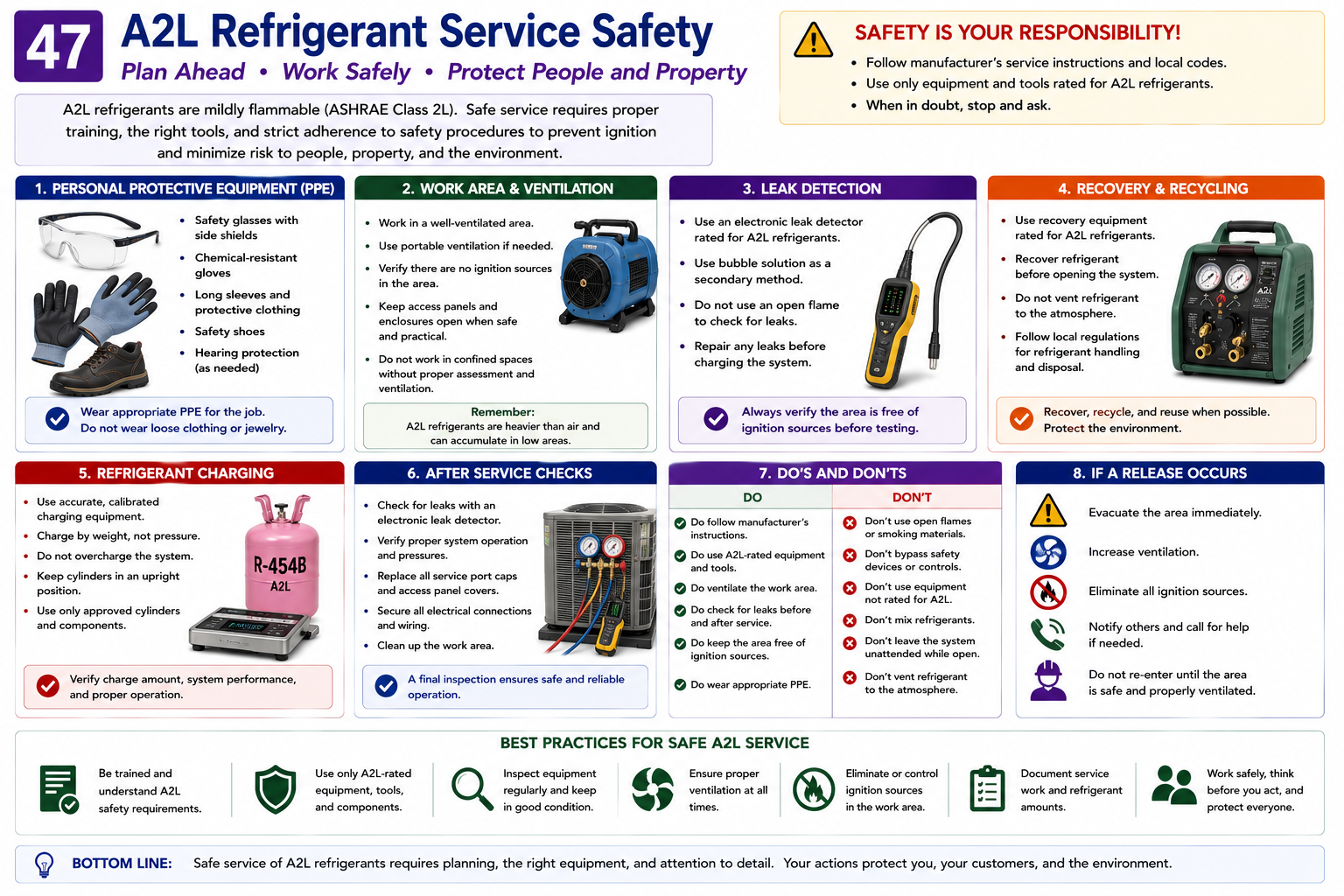
Identify the Refrigerant
Verify the refrigerant from the equipment nameplate and service labels.
Evaluate Ventilation
Determine whether released refrigerant could accumulate in the work area.
Control Ignition Sources
Remove or control potential ignition sources as required by the service procedure.
Use Correct Equipment
Verify that recovery, leak-detection, evacuation, and other service equipment is suitable for the refrigerant.
Do Not Perform Hot Work on a Charged System
Refrigerant must be properly recovered before opening the sealed refrigeration circuit when the repair requires removal of the charge.
This becomes particularly important when brazing, cutting, or another operation could introduce an ignition source.
Do not apply a torch to a refrigeration circuit that contains an A2L refrigerant. Follow the equipment manufacturer’s service procedure, properly recover the refrigerant, and verify safe conditions before beginning hot work.
Use the Correct Gas for the Correct Procedure
Dry nitrogen is commonly used during HVAC/R service for pressure testing, flowing during brazing, and other procedures specified by the equipment manufacturer.
Oxygen should never be used to pressurize a refrigeration system. Compressed air is also inappropriate where it could create an unsafe mixture or introduce moisture and contamination.
Never pressure-test a refrigeration system with oxygen. Use the procedure and test gas specified for the equipment and refrigerant.
Use Equipment Suitable for A2L Refrigerants
Leak detection is especially important when servicing A2L equipment because identifying and repairing refrigerant leakage controls both environmental releases and the possibility of refrigerant accumulation.
Electronic leak detectors used for A2L service should be suitable for the refrigerant being tested and used according to their manufacturer’s instructions.
Do not assume that a leak detector used for R-22 or R-410A is automatically suitable for every A2L refrigerant. Check the detector’s refrigerant compatibility and intended use.
Tool Compatibility Matters
The transition to A2L refrigerants does not make every familiar HVAC tool obsolete. Many basic hand tools and instruments continue to perform the same function. However, equipment that handles refrigerant or could introduce an ignition source requires particular attention.
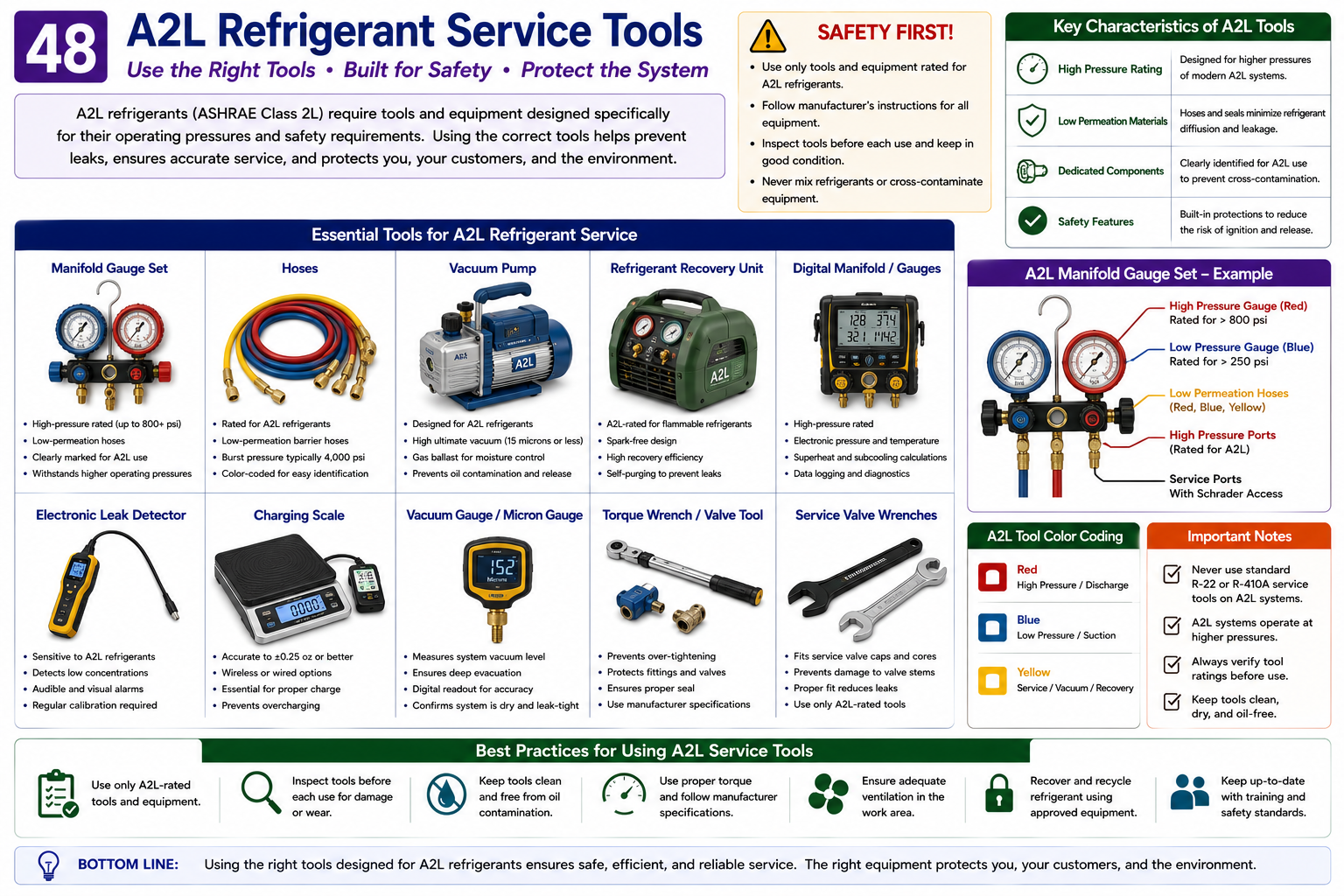
Recovery Machine
Use equipment approved or rated for the refrigerant and applicable flammability classification.
Leak Detector
Verify that the detector is suitable for the specific A2L refrigerant being serviced.
Vacuum Pump
Follow the pump manufacturer’s instructions and equipment service requirements for A2L applications.
Manifold and Hoses
Verify refrigerant compatibility and appropriate working-pressure ratings.
Recovery Cylinder
Use the correct refillable recovery cylinder and follow applicable refrigerant-handling requirements.
Ventilation Equipment
When mechanical ventilation is required, use equipment appropriate for the environment and service procedure.
A2L Equipment Is Designed Around the Refrigerant
Manufacturers do not simply replace R-410A with an A2L refrigerant in an otherwise unchanged appliance. Equipment intended for A2L refrigerants is designed and evaluated with the refrigerant’s characteristics in mind.
Depending on the equipment and application, designs can include refrigerant charge limitations, airflow requirements, leak-mitigation provisions, warning labels, refrigerant detection systems, electrical-component requirements, and installation restrictions.
Always follow the manufacturer’s installation and service instructions. The refrigerant safety classification alone does not tell the technician every requirement for a particular appliance.
Some Systems Include Refrigerant Detection and Mitigation
Depending on the equipment design and refrigerant charge, some A2L systems may incorporate refrigerant detection or mitigation features.
A system may respond to detected refrigerant by operating fans, changing equipment operation, or taking other actions intended to prevent refrigerant from accumulating at an unsafe concentration.
Refrigerant detection and mitigation components are part of the equipment’s safety design. Do not bypass, relocate, disable, or substitute these components except as specifically permitted by the manufacturer.
Identify A2L Equipment Before Beginning Service
A2L equipment includes markings and labels intended to identify the refrigerant and communicate applicable hazards and service information.
Technicians should read the equipment nameplate and safety labels before connecting gauges, recovering refrigerant, opening electrical compartments, or beginning repairs.
Identify the refrigerant before servicing the equipment. Do not determine refrigerant identity by pressure alone or assume that all newer equipment contains the same refrigerant.
Do Not Put A2L Refrigerant Into R-410A Equipment
The fact that R-32 and R-454B are being used in applications previously served by R-410A does not make either refrigerant a field drop-in replacement for R-410A.
Equipment designed for R-410A was evaluated for an A1 refrigerant. A2L equipment incorporates requirements appropriate to a lower-flammability refrigerant.
Use A2L refrigerants only in equipment designed and approved for the specific refrigerant. Do not convert an R-410A system by simply replacing the refrigerant charge.
R-32, R-454B, and R-410A Are Different Refrigerants
R-32 is one component of R-410A and is also one component of R-454B. That chemical relationship does not make the refrigerants interchangeable.
Each has its own composition, pressure-temperature relationship, safety classification, equipment requirements, and approved applications.
Never top off one refrigerant with another. Refrigerant identity must remain known so that published P-T information, equipment ratings, safety requirements, and recovery procedures remain valid.
A2L Refrigerants Must Be Properly Recovered
The introduction of lower-flammability refrigerants does not eliminate refrigerant-recovery requirements. Recover refrigerant using equipment suitable for the refrigerant being serviced and follow applicable EPA requirements and manufacturer procedures.
Recovery also prevents unnecessary refrigerant accumulation in the work area before the refrigeration circuit is opened.
Proper recovery protects the atmosphere and helps create a safer condition for opening and repairing the refrigeration circuit.
Keep the Flammability Classes in Perspective
A2L refrigerants and A3 hydrocarbons are both capable of flame propagation, but they occupy different refrigerant safety classifications because their flammability characteristics differ significantly.
R-290 propane and R-600a isobutane are A3 refrigerants and will be covered separately later in this course.
A2L
Lower flammability and low burning velocity. Examples include R-32 and R-454B.
A3
Higher flammability. Examples include R-290 propane and R-600a isobutane.
Hydrocarbon refrigerants require their own service and safety discussion. Do not apply A2L procedures automatically to A3 equipment.
Acceptability Depends on the End Use and Conditions
EPA evaluates refrigerant substitutes through the Significant New Alternatives Policy, or SNAP, program. A refrigerant’s safety classification alone does not automatically make it acceptable for every HVAC/R application.
A2L refrigerants may be listed as acceptable subject to specific use conditions for particular equipment categories. Those conditions can address equipment design, charge size, markings, installation, and other safety provisions.
Do not ask only, “Is this refrigerant approved?” Ask, “Is this refrigerant acceptable for this specific end use and under what conditions?”
New Refrigerants Require Updated Service Knowledge
A technician experienced with R-22 and R-410A already understands refrigeration theory, recovery, evacuation, charging, electrical troubleshooting, and system diagnosis. Those skills remain valuable.
A2L service adds additional considerations involving refrigerant identification, flammability, ignition-source control, ventilation, compatible service equipment, equipment-specific safety devices, and manufacturer procedures.
The vapor-compression refrigeration cycle still operates according to the same thermodynamic principles. What changes are the refrigerant properties, equipment design, and procedures required to work with the refrigerant safely.
What to Remember About A2L Refrigerants
A2L refrigerants bring together refrigerant safety classification, environmental transition, equipment design, recovery, service procedures, and refrigerant identification.
Remember that A2L refrigerants are lower-toxicity, lower-flammability refrigerants. They are not A1 refrigerants and should not be treated as nonflammable, but they are also not equivalent to higher-flammability A3 hydrocarbons. Use the refrigerant only in equipment designed for it, control ignition sources, provide appropriate ventilation, use compatible service equipment, and follow the manufacturer’s procedures.
Avoid These A2L Errors
“A2L means nonflammable.”
No. A2L refrigerants are capable of flame propagation and are classified as lower flammability.
“A2L refrigerants are basically propane.”
No. Propane is an A3 refrigerant with substantially different flammability characteristics.
“All A2Ls are interchangeable.”
No. Refrigerants within the same safety class can have different compositions, pressures, GWP values, applications, and equipment requirements.
“R-32 can replace R-410A in an existing unit.”
No. Use refrigerants only in equipment designed and approved for them.
“My existing HVAC tools are automatically A2L compatible.”
No. Refrigerant-handling and electrical equipment should be checked for suitability for the intended A2L service.
“If EPA accepts an A2L refrigerant, it can be used anywhere.”
No. SNAP acceptability is based on specific end uses and may include mandatory use conditions.
Introduction to A2L Refrigerants
- What does the letter A indicate in an A2L safety classification?
- What does the 2L portion of the classification indicate?
- Does A2L mean that a refrigerant is nonflammable?
- How does an A2L refrigerant differ generally from an A1 refrigerant?
- How does an A2L refrigerant differ generally from an A3 refrigerant?
- Name two A2L refrigerants increasingly used in comfort-cooling equipment.
- Why are lower-GWP A2L refrigerants replacing R-410A in many new systems?
- What conditions must exist for an A2L refrigerant-air mixture to ignite?
- Name three potential ignition sources that should be considered during A2L service.
- Why is ventilation important when servicing A2L equipment?
- Why should the refrigerant be identified before service begins?
- Why must service tools be checked for A2L suitability?
- Can R-32 simply be placed into existing R-410A equipment?
- Why might an A2L appliance contain refrigerant detection or mitigation equipment?
- Does an EPA SNAP listing automatically mean that a refrigerant can be used in every refrigeration or air-conditioning application?
What You Should Have Learned
A2L Is a Safety Classification
The A indicates lower toxicity, while 2L identifies lower-flammability characteristics with low burning velocity.
A2L Is Not A1
A2L refrigerants can propagate flame and therefore require additional safety considerations.
A2L Is Not A3
A2L refrigerants have substantially different flammability characteristics from higher-flammability hydrocarbons such as propane.
Ignition Requires the Right Conditions
Refrigerant concentration, oxygen, and an adequate ignition source must occur together for combustion.
Ventilation Matters
Preventing refrigerant accumulation helps control both oxygen-displacement and flammability hazards.
Tool Compatibility Matters
Recovery equipment, leak detectors, vacuum pumps, and other refrigerant-handling equipment must be suitable for the refrigerant.
Equipment Is Refrigerant-Specific
A2L refrigerants should only be used in equipment designed and approved for the particular refrigerant.
Manufacturer Instructions Matter
Charge limits, mitigation systems, installation requirements, and service procedures depend on the specific equipment.