Back to: NASCLA Master Electrical Contractor Exam Preparation
Metallic raceways are widely used in commercial, industrial, and many residential electrical installations because they provide a durable path for conductors and can offer substantial mechanical protection. Electrical metallic tubing, intermediate metal conduit, and rigid metal conduit may appear similar in an installation, but their construction, permitted uses, physical strength, fittings, and installation requirements are not identical.
For the NASCLA Electrical Contractor Exam, you should be able to distinguish EMT, IMC, and RMC, locate their individual NEC articles, recognize common fittings and installation requirements, determine where each wiring method is permitted, and understand when a metallic raceway can serve as part of the equipment grounding path.
Comparing Common Metal Raceway Systems
Metal raceways perform several functions at the same time. They provide a defined pathway for conductors, protect those conductors from physical damage, connect boxes and equipment, and, when properly installed and recognized by Article 250, can form part of the effective ground-fault current path.
The three metallic raceways emphasized in this lesson are electrical metallic tubing, intermediate metal conduit, and rigid metal conduit. Their NEC articles are organized in a similar manner, which makes comparison useful when studying for an open-book examination.
Know the Raceway Articles
One of the most useful exam strategies is to associate each common raceway with its NEC article number. Once the correct article is located, its organization makes it relatively easy to find permitted uses, prohibited uses, size requirements, bends, fittings, securing and supporting, and other installation rules.
Article 342 — IMC
Intermediate Metal Conduit is a threaded metal raceway that provides substantial mechanical protection while generally having a thinner wall than rigid metal conduit.
Article 344 — RMC
Rigid Metal Conduit is a heavy-wall metallic raceway commonly selected where substantial physical protection or rugged construction is required.
Article 358 — EMT
Electrical Metallic Tubing is a comparatively thin-wall metallic raceway commonly used for exposed and concealed wiring in commercial and similar installations.
Other Metallic Methods
Chapter 3 also includes flexible metal conduit, liquidtight flexible metal conduit, flexible metallic tubing, metal wireways, surface metal raceways, and other metallic wiring methods with their own articles and limitations.
EMT
Electrical metallic tubing is commonly called EMT or thin-wall conduit. Despite the common field use of the word conduit, the NEC identifies EMT as tubing. EMT is lightweight compared with IMC and RMC and is commonly bent using hand or mechanical bending equipment rather than threaded at the ends.
EMT connections are normally made with listed connectors and couplings designed for the tubing. Depending on the fitting and installation environment, these can include setscrew, compression, or other listed fitting designs.
Lightweight
EMT is thinner and lighter than IMC and RMC, making it relatively easy to cut, bend, handle, and install.
Not Normally Threaded
EMT is joined using listed fittings rather than the threaded couplings commonly associated with IMC and RMC.
Exposed or Concealed
EMT can be used in many exposed and concealed installations where its Article 358 use requirements and environmental limitations are satisfied.
Grounding Path
Properly installed EMT is one of the wiring methods recognized by Article 250 for use as an equipment grounding conductor.
IMC
Intermediate metal conduit provides greater physical strength than EMT while generally using less metal than RMC. It is a threaded raceway and is commonly installed with threaded couplings, threaded fittings, locknuts, bushings, and other components identified for the wiring method.
IMC is useful where a more rugged metallic raceway is needed without necessarily using the heavier construction of RMC. As with all raceways, the specific environmental and physical-damage conditions must be checked against the permitted and prohibited uses in its NEC article.
Threaded Construction
IMC is designed to accept threaded fittings and couplings, allowing mechanically strong connections between raceway sections and enclosures.
Greater Protection
Its construction provides greater mechanical protection than thin-wall EMT in many applications.
Lighter Than RMC
IMC was developed to provide substantial protection with less weight than conventional rigid metal conduit.
Equipment Grounding
Properly installed IMC is recognized as an equipment grounding conductor when it complies with the applicable grounding and bonding requirements.
RMC
Rigid metal conduit is a heavy-wall raceway designed for demanding electrical installations. Steel RMC is common, and other materials can also be manufactured and listed as rigid metal conduit. Because of its substantial wall thickness and threaded connections, RMC provides a high degree of mechanical protection.
RMC is frequently encountered in exposed industrial installations, service installations, outdoor work, locations subject to physical damage, and other applications where a rugged wiring method is appropriate. The exact permitted application still depends on the requirements of Article 344 and other applicable NEC provisions.
Heavy-Wall Construction
RMC has considerably greater mechanical strength than EMT and is selected where robust conductor protection is required.
Threaded Connections
Raceway sections and many fittings are joined using tapered threaded connections designed to provide secure mechanical continuity.
Demanding Environments
RMC can be used in many severe installations when its material, corrosion protection, fittings, and installation method are suitable for the conditions.
Grounding and Bonding
Properly installed RMC can form a highly effective metallic equipment grounding and bonding path.
Metal Raceway Types Are Not Interchangeable
EMT, IMC, and RMC may all carry conductors and may all qualify as equipment grounding conductors when properly installed, but that does not make their Code requirements interchangeable. Each wiring method has its own article and its own permitted uses, prohibited uses, fittings, securing and supporting provisions, and installation rules.
If an exam question identifies a raceway as EMT, answer it from Article 358. If it identifies IMC, go to Article 342. If it identifies RMC, go to Article 344.
EMT vs. IMC vs. RMC
EMT
Article 358
Thin-wall tubing
Lightweight
Normally unthreaded
Uses listed connectors and couplings
Common in commercial construction
IMC
Article 342
Intermediate wall thickness
Threaded raceway
Stronger than EMT
Lighter than typical RMC
Suitable for many rugged installations
RMC
Article 344
Heavy-wall raceway
Threaded construction
High mechanical strength
Common where substantial protection is required
Suitable for many demanding installations
Support the Raceway, Not the Conductors
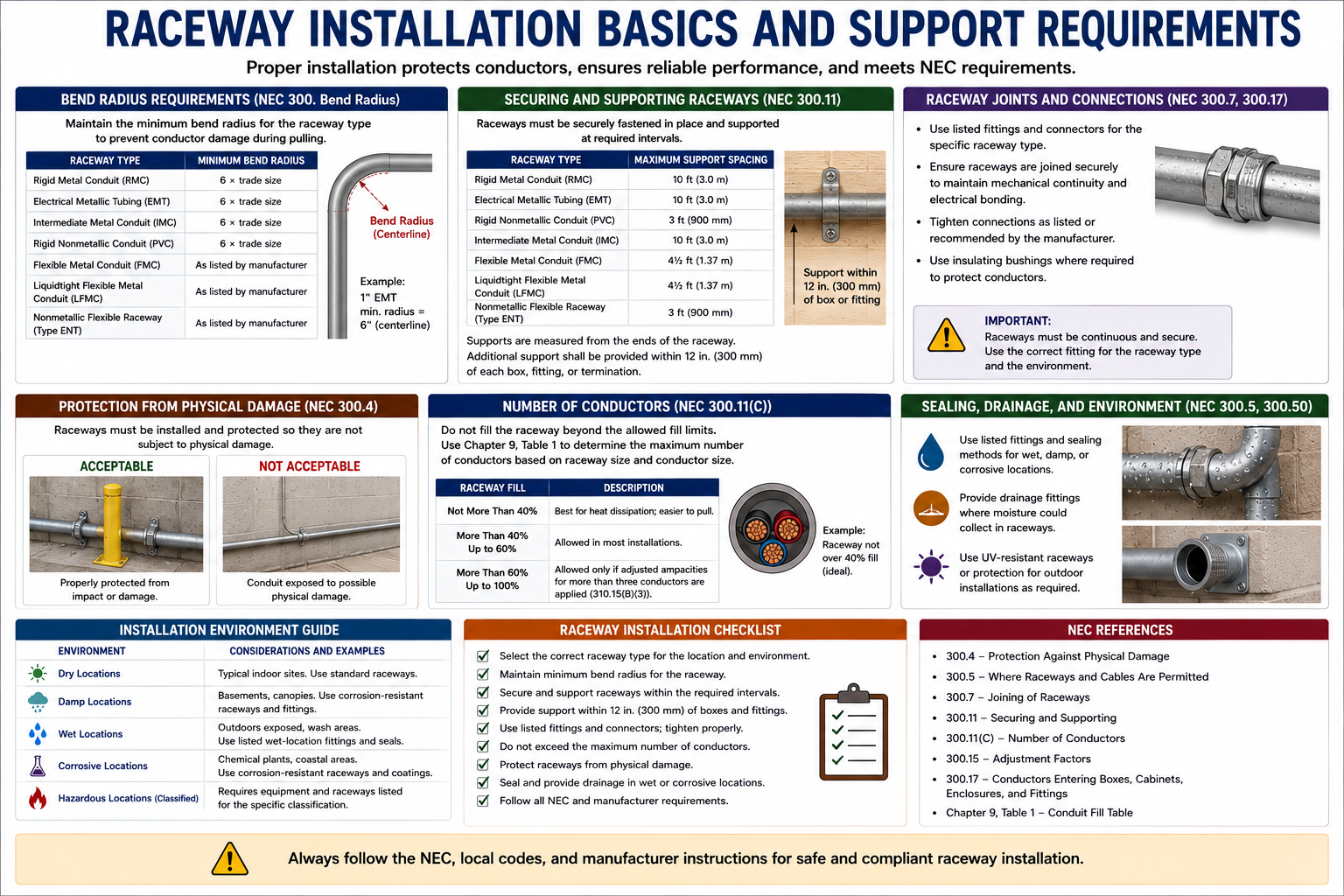
Metal raceways must be securely fastened and supported in accordance with the article governing the raceway. Support keeps the raceway aligned, protects fittings and terminations from mechanical strain, and prevents the weight of the raceway and conductors from being transferred improperly to boxes or equipment.
EMT, IMC, and RMC commonly use requirements based on fastening near terminations and supporting the raceway at specified intervals. Although several of these provisions use similar distances, an exam question should still be answered from the specific raceway article because exceptions and special conditions can differ.
Identify the Raceway
Determine whether the installation is EMT, IMC, RMC, or another wiring method.
Find the .30 Section
The securing-and-supporting requirements in many Chapter 3 wiring-method articles are located in the section ending in .30.
Check Fastening Near Terminations
Determine how close to boxes, cabinets, conduit bodies, or other terminations the raceway must be securely fastened.
Check Support Intervals
Determine the maximum permitted spacing between supports and read any applicable exceptions or special provisions.
Look for the Repeating Article Structure
Many Chapter 3 wiring-method articles use a similar numbering structure. Once you recognize the pattern, you can locate rules more quickly instead of searching an entire article line by line.
For example, securing and supporting is commonly found in the .30 section of the raceway article. This pattern is valuable for open-book exam navigation, but always verify the actual section and wording in the NEC edition used for the examination.
Couplings, Connectors, Locknuts, and Bushings
A metallic raceway installation is a system of raceway sections, boxes, enclosures, fittings, supports, and conductors. The fittings are therefore just as important as the raceway itself.
Couplings
Couplings connect one raceway section to another. EMT commonly uses listed compression or setscrew-type couplings, while IMC and RMC commonly use threaded couplings.
Connectors
Connectors terminate the raceway at boxes, cabinets, panels, conduit bodies, and equipment enclosures.
Locknuts
Threaded raceway fittings and connectors can use locknuts to secure the raceway connection to an enclosure where the fitting design and installation method require them.
Bushings
Bushings and other identified fittings can protect conductors from abrasion and may also be involved in bonding arrangements where required.
Bending Metallic Raceway
Metal raceway bends must be made so that the raceway is not damaged and its internal diameter is not effectively reduced. Excessively flattened, kinked, cracked, or otherwise deformed raceway can damage conductors and make pulling difficult.
EMT is commonly field bent with hand, mechanical, or hydraulic benders. IMC and RMC require equipment appropriate to their heavier construction. Factory elbows can also be used where permitted and suitable for the installation.
Stub-Up
A bend used to turn a raceway from a horizontal run to a vertical position or the reverse.
Offset
Two bends that shift a raceway around an obstruction or align the raceway with a box or enclosure while maintaining the original direction of travel.
90-Degree Bend
A quarter-turn bend commonly used to change direction between horizontal and vertical runs.
Saddle
A group of bends used to route the raceway over or around an obstruction while returning to the original path.
Remember the 360-Degree Limit
For the common conduit and tubing systems covered in this lesson, the total bends between pull points are generally limited to 360 degrees. Four 90-degree bends total 360 degrees and therefore represent the normal maximum between accessible pulling points.
If additional direction changes are required, an accessible box, conduit body, or other permitted pull point must be incorporated into the raceway layout.
IMC and RMC Threads
Threaded metallic raceways require properly made threads and fittings. Field-cut threads must be made using equipment suitable for the raceway and must allow the raceway and fittings to engage properly.
Because cutting threads can expose unprotected metal, corrosion protection can become important where the raceway material or environment requires it. The finished installation must preserve the corrosion resistance required for the location.
Cut the Raceway Squarely
A properly prepared end improves thread quality and helps the raceway seat correctly in fittings.
Ream the Raceway
Remove burrs and sharp edges that could damage conductors during installation.
Cut Proper Threads
Use threading equipment and dies appropriate for the raceway material and size.
Protect Exposed Metal
Restore corrosion protection where required by the raceway material, listing, environment, and applicable NEC provisions.
Metal Raceway Outdoors and in Wet Environments
Metallic raceways can be installed in wet locations where the raceway, fittings, materials, and corrosion protection are suitable for the environment. The installation must also prevent moisture from compromising equipment or connections.
Remember that the interior of a raceway installed in a qualifying wet location is treated as a wet location. Conductors installed inside therefore must be suitable for wet-location use even when the raceway itself is metallic and weather resistant.
Raceway Material
The raceway must be suitable for the environmental conditions and protected from corrosion where necessary.
Fittings
Connectors, couplings, hubs, and other fittings must be identified for the environment where required.
Conductors
Conductors inside raceways in wet locations must be suitable for wet-location use.
Enclosures
Boxes, cabinets, and equipment connected to the raceway must have enclosure ratings and installation methods suitable for the location.
Protecting Metallic Raceway
Metal raceway can deteriorate when exposed to moisture, chemicals, soil, salt, industrial contaminants, or other corrosive conditions. The NEC requires wiring methods to be suitable for the environment or appropriately protected against corrosion.
Factory coatings, galvanizing, corrosion-resistant materials, supplemental protective coatings, and properly selected fittings may be used depending on the raceway and installation. Cutting, threading, or otherwise modifying a raceway must not leave the completed installation inadequately protected.
Metal Raceway as an Equipment Grounding Conductor
EMT, IMC, and RMC are among the wiring methods recognized by NEC 250.118 as equipment grounding conductors when properly installed. This means the metallic raceway itself can provide the effective ground-fault current path rather than requiring a separate wire-type equipment grounding conductor in every installation.
That capability depends on electrical continuity. Couplings, connectors, boxes, enclosures, fittings, and bonding connections must create a reliable conductive path back toward the source so sufficient fault current can flow to operate the overcurrent protective device.
Tight Connections
Loose fittings can compromise both mechanical integrity and electrical continuity.
Proper Fittings
Listed fittings must be installed according to their design and instructions so the intended bonding path is maintained.
Bonding Requirements
Some installations require additional bonding fittings, bushings, or jumpers because an ordinary mechanical connection is not sufficient for the particular application.
Fault-Current Path
The objective is a low-impedance conductive path capable of carrying fault current back to the source so the protective device can open the circuit.
Metal Does Not Automatically Mean Bonded
The presence of a metal raceway does not by itself prove that an effective equipment grounding path exists. Fittings must be properly installed, raceway sections must maintain continuity, and any additional bonding required by Article 250 must be provided.
A question that mentions concentric or eccentric knockouts, service equipment, higher fault-current conditions, or unusual raceway connections may be testing bonding requirements rather than merely asking whether the raceway is metallic.
Selecting the Raceway for the Environment
The mechanical strength of a raceway is one factor in determining where it can be used. EMT provides substantial protection in many installations, while IMC and RMC are commonly selected when a more rugged wiring method is needed.
However, the NEC uses specific permitted-use and prohibited-use language rather than simply ranking raceways from weakest to strongest. When a question states that a wiring method is subject to physical damage or severe physical damage, locate the exact use provision for that raceway.
Flexible Metallic Wiring Methods
Not every metallic raceway is rigid. Chapter 3 includes several flexible metallic wiring methods used where movement, vibration, alignment, or equipment connections make rigid raceway impractical.
FMC
Flexible Metal Conduit is covered by Article 348 and is commonly used for equipment connections and installations requiring flexibility.
LFMC
Liquidtight Flexible Metal Conduit is covered by Article 350 and combines metallic flexible construction with an outer covering designed for applications requiring liquidtight characteristics.
FMT
Flexible Metallic Tubing is covered by Article 360 and is a distinct wiring method with its own permitted uses and installation limitations.
Flexible raceways are examined more closely in Lesson 47. Do not assume that the securing, support, grounding, or permitted-use rules for EMT, IMC, or RMC apply to flexible raceways.
Use the Article Structure
Metal-raceway questions often become quick reference-book questions once the wiring method has been identified. Instead of trying to memorize every requirement, learn how the individual raceway articles are organized.
Identify the Wiring Method
Determine whether the question involves EMT, IMC, RMC, FMC, LFMC, or another metallic system.
Go to the Correct Article
Use Article 358 for EMT, 342 for IMC, 344 for RMC, or the applicable article for another wiring method.
Identify the Type of Requirement
Determine whether the question concerns permitted uses, prohibited uses, bends, fittings, support, physical damage, wet locations, or grounding and bonding.
Read Exceptions and Conditions
Do not stop after finding a familiar number. Check whether an exception or condition changes the general rule for the installation described.
Check Related Articles
Apply Article 300 general requirements and Article 250 grounding and bonding provisions where those subjects are part of the question.
The Article Number Is Often More Valuable Than a Memorized Dimension
Raceway support distances, fitting rules, and use restrictions are easy to confuse because several wiring methods have similar requirements. Knowing that EMT is Article 358, IMC is Article 342, and RMC is Article 344 allows you to confirm the answer quickly instead of relying on a number remembered from a different raceway system.
Code Locations to Know
Article 342
Intermediate Metal Conduit — permitted uses, prohibited uses, construction, bends, fittings, securing and supporting, and related requirements.
Article 344
Rigid Metal Conduit — permitted uses, prohibited uses, construction, bends, fittings, securing and supporting, and related requirements.
Article 358
Electrical Metallic Tubing — permitted uses, prohibited uses, bends, fittings, securing and supporting, and related installation requirements.
Article 348
Flexible Metal Conduit — requirements for one of the principal flexible metallic raceway systems.
Article 350
Liquidtight Flexible Metal Conduit — requirements for flexible metallic raceway installations requiring liquidtight characteristics.
250.118
Identifies wiring methods and conductors recognized as equipment grounding conductors, including qualifying metallic raceway systems.
Key Points to Remember
- EMT, IMC, and RMC are separate metallic raceway systems with separate NEC articles.
- EMT is covered by Article 358, IMC by Article 342, and RMC by Article 344.
- EMT is lightweight, thin-wall tubing and is normally joined with listed connectors and couplings rather than threaded raceway ends.
- IMC is a threaded raceway providing greater mechanical strength than EMT while generally being lighter than RMC.
- RMC is a heavy-wall threaded raceway commonly selected where substantial mechanical protection is required.
- Raceway support requirements must be obtained from the article governing the particular wiring method.
- Couplings, connectors, bushings, locknuts, and bonding fittings are integral parts of a metallic raceway installation.
- Raceway bends must not damage or excessively deform the raceway.
- Common conduit and tubing systems are generally limited to 360 degrees of bend between accessible pull points.
- Threaded raceway ends must be properly cut, reamed, and protected against corrosion where required.
- Raceways and fittings installed in wet or corrosive environments must be suitable for those conditions.
- EMT, IMC, and RMC can qualify as equipment grounding conductors when properly installed and electrically continuous.
- A metallic raceway does not automatically provide an adequate bonding path merely because its components are made of metal.
- Flexible metallic raceways have separate articles and must not automatically be treated according to EMT, IMC, or RMC rules.
- For exam questions, identify the raceway type first and then use its specific Chapter 3 article.
>
Leave a Reply
You must be logged in to post a comment.