Back to: NASCLA Master Electrical Contractor Exam Preparation
Raceway systems provide a protected path for electrical conductors and are among the most common wiring methods covered by the National Electrical Code. Correct installation requires more than choosing a conduit type and pulling conductors through it.
For the NASCLA Electrical Contractor Exam, you should understand the general NEC requirements that apply to raceway systems, including continuity, completion of the raceway before conductor installation, securing and supporting, protection from physical damage, bends, fittings, environmental suitability, conductor protection, and access for pulling and maintenance.
Raceways as Complete Wiring Systems
A raceway is an enclosed channel designed expressly for holding wires, cables, or busbars, with additional functions permitted by the NEC for particular raceway types. Common raceway systems include electrical metallic tubing, rigid metal conduit, intermediate metal conduit, rigid polyvinyl chloride conduit, flexible metal conduit, liquidtight raceways, and other systems covered by Chapter 3.
The NEC contains both general wiring-method requirements and individual articles for specific raceway types. A compliant installation therefore requires the installer to apply the general Chapter 3 rules together with the requirements of the article covering the particular raceway being used.
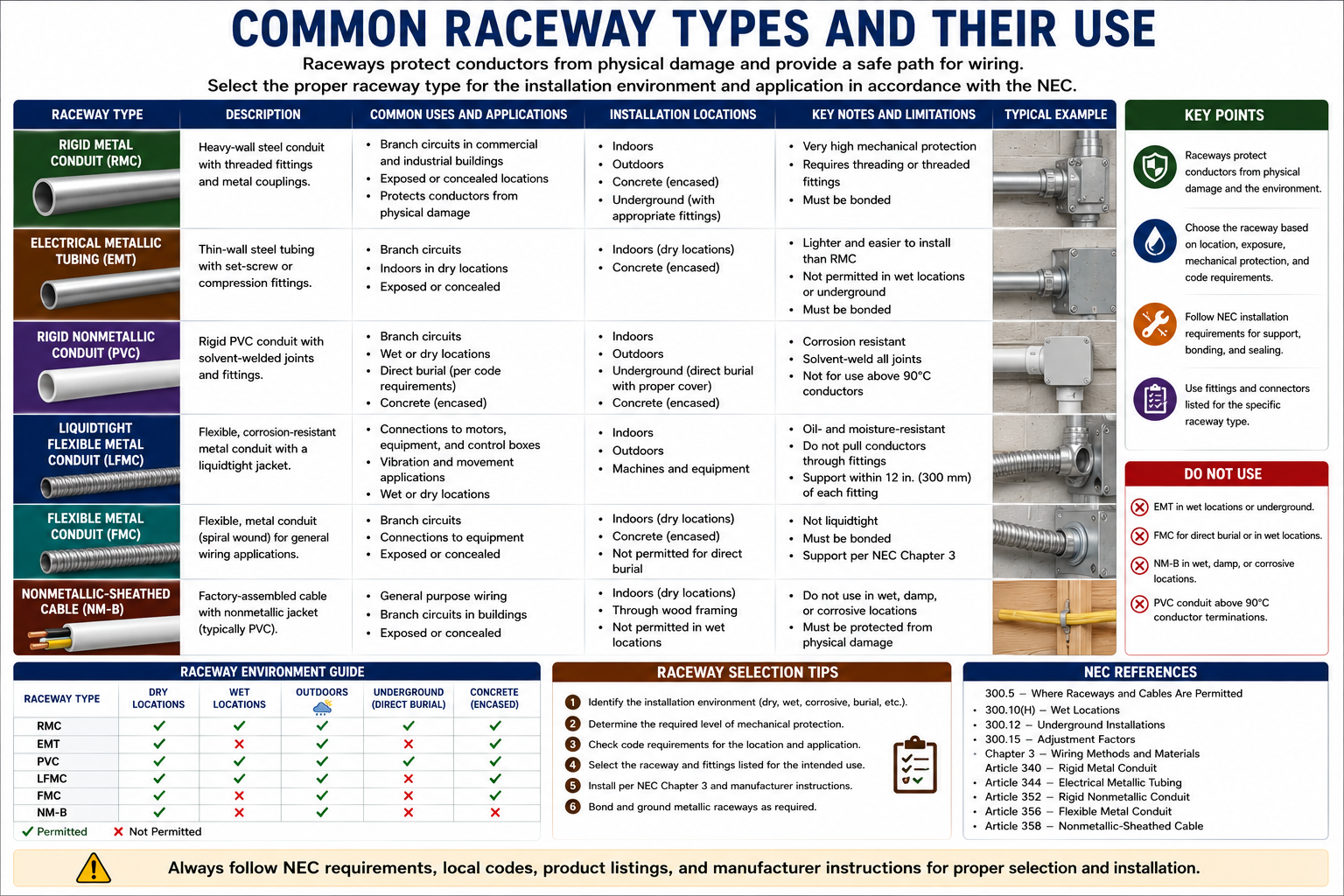
Why Raceway Systems Are Used
Raceways provide a controlled route for electrical conductors and can protect them from physical damage, moisture, corrosive conditions, and other environmental hazards when the selected raceway is suitable for the installation.
Mechanical Protection
A properly selected raceway helps protect conductors against impact, abrasion, crushing, and other physical damage.
Conductor Routing
Raceways establish an organized path between boxes, cabinets, equipment, pull points, and other portions of an electrical system.
Environmental Protection
Raceways and fittings selected for the environment can help protect wiring in wet, corrosive, underground, exposed, or other demanding locations.
Future Access
Many raceway systems allow conductors to be replaced or added later, subject to raceway-fill, ampacity, and other applicable NEC requirements.
Install the Raceway Before Installing Conductors
NEC 300.18 generally requires raceways to be installed complete between outlet, junction, or splicing points before the conductors are installed. This prevents conductors from being used to guide, support, or complete an unfinished raceway installation.
There are limited exceptions, such as short sections used to provide physical protection and certain circumstances associated with utilization equipment, but the normal exam rule is straightforward: build the raceway system first, then install the conductors.
Lay Out the Raceway Route
Determine the path between boxes, equipment, cabinets, and pull points while considering bends, accessibility, support, and physical protection.
Install Raceway and Fittings
Install conduit, tubing, couplings, connectors, boxes, conduit bodies, and other required components.
Secure and Support the System
Provide supports and fasteners according to the general wiring-method rules and the article governing the particular raceway type.
Inspect the Completed Raceway
Verify that the raceway is mechanically complete, free of damaging edges or obstructions, and suitable for conductor installation.
Install the Conductors
Pull or otherwise install the conductors only after the raceway system is ready to receive them.
General Rules and Raceway-Specific Rules Work Together
Article 300 contains general wiring-method requirements, but it does not replace the individual raceway articles. EMT, RMC, IMC, PVC, FMC, LFMC, and other raceways each have their own permitted uses, prohibited uses, support requirements, bending rules, fittings, and installation provisions.
When an exam question identifies a specific raceway type, do not stop at Article 300. Find the article governing that wiring method and apply its requirements as well.
Raceways Must Form a Properly Connected System
Raceways are generally required to be mechanically continuous between cabinets, boxes, conduit bodies, fittings, and other enclosures or outlets. Connections must be made using fittings and methods suitable for the raceway system.
A loose coupling, improperly seated connector, damaged fitting, or missing component can compromise conductor protection and, where metallic raceways are being relied upon as part of the grounding and bonding path, can also affect electrical continuity.
Couplings
Join sections of raceway together and must be suitable for the particular raceway type and environment.
Connectors
Terminate raceways at boxes, cabinets, conduit bodies, and equipment enclosures.
Bushings and Protection
Where required, bushings or equivalent fittings protect conductor insulation from abrasion at raceway entries and terminations.
Bonding Components
Bonding fittings, bushings, jumpers, or other methods may be required where normal raceway connections do not provide the bonding required by Article 250.
Raceways Must Be Properly Supported
Raceways and associated enclosures must be securely fastened and supported. The general requirements of NEC 300.11 apply together with the specific support rules in each raceway article.
Support spacing is not universal. EMT, PVC, flexible raceways, rigid metal conduit, and other wiring methods can have different fastening distances, support intervals, and exceptions. For exam questions, identify the raceway type before selecting a support requirement.
Secure Near Terminations
Many raceway articles require fastening within a specified distance of boxes, cabinets, conduit bodies, or other terminations.
Support Along the Run
Raceway articles establish maximum support intervals based on the particular wiring method.
Use Suitable Supports
Straps, hangers, clamps, structural supports, or other approved methods must properly support the raceway without damaging it.
Do Not Assume the Ceiling Grid Is a Raceway Support
Where wiring is installed above suspended ceilings, the NEC contains specific requirements for independent support rather than simply relying on the ceiling-support system.
There Is No Single Support Spacing for Every Raceway
Do not memorize one support interval and apply it to every conduit or tubing system. For example, the rules for EMT are not automatically the rules for PVC, FMC, LFMC, or another wiring method.
When a question asks how often a raceway must be supported, first identify the raceway article and then locate that article’s securing-and-supporting section.
Protection From Damage
Raceways must be suitable for the conditions in which they are installed. Where a wiring method is exposed to physical damage, the installer must use a wiring method and installation method that provide the required protection.
The phrase subject to physical damage appears throughout Chapter 3. Some raceways are permitted where physical damage is possible, while others are prohibited where severe physical damage is expected. The exact rule depends on the wiring method.
Impact
Raceways installed where vehicles, equipment, tools, or stored materials can strike them may require increased protection or a more robust wiring method.
Abrasion
Conductor insulation must be protected from sharp raceway edges, damaged threads, burrs, or improperly finished raceway ends.
Structural Movement
Expansion, contraction, vibration, settlement, or equipment movement may require fittings or wiring methods that accommodate movement without damaging the raceway or conductors.
Environmental Damage
Corrosion, moisture, sunlight, chemicals, and temperature can affect raceway suitability and may require special materials or protection.
Raceway Bends and Pulling Conditions
Raceway bends must be made without damaging the raceway or effectively reducing its internal diameter. Minimum bending-radius requirements vary with raceway type and size and are addressed by the applicable raceway article and Chapter 9 tables where referenced.
The number of bends in a raceway run also affects conductor installation. For conduit systems subject to the standard rule, the total bends between pull points are limited to 360 degrees. This prevents excessively difficult conductor pulls and reduces the possibility of damaging insulation during installation.
Example
Four 90-degree bends equal 360 degrees. Adding another bend before the next pull point would exceed the normal 360-degree limit and require the raceway layout to be changed or another accessible pull point to be provided.
Boxes and Conduit Bodies
Outlet boxes, junction boxes, pull boxes, and conduit bodies provide locations where conductors can be pulled, spliced where permitted, redirected, or accessed. They also divide long or complex raceway runs into manageable sections.
Pull points must remain accessible where required. A raceway system should not be designed so that conductors can only be installed or serviced by opening building finishes or dismantling inaccessible construction where the NEC requires access.
Count the Bends
Track the total degrees of bend between accessible pulling points.
Evaluate Pull Difficulty
Consider conductor size, raceway size, distance, bend radius, and the number and arrangement of bends.
Add Pull Points Where Required
Provide boxes or conduit bodies where necessary to comply with bending limitations and permit practical conductor installation.
Protecting Conductors From Abrasion
Cut or threaded raceway ends can damage conductor insulation if they contain burrs, sharp edges, or exposed surfaces that contact the conductor during pulling or normal operation. Raceway ends must therefore be properly prepared and fitted.
NEC 300.4 includes requirements for protecting conductors where they enter raceways and enclosures. Conductors 4 AWG and larger entering certain raceways or enclosures require protection from abrasion by an identified fitting or equivalent smooth insulating surface unless the enclosure design provides equivalent protection. :contentReference[oaicite:1]{index=1}
Raceway Material Must Match the Location
A raceway suitable for one installation may not be suitable for another. The installer must consider moisture, corrosion, direct burial, sunlight, physical damage, hazardous conditions, and other environmental factors before selecting the wiring method.
Wet Locations
Raceways and fittings installed in wet locations must be suitable for those conditions, and the conductors inside qualifying wet-location raceways must also be suitable for wet locations.
Corrosive Locations
Raceways, fittings, supports, boxes, and associated hardware must be made of materials suitable for the environment or be provided with appropriate corrosion protection.
Underground Installations
Underground raceway installations must address burial depth, physical protection, moisture, transitions above grade, and other requirements covered later in Part V.
Exposed Installations
Raceways exposed to sunlight, impact, weather, or other conditions must be identified and installed for those conditions.
A Raceway Interior Can Be a Wet Location
Installing conductors inside conduit does not automatically protect those conductors from wet-location requirements. Where a raceway is installed in a qualifying wet location, the NEC treats the raceway interior as a wet location, and the conductors installed inside must be suitable for that environment. :contentReference[oaicite:2]{index=2}
Metal Raceway and the Fault-Current Path
Many metallic raceway systems can serve as equipment grounding conductors when installed in accordance with Article 250 and the applicable wiring-method requirements. When a metallic raceway is used as part of the equipment grounding path, its electrical continuity becomes especially important.
Couplings, connectors, locknuts, bonding fittings, boxes, enclosures, and other components must maintain the required fault-current path. Paint, corrosion, loose fittings, improper connections, or nonconductive transitions can affect bonding and may require additional bonding provisions.
Do not confuse mechanical continuity with effective electrical bonding. A raceway can appear mechanically connected while still failing to provide the bonding required by the NEC.
Raceway Size Also Controls Conductor Capacity
A raceway cannot simply be filled with conductors until no additional conductor will physically fit. Chapter 9 establishes conductor-fill rules based on conductor area and raceway internal area.
Raceway-fill calculations are covered in detail in Lesson 51. For now, recognize that raceway trade size affects how many and what sizes of conductors can legally be installed, and that conductor fill is a separate calculation from ampacity adjustment for current-carrying conductors.
Supporting Conductors in Vertical Raceways
Long vertical raceway runs can place substantial mechanical weight on conductor insulation and terminations. NEC 300.19 requires conductor support when vertical rises exceed the limits specified in Table 300.19(A).
The support is intended to prevent the conductor’s own weight from damaging insulation or pulling excessively on terminations. At least one support is provided at or near the top, with additional supports where necessary for longer vertical runs. :contentReference[oaicite:3]{index=3}
Identify the Raceway Before Looking for the Rule
Raceway questions become much easier when you first identify whether the problem is asking about a general wiring-method rule or a rule that applies only to one particular raceway system.
Identify the Raceway Type
Determine whether the question involves EMT, IMC, RMC, PVC, FMC, LFMC, ENT, or another wiring method.
Identify the Installation Environment
Look for wet, dry, underground, exposed, corrosive, hazardous, or physical-damage conditions.
Check the General Requirements
Use Article 300 for requirements that apply broadly to wiring methods.
Go to the Raceway Article
Find the specific Chapter 3 article governing the raceway type for permitted uses, prohibited uses, securing, supporting, bends, fittings, and related installation requirements.
Check Related Requirements
Consider grounding and bonding, conductor fill, ampacity, environmental conditions, boxes, pull points, and any equipment-specific rules that also apply.
Do Not Apply EMT Rules to Every Raceway
EMT is common enough that its installation rules can become familiar and easy to remember. That familiarity can become a problem on an exam if you apply an EMT fastening distance, support interval, permitted-use rule, or bending requirement to PVC, flexible conduit, rigid conduit, or another wiring method.
Always identify the raceway first. The specific raceway article controls its detailed installation requirements.
Code Locations to Know
Article 300
Contains general wiring-method requirements that apply broadly to raceways, cables, boxes, conductors, and associated installations.
300.11
Addresses securing and supporting of raceways, cable assemblies, boxes, cabinets, and related wiring-system components.
300.18
Establishes the general requirement that raceways be installed complete before conductors are installed.
300.19
Addresses support of conductors in vertical raceways.
Chapter 3 Raceway Articles
Individual articles establish requirements for specific wiring methods such as EMT, IMC, RMC, PVC, FMC, and liquidtight raceways.
Chapter 9
Contains tables used for calculations and installation requirements including raceway fill and bending information referenced by Chapter 3 rules.
Key Points to Remember
- Raceways provide a protected and organized path for electrical conductors.
- General Article 300 requirements must be used together with the article governing the specific raceway type.
- Raceways generally must be installed complete between applicable points before conductors are installed.
- Raceway connections must maintain required mechanical continuity and, where applicable, electrical bonding continuity.
- Raceways must be securely fastened and supported according to both general and raceway-specific rules.
- Support spacing is not the same for every type of raceway.
- Raceways must be protected from physical damage and environmental conditions for which they are not suitable.
- Bends must not damage the raceway or effectively reduce its internal diameter.
- Conduit systems subject to the standard rule are generally limited to 360 degrees of bend between pull points.
- Raceway entries must be prepared so that conductor insulation is not damaged by burrs, sharp edges, or improper fittings.
- A raceway installed in a wet location can have a wet interior, requiring wet-location conductors.
- Long vertical raceway runs can require support for the conductors themselves.
- Raceway fill and conductor ampacity adjustment are separate calculations.
- On the exam, identify the exact raceway type before applying a support, use, or installation rule.
Leave a Reply
You must be logged in to post a comment.