Back to: NASCLA Master Electrical Contractor Exam Preparation
Conductor Insulation and Applications
Electrical conductors are selected for more than their size and ampacity. The insulation surrounding a conductor establishes important characteristics such as maximum operating temperature, suitability for wet or dry locations, and resistance to environmental conditions that could damage the insulation.
For the NASCLA Electrical Contractor Exam, you should be able to interpret common conductor insulation designations, use NEC Table 310.4(1), distinguish temperature ratings from location ratings, and determine whether a conductor is suitable for the conditions described in an exam question.
Understanding Conductor Insulation
The insulation surrounding an electrical conductor performs several functions. It electrically isolates the conductor, helps protect against contact with other conductive materials, and must withstand the temperatures and environmental conditions expected during normal operation.
Conductor markings provide information that allows an electrician to determine these characteristics. A designation such as THHN, THWN-2, or XHHW-2 is not simply a product name. The letters and suffixes identify properties that affect where and how the conductor can be installed.
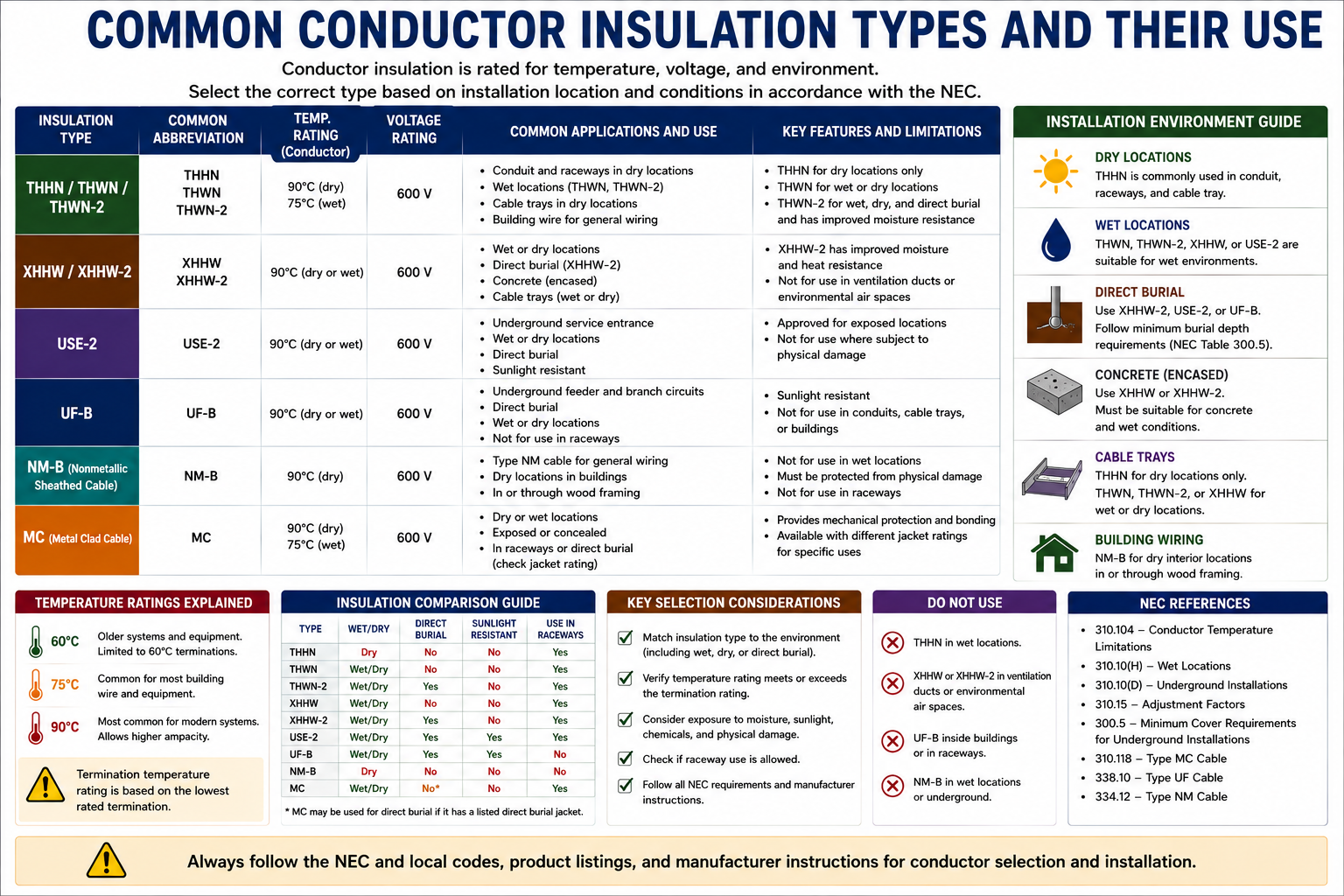
Table 310.4(1)
NEC Table 310.4(1) is a primary reference for identifying conductor insulation characteristics. The table provides information such as conductor type letters, maximum operating temperatures, permitted applications, insulation materials, and insulation thicknesses.
On an open-book exam, this table is more reliable than attempting to memorize every conductor designation. You should become comfortable locating the table quickly and reading across the appropriate row to determine whether a particular conductor is suitable for the installation described.
Type Letter
Identifies the conductor insulation designation, such as THHN, THWN-2, XHHW, or XHHW-2.
Maximum Operating Temperature
Identifies the maximum conductor operating temperature associated with the insulation type and its specified application.
Application Provisions
Indicates whether the conductor is suitable for dry, damp, wet, or other specified installation conditions.
Insulation
Describes characteristics of the insulating material, such as thermoplastic or thermoset construction and resistance to moisture or heat.
Reading Conductor Type Letters
Conductor type letters describe characteristics of the insulation system. Although understanding the general meaning of the letters is useful, the NEC table remains the controlling reference when determining whether a conductor is permitted for a particular application.
Thermoplastic
The letter T identifies thermoplastic insulation in common conductor designations such as THHN and THWN.
Heat Resistant
The H designation relates to heat resistance. Additional H designations can indicate a higher temperature capability within the particular conductor designation.
Wet-Location Suitability
The W designation is important when evaluating conductors for wet locations. Conductors used in wet locations must be a type permitted or listed for that environment.
Nylon Jacket
The N designation in common thermoplastic conductor types identifies a nylon or equivalent outer covering associated with the conductor construction.
Thermoset Insulation
Designations beginning with X identify thermoset-insulated conductor constructions. XHHW-2 is a common example used in electrical installations.
90°C Wet and Dry Rating
For common conductor designations such as THWN-2 and XHHW-2, the -2 suffix identifies a 90°C maximum operating temperature for both wet and dry-location applications.
THHN and THWN-2
THHN is one of the most familiar conductor markings encountered in electrical work. THHN is a 90°C conductor for dry and damp locations, but the THHN designation by itself does not make the conductor suitable for a wet location.
Many commercially available conductors carry multiple listings or markings, such as THHN/THWN-2. When the same conductor is also marked THWN-2, that additional designation makes it suitable for wet-location applications within the conditions of its listing, and THWN-2 has a 90°C maximum operating temperature in both wet and dry locations.
Read the Entire Conductor Marking
Do not treat THHN and THHN/THWN-2 as identical descriptions. If an exam question states only that a conductor is THHN, evaluate it according to the THHN designation given in the problem. If the conductor is identified as THHN/THWN-2, the additional THWN-2 rating changes its permitted environmental applications.
XHHW and XHHW-2
XHHW and XHHW-2 are thermoset-insulated conductor types frequently encountered in feeders, services, and other electrical installations. As with thermoplastic conductors, the complete designation matters when determining temperature and location suitability.
XHHW-2 is rated for a maximum operating temperature of 90°C in both dry and wet locations. The -2 suffix is therefore an important distinction when comparing it with conductor types whose maximum operating temperature changes according to the installation environment.
Thermoplastic
THHN and THWN-type conductors use thermoplastic insulation systems. Thermoplastic materials soften when sufficiently heated and harden again as they cool.
Thermoset
XHHW-type conductors use thermoset insulation. Thermoset materials are chemically cross-linked during manufacture and do not respond to heat in the same manner as thermoplastic materials.
Dry, Damp, and Wet Locations
The NEC distinguishes between dry, damp, and wet locations. Conductor selection must match the actual environment of the wiring method rather than simply whether the installation appears to be physically protected.
Dry Locations
Locations not normally subject to dampness or wetness. A location temporarily subject to dampness or wetness during building construction does not necessarily become a wet or damp location for the completed installation.
Damp Locations
Locations protected from weather and not subject to saturation with water or other liquids but subject to moderate degrees of moisture.
Wet Locations
Locations subject to saturation with water or other liquids and locations exposed to weather under the conditions established by the NEC.
Section 310.10 contains the application rules for insulated conductors and cables in these environments. Conductors used in wet locations must have an insulation type or construction permitted for wet-location use.
A Raceway Does Not Automatically Make a Location Dry
Installing conductors inside a raceway does not automatically convert a wet environment into a dry one. Raceway interiors can be classified as wet locations under NEC requirements when the raceway is installed in qualifying wet environments.
This is particularly important for underground raceways and raceways exposed to weather. The conductors installed inside must be suitable for the environment that exists inside the raceway, even though the conductor itself is not directly exposed to rain or soil.
Insulation Temperature and Ampacity
The conductor insulation temperature rating also affects ampacity calculations. Table 310.16 contains 60°C, 75°C, and 90°C ampacity columns corresponding to conductor temperature ratings.
As discussed in Lessons 41 and 42, the insulation temperature rating does not automatically establish the final allowable circuit ampacity. Equipment termination ratings and other applicable NEC requirements must also be satisfied.
Identify the Insulation
Read the complete conductor designation rather than assuming the conductor’s characteristics from appearance or a partial marking.
Determine the Temperature Rating
Use Table 310.4(1) to determine the maximum operating temperature applicable to that conductor type and installation.
Determine Location Suitability
Verify whether the conductor is suitable for the dry, damp, wet, or other environmental conditions described in the installation.
Determine Ampacity
Use the applicable ampacity table together with the conductor temperature rating and material.
Apply Other Limitations
Check termination ratings, correction and adjustment requirements, and any circuit- or equipment-specific NEC provisions.
Sunlight, Direct Burial, and Corrosive Environments
Temperature and moisture are not the only environmental conditions that affect conductor selection. Article 310 also addresses conductors exposed to direct sunlight, conductors used for direct burial, and conductors exposed to substances that can damage the conductor or its insulation.
Direct Sunlight
Where conductors or cables are exposed to direct sunlight, they must satisfy the applicable NEC sunlight-resistance requirements.
Direct Burial
A conductor installed as a direct-burial wiring method must be identified for that use. Wet-location suitability alone does not automatically establish a conductor as suitable for direct burial.
Corrosive Conditions
Where oils, greases, vapors, gases, fumes, liquids, or other substances can damage the conductor or insulation, the conductor must be suitable for the application.
Wet Location Does Not Mean Direct Burial
A conductor can be listed for use in a wet location without being identified for direct burial. These are separate installation characteristics. If an exam question describes conductors installed directly in the earth rather than inside an approved raceway, verify that the conductor or cable is specifically suitable for direct burial.
Color and Identification Requirements
Insulation color can also have a Code function. Grounded conductors and equipment grounding conductors have specific identification requirements, while ungrounded conductors must not use identification reserved for those purposes except where specifically permitted.
Grounded Conductors
Insulated grounded conductors are generally identified by white or gray in accordance with the applicable Article 200 requirements.
Equipment Grounding Conductors
Insulated equipment grounding conductors are generally identified by green or green with one or more yellow stripes in accordance with Article 250.
Ungrounded Conductors
Ungrounded conductor identification must avoid colors reserved for grounded and equipment grounding conductors and must comply with any additional identification requirements applicable to the system.
Decode the Question Before Opening the Table
Conductor-insulation questions often provide several details that appear unrelated: conductor type, installation location, raceway location, temperature, and terminal rating. Each detail may control a different part of the answer.
Identify the Environment
Determine whether the location is dry, damp, wet, exposed to sunlight, direct buried, corrosive, or subject to another special condition.
Identify the Conductor Designation
Read every letter and suffix given in the question. THHN, THWN, and THWN-2 do not communicate identical properties.
Use Table 310.4(1)
Confirm the maximum operating temperature and application provisions for the conductor rather than relying solely on memory.
Check Section 310.10
Verify that the conductor is permitted for the environmental condition described in the question.
Then Evaluate Ampacity
After establishing that the conductor is suitable for the application, determine ampacity and apply any required correction, adjustment, or termination limitations.
Do Not Assume All THHN Is Wet-Location Rated
Many conductors encountered in the field carry multiple markings such as THHN/THWN-2, which can make it easy to associate THHN itself with wet-location installations. On the exam, however, use the conductor designation actually provided. THHN alone is not one of the conductor types identified by NEC 310.10(C) for wet locations.
If the question identifies the conductor as THHN/THWN-2, the THWN-2 designation provides the wet-location suitability. The complete marking matters.
Code Locations to Know
Article 310
Contains general requirements for conductors used in electrical wiring installations.
Table 310.4(1)
Provides conductor type letters, maximum operating temperatures, application provisions, insulation characteristics, and related information.
310.10
Addresses permitted conductor applications, including dry, damp, wet, sunlight-exposed, direct-burial, and corrosive conditions.
Table 310.16
Provides allowable ampacities for insulated conductors under its specified conditions of use.
Article 200
Contains requirements associated with grounded conductors, including conductor identification.
Article 250
Contains grounding and bonding requirements, including identification requirements for insulated equipment grounding conductors.
Key Points to Remember
- Conductor insulation determines important temperature and environmental characteristics.
- NEC Table 310.4(1) is a primary reference for conductor insulation types and applications.
- The complete conductor designation matters; similar conductor types can have different permitted applications.
- THHN is suitable for dry and damp locations but the THHN designation alone does not establish wet-location suitability.
- THWN-2 is suitable for dry and wet locations and has a 90°C maximum operating temperature in those applications.
- XHHW-2 is a thermoset-insulated conductor suitable for dry and wet locations at a 90°C maximum operating temperature.
- A conductor’s insulation temperature rating does not override equipment termination temperature limitations.
- Conductors installed in raceways located in qualifying wet environments may themselves be considered installed in a wet location.
- Wet-location suitability and direct-burial suitability are separate requirements.
- Sunlight exposure and corrosive conditions can impose additional conductor-selection requirements.
- Use the NEC tables and conductor markings rather than assuming a conductor is suitable based on appearance or common field practice.
Leave a Reply
You must be logged in to post a comment.