Back to: NASCLA Master Electrical Contractor Exam Preparation
Nonmetallic raceways provide an alternative to metallic conduit in many electrical installations. Rigid polyvinyl chloride conduit, commonly called PVC conduit, is widely used underground, outdoors, in corrosive environments, and in other applications where its electrical insulation and resistance to moisture and corrosion provide important advantages.
For the NASCLA Electrical Contractor Exam, you should understand where PVC conduit is permitted, how Schedule 40 and Schedule 80 applications differ, how PVC must be secured and supported, why thermal expansion and contraction matter, how underground installations affect conductor selection, and why a nonmetallic raceway normally requires a separate equipment grounding conductor.
Understanding Nonmetallic Raceway Systems
Rigid PVC conduit is one of the most important nonmetallic raceway systems covered by the NEC. Unlike EMT, IMC, or RMC, PVC does not provide a conductive metallic path. Its characteristics make it especially useful where moisture, corrosion, soil contact, or electrical isolation are important considerations.
PVC raceway requirements are primarily found in NEC Article 352. Other nonmetallic raceways have their own Chapter 3 articles, so the rules for PVC should not automatically be applied to every nonmetallic wiring method.
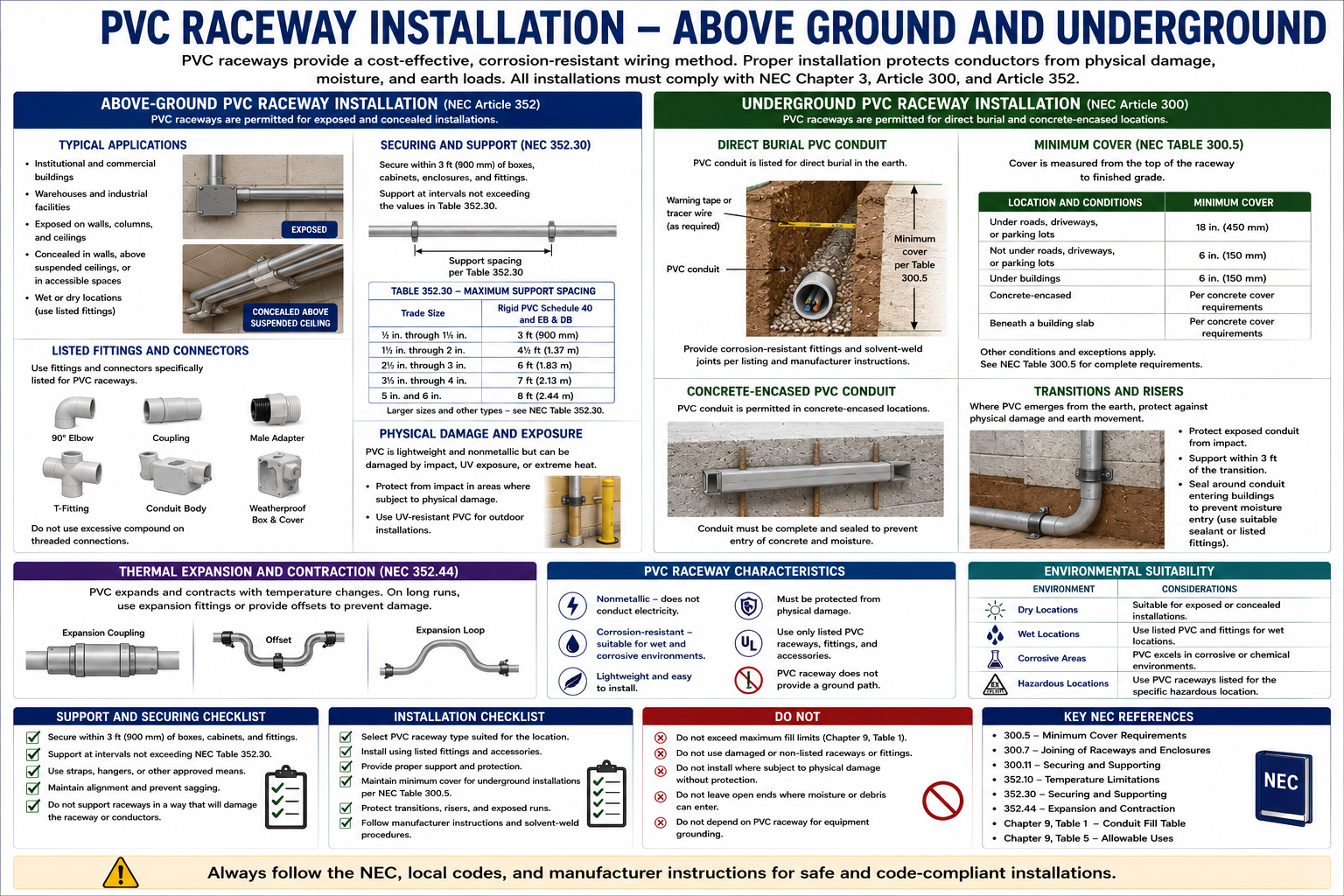
Article 352 — Rigid Polyvinyl Chloride Conduit
Article 352 covers rigid polyvinyl chloride conduit and its associated installation requirements. Like the metallic raceway articles studied previously, Article 352 includes permitted uses, prohibited uses, securing and supporting, bends, fittings, expansion provisions, and other requirements specific to the wiring method.
352.10
Identifies applications in which PVC conduit is permitted.
352.12
Identifies uses that are not permitted for PVC conduit.
352.30
Contains the requirements for securing and supporting PVC conduit.
352.44
Addresses expansion fittings and movement associated with temperature changes and other conditions.
Why PVC Is Used
PVC conduit has physical and electrical characteristics that make it particularly useful in environments where metallic raceway may require additional corrosion protection or where a nonconductive wiring method is desirable.
Corrosion Resistance
PVC does not rust like ferrous metal raceways and can be useful in damp, wet, underground, and corrosive environments when the material is suitable for the conditions.
Nonconductive Construction
PVC is electrically nonconductive, so it does not provide the metallic equipment-grounding path that EMT, IMC, or RMC can provide.
Light Weight
PVC is relatively light and can be cut and assembled without the threading equipment required for many metallic conduit systems.
Underground Use
PVC is widely used in underground installations where the raceway and installation comply with Article 352 and the underground requirements of Article 300.
PVC Is Not Limited to Underground Work
A common misconception is that PVC conduit is only an underground wiring method. Article 352 permits PVC in a variety of applications, including concealed work, dry and damp locations, wet locations, exposed work where permitted, corrosive environments where suitable, and underground installations.
The installation conditions determine the type of PVC, physical protection, supports, fittings, conductor requirements, and other provisions that must be applied.
Concealed
PVC can be installed within walls, floors, ceilings, and other concealed locations where permitted by Article 352.
Dry and Damp
PVC can be used in dry and damp locations unless a specific prohibited-use provision applies.
Wet Locations
PVC can be installed in wet locations when the complete raceway system and its associated hardware are suitable for the conditions.
Exposed
PVC can be installed exposed where the raceway type and installation meet the applicable physical-damage and environmental requirements.
Underground
PVC can be installed underground, including qualifying direct-burial and concrete-encased applications, subject to the applicable underground requirements.
Corrosive Environments
PVC can be advantageous where corrosive influences would attack ordinary metallic wiring methods, provided the material is suitable for the particular environment.
PVC Can Be Installed Above Ground
Do not automatically reject PVC because an installation is exposed or above grade. Article 352 permits exposed PVC installations when the raceway is suitable for the application and the physical-damage requirements are satisfied.
The exam question may therefore depend on whether the installation is merely exposed or whether it is specifically subject to physical damage.
Schedule 40 and Schedule 80
PVC conduit is manufactured in different wall thicknesses. Schedule 40 and Schedule 80 are the two designations most commonly encountered in electrical work. Schedule 80 has a thicker wall and greater mechanical strength than Schedule 40 of the same nominal trade size.
Schedule 40 PVC is commonly used where the conduit is not subject to physical damage. Where PVC conduit is exposed to physical damage, the raceway must be identified for that application. Schedule 80 PVC is commonly identified for locations subject to physical damage.
Schedule 40
Commonly used for underground, concealed, exposed, and other qualifying applications where the raceway is not subject to physical damage requiring a more robust wiring method.
Schedule 80
Has a heavier wall and is commonly identified for applications where PVC conduit is subject to physical damage.
Exposed Does Not Automatically Mean Subject to Physical Damage
An exposed raceway is not automatically considered subject to physical damage merely because it is visible. The actual conditions of the installation determine whether physical-damage protection is required.
When an exam problem specifically states that PVC is subject to physical damage, look for the Article 352 requirements governing that condition rather than assuming ordinary Schedule 40 is acceptable.
PVC Below Grade
PVC conduit is extensively used underground because it is resistant to moisture and soil-related corrosion. Underground installations must comply not only with Article 352 but also with the applicable requirements of NEC 300.5.
Article 300.5 addresses issues including minimum cover, protection where raceways emerge from grade, wet-location conditions, underground transitions, and protection from movement or physical damage.
Select the Wiring Method
Verify that the PVC raceway type is permitted for the underground application.
Determine Required Cover
Use the applicable Article 300.5 requirements and table rather than assuming one burial depth applies to every circuit and location.
Protect Raceway Emerging From Grade
Evaluate the portion of the raceway that emerges from the earth for physical damage and other applicable protection requirements.
Use Wet-Location Conductors
Conductors installed in underground raceways must be suitable for wet locations because the raceway interior is considered a wet location.
Allow for Movement
Consider settling, frost heave, thermal movement, and transitions between underground and above-ground portions of the system.
Underground PVC Is a Wet Location Inside
Buried PVC conduit should not be treated as a dry enclosure for conductor selection. The NEC considers the interior of underground raceways to be a wet location.
Conductors installed inside therefore must have a wet-location rating even though the PVC raceway itself is resistant to water and corrosion.
PVC Support Spacing Depends on Raceway Size
NEC 352.30 requires PVC conduit to be securely fastened and supported while permitting the raceway to move as necessary because of thermal expansion and contraction. PVC must generally be securely fastened within 3 feet of boxes, cabinets, conduit bodies, or other termination fittings.
The maximum spacing between supports is found in Table 352.30. The permitted distance changes with raceway trade size, which means there is no single support interval that applies to all PVC conduit.
Near Terminations
PVC is generally secured within 3 feet of each box, cabinet, conduit body, or other termination fitting.
Along the Raceway
Support intervals are determined from Table 352.30 according to the trade size of the conduit.
Allow Movement
Supports must not prevent the thermal movement that the PVC system is designed to accommodate.
Framing Support
Horizontal PVC installed through qualifying bored or punched framing members can be considered supported, subject to the applicable fastening requirements near terminations.
Do Not Memorize a Universal 10-Foot PVC Support Rule
PVC support spacing varies with trade size. Smaller PVC conduit requires closer support than larger sizes under Table 352.30.
If the question asks for the maximum support spacing, identify the trade size and use Table 352.30 rather than borrowing a support dimension from EMT, IMC, RMC, or another raceway system.
PVC Expands and Contracts
PVC changes length significantly as its temperature changes. A long raceway installed outdoors can experience substantial movement between cold and hot conditions, especially where it is exposed to direct sunlight or large seasonal temperature swings.
If the ends of a long PVC run are rigidly fixed without allowing for this movement, the raceway can bow, pull apart fittings, damage boxes, or place excessive stress on supports and terminations.
Temperature Change
The greater the temperature difference between installation conditions and expected operating conditions, the greater the potential movement.
Length of Run
A longer straight run produces more total dimensional change than a short run exposed to the same temperature difference.
Fixed Terminations
Raceways installed between securely mounted boxes, cabinets, elbows, or other fixed points require special attention because movement cannot simply occur at the ends.
Expansion Fittings
Expansion fittings or other applicable provisions allow the raceway to change length without damaging the completed installation.
Article 352.44
Article 352 contains specific requirements for accommodating expansion and contraction of PVC conduit. Where a straight run between securely mounted items is expected to experience sufficient length change, an expansion fitting is required.
The applicable expansion information is determined using the NEC provisions and Table 352.44. On the exam, pay attention to the total raceway length, temperature range, and whether the ends of the raceway are restrained.
Determine Raceway Length
Identify the length of the straight PVC run between fixed points.
Determine Temperature Change
Determine the expected temperature difference over the operating range of the installation.
Determine Length Change
Use the applicable Article 352 expansion information to determine the expected expansion or contraction.
Provide Movement Where Required
Install an expansion fitting or other required means so the raceway can move without damaging fittings, enclosures, or supports.
Supports Must Allow the Expansion Fitting to Work
Installing an expansion fitting does little good if every raceway strap clamps the PVC so tightly that the conduit cannot move. The raceway must be secured and supported while still allowing the intended thermal movement.
Think of the entire PVC installation as a system: fixed points, supports, raceway length, fittings, and expansion provisions must work together.
Transitions From Underground to Above Grade
PVC raceway emerging from the earth can be affected by soil settlement, frost heave, and other earth movement. This can impose substantial stress on the raceway and the equipment or enclosure to which it is connected.
Article 300.5 and the applicable Article 352 requirements must be considered where movement could damage the raceway. An underground-to-above-grade transition is therefore more than simply gluing a vertical piece of PVC onto a buried horizontal run.
Fittings and Solvent-Cemented Connections
PVC raceway sections are commonly joined using listed couplings and fittings with the joining method specified for the raceway system. Proper preparation and assembly are important because the completed fitting must maintain mechanical strength and raceway continuity.
Cut Squarely
Prepare the raceway end so it seats correctly in the fitting.
Remove Burrs
Remove sharp edges and debris that could interfere with assembly or damage conductors.
Use Listed Components
Use couplings, adapters, expansion fittings, boxes, and other components suitable for the PVC raceway system.
Follow Installation Instructions
Use the manufacturer’s specified preparation, cementing, insertion, curing, and assembly procedures for the listed raceway system.
Field Bends and Factory Elbows
PVC raceway can be installed with factory elbows and can also be field bent using methods appropriate for the product. A field bend must not damage, flatten, burn, kink, or otherwise impair the raceway.
As with other raceways, the finished bend must maintain adequate internal space for conductors and comply with the applicable bending-radius and total-bend limitations.
PVC Does Not Provide a Fault-Current Path
Unlike EMT, IMC, and RMC, PVC conduit is nonconductive and cannot serve as an equipment grounding conductor. Where equipment grounding is required, a wire-type or other NEC-recognized equipment grounding conductor must be provided with the circuit as applicable.
Metal boxes, cabinets, equipment enclosures, fittings, and other conductive components connected to a PVC raceway system still require grounding and bonding. The absence of a metallic raceway makes the separate equipment grounding path especially important.
PVC Raceway
Does not carry ground-fault current as an equipment grounding conductor because the raceway material is nonconductive.
Equipment Grounding Conductor
A qualifying equipment grounding conductor provides the low-impedance fault-current path required by Article 250.
Metal Enclosures
Metal boxes, cabinets, and equipment connected to PVC raceway must still be bonded to the equipment grounding system.
Transitions to Metal Raceway
Where PVC transitions to metallic raceway or equipment, the grounding and bonding arrangement must maintain the required fault-current path.
The Earth Is Not the Equipment Grounding Conductor
A buried PVC raceway does not obtain an effective ground-fault current path merely because it is surrounded by earth. Ground-fault current must have an effective conductive path back to the source so the overcurrent protective device can operate.
The equipment grounding conductor installed with the circuit performs that function. Soil is not a substitute for the required equipment grounding and bonding path.
Conductor Selection Inside PVC
PVC itself may be suitable for wet environments, but that does not change the rating required for the conductors inside it. Raceway systems installed underground and raceways in qualifying wet locations can contain moisture or condensation.
Conductors installed in these locations must therefore be listed for wet-location use. Common examples include conductors carrying a THWN-2 or XHHW-2 designation, depending on the specific conductor and application.
Nonmetallic Does Not Mean Indestructible
PVC is resistant to many corrosive environments, but it is not automatically suitable for every chemical exposure. Article 352 requires the raceway to be suitable for corrosive influences to which it will be exposed.
Chemicals, extreme temperatures, mechanical impact, ultraviolet exposure, and other conditions can affect the raceway or its fittings. Always evaluate the actual environment rather than assuming that a nonmetallic raceway cannot be damaged.
Beyond Rigid PVC
Chapter 3 contains other nonmetallic wiring methods in addition to rigid PVC conduit. These systems have different construction, applications, and installation rules.
ENT
Electrical Nonmetallic Tubing is a flexible corrugated nonmetallic raceway covered by Article 362.
LFNC
Liquidtight Flexible Nonmetallic Conduit is covered by Article 356 and provides flexibility combined with liquidtight characteristics for permitted applications.
RTRC
Reinforced Thermosetting Resin Conduit is another rigid nonmetallic raceway system with its own construction characteristics and NEC article.
The presence of several nonmetallic raceway types reinforces an important exam principle: identify the exact wiring method before applying its permitted-use, support, fill, grounding, or installation requirements.
Work From the Installation Conditions
PVC questions often combine several requirements in one problem. The question may describe an underground run that emerges above grade, passes through an area subject to physical damage, experiences a large temperature change, and terminates at metal equipment.
Confirm the Raceway
Verify that the wiring method is PVC conduit and locate Article 352.
Identify the Environment
Determine whether the installation is above ground, underground, wet, corrosive, concealed, exposed, or subject to physical damage.
Check Permitted and Prohibited Uses
Use 352.10 and 352.12 before focusing on installation dimensions.
Check Supports and Expansion
Use 352.30 and 352.44 to evaluate support spacing and required accommodation for movement.
Check Related NEC Articles
Use Article 300 for underground and general installation requirements and Article 250 for grounding and bonding.
Evaluate the Conductors
Verify wet-location suitability, ampacity, fill, and any other requirements affecting the conductors installed inside the PVC.
Know the Article, Then Use the Tables
For PVC questions, memorizing isolated support distances or burial depths is less useful than knowing where those requirements are found. Start with Article 352 for the raceway itself, Article 300.5 for underground installations, Article 250 for grounding and bonding, and Chapter 9 when raceway-fill calculations are required.
Code Locations to Know
Article 352
Rigid Polyvinyl Chloride Conduit.
352.10
Permitted uses for PVC conduit.
352.12
Uses not permitted for PVC conduit.
352.30 and Table 352.30
Securing and supporting requirements, including trade-size-dependent support intervals.
352.44
Expansion and movement provisions for PVC raceway installations.
300.5
Underground installation requirements, including cover, wet-location conditions, physical protection, and earth movement.
Article 250
Grounding and bonding requirements, including the equipment grounding path required when nonmetallic raceway is used.
Chapter 9
Contains tables and information used for raceway-fill calculations addressed later in Part V.
Key Points to Remember
- Rigid PVC conduit is covered by NEC Article 352.
- PVC is permitted in many above-ground as well as underground applications.
- PVC can be used in concealed, dry, damp, wet, exposed, corrosive, and underground installations when the applicable requirements are satisfied.
- Schedule 40 and Schedule 80 have different wall thicknesses and physical-protection capabilities.
- PVC exposed to physical damage must be identified for that application.
- Schedule 80 PVC is commonly identified for areas subject to physical damage.
- Underground PVC installations are also subject to NEC 300.5.
- The interior of underground raceways is considered a wet location.
- Conductors installed underground in PVC must therefore be suitable for wet locations.
- PVC must generally be secured within 3 feet of boxes, cabinets, conduit bodies, and other termination fittings.
- PVC support spacing varies according to raceway trade size and must be determined from Table 352.30.
- PVC expands and contracts substantially with temperature changes.
- Expansion fittings or other required provisions must accommodate expected raceway movement.
- Supports must permit the thermal movement necessary for the expansion system to function.
- Underground-to-above-grade transitions must account for physical protection and possible earth movement.
- PVC is nonconductive and cannot itself serve as an equipment grounding conductor.
- A separate NEC-recognized equipment grounding path must be provided where required.
- Metal boxes and equipment connected to PVC raceway still require grounding and bonding.
- ENT, LFNC, RTRC, and other nonmetallic raceways have separate NEC requirements and should not automatically be treated as PVC.
Leave a Reply
You must be logged in to post a comment.