Back to: NASCLA Master Electrical Contractor Exam Preparation
Bonding joins conductive parts together to establish electrical continuity and the capacity to safely carry current that may be imposed on those parts. Proper bonding is an essential part of the effective ground-fault current path because it prevents metal enclosures, raceways, equipment frames, and other conductive parts from remaining electrically isolated if they become energized.
This lesson examines bonding at services, the main bonding jumper, bonding of metallic raceways and enclosures, equipment bonding, piping and structural metal, and the critical distinction between bonding conductive parts together and grounding an electrical system to earth.
Creating Electrical Continuity
Bonding creates reliable electrical connections between conductive parts so they operate as an electrically continuous system. When a ground fault energizes bonded metal, the bonding system helps carry fault current through the equipment-grounding path back toward the source.
Bonding is therefore closely related to equipment grounding, but it is not the same as grounding to earth. A grounding electrode system connects the electrical system to earth. Bonding joins conductive parts together and helps establish the effective ground-fault current path.
What Is Bonding?
Bonding is the joining of conductive parts to establish electrical continuity and conductivity. The objective is to ensure that conductive parts required to be connected together do not remain electrically isolated from the grounding and bonding system.
During a ground fault, properly bonded conductive parts become part of the effective ground-fault current path. The path must be capable of safely carrying the fault current likely to be imposed until the applicable protective device operates.
Electrical Continuity
Bonding electrically connects conductive parts that are required to function together as part of the grounding and bonding system.
Fault-Current Path
Bonded metal can form part of the low-impedance conductive path that returns ground-fault current toward the source.
Fault Clearing
A sufficiently low-impedance fault path permits enough current to flow to facilitate operation of the applicable protective device.
Equipotential Connection
Bonding reduces dangerous differences in electrical potential between interconnected conductive parts.
Bonding Is Not Grounding to Earth
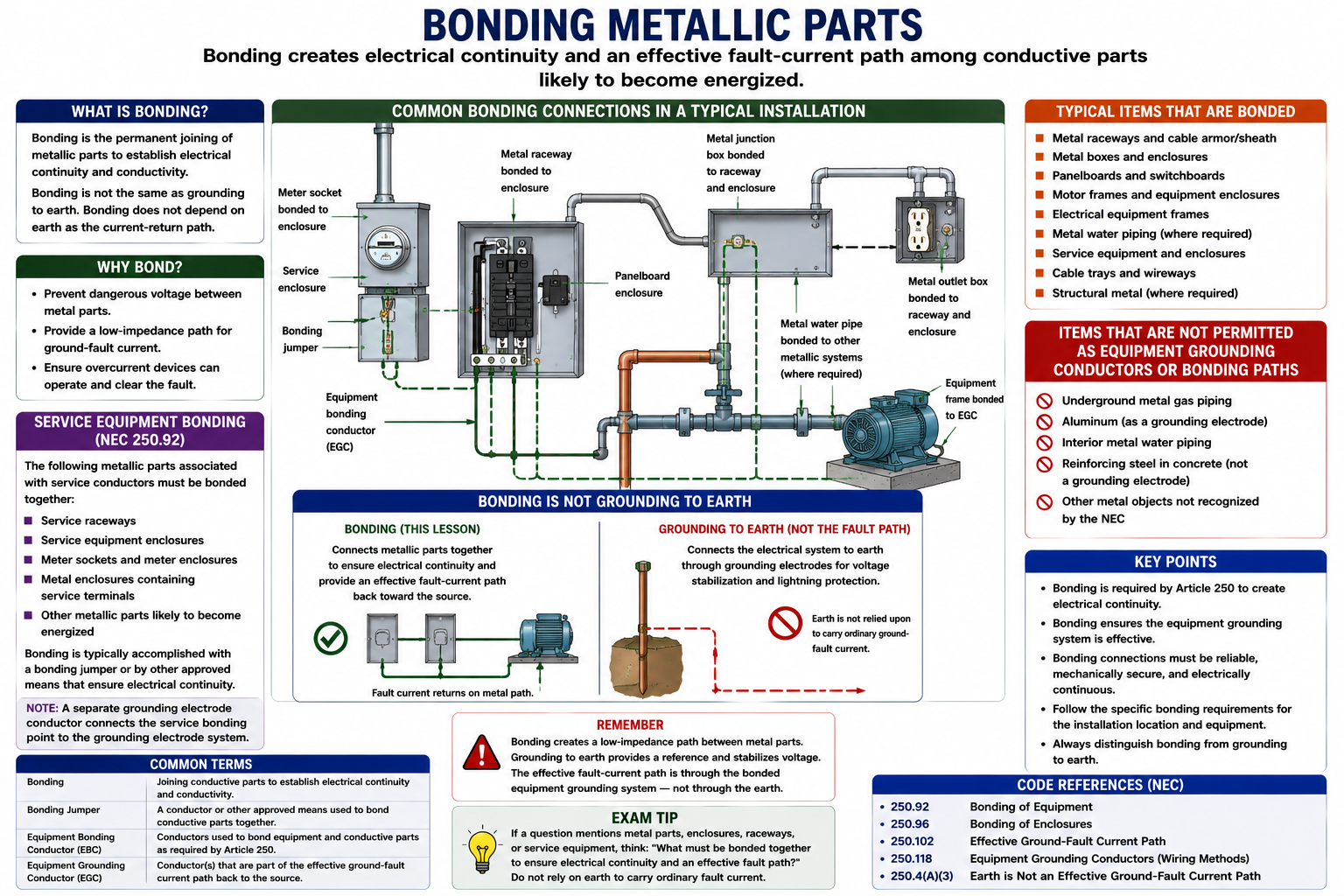
Bonding joins conductive parts together. Grounding connects an electrical system or equipment to earth as required by Article 250. These functions interact, but ordinary ground-fault current must not depend on earth as the effective path back to the source.
Bonding at the Electrical Service
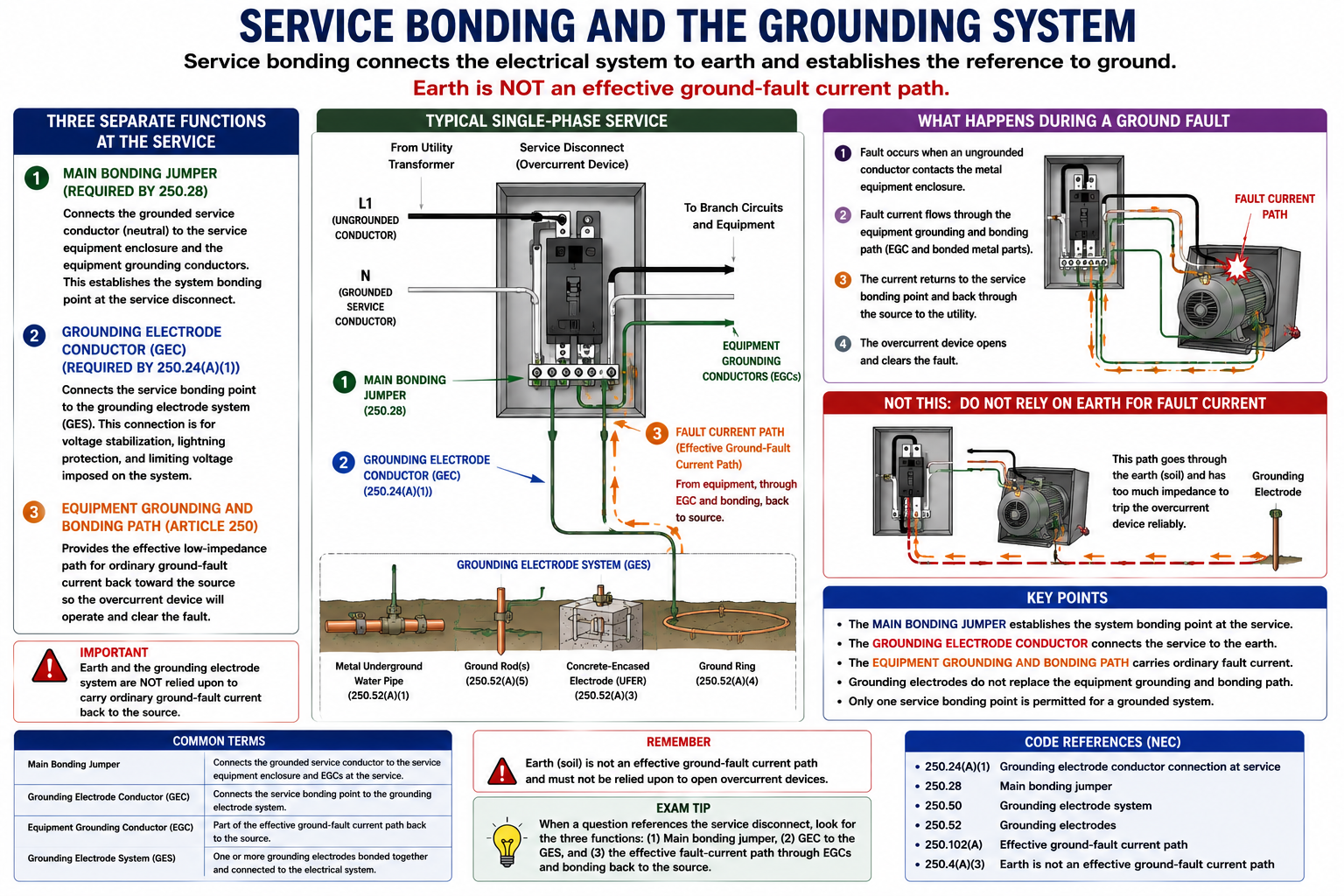
The service is a critical location in a grounded electrical system because the grounded service conductor and the equipment-grounding and bonding system are intentionally connected at the service bonding point. The main bonding jumper establishes this connection within the service equipment as required by Article 250.
This connection allows fault current arriving through equipment grounding and bonded conductive paths to reach the grounded service conductor and complete the conductive fault-current circuit back toward the source.
The Main Bonding Jumper
For a grounded electrical system, the main bonding jumper connects the grounded service conductor to the service-disconnect enclosure and equipment-grounding conductors at the service. This connection is a critical part of the effective ground-fault current path.
The main bonding jumper can take several permitted physical forms, such as a conductor, bus, screw, or other suitable means incorporated into listed service equipment. It must be installed and sized according to the applicable Article 250 requirements.
The Main Bonding Jumper Completes the Service Fault Path
If fault current returns to the service equipment through an equipment grounding conductor or bonded metal path, the main bonding jumper provides the required connection between that grounding and bonding system and the grounded service conductor. The grounded service conductor then provides the conductive path back toward the grounded source.
Do Not Confuse the Conductors at the Service
Main Bonding Jumper
Connects the grounded service conductor to the service-disconnect enclosure and equipment-grounding system.
Grounding Electrode Conductor
Connects the electrical system to the grounding electrode system according to the requirements of Article 250.
Equipment Grounding Path
Carries ordinary ground-fault current from equipment and bonded metal parts back toward the service bonding point.
Grounded Service Conductor
Provides the conductive connection from the service bonding point back toward the grounded source in the service fault-current path.
The GEC Is Not the Main Fault-Current Return Path
The grounding electrode conductor connects the electrical system to the grounding electrode system. It should not be confused with the equipment grounding and bonding path used to return ordinary ground-fault current toward the source.
Bonding Service Equipment
Metal parts associated with service conductors require special bonding because a fault can occur on the supply side of the service overcurrent protective device. Article 250 requires specified service raceways, cable systems, enclosures, meter fittings, boxes, and similar conductive parts associated with service conductors to be effectively bonded.
The bonding method must maintain electrical continuity and provide a path capable of carrying fault current that could be imposed on the service equipment.
Why Service Raceway Bonding Is Important
Metal raceways containing service conductors can become energized if conductor insulation fails. Because this fault can occur ahead of the service overcurrent protective device, the service raceway and associated metal enclosures must have an effective bonding path back toward the grounded source.
Article 250 therefore contains specific bonding methods for service equipment rather than relying automatically on every ordinary mechanical connection to provide the required electrical continuity.
Service Bonding Can Require Special Methods
When a question involves metallic service raceways, meter fittings, service enclosures, concentric or eccentric knockouts, bonding bushings, bonding locknuts, or supply-side bonding jumpers, go directly to the service bonding requirements rather than assuming that ordinary downstream raceway bonding rules apply.
Methods Used to Establish Bonding
The NEC recognizes multiple methods for establishing reliable bonding. The permitted method depends on the equipment, wiring method, location, and whether the installation is on the supply side or load side of the service disconnect.
Bonding Jumpers
A conductor can be installed between conductive parts to establish the required electrical continuity.
Threaded Connections
Properly installed threaded couplings, entries, and listed threaded hubs can provide bonding where permitted.
Listed Bonding Devices
Bonding-type locknuts, bushings, fittings, and other listed devices can establish required bonding in appropriate applications.
Equipment Grounding Conductors
Wire-type EGCs and recognized conductive wiring methods can connect equipment and enclosures into the grounding and bonding system.
Bonding Raceways, Boxes, and Equipment
Metal raceways, boxes, cabinets, equipment enclosures, motor frames, and other conductive parts can become energized if an ungrounded conductor faults to them. Where Article 250 requires these parts to be grounded and bonded, the connections must maintain electrical continuity and safely carry fault current.
The bonding system can include a combination of equipment grounding conductors, metallic raceways, listed fittings, bonding jumpers, and conductive equipment enclosures.
Bonding Other Enclosures and Metal Parts
Metal raceways, cable trays, cable armor, cable sheaths, enclosures, frames, fittings, and other non-current-carrying metal parts that serve as part of the equipment-grounding path must be bonded where necessary to ensure electrical continuity and the capacity to safely conduct fault current.
Paint, enamel, corrosion, loose fittings, or other nonconductive conditions can interfere with electrical continuity. Connections must therefore be made using methods that establish the required conductive path.
When a Bonding Jumper Is Needed
A bonding jumper provides electrical continuity around or between conductive parts when the normal mechanical connection does not provide the required bonding path or when Article 250 specifically requires a jumper.
Bonding jumpers can be used around flexible connections, between enclosures and raceways, at service equipment, around certain fittings, and in other locations where an effective conductive connection must be ensured.
Supply-Side Bonding Jumpers
A supply-side bonding jumper is used on the supply side of a service or in other applications identified by Article 250 to ensure electrical conductivity between metal parts that are required to be electrically connected.
Because a supply-side bonding jumper can carry substantial ground-fault current before the service overcurrent device, its sizing rules differ from ordinary equipment grounding conductor sizing. Article 250.102 contains the applicable bonding-conductor sizing provisions.
Do Not Size Every Bonding Conductor from 250.122
Article 250 contains different sizing rules for different grounding and bonding conductors. Supply-side bonding jumpers and main bonding jumpers generally direct you toward 250.102 and 250.28, while wire-type equipment grounding conductors generally direct you toward 250.122.
Bonding Metal Water Piping
Metal water piping systems in or attached to a building or structure are subject to Article 250 bonding requirements. The objective is to connect the metal piping to the electrical grounding and bonding system so it does not remain at a dangerous potential if it becomes energized.
Bonding metal water piping is different from determining whether an underground portion of that piping qualifies as a grounding electrode. A piping system can require bonding even when it does not qualify as a grounding electrode.
Bonding a Pipe Does Not Make It a Grounding Electrode
Whether a conductive piping system must be bonded and whether it qualifies as a grounding electrode are separate Code questions. Determine the applicable requirement independently rather than assuming one automatically establishes the other.
Other Piping Likely to Become Energized
Article 250 also addresses other metal piping systems that are likely to become energized. Where bonding is required, the piping is connected into the grounding and bonding system according to the applicable requirements.
Metal gas piping provides a useful examination distinction: piping can require bonding when likely to become energized even though underground metal gas piping is prohibited from being used as a grounding electrode.
Bonding Structural Metal
Exposed structural metal that is interconnected to form a building frame and is likely to become energized can be subject to bonding requirements. The purpose is again to prevent conductive building components from remaining electrically isolated at a hazardous potential.
As with piping, the question of whether structural metal must be bonded is separate from whether it satisfies the requirements to qualify as a grounding electrode.
Bonding Across Flexible Equipment Connections
Flexible raceways and other flexible connections require attention because not every flexible wiring method is automatically suitable as an equipment-grounding or bonding path under every condition. The applicable wiring-method and Article 250 requirements determine whether an additional bonding or equipment grounding conductor is required.
Do not assume that mechanical flexibility eliminates the need for electrical continuity.
Bonding Should Not Carry Normal Load Current
Equipment grounding and bonded conductive parts are intended primarily for grounding, bonding, and fault-current functions rather than normal load-current return. Improper downstream connections between grounded conductors and equipment grounding or bonded metal can place objectionable current on normally non-current-carrying conductive parts.
This is one reason the neutral-to-ground relationship changes after the service bonding point in a typical grounded service-supplied system.
Bond at the Service — Isolate Downstream
At the service bonding point, the grounded service conductor and equipment-grounding system are intentionally connected through the main bonding jumper. Downstream of the service disconnect, the grounded conductor is generally kept isolated from equipment grounding conductors and bonded enclosures except where the NEC specifically permits otherwise.
System Bonding Jumpers
Separately derived systems, such as many transformer secondary systems, use a system bonding jumper rather than the service main bonding jumper terminology. The system bonding jumper establishes the required connection between the grounded circuit conductor and the equipment grounding or supply-side bonding system at the separately derived system.
The system bonding jumper performs a fault-current-path function similar to the main bonding jumper, but its location and installation are governed by the separately derived system requirements of Article 250.
Main Bonding Jumper vs. System Bonding Jumper
Use the correct term for the system being discussed. A main bonding jumper is associated with a service. A system bonding jumper is associated with a separately derived system. NASCLA questions can test the terminology as well as the electrical function.
Why Low Impedance Matters
Bonding connections must do more than show electrical continuity on a meter with almost no current flowing. During a ground fault, the bonding path can be required to carry substantial current. Excessive impedance can reduce fault current and delay or prevent operation of the protective device.
Reliable connections, proper conductor sizing, appropriate fittings, adequate contact surfaces, and correct installation methods are therefore essential parts of an effective bonding system.
Conditions That Can Defeat Bonding
Loose Connections
Loose fittings and terminals can increase impedance or interrupt electrical continuity between bonded components.
Paint or Coatings
Nonconductive coatings at required contact surfaces can interfere with bonding unless the connection method is designed to establish continuity through the coating.
Missing Bonding Jumper
A required jumper that is omitted can leave raceways, enclosures, or equipment without the intended fault-current path.
Improper Neutral Bond
An unnecessary downstream neutral-to-ground bond can place normal load current onto equipment grounding conductors and other bonded metal.
How to Analyze a Bonding Question
Identify the Conductive Parts
Determine which raceways, enclosures, equipment frames, piping systems, structural components, or other conductive parts are involved.
Identify the Location
Determine whether the installation is at the service, on the supply side of the service disconnect, downstream of the service, or at a separately derived system.
Determine Why Bonding Is Required
Identify whether the purpose is service bonding, equipment bonding, piping bonding, structural-metal bonding, or continuity of the effective fault-current path.
Select the Bonding Method
Determine whether the required continuity is provided by a bonding jumper, listed fitting, threaded connection, equipment grounding conductor, raceway, or another permitted method.
Trace the Fault Path
Verify that fault current can travel through the bonded conductive system back toward the source without relying on earth as the effective return path.
Identify the Correct Sizing Rule
Determine whether the conductor is a main bonding jumper, supply-side bonding jumper, equipment bonding jumper, equipment grounding conductor, or another bonding conductor before selecting a sizing rule.
Check for Improper Parallel Paths
Determine whether an improper grounded-conductor connection could place normal load current onto bonded equipment or grounding paths.
Ask: What Must Be Electrically Connected?
When a bonding question appears, identify the conductive parts that must remain electrically continuous and then determine how the Code requires that continuity to be established. Next trace the possible fault-current path back toward the source. This approach is more reliable than treating every green conductor, ground rod, neutral connection, and bonding jumper as though they perform the same function.
Bonding Requirements
Bonding
Bonding joins conductive parts together to establish electrical continuity and the capacity to safely carry current likely to be imposed.
Main Bonding Jumper
At a grounded service, the main bonding jumper connects the grounded service conductor to the service enclosure and equipment-grounding system.
Service Bonding
Metal raceways, enclosures, meter fittings, and other specified conductive parts associated with service conductors require effective bonding.
Equipment Bonding
Metal raceways, boxes, enclosures, frames, fittings, and other required conductive parts are bonded to maintain the effective fault-current path.
Piping and Structural Metal
Applicable metal piping systems and structural metal can require bonding even when they do not qualify as grounding electrodes.
Earth
Bonding and equipment grounding provide the effective conductive fault-current path; earth is not relied upon as the ordinary ground-fault current return path.
Leave a Reply
You must be logged in to post a comment.