Back to: NASCLA Master Electrical Contractor Exam Preparation
Grounded conductors and equipment grounding conductors perform very different functions in an electrical system. A grounded conductor is intentionally connected to ground and can carry normal circuit current, while an equipment grounding conductor normally carries no load current and instead provides part of the effective ground-fault current path.
For the NASCLA examination, one of the most important Article 250 concepts is understanding where the grounded conductor is intentionally connected to the grounding and bonding system and why it is generally isolated from equipment grounding conductors and metal enclosures downstream of that bonding point.
Understanding the Grounded Conductor
A grounded conductor is a system or circuit conductor that is intentionally grounded. In many common alternating-current systems, the grounded conductor is also the neutral conductor. It can therefore carry normal load current as part of the intended circuit.
The grounded conductor must not be confused with an equipment grounding conductor. Although these conductors are intentionally connected at specified bonding points, they perform different functions throughout most of the electrical distribution system.
Grounded Conductor vs. Neutral Conductor
The terms grounded conductor and neutral conductor are often used interchangeably in the field, but they are not technically identical. A grounded conductor is a conductor that is intentionally grounded. A neutral conductor is connected to the neutral point of a system and is intended to carry current under normal operating conditions.
In a typical 120/240-volt single-phase dwelling service, the center-tapped conductor from the transformer is both the grounded conductor and the neutral conductor. In other electrical systems, however, a grounded conductor is not necessarily a neutral conductor.
Do Not Automatically Replace “Grounded Conductor” with “Neutral”
When the NEC uses the term grounded conductor, read the requirement using that exact term. A neutral is one type of grounded conductor in many common systems, but not every grounded conductor is necessarily a neutral conductor.
The Grounded Conductor Can Carry Load Current
The grounded conductor can be an intentionally current-carrying conductor. In a typical 120/240-volt single-phase system, 120-volt loads connected between an ungrounded conductor and the neutral return current through the neutral conductor.
When loads on the two ungrounded conductors are unequal, the neutral carries the imbalance between those loads. When the loads are perfectly balanced, the neutral current can approach zero even though both ungrounded conductors are carrying load current.
Ungrounded Conductor
Carries current from the source to the load and is not intentionally grounded.
Grounded Conductor
Is intentionally grounded and can carry normal load current as part of the circuit.
Neutral Conductor
Is connected to the neutral point of the system and carries current associated with load imbalance or line-to-neutral loads.
Equipment Grounding Conductor
Normally carries no load current and provides part of the effective ground-fault current path.
The Grounded Conductor at the Service
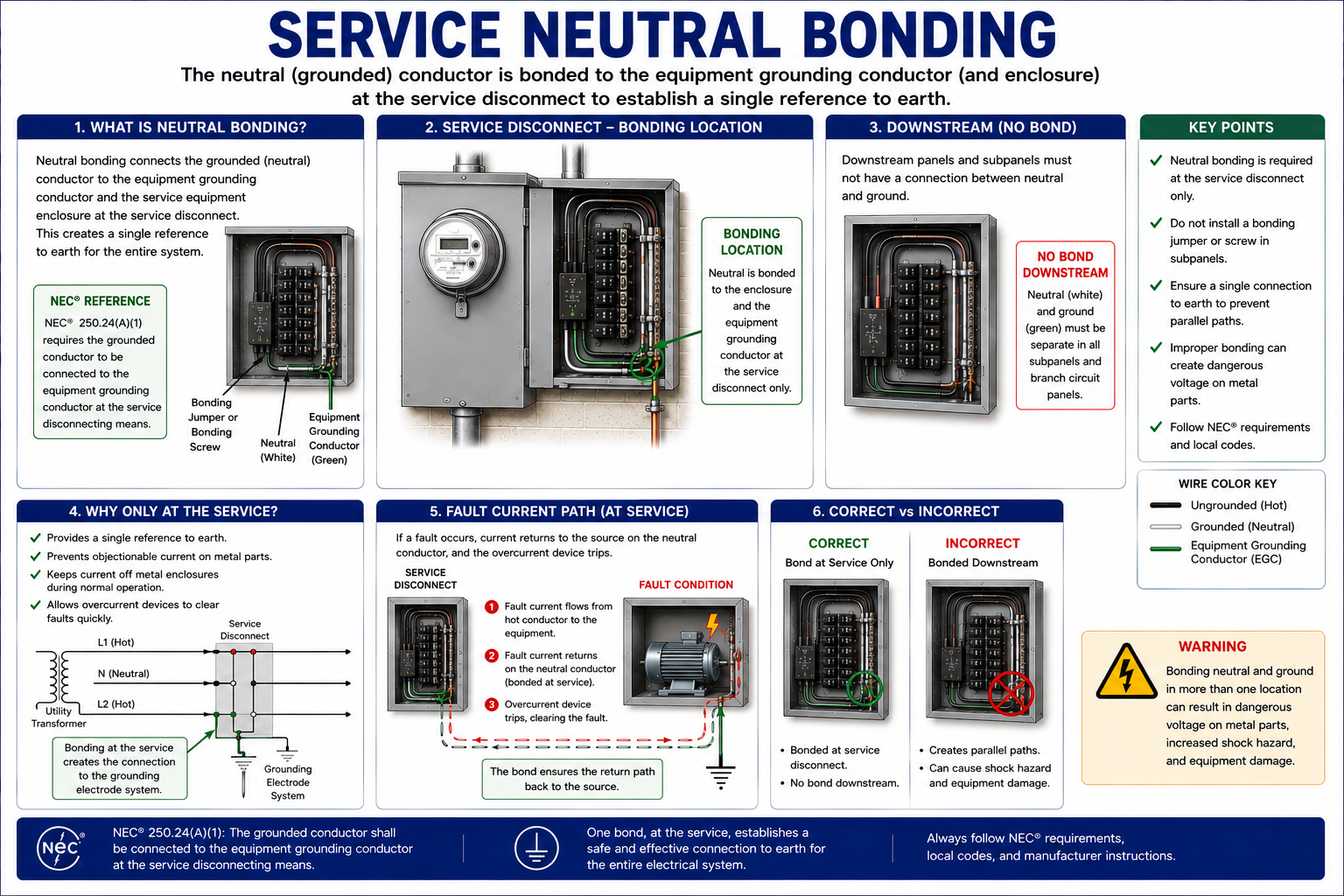
At the service of a grounded electrical system, the grounded service conductor is intentionally connected to the service equipment grounding and bonding system through the main bonding jumper. This connection establishes the service bonding point required for the effective ground-fault current path.
At this location, the grounded service conductor, service enclosure, equipment grounding conductors, bonding system, and grounding electrode connection are electrically related as required by Article 250.
Why the Service Bond Is Necessary
Suppose an ungrounded conductor contacts a bonded metal equipment enclosure downstream. Fault current travels through the equipment grounding and bonding path back toward the service equipment. At the service bonding point, the main bonding jumper connects that path to the grounded service conductor.
The grounded service conductor then provides a conductive path back toward the grounded source. This completes the fault-current circuit and allows sufficient current to flow so the applicable protective device can operate.
The Bonding Point Connects Two Different Functions
The grounded conductor normally carries intended circuit current. The equipment grounding and bonding system normally does not. Their intentional connection at the service bonding point provides the conductive connection necessary for ground-fault current to return toward the source.
Neutral Isolation Downstream of the Service
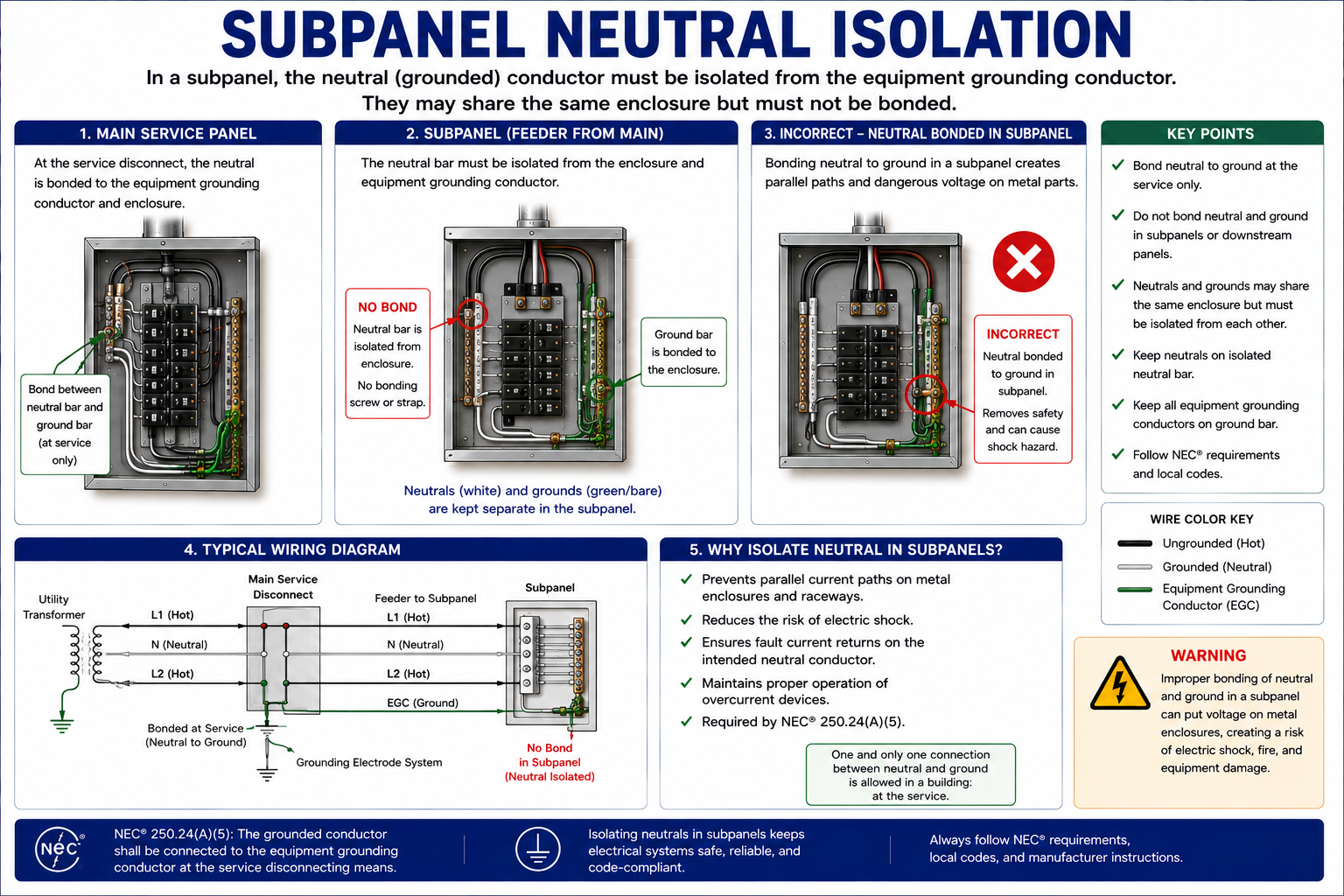
On the load side of the service disconnect, the grounded conductor is generally kept isolated from equipment grounding conductors, bonded metal enclosures, and normally non-current-carrying conductive parts except where the NEC specifically permits otherwise.
In a feeder-supplied panelboard, this normally means the neutral bus is insulated from the metal enclosure while the equipment grounding bus is bonded to the enclosure. The feeder includes an equipment grounding conductor in addition to the circuit conductors required for the load.
Preventing Normal Current on Grounding Paths
If the grounded conductor is connected again to the equipment grounding system downstream of the service bonding point without a Code-permitted reason, normal neutral current can divide between the grounded conductor and parallel conductive paths.
Those parallel paths can include equipment grounding conductors, metal raceways, enclosures, building steel, piping, cable armor, and other bonded conductive components. Current flowing on these normally non-current-carrying paths is commonly referred to as objectionable current.
Do Not Install a Second Neutral-to-Ground Bond Simply Because the Panel Has a Grounding Electrode
A downstream panel or separate building can have a grounding electrode system without requiring the grounded conductor to be bonded to the equipment grounding system at that location. Determine the applicable Article 250 requirements rather than assuming that connection to earth requires another neutral-to-ground bond.
What Happens with an Improper Downstream Bond?
Load Current Reaches the Neutral Bus
Normal load current returns to the feeder-supplied panel on the grounded conductor.
An Improper Bond Connects Neutral to Ground
A bonding screw, strap, jumper, or other connection improperly connects the neutral bus to the equipment grounding bus or enclosure.
Current Finds Parallel Paths
Neutral current can now divide between the intended grounded conductor and the equipment grounding and bonded-metal paths.
Grounding Components Carry Normal Current
Equipment grounding conductors, raceways, enclosures, piping, and other bonded metal can carry a portion of the normal return current.
An Unsafe Condition Can Result
Normally non-current-carrying conductive parts can develop unwanted voltage differences and carry current during ordinary system operation.
The Neutral Bus in a Feeder-Supplied Panel
In a typical feeder-supplied panelboard downstream of the service, the neutral bus is mounted so it remains electrically isolated from the metal cabinet. Grounded conductors terminate on this insulated bus.
The equipment grounding bus is bonded to the metal cabinet. Equipment grounding conductors terminate on the grounding bus and connect the enclosure to the effective ground-fault current path.
Service Configuration vs. Feeder Configuration
Many panelboards are manufactured so they can be used in more than one permitted application. Depending on the equipment and installation, a bonding screw, strap, or similar component can be provided to bond the grounded conductor bus to the enclosure where such bonding is required.
When the panel is used in a downstream feeder application where neutral isolation is required, the neutral bonding means must not create an unintended connection between the grounded conductor and the enclosure.
Check the Bonding Screw
When inspecting a feeder-supplied panelboard, verify whether the neutral bus is actually isolated from the enclosure. A bonding screw or strap installed in the wrong application can defeat the required separation even when the neutral and grounding conductors appear to terminate on separate bars.
Feeders to Separate Buildings or Structures
Modern feeder installations to separate buildings or structures generally include an equipment grounding conductor with the supply conductors. At the supplied building, the grounded conductor remains separated from equipment grounding conductors and normally non-current-carrying metal parts under the applicable Article 250 requirements.
The supplied building can also require a grounding electrode system. The presence of that grounding electrode system does not mean the neutral should automatically be bonded to the building enclosure or equipment grounding system.
Older Installations Can Involve Specific Exceptions
Article 250 contains limited provisions affecting certain existing installations and particular system configurations. For exam questions, read the conditions carefully before applying an exception. Do not turn an exception for a qualifying installation into a general rule for new feeder wiring.
Neutral Bonding at Separately Derived Systems
Separately derived systems require their own grounding and bonding analysis. A transformer secondary is a common example. Where the secondary is a grounded separately derived system, a system bonding jumper establishes the required connection between the grounded conductor and the equipment grounding and bonding system at a location permitted by Article 250.
This is why the statement “neutral and ground are connected only at the service” is too broad. Separately derived systems and other specific Code provisions can establish additional permitted or required bonding points.
Avoid the Phrase “Only at the Main Panel”
A better examination rule is that grounded conductors and equipment grounding conductors are intentionally connected at required or permitted system bonding points. Downstream from those points, they are generally kept separated unless a specific NEC provision permits otherwise.
Neutral Current and Multiwire Branch Circuits
A multiwire branch circuit can use a grounded conductor shared by two or more ungrounded conductors when the circuit meets the applicable NEC requirements. In a typical single-phase 120/240-volt system, the shared neutral carries the imbalance between loads connected to opposite ungrounded conductors.
Because neutral current depends on the relationship between the loads and source conductors, conductor arrangement and system configuration must be understood before determining expected neutral current.
Neutral Current in Three-Phase Systems
In a four-wire wye system, the neutral can carry current resulting from unbalanced line-to-neutral loads. The amount of neutral current depends on the load distribution and electrical characteristics of the loads.
Nonlinear loads can introduce harmonic currents that affect neutral loading. When a calculation or conductor-sizing question involves nonlinear loads, do not assume that the neutral current will simply cancel because the phase loads appear balanced.
Determining the Neutral Load
The NEC permits specific demand and load-calculation rules to be applied when determining the maximum unbalanced load on a neutral conductor. The applicable calculation depends on the system and loads involved.
Do not automatically size every neutral conductor identically to the ungrounded conductors. First determine the calculated neutral load and then apply the applicable conductor-sizing and equipment requirements.
Identifying Grounded Conductors
Article 200 contains identification requirements for grounded conductors. White and gray are strongly associated with grounded conductors, but the precise permitted identification methods depend on conductor size, cable construction, application, and other Code conditions.
For NASCLA questions involving conductor colors or field identification, use Article 200 rather than relying solely on field convention.
White Does Not Mean Equipment Ground
A white or gray conductor is generally associated with the grounded conductor under the applicable identification rules. Equipment grounding conductors use their own identification requirements. Do not treat neutral and equipment-ground conductor colors as interchangeable.
Opening the Grounded Conductor
Because a grounded conductor is an intentional circuit conductor, the NEC regulates when it can be disconnected or switched. A switching device generally must not leave the grounded conductor open while the associated ungrounded conductor remains energized unless the arrangement satisfies the applicable Code requirements.
When an exam question involves switching, disconnecting, or overcurrent protection of a grounded conductor, consult the specific NEC rule rather than treating it exactly like an ungrounded conductor.
Overcurrent Devices in Grounded Conductors
Overcurrent protection is generally installed in ungrounded conductors. Installing an overcurrent device that can independently open only the grounded conductor can create a hazardous condition by leaving equipment connected to an energized ungrounded conductor while the intended grounded return path is open.
The NEC contains specific rules governing overcurrent devices in grounded conductors. When this subject appears on the examination, identify the exact circuit configuration and consult the applicable overcurrent-protection requirements.
Recognizing Neutral and Grounding Problems
Open Neutral
An open grounded conductor can cause loss of line-to-neutral loads and potentially abnormal voltages in circuits that share a neutral.
Loose Neutral
A high-resistance neutral connection can produce voltage instability, heating, and abnormal equipment operation.
Improper Neutral Bond
An unauthorized downstream connection between neutral and ground can place normal load current onto equipment grounding and bonded-metal paths.
Open EGC
An open equipment grounding path can leave equipment without the intended low-impedance fault-current return path even though the neutral circuit continues to operate normally.
Current on Grounding Conductors
Current detected on equipment grounding conductors or bonded metallic paths during normal operation can indicate an unintended parallel path. One possible cause is an improper neutral-to-ground connection downstream of the intended bonding point.
Diagnosis requires examination of the complete grounding and bonding system because multiple conductive paths can exist through raceways, piping, building steel, cable systems, and interconnected equipment.
How to Analyze a Neutral and Grounding Question
Identify the System
Determine whether the question involves a service, feeder, branch circuit, separate building, separately derived system, or another configuration.
Identify the Conductor
Determine whether the conductor is an ungrounded conductor, grounded conductor, neutral conductor, equipment grounding conductor, grounding electrode conductor, or bonding jumper.
Determine Whether It Carries Normal Current
Ask whether the conductor is intended to carry load current during normal operation or primarily fault current during abnormal conditions.
Locate the Bonding Point
Determine where the grounded conductor is intentionally connected to the equipment grounding and bonding system for the installation being analyzed.
Check Downstream Isolation
Determine whether a downstream grounded conductor must remain isolated from equipment grounding conductors and metal enclosures.
Look for Parallel Paths
Identify any connection that could allow normal grounded-conductor current to flow on equipment grounding conductors or bonded metal.
Check for Specific Exceptions
Before selecting an answer, determine whether the installation falls under a specific NEC provision for existing installations, separately derived systems, or another special condition.
Ask Whether the Current Is Normal or Fault Current
A useful way to separate neutral and grounding concepts is to ask what type of current the conductor is intended to carry. The grounded or neutral conductor can carry normal load current. Equipment grounding and bonding paths normally do not carry load current but must be capable of carrying fault current when a ground fault occurs.
Grounded Conductors and Neutral Conductors
Grounded Conductor
A grounded conductor is intentionally grounded and can carry normal circuit current.
Neutral Conductor
A neutral conductor is connected to the neutral point of a system and can carry normal load current.
Service Bond
The grounded service conductor is intentionally connected to the equipment grounding and bonding system at the service through the main bonding jumper.
Downstream Isolation
Downstream grounded conductors are generally isolated from equipment grounding conductors and bonded enclosures except where specifically permitted otherwise.
Objectionable Current
An improper downstream neutral-to-ground connection can place normal load current onto equipment grounding conductors and other bonded conductive paths.
Separate Functions
The neutral can carry normal load current, while the equipment grounding and bonding system provides the effective path for ground-fault current.
Leave a Reply
You must be logged in to post a comment.