Back to: NASCLA Master Electrical Contractor Exam Preparation
Arc-fault circuit interrupter protection is intended to reduce the risk of electrical fires caused by dangerous arcing faults in branch-circuit wiring, connections, cords, and connected equipment. These faults can produce enough localized heat to ignite nearby combustible material even when the current is too low or too intermittent to operate a conventional circuit breaker or fuse.
This lesson explains series and parallel arcing faults, how AFCI protection detects hazardous arcing conditions, how AFCI protection differs from GFCI and ordinary overcurrent protection, and how NEC Article 210 requirements are applied on the NASCLA Electrical Contractor examination.
Protecting Against Dangerous Electrical Arcing
Electrical arcs are not always abnormal. Switching contacts, motor brushes, plugs being disconnected under load, and other electrical equipment can produce normal arcing during operation. AFCI protection must distinguish these normal operating characteristics from electrical signatures associated with potentially hazardous arcing faults.
Hazardous arcing can result from loose connections, damaged conductors, deteriorated insulation, broken wires, damaged cords, poor terminations, or other failures. AFCI devices monitor electrical characteristics of the circuit and interrupt the circuit when conditions consistent with a hazardous arc fault are detected.
What Is an AFCI?
An arc-fault circuit interrupter is a protective device designed to provide protection from the effects of arc faults by recognizing characteristics unique to arcing and functioning to de-energize the circuit when an arc fault is detected.
Fire Protection
The principal purpose of AFCI protection is to reduce the risk of fire resulting from hazardous electrical arcing.
Arc Detection
An AFCI evaluates electrical characteristics of the circuit to identify conditions associated with hazardous arcing.
Circuit Interruption
When the AFCI recognizes an arcing condition within its protective capabilities, it opens the protected circuit.
Article 210
NEC Article 210 contains the principal branch-circuit AFCI protection requirements encountered in dwelling-unit and other specified applications.
AFCI Protection Addresses a Different Hazard
AFCI protection should not be treated as another name for a circuit breaker or GFCI. Conventional overcurrent protection primarily addresses excessive current, GFCI protection addresses hazardous current imbalance associated with shock risk, and AFCI protection addresses electrical characteristics associated with dangerous arcing and fire risk.
Why Arcing Can Be Dangerous
An electrical arc occurs when current travels through an ionized path between conductive surfaces. The resulting arc can produce intense localized heating and can damage insulation or ignite nearby combustible material.
A hazardous arc does not necessarily draw enough current to operate a conventional branch-circuit overcurrent device. This is particularly important with series arcing faults, where the load itself limits the current flowing through the arc.
An Arc in the Current-Carrying Path
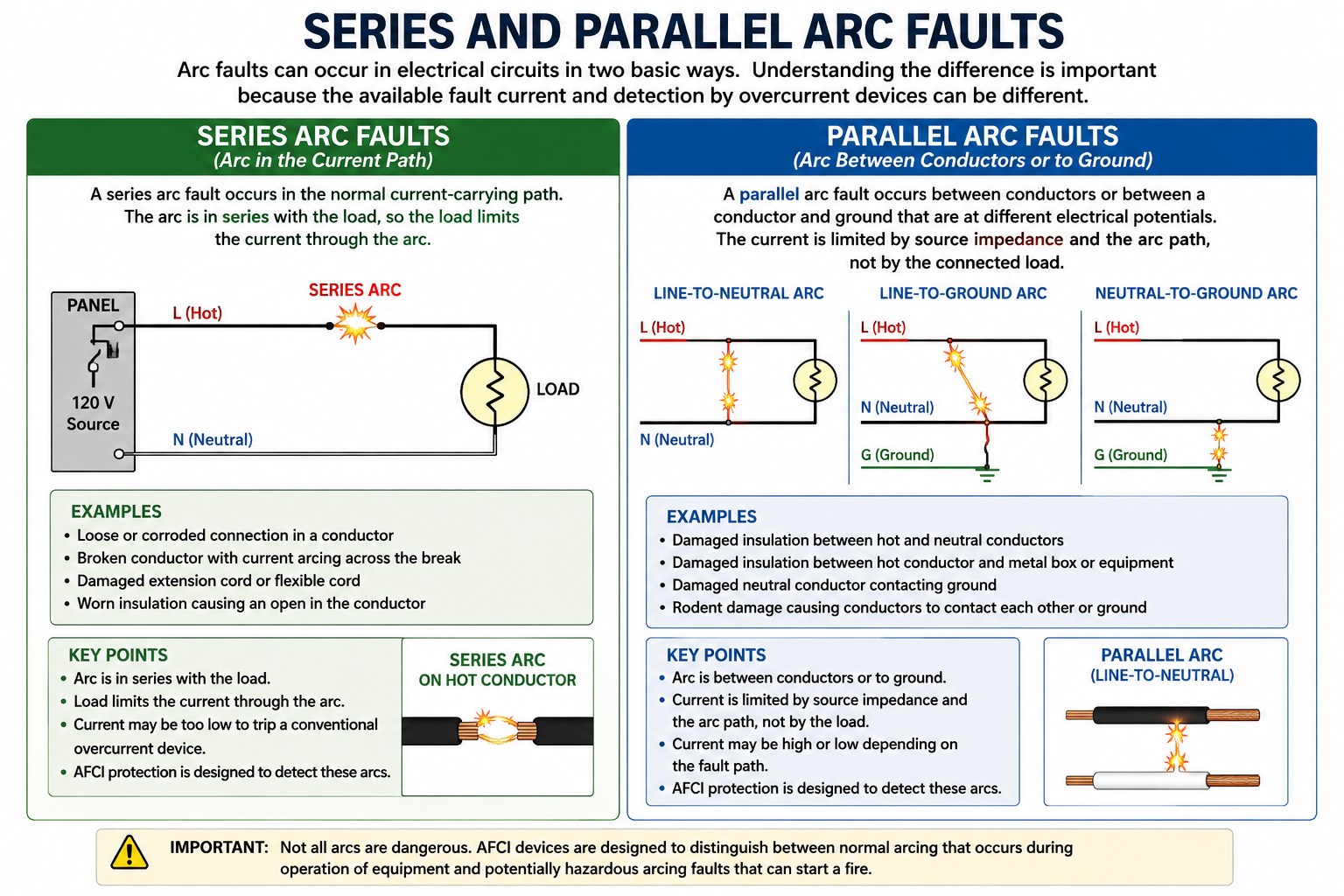
A series arc occurs when the normal current-carrying path is unintentionally broken or develops a poor connection and current arcs across the resulting gap. Because the arc is electrically in series with the connected load, the load limits the current through the arc.
Loose Connection
A loose terminal or splice can develop intermittent contact and arcing while continuing to carry load current.
Broken Conductor
A partially broken conductor can create a small gap across which current arcs while the connected load continues operating intermittently.
Damaged Cord
Repeated flexing, crushing, or mechanical damage can partially separate a conductor and create conditions for series arcing.
Load-Limited Current
Because the arc is in series with the load, its current can remain below the rating of the conventional branch-circuit overcurrent protective device.
A Series Arc Is Not Line-to-Neutral
A series arc is located within the normal current path and is electrically in series with the load. An arc directly between an ungrounded conductor and a grounded conductor is a parallel arcing fault, not a series arcing fault.
An Arc Between Conductive Paths
A parallel arc occurs when an unintended arcing path develops between conductors or conductive parts at different electrical potentials. Unlike a series arc, the arc is not simply inserted into the normal load-current path.
Line-to-Neutral
Damaged insulation can allow arcing between an ungrounded conductor and a grounded circuit conductor.
Line-to-Ground
An ungrounded conductor can arc to grounded metal, an equipment grounding conductor, or another grounded conductive path.
Available Fault Current
The magnitude of a parallel arcing fault depends on source capacity and the impedance of the arcing path rather than being limited by the normal connected load.
Intermittent Fault
A high-impedance or intermittent parallel arc might not produce enough sustained current to operate an ordinary overcurrent protective device promptly.
Know the Electrical Difference
Series Arc
The arc occurs in the normal current path and is in series with the load. Current is therefore limited by the load and circuit impedance.
Parallel Arc
The arc occurs between conductors or conductive paths at different potentials. Current is limited primarily by source and fault-path impedance.
Do Not Identify an Arc Only by Current Magnitude
A high-current fault can operate an ordinary breaker quickly, while a lower-current or intermittent arc can continue without operating conventional overcurrent protection. AFCI protection is intended to recognize characteristics associated with arcing rather than relying only on the total magnitude of circuit current.
Recognizing an Arcing Signature
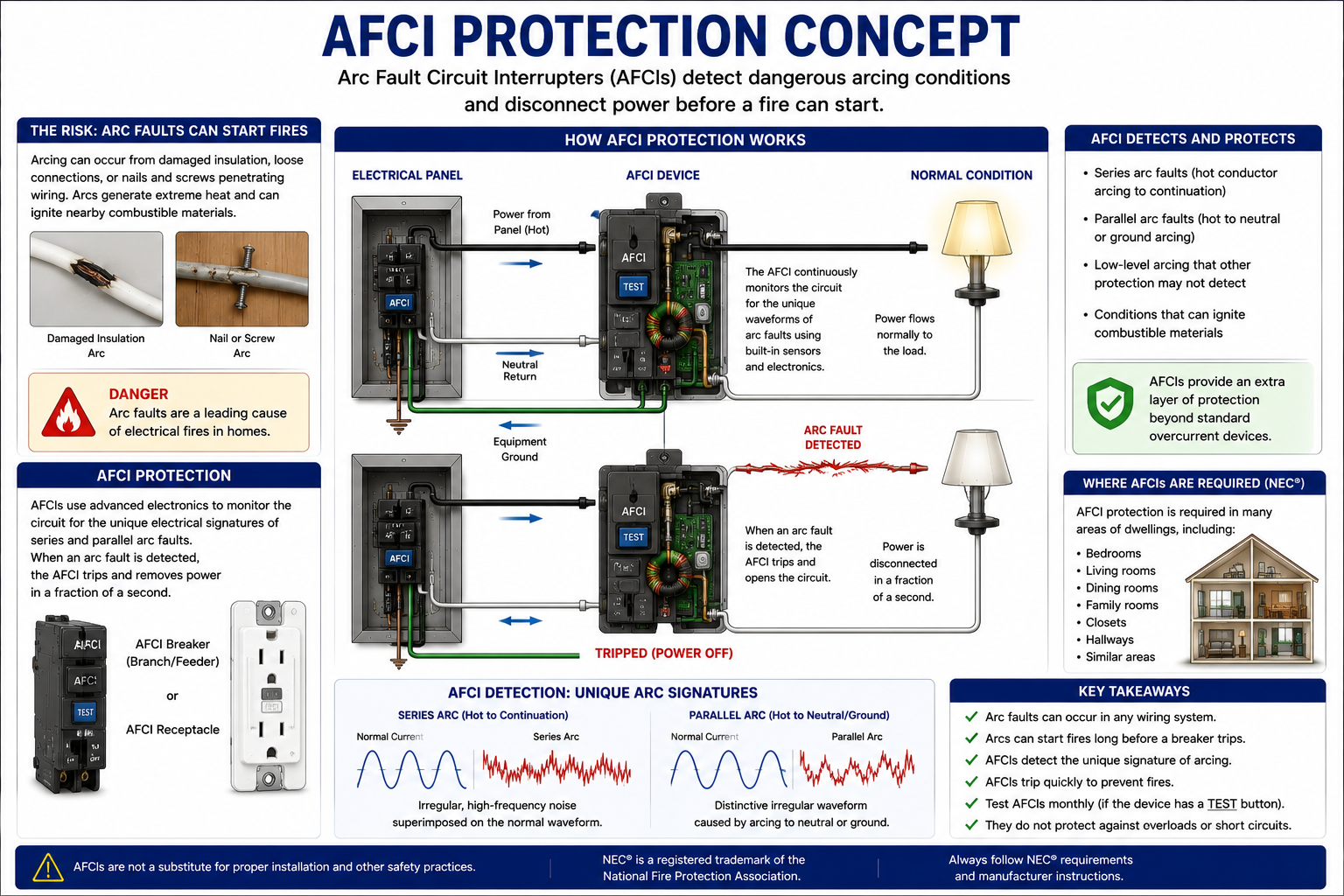
AFCI devices monitor electrical characteristics of the protected circuit. Electronic circuitry evaluates current behavior and other characteristics to distinguish potentially hazardous arcing from normal electrical operation.
When the device determines that the monitored conditions satisfy its arc-fault detection criteria, the AFCI causes the circuit to open and remove power from the faulted circuit.
Not Every Electrical Arc Is a Fault
Normal electrical equipment can produce arcs. A switch can arc as its contacts open, brushed motors produce repetitive arcing at the commutator, and plugs can produce a small arc when disconnected while carrying load.
AFCI technology is therefore designed to distinguish electrical characteristics associated with normal operation from those associated with hazardous arcing faults. The device does not simply trip whenever any arc occurs.
AFCI Does Not Mean “No Arcing Allowed”
The purpose of an AFCI is to recognize and interrupt hazardous arc-fault conditions. Normal arcing associated with properly operating switches, motors, and other listed equipment is not automatically an arc fault.
Conventional Overcurrent Protection Is Still Required
A conventional circuit breaker protects the branch circuit against overloads and high-current short circuits and ground faults according to its operating characteristics. AFCI protection adds detection capabilities intended to address hazardous arcing conditions that ordinary overcurrent protection might not detect promptly.
A combination-type AFCI circuit breaker can incorporate conventional branch-circuit overcurrent protection and AFCI protection in the same device, but the protective functions remain conceptually different.
Fire Protection and Shock Protection
AFCI and GFCI protection address different electrical hazards. An AFCI is intended primarily to reduce fire hazards associated with dangerous arcing, while a Class A GFCI is intended primarily to protect people against hazardous ground-fault current and electric shock.
AFCI
Detects characteristics associated with hazardous electrical arcing and opens the circuit to reduce the risk of electrical fire.
GFCI
Detects an imbalance between outgoing and returning circuit current and opens the circuit to provide personnel protection from ground-fault current.
One Requirement Does Not Cancel the Other
A location can require both AFCI and GFCI protection. Meeting the AFCI requirement does not automatically satisfy a GFCI requirement, and providing GFCI protection does not automatically satisfy an AFCI requirement.
AFCI and GFCI in One Device
Listed dual-function circuit breakers are available that provide both AFCI and GFCI protection in addition to the breaker’s overcurrent-protection function. These devices are commonly used where the same branch circuit is required to have both forms of protection.
When evaluating an examination question, identify the required protective functions rather than assuming that every AFCI breaker also provides GFCI protection.
Dwelling-Unit AFCI Requirements
NEC 210.12 contains the principal AFCI requirements for branch circuits. In dwelling units, the applicable Code edition identifies specified 120-volt, single-phase branch circuits supplying outlets or devices in designated areas that require AFCI protection.
Common areas included in the Article 210 AFCI requirements include kitchens, family rooms, dining rooms, living rooms, parlors, libraries, dens, bedrooms, sunrooms, recreation rooms, closets, hallways, laundry areas, and similar areas. The exact circuit ratings, locations, exceptions, and permitted protection methods must be checked in the NEC edition specified for the examination.
Do Not Rely on the Old “Bedroom AFCI” Rule
Early NEC AFCI requirements were much narrower and are sometimes remembered primarily as bedroom requirements. Current Code requirements cover many additional dwelling-unit areas. For NASCLA questions, use the Article 210.12 requirements in the examination’s specified NEC edition rather than relying on an older memorized rule.
Outlets and Devices Matter
AFCI questions require careful attention to the language describing what the branch circuit supplies. Article 210.12 uses defined requirements involving branch circuits supplying outlets or devices in specified areas rather than simply asking whether a particular receptacle itself needs an AFCI.
This makes the location and function of the entire branch circuit important when determining whether AFCI protection is required.
Where AFCI Protection Can Be Provided
Article 210.12 identifies permitted methods for providing AFCI protection. A common method is a listed combination-type AFCI installed at the origin of the branch circuit to protect the entire branch circuit.
The NEC also recognizes specified alternative arrangements involving AFCI devices when all of the wiring-method, conductor-length, first-outlet, identification, listing, and other conditions of the applicable protection method are satisfied.
Do Not Assume the AFCI Must Always Be a Breaker
A combination-type AFCI circuit breaker installed at the branch-circuit origin is a common protection method, but Article 210.12 recognizes other listed protection arrangements when all of their specific conditions are satisfied. If an examination question presents an outlet-type AFCI, examine the complete installation before deciding whether it complies.
What “Combination” Means
The term combination-type AFCI refers to the AFCI’s arc-fault protection capabilities and should not automatically be interpreted to mean that the device combines AFCI and GFCI protection. A combination-type AFCI is an AFCI classification associated with protection against specified types of arcing faults.
A device that provides both AFCI and GFCI functions is commonly identified as a dual-function device. Read equipment markings and examination terminology carefully.
Combination AFCI ≠ Dual-Function AFCI/GFCI
These terms describe different concepts. Do not select an answer stating that a combination-type AFCI automatically provides Class A GFCI personnel protection unless the device is specifically listed and identified to provide that additional function.
Extensions and Modifications
Article 210.12 contains requirements addressing certain branch-circuit extensions and modifications in areas where AFCI protection is required. This is important when existing wiring is extended or altered rather than when an entirely new branch circuit is installed.
When an examination problem involves modification of existing wiring, do not assume that existing conditions are automatically exempt from current AFCI requirements. Check the specific extension or modification provisions and their exceptions.
When an AFCI Trips
An AFCI trip should be treated as an indication that the circuit requires investigation rather than simply being reset repeatedly. Possible causes include damaged conductors, loose connections, damaged cords, defective utilization equipment, wiring errors, or an actual arcing fault.
Troubleshooting should also consider whether the device is properly installed, whether neutral conductors are correctly associated with the protected circuit, and whether connected equipment is operating normally.
Repeated Tripping Is Information
Repeated AFCI operation should not automatically be dismissed as nuisance tripping. Determine why the protective device is operating before restoring the circuit to normal service.
How to Analyze an AFCI Question
Identify the Occupancy
Determine whether the installation is a dwelling unit or another occupancy subject to an applicable AFCI requirement.
Identify the Branch Circuit
Determine the voltage, phase, ampere rating, and what outlets or devices the branch circuit supplies.
Identify the Location
Determine whether the outlets or devices are installed in an area included by the applicable Article 210.12 requirement.
Determine the Protection Method
Identify whether protection is provided by a combination-type AFCI at the branch-circuit origin or another method specifically permitted by Article 210.12.
Check Installation Conditions
If an alternative AFCI protection method is used, verify all applicable wiring-method, conductor-length, outlet-location, marking, and listing requirements.
Check Exceptions
Determine whether a specific exception applies to the branch circuit or installation described in the question.
Check for GFCI Requirements
Determine separately whether the location or equipment also requires GFCI protection. AFCI compliance does not eliminate an independent GFCI requirement.
Separate the Hazard from the Code Requirement
First understand what AFCI protection does: it addresses hazardous electrical arcing and associated fire risk. Then use Article 210.12 to determine whether the particular branch circuit requires that protection and which protection methods are permitted. Keeping the operating principle separate from the location requirement makes AFCI questions much easier to analyze.
Arc-Fault Circuit Interrupter Protection
AFCI Purpose
AFCI protection is intended to reduce the risk of electrical fire caused by hazardous arcing faults.
Series Arc
A series arc occurs in the normal current path and is electrically in series with the load, which limits the current through the arc.
Parallel Arc
A parallel arc occurs between conductive paths at different potentials, such as line-to-neutral or line-to-ground.
AFCI vs. GFCI
AFCI protection primarily addresses arcing-related fire hazards, while GFCI protection primarily addresses electric-shock hazards from ground-fault current.
Combination AFCI
Combination-type AFCI describes an AFCI protection classification and does not automatically mean that the device also provides GFCI protection.
Article 210.12
Use the applicable edition of Article 210.12 to determine which branch circuits require AFCI protection and which protection methods and exceptions apply.
Leave a Reply
You must be logged in to post a comment.