Back to: NASCLA Master Electrical Contractor Exam Preparation
Electrical systems can be exposed to short-duration transient overvoltages caused by lightning, utility switching, equipment operation, and other electrical events. These voltage surges can damage insulation, electronic controls, appliances, communication equipment, and other sensitive electrical loads.
This lesson explains surge protective devices, the differences between Type 1 and Type 2 SPDs, NEC service surge-protection requirements, important SPD ratings, installation considerations, and the relationship between surge protection, grounding, bonding, and overcurrent protection.
Limiting Transient Overvoltages
A surge protective device, or SPD, is intended to limit transient overvoltages and divert surge current. Unlike a circuit breaker or fuse, an SPD is not primarily intended to disconnect a circuit because normal load current becomes excessive.
Surge protection is especially important in modern electrical systems because electronic controls, appliances, HVAC equipment, communication equipment, lighting systems, and other loads can contain components that are vulnerable to transient overvoltages.
What Is an Electrical Surge?
An electrical surge is a temporary increase in voltage that exceeds the normal operating voltage of the electrical system. Many surges are extremely brief, but the elevated voltage can place significant electrical stress on insulation and electronic components.
Surges should be distinguished from sustained abnormal voltage conditions. An SPD is designed primarily for transient overvoltage events rather than long-duration overvoltage caused by an incorrectly connected system, loss of a neutral conductor, or other sustained abnormal condition.
Transient Event
A surge normally exists for a relatively short duration rather than representing a continuous increase in system voltage.
High Voltage
The transient voltage can rise substantially above the normal operating voltage of the circuit.
Energy Transfer
Surge current can carry substantial energy even though the event exists for only a short period.
Equipment Stress
Repeated or severe transient events can damage insulation and sensitive electronic components.
Where Do Electrical Surges Come From?
Transient overvoltages can originate outside or inside a building electrical system. Understanding this is important because surge protection should not be thought of only as protection against a direct lightning strike.
Lightning
Nearby lightning activity can induce transient voltages into utility conductors, communication wiring, and other conductive systems without lightning directly striking the building.
Utility Switching
Switching operations on the utility distribution system can produce transient electrical disturbances that reach customer equipment.
Inductive Loads
Switching motors, transformers, contactors, and other inductive loads can create transient voltages within an electrical system.
Internal Switching
Equipment operation within a facility can generate transient events that affect other loads connected to the same distribution system.
Surge Protection Is Not Just Lightning Protection
Lightning is an important source of transient overvoltage, but SPDs also protect against transient events produced by utility and facility switching. Do not assume that a building without an external lightning protection system has no need for surge protection.
How a Surge Protective Device Works
During normal system operation, an SPD has little effect on the electrical circuit. When the voltage across the protected conductors rises to a level that causes the SPD to respond, the device provides a path for surge current and limits the voltage appearing across protected equipment.
After the transient event has passed, a properly functioning SPD returns to its normal condition. SPDs can experience degradation from repeated surge events, however, and some devices include indicators or monitoring contacts to show their operating status.
An SPD Does Not Eliminate the Surge
An SPD limits the transient voltage presented to protected equipment and diverts surge current through its designed protective paths. It does not guarantee that every transient will be reduced to zero volts above normal system voltage, nor does it make connected equipment immune to all surge damage.
Type 1 and Type 2 Surge Protective Devices
For service surge protection, Type 1 and Type 2 are the classifications most important for the NASCLA examination. The classifications relate in part to where the SPD is permitted to be installed in relation to the service disconnect and service overcurrent protection.
Type 1 SPD
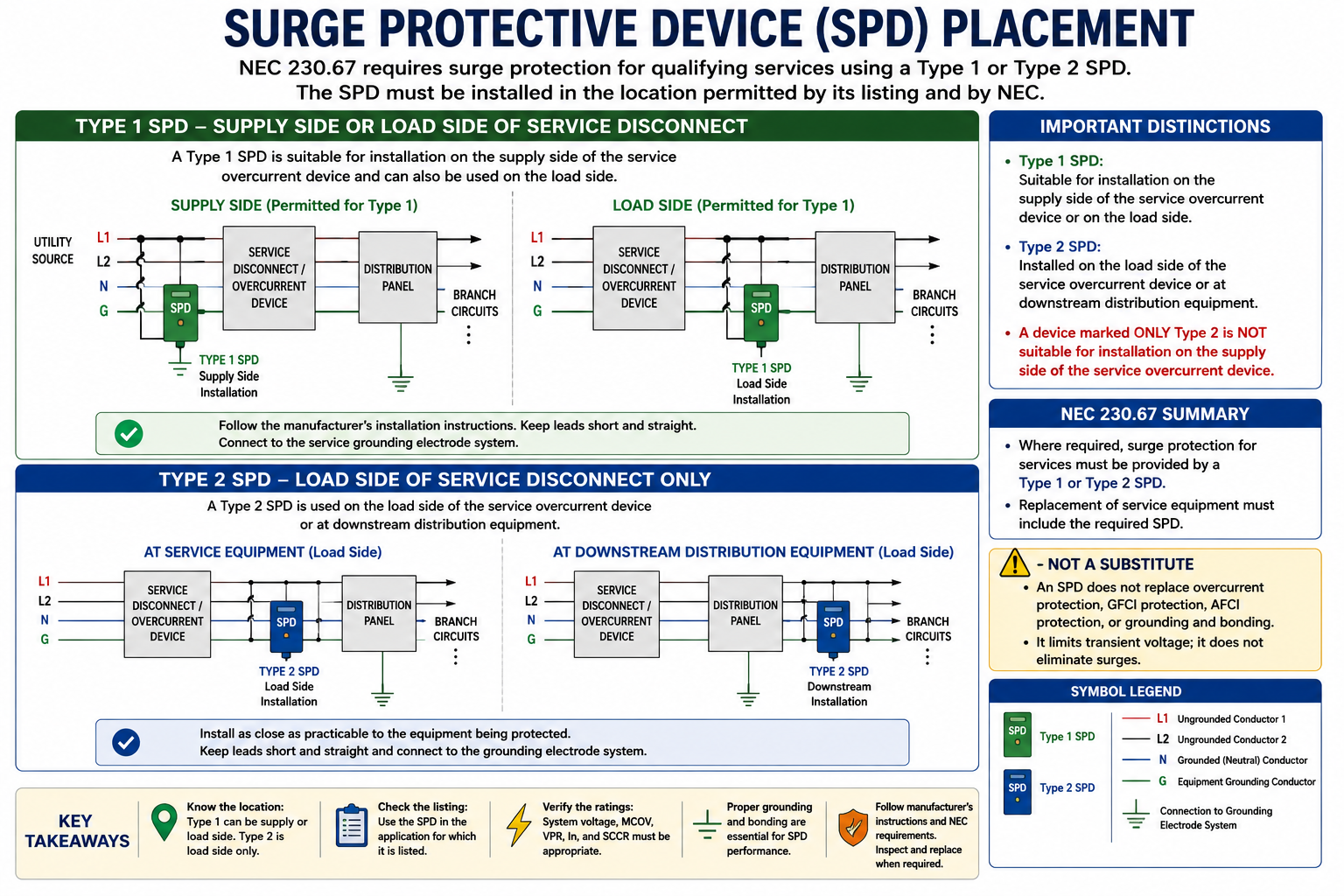
A Type 1 SPD is suitable for installation on the supply side of the service overcurrent protective device and can also be used in permitted load-side applications. Its installation must comply with its listing, instructions, and applicable NEC requirements.
Type 2 SPD
A Type 2 SPD is used on the load side of the service overcurrent protective device and at downstream distribution equipment as permitted by its listing and applicable NEC requirements.
Type 1 Can Have Broader Placement Than Type 2
A listed Type 1 SPD can be suitable for applications on either side of the service overcurrent device as permitted by its listing and the NEC. An SPD marked only as Type 2 is not automatically suitable for installation on the supply side of the service overcurrent device.
Type 3 and Component SPDs
The surge-protection system includes additional SPD classifications. Type 3 devices are associated with utilization-side or point-of-use applications and can include cord-connected, direct plug-in, and receptacle-type surge protective devices when installed within the conditions of their listing.
Component SPD classifications are also used within listed equipment and assemblies. For NEC examination questions involving a service, however, focus carefully on whether the Code specifically requires a Type 1 or Type 2 SPD.
Service Surge Protection
NEC 230.67 contains surge-protection requirements for specified services. The requirement is important because surge protection is no longer simply an optional accessory in the occupancies covered by the applicable Code edition.
The applicable NEC edition should always be checked carefully because the scope of 230.67 has evolved. Determine the occupancy, whether the work involves a service, and the exact requirements of the Code edition used for the examination.
Type 1 or Type 2 at Covered Services
Where NEC 230.67 requires service surge protection, the required SPD is a Type 1 or Type 2 device. The Code also establishes requirements governing its location, application, and replacement of service equipment. Always use the examination’s adopted NEC edition for the exact scope and wording.
Where the Service SPD Is Installed
The location of an SPD matters because conductor length, routing, device type, service configuration, and the SPD listing affect the installation. NEC 230.67 establishes location requirements for the required service SPD and recognizes specified downstream arrangements.
A Type 1 SPD may be suitable for installation on the supply side of the service overcurrent device. A Type 2 SPD is installed on the load side of the service overcurrent device. Do not place a Type 2-only device on the supply side merely because both device types can satisfy a service surge-protection requirement when installed in their permitted locations.
“Type 1 or Type 2 Required” Does Not Mean Identical Installation
The NEC can permit either Type 1 or Type 2 surge protection for a particular requirement while the permitted electrical connection locations of the devices remain different. Always consider both the Code requirement and the SPD’s listing.
Keep SPD Conductors Short and Direct
SPD installation effectiveness is influenced by conductor impedance. Excessive conductor length and unnecessary bends can increase the voltage that appears at protected equipment during a rapidly changing surge event.
Install SPD conductors according to the manufacturer’s instructions and route them as short and direct as practicable while complying with electrical and mechanical installation requirements.
Which Conductors Are Protected?
SPDs can provide protection across different conductor combinations depending on the system configuration and device design. Common protection modes include line-to-neutral, line-to-line, line-to-ground, and neutral-to-ground.
Line-to-Neutral
Limits transient voltage between an ungrounded conductor and the grounded circuit conductor.
Line-to-Line
Limits transient voltage appearing between ungrounded conductors.
Line-to-Ground
Limits transient voltage between an ungrounded conductor and the equipment grounding or bonding system.
Neutral-to-Ground
Some SPD configurations also provide a protective mode between the grounded circuit conductor and grounding system.
Understanding Important Device Ratings
An SPD has several ratings that describe its electrical application and performance. Examination questions can require recognizing what these ratings mean rather than simply selecting the device with the largest number on its label.
System Voltage
The SPD must be suitable for the nominal voltage and electrical system configuration on which it is installed.
MCOV
Maximum Continuous Operating Voltage identifies the maximum continuous RMS voltage that can be applied to the SPD protection mode under specified conditions.
VPR
Voltage Protection Rating is a UL 1449 performance rating associated with the measured limiting voltage of the SPD under standardized test conditions.
Nominal Discharge Current
The nominal discharge current rating, commonly shown as In, is a standardized surge-current rating used in the evaluation and classification of SPDs.
SCCR
The SPD short-circuit current rating must be suitable for the available fault-current conditions at the point where the device is installed.
SPD Type
The Type 1, Type 2, or other classification identifies permitted applications and is not simply a measure of how powerful the device is.
SPD Type Is Not a Quality Ranking
Do not interpret Type 1 as automatically meaning “better” than Type 2. The type designation identifies installation and product-classification characteristics. Select and install an SPD according to the system, location, NEC requirements, listing, and manufacturer’s instructions.
Voltage Protection Rating
The Voltage Protection Rating provides standardized information about the voltage-limiting performance of a listed SPD. When comparing otherwise appropriate devices for the same electrical system, VPR can help describe how much transient voltage is allowed to appear under the standardized test conditions.
VPR should not be interpreted as the normal system voltage, nor does it mean the SPD maintains the circuit at exactly that voltage during every possible real-world surge event.
Maximum Continuous Operating Voltage
The SPD must tolerate the normal continuous voltage present on the electrical system without continuously entering its surge-protective state. MCOV is therefore an important part of matching an SPD to the system voltage and wiring configuration.
An SPD selected for the wrong voltage or system configuration can be ineffective, damaged, or unsafe. Never select an SPD solely by enclosure size or surge-current advertising.
SPD Short-Circuit Current Rating
The SPD is connected to an electrical system that can deliver substantial current if the device or its conductors experience a fault. The SPD’s short-circuit current rating must therefore be appropriate for the available fault current at its installation point.
This connects surge-protection questions to the available-fault-current and equipment-rating concepts covered earlier in the course. Surge protection does not eliminate the requirement for equipment to have appropriate fault-current ratings.
Surge Protection Depends on the Electrical System
SPD performance is closely related to proper system grounding and bonding because surge current must travel through the conductive paths provided by the installation. Poor bonding, improper connections, or excessive conductor impedance can reduce the effectiveness of the overall protection system.
However, an SPD does not replace the grounding electrode system, equipment grounding conductors, bonding conductors, or other grounding and bonding requirements of NEC Article 250.
Grounding and Surge Protection Are Not the Same Function
The grounding electrode system establishes the electrical system’s connection to earth for the purposes required by Article 250, while bonding and equipment grounding establish conductive paths required for fault-current performance. An SPD limits transient overvoltages. These systems interact, but one does not substitute for another.
Protection at More Than One Level
Surge protection can be applied at multiple levels of an electrical distribution system. A service-level SPD can limit incoming transient energy, while additional downstream or point-of-use devices can provide another level of protection closer to sensitive equipment.
This approach is often called layered or cascaded surge protection. The devices must still be properly selected for their installation locations and coordinated with the electrical system and equipment being protected.
Know the Limits of Surge Protection
Not Overload Protection
An SPD does not replace the branch-circuit or feeder overcurrent protective device.
Not GFCI Protection
An SPD does not provide personnel ground-fault protection unless some separate listed function specifically provides it.
Not AFCI Protection
An SPD does not perform the hazardous arc-detection function of an AFCI.
Not a Grounding Substitute
An SPD does not replace grounding electrodes, equipment grounding conductors, or required bonding.
Surge Protective Devices Can Degrade
SPDs can absorb or divert energy repeatedly during their service life. Severe or repeated surge events can degrade protective components. Many devices therefore incorporate visual indicators, alarms, or monitoring contacts to indicate whether their protective components remain operational.
A device showing a failed or loss-of-protection indication should be evaluated and replaced in accordance with the manufacturer’s instructions and applicable electrical requirements.
How to Analyze a Surge-Protection Question
Identify the Installation
Determine whether the question involves a service, feeder, downstream distribution equipment, branch circuit, or point-of-use device.
Identify the Occupancy
Determine whether the occupancy is one for which the applicable NEC edition requires service surge protection.
Determine the Required SPD Type
Where Article 230 requires service surge protection, identify the permitted Type 1 or Type 2 device and its permitted installation location.
Check System Voltage and Configuration
Verify that the SPD is listed and rated for the voltage, phase, and wiring configuration of the electrical system.
Check Fault-Current Rating
Verify that the SPD’s short-circuit current rating is suitable for the available fault current at the installation point.
Check Location and Connections
Determine whether the device is installed on the permitted side of the service disconnect or overcurrent device and according to its listing and instructions.
Check the Adopted NEC Edition
Verify the exact Article 230.67 requirements in the Code edition specified for the NASCLA examination rather than relying on a requirement remembered from another edition.
Start with Type and Location
For an SPD question, first determine where in the distribution system the device is being installed. Then determine which SPD type is permitted at that location. This prevents the common mistake of treating Type 1 and Type 2 devices as interchangeable simply because both can be used to satisfy specified service surge-protection requirements.
Surge Protection
Transient Overvoltage
A surge is a temporary overvoltage that can damage insulation and sensitive electrical and electronic equipment.
SPD Function
An SPD limits transient overvoltage and diverts surge current through its designed protective paths.
Type 1
A Type 1 SPD can be suitable for supply-side service applications as well as permitted load-side applications.
Type 2
A Type 2 SPD is installed on the load side of service overcurrent protection or in other permitted downstream applications.
Article 230.67
Where the applicable NEC edition requires service surge protection, check the exact occupancy, SPD type, location, replacement, and rating requirements.
System Coordination
Correct voltage, system configuration, SCCR, conductor routing, grounding, bonding, listing, and installation instructions all affect proper SPD application.
Leave a Reply
You must be logged in to post a comment.