Back to: NASCLA Master Electrical Contractor Exam Preparation
Ground-fault circuit interrupter protection is designed primarily to reduce the risk of electric shock to people. A GFCI does not wait for fault current to become large enough to trip a conventional circuit breaker or fuse. Instead, it monitors the current flowing through the circuit conductors and opens the circuit when a small imbalance indicates that current is leaving the intended path.
This lesson explains how GFCI protection works, how it differs from ordinary overcurrent protection and equipment grounding, where GFCI protection is commonly required, and how to approach GFCI questions on the NASCLA Electrical Contractor examination.
Detecting Current That Leaves the Intended Path
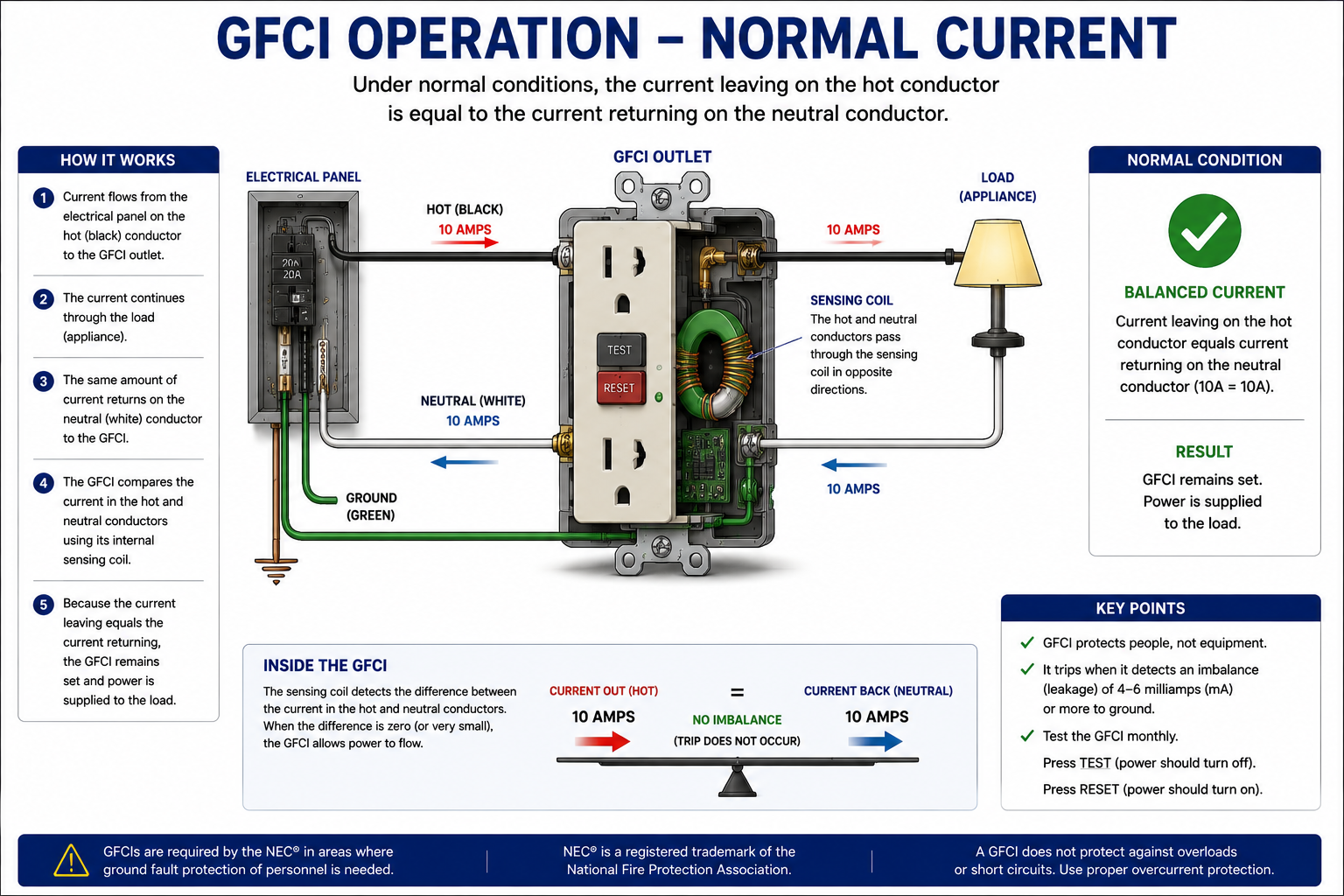
Under normal operation, the current flowing out to a load through the ungrounded conductor or conductors should equal the current returning through the other monitored circuit conductor or conductors. A GFCI continuously compares these currents.
If some current leaves the intended circuit path, such as through damaged insulation, grounded metal, moisture, or a person, the outgoing and returning currents no longer balance. The GFCI detects that difference and opens the circuit when the imbalance reaches its operating threshold.
What Is a GFCI?
A ground-fault circuit interrupter is a device intended for personnel protection that de-energizes a circuit or portion of a circuit when current to ground exceeds a predetermined value that is below the amount normally required to operate the circuit’s overcurrent protective device.
Personnel Protection
The principal purpose of a GFCI is to reduce the risk of serious electric shock when current leaves the intended circuit path.
Current Comparison
The device compares current flowing through the monitored circuit conductors and looks for a difference between outgoing and returning current.
Small Imbalance Detection
A Class A GFCI is designed to respond to a small current imbalance in the milliampere range rather than waiting for ordinary branch-circuit overcurrent protection to operate.
Automatic Interruption
When the imbalance reaches the device’s operating threshold, the GFCI opens the circuit within its required operating characteristics.
A GFCI Does Not Measure Current to Earth Directly
A common misconception is that a GFCI must somehow sense current flowing through a grounding electrode or through the earth. Its normal detection method is simpler: it compares the current flowing through the monitored circuit conductors. If the currents do not balance, some current has taken another path.
Equal Current Means No Ground-Fault Imbalance
Consider a 120-volt load drawing 6 amperes. Approximately 6 amperes leaves the source through the ungrounded conductor and approximately 6 amperes returns through the grounded conductor. Because those currents balance, the GFCI sees no ground-fault imbalance and remains closed.
The actual load current can be much larger than the GFCI’s milliampere-level ground-fault threshold. What matters to the GFCI sensing function is the difference between the monitored outgoing and returning currents, not simply the total amperes being used by the load.
When Current Takes Another Path
If insulation fails or energized metal is contacted, some current may return through a path other than the normal circuit conductor. That path might include an equipment grounding conductor, bonded metal, building structure, earth, plumbing, or a person’s body.
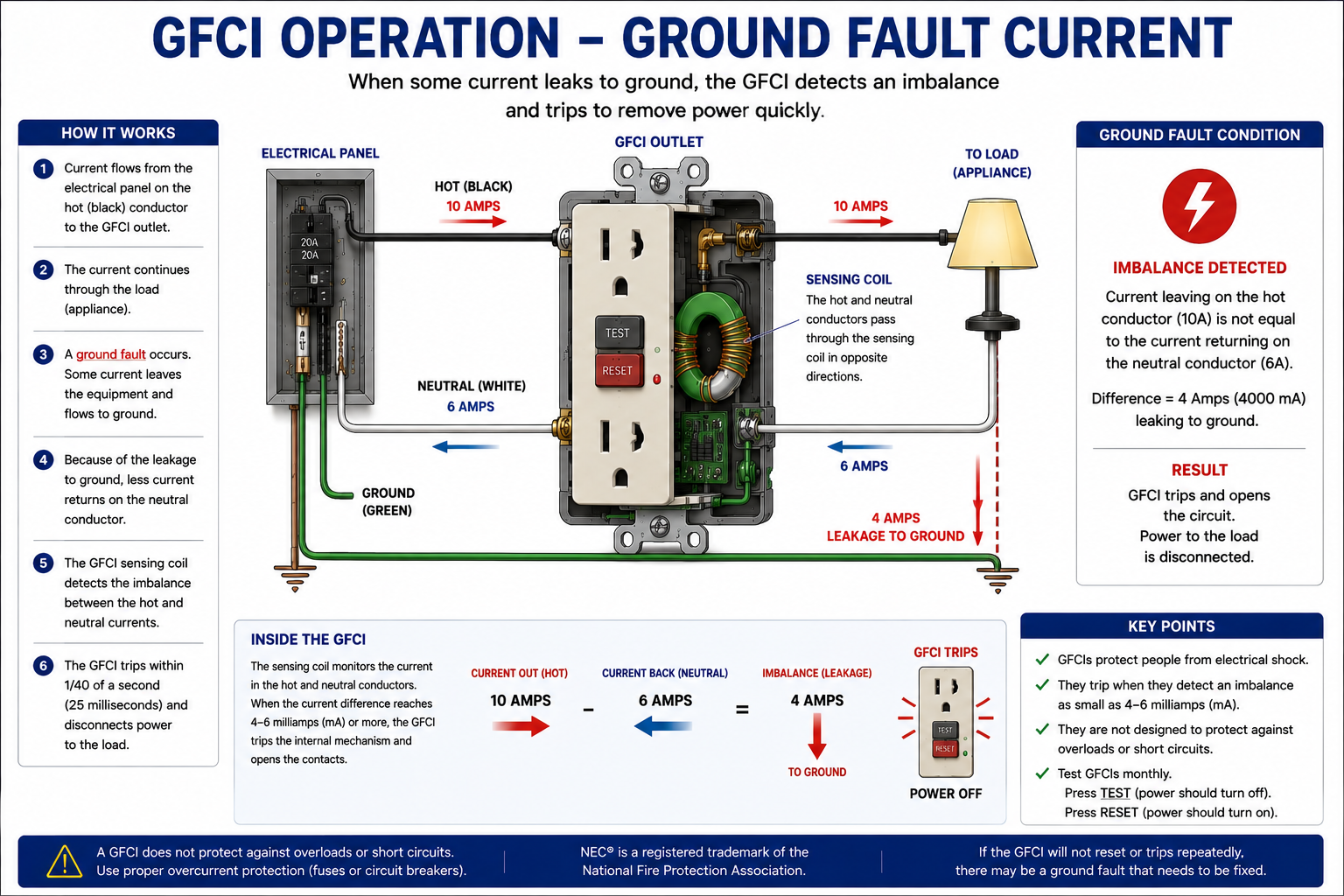
For example, if 6.000 amperes leaves through the ungrounded conductor but only 5.995 amperes returns through the grounded conductor, the missing 0.005 ampere equals 5 milliamperes. That small difference indicates current is flowing through another path.
Think in Milliamperes, Not Amperes
Personnel-protection GFCIs operate in the milliampere range. OSHA describes typical GFCI operation when the outgoing and returning current differ by approximately 5 milliamperes. This is dramatically smaller than the 15- or 20-ampere rating of a common branch-circuit breaker.
GFCI Protection Is Not Overcurrent Protection
A conventional fuse or circuit breaker is intended primarily to protect conductors and equipment from damaging overcurrent. A GFCI serves a different function by detecting small current imbalances associated with a ground-fault path that can present a shock hazard.
Circuit Breaker or Fuse
Responds to excessive circuit current caused by overloads, short circuits, or sufficiently large ground faults.
GFCI
Responds to a relatively small difference between current leaving and returning through the monitored circuit conductors.
A GFCI Does Not Replace the Circuit Breaker
A GFCI does not eliminate the need for branch-circuit overcurrent protection. A circuit can require both an appropriately rated fuse or circuit breaker for overcurrent protection and GFCI protection for personnel.
GFCI Protection and Equipment Grounding Are Different
Equipment grounding and GFCI protection both contribute to electrical safety, but they work differently. The equipment grounding and bonding system provides an effective low-impedance fault-current path back toward the source so that sufficiently large ground-fault current can operate the applicable overcurrent device.
A GFCI detects current imbalance and can open the circuit even when the ground-fault current is far below the level required to operate a conventional branch-circuit breaker.
Grounding Does Not Make a GFCI Unnecessary
An equipment grounding conductor and a GFCI perform different protective functions. A properly grounded circuit can still require GFCI protection, and in certain NEC-permitted replacement situations a GFCI can provide personnel protection even where an equipment grounding conductor is not present. The presence of one should not be used as a substitute for checking whether the other is required.
Common Forms of GFCI Protection
GFCI protection can be incorporated into several types of devices. The correct choice depends on the circuit arrangement, equipment, accessibility, listing, and applicable NEC requirements.
GFCI Receptacle
A receptacle-type GFCI can protect the receptacle itself and, when properly connected and permitted, downstream outlets supplied from its load terminals.
GFCI Circuit Breaker
A GFCI circuit breaker combines branch-circuit overcurrent protection with ground-fault circuit-interrupter protection for the circuit it supplies.
Portable GFCI
Portable units can provide GFCI protection for cord-connected equipment where permitted and are commonly used in temporary and construction applications.
Equipment-Integrated Protection
Some listed equipment incorporates ground-fault protection or interruption functions as part of the equipment design, subject to the applicable product and NEC requirements.
Why GFCI Connections Matter
Receptacle-type GFCIs commonly have terminals identified as LINE and LOAD. The incoming supply conductors connect to the line terminals. When downstream protection is intended and permitted, the conductors supplying downstream outlets are connected to the load terminals according to the manufacturer’s instructions.
Incorrect line/load connections can prevent the device from operating or providing downstream protection as intended. Modern listed devices can incorporate features that prevent operation when improperly wired, but installation must always follow the device listing and instructions.
One Device Can Protect Multiple Outlets
A properly installed GFCI device can protect downstream outlets when those outlets are supplied from the protected load side of the device. This means every protected receptacle does not necessarily require its own GFCI receptacle.
When answering an examination question, distinguish between a location that requires GFCI protection and the physical location of the GFCI device itself. The Code requirement is often that the outlet or equipment be protected, not necessarily that each outlet contain a separate GFCI device.
“GFCI Protected” Does Not Mean “GFCI Receptacle”
A receptacle can receive GFCI protection from an upstream GFCI receptacle or a GFCI circuit breaker. Read the examination wording carefully and determine whether the question asks where protection is required or what type of device must provide it.
Locations Requiring GFCI Protection
NEC Article 210 contains extensive GFCI requirements for receptacles, outlets, and equipment in locations where increased shock risk exists. The exact list has expanded and changed across NEC editions, so NASCLA questions should be answered using the Code edition specified for the examination.
Typical dwelling-unit locations associated with GFCI requirements include bathrooms, garages, outdoors, crawl spaces, basements, kitchens, sinks, boathouses, laundry areas, and other locations identified by the applicable NEC edition.
Water, Grounded Surfaces, and Increased Shock Risk
Many GFCI-required locations combine electrical equipment with water, dampness, grounded surfaces, earth contact, concrete floors, plumbing, or other conditions that can increase the likelihood that a person could become part of an unintended current path.
The Code therefore places additional personnel protection requirements in these locations even though the branch circuit already has ordinary overcurrent protection.
Read the Scope of the Requirement Carefully
GFCI provisions can apply to receptacles, outlets, or specific equipment depending on the particular NEC section. These terms are not interchangeable. A requirement that applies to outlets can extend beyond receptacle outlets, while another provision may specifically address receptacles of particular ratings or locations.
This distinction has become increasingly important as NEC GFCI requirements have expanded to additional equipment and outlet types in recent editions.
Check Three Things
When you encounter a GFCI question, identify the occupancy or installation type, identify the exact location or equipment involved, and determine whether the Code provision applies to a receptacle, an outlet, or the equipment itself. Those three details usually lead you to the correct subsection much faster than searching broadly for the word GFCI.
Common GFCI Applications
Bathrooms
Bathroom receptacle outlets are a long-established application for GFCI personnel protection because of the close relationship between electrical equipment, plumbing, water, and grounded surfaces.
Garages
Garage receptacles are commonly subject to GFCI requirements because users can be in contact with concrete floors, earth, tools, vehicles, and grounded equipment.
Outdoor Locations
Outdoor receptacles and other identified outlets are commonly subject to GFCI protection because moisture and direct contact with earth increase shock risk.
Kitchens and Sinks
Kitchen and sink-related requirements are important examination topics, but the exact extent of required protection depends on the applicable NEC edition and the type and location of the outlet or equipment.
GFCI Protection Is Not Limited to Houses
Commercial, industrial, institutional, construction, agricultural, and other installations can also require GFCI protection. Article 210 includes requirements for locations other than dwelling units, and specialized NEC articles can contain additional GFCI provisions for particular equipment or occupancies.
Do not assume that GFCI protection is only a residential receptacle requirement. Always identify the occupancy and application before selecting the applicable Code subsection.
Testing GFCI Operation
GFCI devices commonly include TEST and RESET functions. Operating the test function creates an internal condition that verifies the sensing and interruption mechanism. The device should be tested in accordance with its listing and manufacturer instructions.
If a GFCI trips repeatedly, do not treat repeated resetting as a repair. Determine whether the cause is an actual ground fault, damaged equipment, moisture, wiring error, neutral-to-ground connection on the protected load side, or a defective device.
The GFCI Must Monitor the Complete Current Path
A GFCI must monitor the conductors necessary to compare all current leaving and returning through the protected circuit. Wiring errors involving shared neutrals, multiwire branch circuits, or neutral connections downstream of the sensing device can create an imbalance and cause unwanted operation.
When a multiwire branch circuit requires GFCI protection, use a configuration and device arrangement specifically suited to monitor the circuit correctly and meet the applicable simultaneous-disconnection and protection requirements.
A Neutral-to-Ground Connection Can Trip a GFCI
On the load side of a GFCI, neutral current must return through the monitored grounded conductor rather than through equipment grounding or bonding paths. An improper downstream neutral-to-ground connection can allow some normal return current to bypass the sensing path, producing an imbalance and causing the GFCI to trip.
Personnel Protection and Equipment Protection
Do not confuse a ground-fault circuit interrupter with ground-fault protection of equipment. A GFCI is intended for personnel protection and responds at relatively low ground-fault current levels. Ground-fault protection of equipment is intended to protect equipment from damaging ground-fault currents and generally operates at substantially higher current levels.
GFCI
Personnel protection involving low-level ground-fault current detection.
GFPE
Equipment protection intended to reduce damage from ground-fault currents and used in applications where the applicable Code rules require or permit it.
Similar Names, Very Different Protection Levels
GFCI and ground-fault protection of equipment both involve ground-fault current, but their purposes and operating levels are different. If the question asks about personnel shock protection, do not substitute an equipment ground-fault protection requirement.
How to Analyze a GFCI Question
Identify the Occupancy
Determine whether the installation is a dwelling unit or another occupancy because the applicable requirements can differ.
Identify the Location
Determine whether the outlet or equipment is in a bathroom, kitchen, garage, outdoors, basement, laundry area, near a sink, or another specifically identified location.
Identify What Must Be Protected
Determine whether the Code requirement applies to a receptacle, all outlets, particular equipment, or another defined portion of the installation.
Check the Circuit Rating and Voltage
Some requirements depend on the circuit voltage, receptacle rating, branch-circuit rating, phase configuration, or equipment involved.
Verify the NEC Edition
Because GFCI requirements have expanded substantially over successive NEC editions, verify the edition specified for the NASCLA examination before relying on a memorized location list.
Check Other Applicable Articles
Specialized equipment, pools, spas, marinas, HVAC equipment, temporary wiring, health-care facilities, and other applications can have additional GFCI requirements outside the general Article 210 rules.
Do Not Memorize Only a Location List
Memorizing common locations can help, but the stronger examination strategy is knowing how Article 210 is organized and checking the exact edition-specific requirement. Changes between NEC editions can alter which receptacles, outlets, voltages, circuit ratings, or types of equipment require GFCI protection.
Ground-Fault Circuit Interrupter Protection
Purpose
A GFCI is intended primarily for personnel protection against hazardous low-level ground-fault current.
Operating Principle
The GFCI compares current flowing out through the monitored conductors with current returning through them and responds when an excessive imbalance occurs.
Milliampere Detection
Personnel-protection GFCIs respond to ground-fault current in the milliampere range, far below ordinary branch-circuit breaker ratings.
Not an OCPD Substitute
GFCI protection does not replace required branch-circuit overcurrent protection.
Not the Same as Grounding
Equipment grounding and bonding establish a fault-current path, while a GFCI detects current imbalance. Both can be required in the same installation.
Edition-Specific Requirements
GFCI-required locations and equipment have changed across NEC editions, so use the Code edition specified for the examination.
Leave a Reply
You must be logged in to post a comment.