Back to: NASCLA Master Electrical Contractor Exam Preparation
Overcurrent protection limits the damaging effects of excessive electrical current on conductors, equipment, and electrical systems. Circuit breakers and fuses are the most common overcurrent protective devices, but selecting and applying them correctly requires more than simply matching a device rating to a conductor size.
This lesson introduces overloads, short circuits, ground faults, fuse and circuit-breaker operation, standard overcurrent-device ratings, conductor protection, device placement, interrupting ratings, and the NEC Article 240 principles that form the foundation for overcurrent-protection questions on the NASCLA Electrical Contractor examination.
Protecting Conductors and Equipment from Excessive Current
An overcurrent is current that exceeds the rated current of equipment or the ampacity of a conductor. An overcurrent can result from an overload, short circuit, or ground fault. Although all three conditions involve excessive current, their causes and magnitudes can be very different.
Overcurrent protective devices are designed to interrupt current before conductors or equipment are damaged beyond acceptable limits. Correct application requires coordination among conductor ampacity, load characteristics, equipment requirements, overcurrent-device ratings, and available fault current.
What Is Overcurrent?
An overcurrent occurs when current exceeds the rated current of equipment or the ampacity of a conductor. The excessive current may be caused by normal equipment being overloaded or by an abnormal fault condition.
Overload
An overload occurs when equipment or conductors carry current above normal full-load current without an insulation failure or direct fault between conductors. A motor driving an excessive mechanical load is a common example.
Short Circuit
A short circuit is an abnormal connection between conductors at different electrical potentials that can produce very high current limited primarily by circuit impedance.
Ground Fault
A ground fault is an unintended conductive connection between an ungrounded conductor and normally non-current-carrying conductive material, equipment grounding paths, or ground.
Overcurrent Protective Device
A fuse or circuit breaker opens the circuit when current reaches conditions that require interruption according to the device’s operating characteristics.
Overload and Fault Current Are Not the Same
An overload can be only moderately greater than normal operating current and may continue for a relatively long period. A short circuit or low-impedance ground fault can produce current many times the normal circuit current almost instantaneously. Overcurrent devices must respond appropriately to both types of conditions.
How a Fuse Provides Protection
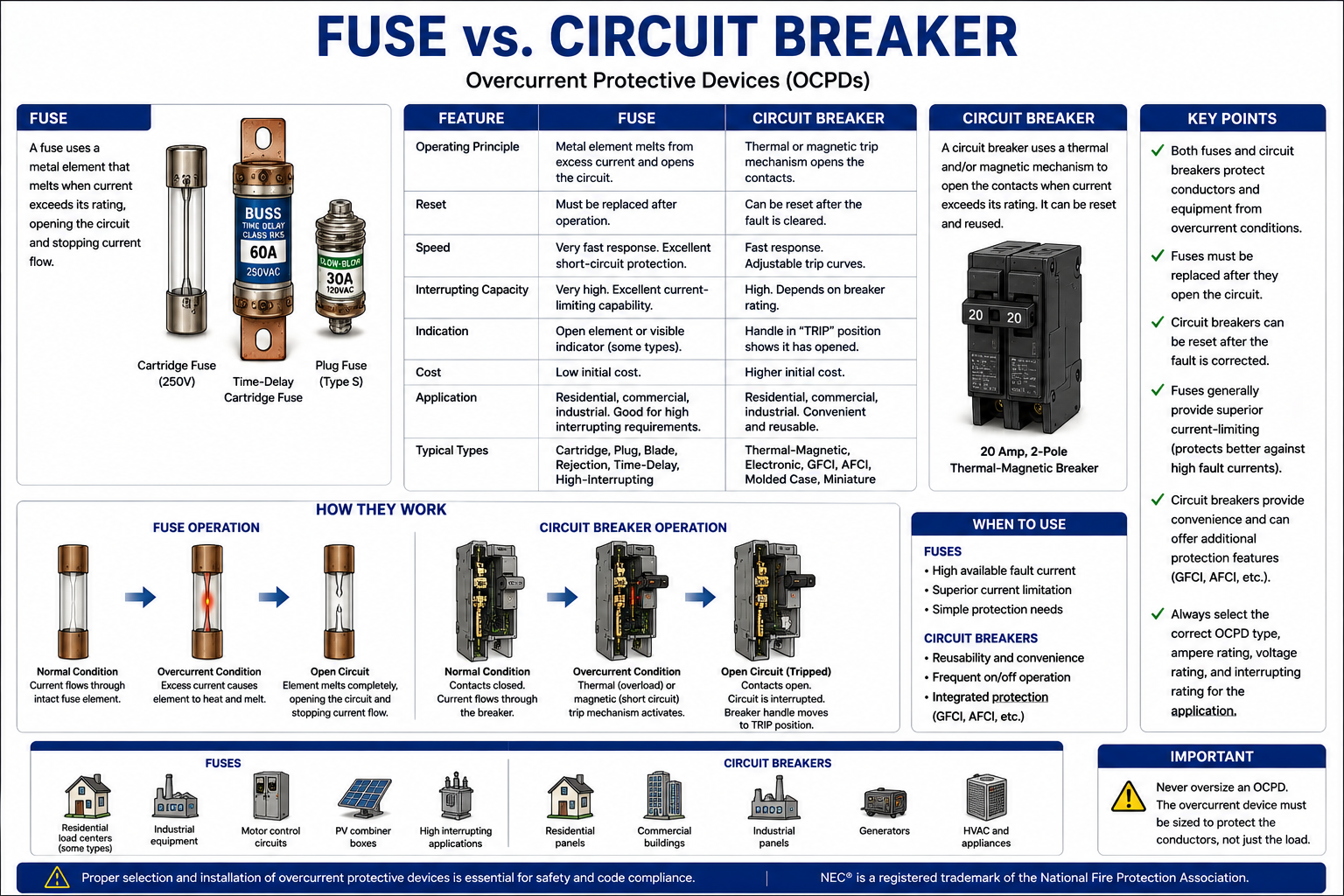
A fuse contains a current-carrying element designed to melt when sufficient overcurrent passes through it for a sufficient period of time. Opening the fusible element interrupts the circuit and stops current flow.
One-Time Operation
After a fuse operates, the fuse must normally be replaced before the circuit can be restored.
Time-Current Response
Fuse operation depends on both current magnitude and duration. Different fuse classes and designs provide different time-current characteristics.
Current Limitation
Certain current-limiting fuses can substantially reduce the magnitude and duration of fault current that passes through downstream equipment during high-level faults.
Interrupting Rating
A fuse must have an interrupting rating adequate for the available fault current at the point where it is installed.
How a Circuit Breaker Provides Protection
A circuit breaker is designed to open and close a circuit manually and to open automatically when predetermined overcurrent conditions occur. Unlike a fuse, a circuit breaker can normally be reset after the cause of operation has been identified and corrected.
Thermal Operation
Many molded-case circuit breakers use a thermal element to respond to sustained overload current.
Magnetic Operation
A magnetic trip mechanism can respond rapidly to high-current short circuits and ground faults.
Electronic Trip Units
Larger breakers can use electronic sensing and adjustable trip functions for more precise protection and coordination.
Interrupting Rating
The breaker must be capable of safely interrupting the available fault current at its point of installation.
Different Devices, Same Basic Objective
Both fuses and circuit breakers protect circuits by interrupting excessive current, but they do so differently. Neither device type is universally superior. Selection depends on interrupting capability, current limitation, coordination, equipment design, maintenance considerations, cost, and the requirements of the particular installation.
Fuse
A fuse opens by melting its fusible element and must normally be replaced after operation.
Circuit Breaker
A circuit breaker opens through a mechanical trip mechanism and can generally be reset after the fault or overload condition has been corrected.
Protection of Conductors
The general Article 240 principle is that conductors must be protected against overcurrent in accordance with their ampacity unless another NEC provision permits a different protection method. This requirement must be applied after conductor ampacity has been determined using the applicable correction, adjustment, termination, and installation requirements.
The NEC also contains specific exceptions and alternative requirements for particular conductor applications. Examples include motor circuits, air-conditioning and refrigeration equipment, transformer circuits, fire pumps, welders, and other specialized installations.
Do Not Assume Every Conductor Uses the Same Article 240 Rule
The general conductor-protection rule is only the starting point. Article 240 specifically recognizes conductor applications that are protected under other NEC articles. When the question involves motors, HVAC equipment, transformers, fire pumps, welders, or other specialized loads, check the equipment article before selecting the overcurrent protective device.
Protection Where Conductors Receive Their Supply
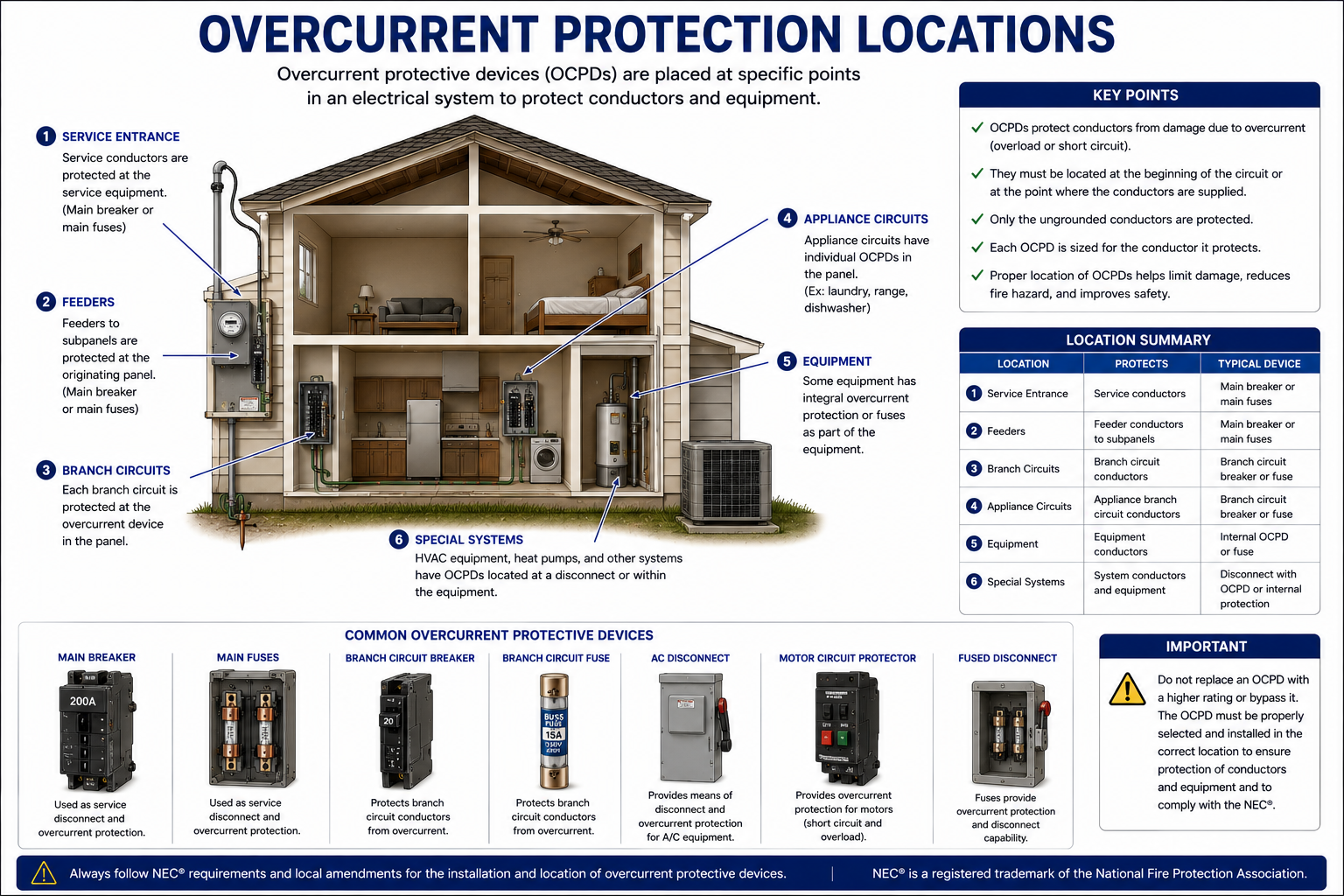
The general NEC principle is that conductors receive overcurrent protection at the point where they receive their supply. This prevents a conductor from being supplied through an overcurrent device that is too large for the conductor without another applicable Code provision providing protection.
The Supply-Point Rule Has Exceptions
Do not turn the general supply-point rule into an absolute statement. The NEC permits specific tap conductors and other arrangements where all conditions of the applicable rule are satisfied. On the examination, a conductor without an overcurrent device directly at its supply point is not automatically a violation.
Standard Ampere Ratings
NEC 240.6 establishes standard ampere ratings for fuses and fixed-trip or inverse-time overcurrent protective devices. Common ratings include 15, 20, 25, 30, 35, 40, 45, 50, 60, 70, 80, 90, 100, 110, 125, 150, 175, 200, 225, 250, 300, 350, 400 amperes, and additional larger ratings.
Knowing that standard ratings exist is especially important when calculated load or conductor ampacity does not correspond exactly to a standard overcurrent-device rating.
The 800-Ampere-or-Less Rule
Under the conditions permitted by NEC 240.4(B), conductors can be protected by the next higher standard overcurrent-device rating when the conductor ampacity falls between standard device ratings, the overcurrent device does not exceed 800 amperes, and all other conditions of the rule are satisfied.
This is a permission, not a universal rounding rule. The next higher rating cannot automatically be used whenever a selected conductor has an ampacity below the desired breaker or fuse rating.
Understanding the Next-Higher Standard Rating
Suppose a conductor has an allowable ampacity of 58 amperes after all applicable conditions have been considered. Fifty-eight amperes is not a standard overcurrent-device rating. If all conditions of the applicable NEC rule are satisfied, the next higher standard device rating may be 60 amperes.
The important examination step is not merely recognizing that 60 amperes is the next standard size. You must also verify that the installation qualifies for the permission to use the next higher standard rating.
Larger Overcurrent Devices
Where an overcurrent protective device exceeds 800 amperes, the general next-higher-standard-rating permission does not apply in the same manner. Under the general Article 240 rule, the conductor ampacity must be at least equal to the overcurrent-device rating or setting, subject to other applicable Code provisions.
Overcurrent Devices and the Neutral
Overcurrent protection is normally installed in ungrounded conductors. An overcurrent device generally must not be inserted independently in a grounded conductor where opening that conductor could leave the ungrounded conductors energized.
Where a circuit breaker opens a grounded conductor as part of a permitted arrangement, it must simultaneously open the required ungrounded conductors so that the grounded conductor is not opened independently while the circuit remains energized.
“Protect Only the Hot Conductors” Is Too Simplified
For ordinary circuits, overcurrent devices are placed in the ungrounded conductors. However, the Code contains permitted arrangements involving simultaneous opening of grounded and ungrounded conductors. Use the applicable rule instead of relying on the absolute statement that an overcurrent device can never involve a grounded conductor.
Ampere Rating Is Not Interrupting Rating
The ampere rating of an overcurrent protective device tells you the current rating associated with its normal circuit application. The interrupting rating tells you the maximum fault current the device is identified to interrupt safely under specified conditions.
A 100-ampere circuit breaker therefore cannot be evaluated only by its 100-ampere rating. If the available fault current at the installation is greater than the breaker’s interrupting rating, the device is not adequate for that location unless an approved series-rated or other permitted system arrangement applies.
Available Fault Current Matters
The current produced during a short circuit can be thousands or tens of thousands of amperes even on a circuit whose normal load is relatively small. The actual fault-current magnitude depends on source capacity, transformer impedance, conductor impedance, and the location of the fault within the system.
Overcurrent devices and connected equipment must therefore be selected with adequate interrupting and short-circuit ratings for the available fault current at their points of installation.
Three Ratings May Be Involved
When evaluating an overcurrent-protection question, distinguish the circuit or device ampere rating, the overcurrent device’s interrupting rating, and the equipment short-circuit current rating. These ratings address different electrical conditions and should not be treated as interchangeable.
Why an OCPD Does Not Trip Instantly at Its Nameplate Rating
Overcurrent protective devices operate according to time-current characteristics. A modest overload may be permitted to continue temporarily, while a high-magnitude fault produces much faster operation. This allows normal transient currents such as motor starting current to occur without unnecessary interruption while still protecting the system from damaging overcurrent.
The exact time-current response depends on the fuse class, breaker design, trip unit, settings, ambient conditions, and other device characteristics.
Which Device Should Open?
Electrical distribution systems often contain multiple overcurrent protective devices in series. Ideally, a downstream fault is cleared by the protective device nearest the fault so that unaffected portions of the electrical system remain energized.
Achieving this behavior requires analysis of device time-current characteristics and, in certain installations, compliance with specific selective-coordination requirements. Do not assume that simply installing progressively larger breakers upstream automatically guarantees coordination.
When the OCPD Can Be Larger Than Conductor Ampacity
Some specialized electrical equipment uses overcurrent-protection rules that differ from the general conductor-protection rules. Motor branch circuits are a common example because short-circuit and ground-fault protection must allow normal motor starting current while separate overload protection protects the motor and conductors from sustained overload conditions.
Air-conditioning and refrigeration equipment, transformers, welders, fire pumps, and other specialized applications also have specific rules. Always check the applicable equipment article when the load falls into one of these categories.
Motor Breaker Size Can Look “Too Large”
A motor circuit may legitimately have a branch-circuit short-circuit and ground-fault protective device rated substantially higher than the conductor ampacity because the NEC coordinates that device with separate motor overload protection and the motor’s starting characteristics. Do not apply ordinary general-purpose branch-circuit rules to a motor problem without checking Article 430.
How to Analyze an Overcurrent-Protection Question
Identify the Circuit
Determine whether the conductors are service conductors, feeders, branch circuits, tap conductors, or part of specialized equipment.
Determine Conductor Ampacity
Establish the allowable conductor ampacity after applying the applicable termination, temperature, correction, adjustment, and installation requirements.
Identify the Load
Determine whether the load is general-purpose or subject to a specialized equipment article that modifies the overcurrent-protection rules.
Select the Applicable OCPD Rule
Use the general Article 240 rule or the specific equipment article referenced for the conductor or load involved.
Check the Standard Rating
Determine the applicable standard fuse or circuit-breaker rating and whether a next-higher-standard-rating permission is available.
Check Device Location
Verify that protection is provided at the required point of supply or that a specific tap or other exception applies.
Verify Interrupting Rating
Confirm that the fuse or circuit breaker can safely interrupt the available fault current at its point of installation.
Check Equipment Ratings
Verify that the connected equipment has an adequate short-circuit current rating and that any series-rated or coordinated system requirements are satisfied.
Ask What the Device Is Protecting
Before selecting an overcurrent device, identify what protection function the question is asking about. Conductor overload protection, branch-circuit short-circuit and ground-fault protection, motor overload protection, equipment protection, and available-fault-current interruption are related concepts, but they are not the same calculation.
Overcurrent Protection
Overcurrent
Overcurrent includes excessive current resulting from overloads, short circuits, and ground faults.
Fuses
Fuses interrupt overcurrent by opening a fusible element and normally require replacement after operation.
Circuit Breakers
Circuit breakers automatically open under specified overcurrent conditions and can generally be reset after the cause of operation has been corrected.
Conductor Protection
Conductors are generally protected in accordance with their ampacity, subject to Article 240 exceptions and specialized equipment rules.
Device Placement
Overcurrent protection is generally provided where conductors receive their supply, with defined Code permissions for tap conductors and other arrangements.
Interrupting Rating
The protective device must be capable of safely interrupting the available fault current at the point where it is installed.
Leave a Reply
You must be logged in to post a comment.