Back to: NASCLA Master Electrical Contractor Exam Preparation
Branch-circuit requirements involve more than selecting a circuit breaker and conductor size. The National Electrical Code establishes recognized branch-circuit ratings, limits the loads that may be supplied by circuits of different ratings, and requires specific branch circuits for certain dwelling-unit loads.
This lesson builds on the branch-circuit fundamentals introduced in Lesson 27 and focuses on circuit ratings, permissible loads, required dwelling-unit circuits, and the Code-navigation process needed to solve branch-circuit questions on the NASCLA Electrical Contractor examination.
Understanding Branch-Circuit Ratings
A branch circuit is rated according to the maximum permitted ampere rating or setting of its overcurrent protective device. This is an important examination concept because the circuit rating is not determined simply by looking at conductor size or the connected load.
Article 210 recognizes standard ratings for branch circuits other than individual branch circuits. The circuit rating then becomes part of the process used to determine conductor requirements, permissible loads, receptacle requirements, and other installation rules.
What Determines a Branch-Circuit Rating?
The rating of a branch circuit is based on the maximum permitted ampere rating or setting of the overcurrent protective device protecting that circuit. The conductor ampacity must be coordinated with the overcurrent protection, but conductor size by itself does not establish the branch-circuit rating.
15-Ampere Circuit
A 15-ampere overcurrent protective device establishes a 15-ampere branch circuit when used within the applicable Article 210 requirements.
20-Ampere Circuit
A 20-ampere overcurrent protective device establishes a 20-ampere branch circuit. Many required dwelling-unit circuits use this rating.
30-Ampere Circuit
A 30-ampere branch circuit is commonly encountered with individual equipment and other loads permitted by the NEC.
40- and 50-Ampere Circuits
These ratings are commonly encountered with larger utilization equipment such as cooking appliances and other loads permitted for circuits of these ratings.
Breaker Size and Wire Size Are Not the Same Question
Do not determine the branch-circuit rating merely from the conductor size shown in an examination problem. First identify the maximum permitted rating or setting of the branch-circuit overcurrent protective device. Then separately verify that the conductors have sufficient ampacity and satisfy any applicable minimum conductor-size requirements.
The Circuit Rating Affects What It May Supply
The NEC limits the types and ratings of loads that may be supplied by multiple-outlet branch circuits. These restrictions become particularly important when determining whether lighting, receptacles, fixed equipment, or combinations of loads can be supplied by the same circuit.
15- and 20-Ampere Circuits
These circuits can generally supply lighting outlets, lighting units, other utilization equipment, or combinations of permitted loads, subject to the applicable limitations and any special-purpose circuit requirements.
30-Ampere Circuits
Thirty-ampere circuits are subject to more restrictive permissible-load provisions and are not simply larger versions of ordinary 15- or 20-ampere general-purpose circuits.
40- and 50-Ampere Circuits
These circuits may supply permitted utilization equipment such as fastened-in-place cooking appliances, with additional applications permitted outside dwelling units.
Circuits Over 50 Amperes
Multiple-outlet branch circuits larger than 50 amperes are restricted to nonlighting outlet loads under the general Article 210 rules.
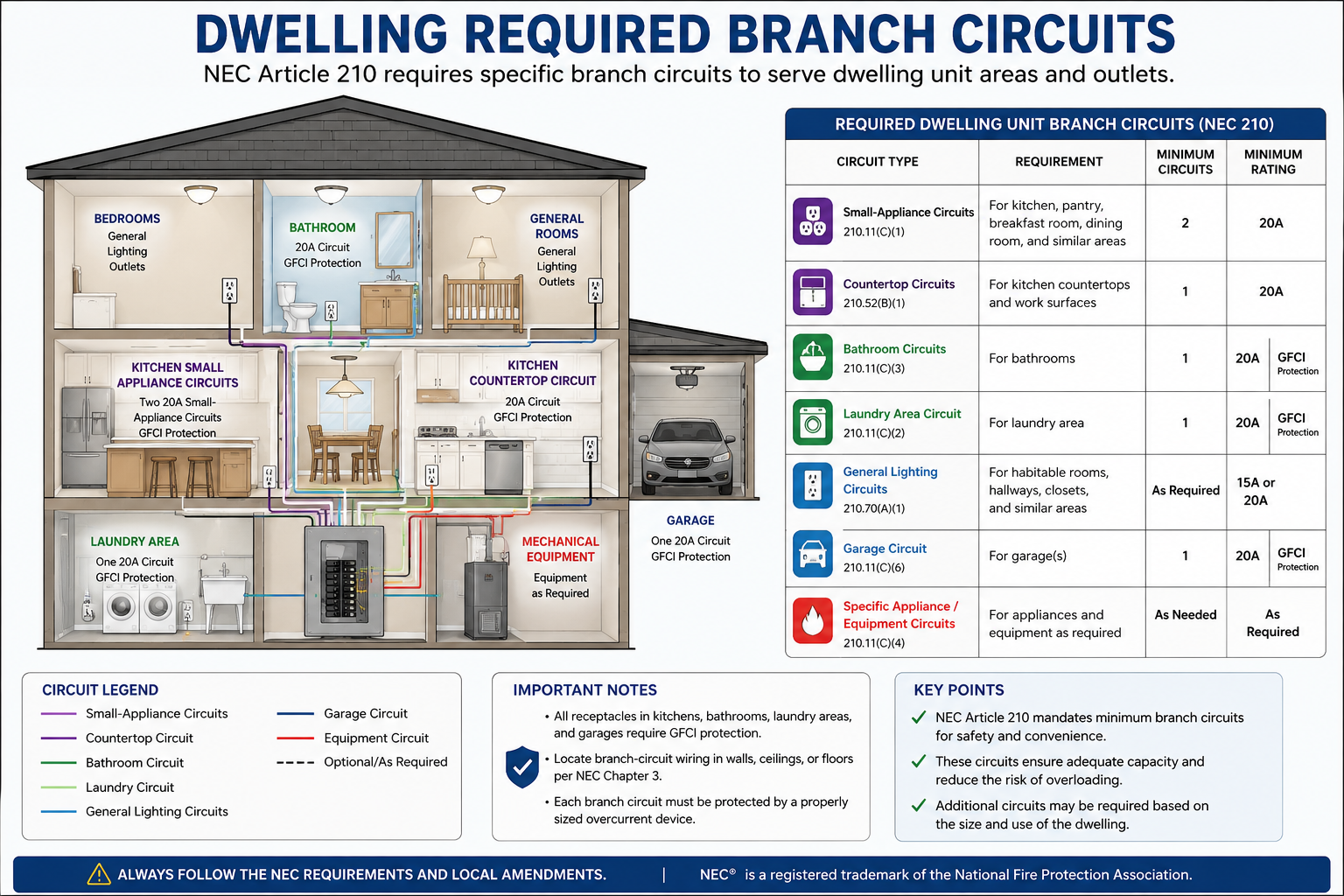
Required Branch Circuits
A dwelling cannot be designed only by calculating the total load and installing enough general-purpose circuits to carry it. Article 210 requires specific branch circuits for certain areas and functions in addition to the circuits necessary to serve the calculated load.
Small-Appliance Branch Circuits
At least two 20-ampere small-appliance branch circuits are required to supply the receptacle outlets specified for kitchens, pantries, breakfast rooms, dining rooms, and similar dwelling-unit areas.
Laundry Area Branch Circuit
At least one additional 120-volt nominal, 20-ampere branch circuit is required for the receptacle outlet or outlets serving the dwelling-unit laundry area.
Bathroom Branch Circuit
One or more 120-volt nominal, 20-ampere branch circuits are required to supply the required bathroom receptacle outlets. The Code places restrictions on what else these circuits may supply, with an exception where one 20-ampere circuit serves a single bathroom.
Garage Branch Circuit
For dwelling-unit garages within the scope of the requirement, at least one 120-volt nominal, 20-ampere branch circuit is required for the applicable garage receptacle outlets.
Two or More 20-Ampere Circuits
The small-appliance branch-circuit requirement is particularly important for NASCLA examination questions. A dwelling requires at least two 20-ampere small-appliance branch circuits for the receptacle outlets identified by Article 210 for kitchens, pantries, breakfast rooms, dining rooms, and similar areas.
The requirement is for at least two circuits. Larger dwellings or designs with substantial kitchen loads may use additional circuits, but the minimum Code requirement does not disappear simply because the calculated load could theoretically be carried by fewer circuits.
Do Not Invent a Separate Required “Countertop Circuit”
Countertop receptacle outlets are generally supplied by the required small-appliance branch circuits. When reading a dwelling-unit question, distinguish between the requirements governing where countertop receptacles must be installed and the requirement for the small-appliance branch circuits that supply them.
Laundry Area Circuit
A dwelling unit requires at least one additional 20-ampere branch circuit for the required laundry-area receptacle outlet or outlets. This requirement exists in addition to the general branch circuits and the required small-appliance circuits.
The laundry branch circuit is restricted to the permitted laundry-area receptacle outlets. A common exam error is treating it as an ordinary general-purpose circuit that can also supply unrelated outlets elsewhere in the dwelling.
Bathroom Receptacle Circuit
At least one 120-volt, 20-ampere branch circuit is required to supply dwelling-unit bathroom receptacle outlets. The general rule restricts this circuit to the bathroom receptacle outlets covered by the requirement.
An important exception applies when a 20-ampere branch circuit supplies only one bathroom. In that arrangement, the circuit is permitted to supply other outlets for equipment within that same bathroom when the applicable load limitations are satisfied.
Multiple Bathrooms
A 20-ampere circuit can be arranged to supply the required receptacle outlets in more than one bathroom, but it cannot then be used as a general bathroom lighting and equipment circuit.
One Bathroom
Where the circuit supplies a single bathroom, the applicable exception permits other outlets within that bathroom to be supplied from the same circuit when the Code conditions are satisfied.
Required Garage Branch Circuit
Dwelling units with qualifying attached garages and detached garages supplied with electric power are subject to a required 120-volt, 20-ampere garage branch-circuit provision. The permitted outlets and applicable exceptions should be checked carefully when answering an examination question.
Do not confuse the requirement for a garage branch circuit with GFCI protection requirements. Circuit provision and personnel protection are separate Code questions even though both may apply to the same receptacle outlet.
Required Circuit Does Not Mean Individual Circuit
The NEC uses several different concepts that can sound similar. A required branch circuit is a circuit that the Code specifically requires to be provided. An individual branch circuit is a branch circuit that supplies only one utilization equipment. Do not assume that every required dwelling-unit circuit is an individual branch circuit.
15- and 20-Ampere Multiple-Outlet Circuits
When a 15- or 20-ampere branch circuit supplies multiple outlets, the rating of any one cord-and-plug-connected utilization equipment that is not fastened in place is generally limited to 80 percent of the branch-circuit rating.
Where lighting units, cord-and-plug-connected equipment not fastened in place, or both are also supplied, the total rating of utilization equipment fastened in place other than luminaires is generally limited to 50 percent of the branch-circuit ampere rating.
15-Ampere Circuit
Eighty percent of 15 amperes is 12 amperes. This relationship commonly appears in questions involving individual cord-and-plug-connected loads on multiple-outlet circuits.
20-Ampere Circuit
Eighty percent of 20 amperes is 16 amperes. Always verify that the particular Code rule applies before automatically using an 80-percent calculation.
Do Not Apply “80 Percent” to Everything
The 80-percent value appears in several electrical rules, but it does not mean that every branch circuit can carry only 80 percent of its rating. Determine why the 80-percent factor applies in the particular problem. Continuous loads, receptacle loading, and permissible equipment loading involve different Code provisions and should not be treated as one universal rule.
Follow the Article 210 Trail
Branch-circuit examination questions frequently require several Code lookups rather than one. Begin with the branch-circuit requirement and then follow the applicable references for conductor ampacity, permissible loads, receptacles, calculated loads, overcurrent protection, or specialized equipment.
Identify the Circuit
Determine whether the question involves a general-purpose, required dwelling, individual, multiwire, or specialized branch circuit.
Determine the Required Rating
Identify the applicable circuit rating and overcurrent protection.
Check Permissible Loads
Determine whether the proposed loads are permitted on a circuit of that rating and type.
Check Special Circuit Restrictions
For required dwelling circuits, determine whether the circuit is restricted to particular receptacles, rooms, or types of loads.
Follow Cross-References
Continue to the applicable conductor, receptacle, load-calculation, protection, appliance, motor, HVAC, or other specialized provisions needed to complete the problem.
Separate Four Questions
When analyzing a branch circuit, treat circuit rating, conductor ampacity, permissible load, and required circuit as four related but separate questions. Many incorrect examination answers result from finding the rule for one of these issues and assuming that it automatically answers the others.
Branch-Circuit Ratings and Required Circuits
Circuit Rating
The branch-circuit rating is based on the maximum permitted ampere rating or setting of the overcurrent protective device.
Small-Appliance Circuits
Dwelling units require at least two 20-ampere small-appliance branch circuits for the applicable receptacle outlets.
Laundry Circuit
At least one additional 20-ampere branch circuit is required for the applicable dwelling-unit laundry-area receptacle outlets.
Bathroom Circuit
One or more 120-volt, 20-ampere circuits are required for the applicable bathroom receptacle outlets, subject to the Code restrictions and single-bathroom exception.
Garage Circuit
A qualifying dwelling garage requires a 120-volt, 20-ampere branch circuit for the applicable garage receptacle outlets.
Code Navigation
Required circuits, circuit ratings, conductor sizing, permissible loads, and protective requirements should be checked independently before selecting an answer.
Leave a Reply
You must be logged in to post a comment.