Back to: NASCLA Master Electrical Contractor Exam Preparation
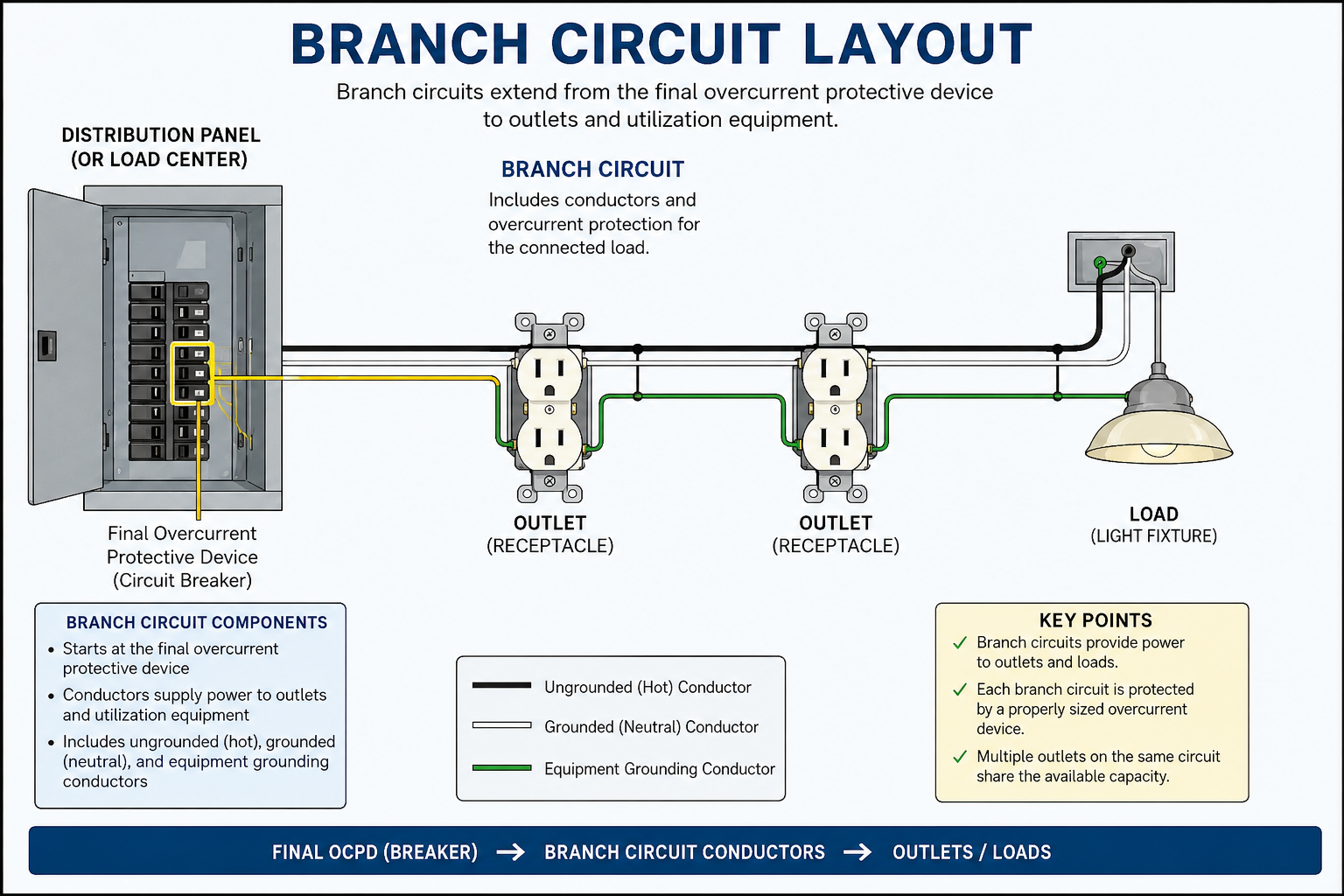
Branch circuits form the final portion of the electrical distribution system, carrying electrical power from the final overcurrent protective device to outlets and utilization equipment. Understanding where a branch circuit begins and ends is fundamental to applying many National Electrical Code requirements correctly.
This lesson introduces branch-circuit terminology, circuit components, ratings, conductor relationships, outlets, loads, and the distinction between branch circuits, feeders, and services. These concepts provide the foundation for the more detailed branch-circuit requirements covered in the next lesson.
From the Final Overcurrent Device to the Load
A branch circuit is the portion of an electrical distribution system between the final overcurrent protective device protecting the circuit and the outlet or outlets supplied by that circuit. This definition establishes an important boundary that appears repeatedly in NEC questions.
Once power leaves the final branch-circuit overcurrent protective device, the conductors supplying the outlets and loads are part of the branch circuit. Conductors upstream of that final overcurrent device may instead be feeders, service conductors, or another portion of the distribution system.
What Is a Branch Circuit?
The most important concept to remember is that a branch circuit begins on the load side of the final overcurrent protective device protecting the circuit. The circuit then extends through the branch-circuit conductors to the outlets where electrical energy is supplied to utilization equipment.
Final Overcurrent Protective Device
The circuit breaker or fuse providing the final overcurrent protection for the circuit establishes the beginning of the branch circuit on its load side.
Branch-Circuit Conductors
These conductors carry power from the final overcurrent protective device toward the outlets and loads served by the circuit.
Outlets
An outlet is a point in the wiring system where current is taken to supply utilization equipment. An outlet is not necessarily a receptacle.
Utilization Equipment
Utilization equipment uses electrical energy for an electronic, electromechanical, chemical, heating, lighting, or similar purpose.
Locate the Final Overcurrent Device First
When an examination question asks about a branch circuit, identify the final overcurrent protective device supplying the circuit before performing calculations or searching for detailed requirements. This establishes the starting point of the branch circuit and helps distinguish branch-circuit conductors from feeder conductors.
Where the Branch Circuit Fits in the Electrical System
Electrical power normally passes through several distinct portions of the distribution system before reaching utilization equipment. Recognizing these boundaries is essential because different NEC requirements apply to services, feeders, and branch circuits.
Electrical Source or Utility
Electrical energy originates from a utility system, transformer, generator, or another permitted source.
Service
Where a utility service supplies the premises, service conductors deliver power to the service equipment.
Feeder
A feeder can carry power from service equipment or another source to downstream distribution equipment containing the final branch-circuit overcurrent devices.
Final Branch-Circuit Overcurrent Device
The final circuit breaker or fuse protecting the branch circuit establishes the branch circuit’s origin on its load side.
Branch Circuit
Branch-circuit conductors extend from the final overcurrent protective device to the outlets supplied by the circuit.
Outlet and Load
The branch circuit ultimately supplies outlets where electrical energy is taken to utilization equipment.
Branch Circuit vs. Feeder
Branch circuits and feeders may contain similar conductors and may even be located in the same distribution system, but they are defined by where they are located relative to the final branch-circuit overcurrent protective device.
Feeder
A feeder supplies downstream distribution equipment and terminates at the final branch-circuit overcurrent protective device or devices.
Branch Circuit
A branch circuit begins after the final branch-circuit overcurrent protective device and supplies outlets and utilization equipment.
A common exam strategy is therefore to locate the overcurrent protective devices on a one-line diagram. If another overcurrent device downstream provides the final protection for the load circuit, the conductors supplying that downstream device are generally part of a feeder rather than the final branch circuit.
Conductors in a Typical Branch Circuit
A branch circuit can contain several conductor types. The exact conductors depend on the system and load, but technicians and contractors must understand the function of each conductor rather than relying only on insulation color.
Ungrounded Conductors
Ungrounded conductors normally carry current from the source toward the load and are commonly referred to as phase or hot conductors.
Grounded Conductor
Where used, the grounded conductor normally provides an intentionally grounded current-carrying path and is commonly called the neutral in systems where it performs that function.
Equipment Grounding Conductor
The equipment grounding conductor provides an effective ground-fault current path by connecting normally non-current-carrying metal parts of equipment to the grounding and bonding system.
Switching and Control Conductors
Some branch circuits also contain conductors associated with switches, controls, travelers, electronic controls, or other circuit functions.
An Outlet Is More Than a Receptacle
One frequent source of examination mistakes is treating the terms outlet and receptacle as interchangeable. They are not. An outlet describes a point in the wiring system where current is taken to supply utilization equipment, while a receptacle is a specific contact device installed at an outlet.
Receptacle Outlet
A receptacle installed as the connection point for cord-and-plug-connected equipment is one common type of outlet.
Lighting Outlet
A wiring point intended for the direct connection of a lampholder, luminaire, or pendant cord terminating in a lampholder is a lighting outlet.
Equipment Outlet
Permanently connected utilization equipment can also be supplied at an outlet even though no receptacle is present.
The Overcurrent Device Establishes the Circuit Rating
For NEC branch-circuit application, the circuit rating is associated with the maximum permitted ampere rating or setting of the overcurrent protective device. Conductor ampacity, load characteristics, equipment ratings, receptacle requirements, and other Code provisions must then be coordinated with that circuit rating.
This relationship is important on the NASCLA examination because simply identifying conductor size does not complete a branch-circuit analysis. The applicable overcurrent protection, conductor requirements, connected load, and permitted outlets must all be considered together.
Start with NEC Article 210
Article 210 is the primary starting point for general branch-circuit requirements. Depending on the question, however, other articles can modify or supplement those general rules for particular equipment, occupancies, wiring methods, motors, appliances, HVAC equipment, or other installations.
For exam questions, identify the load and circuit type first, locate the general branch-circuit requirement, and then determine whether another applicable article modifies that requirement.
How to Analyze a Branch-Circuit Question
Identify the Load
Determine what equipment, outlets, appliances, lighting, or other utilization equipment the circuit supplies.
Locate the Final OCPD
Find the final circuit breaker or fuse protecting the circuit so you can establish where the branch circuit begins.
Determine the Circuit Rating
Identify the applicable overcurrent-device rating and determine the branch-circuit requirements associated with that rating.
Identify the Conductors
Determine the required ungrounded, grounded where applicable, and equipment grounding conductors and verify the rules governing their installation.
Check the Load Requirements
Determine whether the load is continuous or noncontinuous and whether special equipment or occupancy requirements apply.
Check Related Protection Requirements
Determine whether the installation requires additional protection such as GFCI, AFCI, surge protection, or requirements contained in another applicable NEC article.
Do Not Stop at Article 210
Article 210 provides the general framework for branch circuits, but a specific load may be governed by additional requirements elsewhere in the NEC. A motor, air-conditioning unit, appliance, electric vehicle supply circuit, or other specialized load may require you to follow cross-references into another article before determining the final answer.
Branch Circuit Fundamentals
Before continuing, make sure you can identify the beginning and end of a branch circuit and distinguish it from a feeder.
Branch-Circuit Boundary
The branch circuit begins on the load side of the final overcurrent protective device and extends to the outlets supplied by the circuit.
Final OCPD
Finding the final overcurrent protective device is one of the fastest ways to distinguish a branch circuit from upstream distribution wiring.
Outlet
An outlet is a point where current is taken to supply utilization equipment and should not automatically be interpreted as a receptacle.
Article 210
Article 210 is the primary starting point for general branch-circuit requirements, but other NEC articles may supplement or modify those requirements.
Leave a Reply
You must be logged in to post a comment.