Back to: NASCLA Master Electrical Contractor Exam Preparation
Success on an open-book electrical examination depends on more than knowing electrical theory. You must be able to recognize the subject of a question, translate it into NEC terminology, locate the applicable article and section, follow definitions and cross-references, interpret tables correctly, and recognize when informational material is useful without mistaking it for a mandatory Code requirement.
Lesson 26 brings the Part III material together by developing a systematic NEC lookup process. The goal is not to memorize the entire Code but to understand its organization well enough to move quickly from an examination question to the complete requirement that controls the answer.
The NEC Is a System of Connected Requirements
A Code question is rarely solved by finding a single word and reading one sentence. The governing requirement may depend on a definition, another section, an exception, a table, a note, a special-occupancy article, or another referenced requirement.
Efficient NEC navigation therefore requires two skills: knowing where subjects are generally located and knowing how to follow the Code from the initial reference to the complete answer.
Start With the NEC’s Overall Structure
The NEC is organized so that broad requirements appear before many of the specialized rules that apply to particular occupancies, equipment, systems, or conditions. Understanding this relationship allows you to predict where a requirement is likely to be located before opening the book.
Chapter 1 — General
Contains general requirements and definitions that affect electrical installations throughout the Code.
Chapter 2 — Wiring and Protection
Addresses topics such as branch circuits, feeders, services, overcurrent protection, grounding, and bonding.
Chapter 3 — Wiring Methods and Materials
Addresses conductors, raceways, cables, boxes, enclosures, and other wiring methods and materials.
Chapter 4 — Equipment for General Use
Addresses equipment such as flexible cords, switches, receptacles, panelboards, luminaires, appliances, motors, transformers, and related equipment.
Chapters 5 Through 7
Address special occupancies, special equipment, special conditions, and specialized systems that can supplement or modify the generally applicable requirements.
Chapter 8
Addresses communications systems and has a special relationship to the requirements in the other chapters as established by the Code arrangement rules of the applicable NEC edition.
Chapter 9
Contains tables that are used when referenced by applicable Code requirements.
Informative Annexes
Provide supplementary explanatory and reference information but are not themselves mandatory NEC requirements.
General Rules Come First, but They May Not Be the Final Rule
Chapters 1 through 4 generally establish the foundation of the electrical installation. A specialized requirement found later in the NEC can supplement or modify those general requirements when it applies to the installation described in the question.
Finding a general rule does not mean you should stop searching if the question involves a special occupancy, special equipment, or special condition.
Follow the Requirement to the Most Specific Applicable Rule
Suppose an examination question involves wiring installed in a hazardous location. Chapter 3 may establish the general requirements for a wiring method, but the applicable hazardous-location requirements can impose additional restrictions or modify how that wiring method may be used.
The same reasoning applies to specialized equipment and systems. Begin with the general requirement when necessary, then determine whether another article supplements or modifies it for the installation in the question.
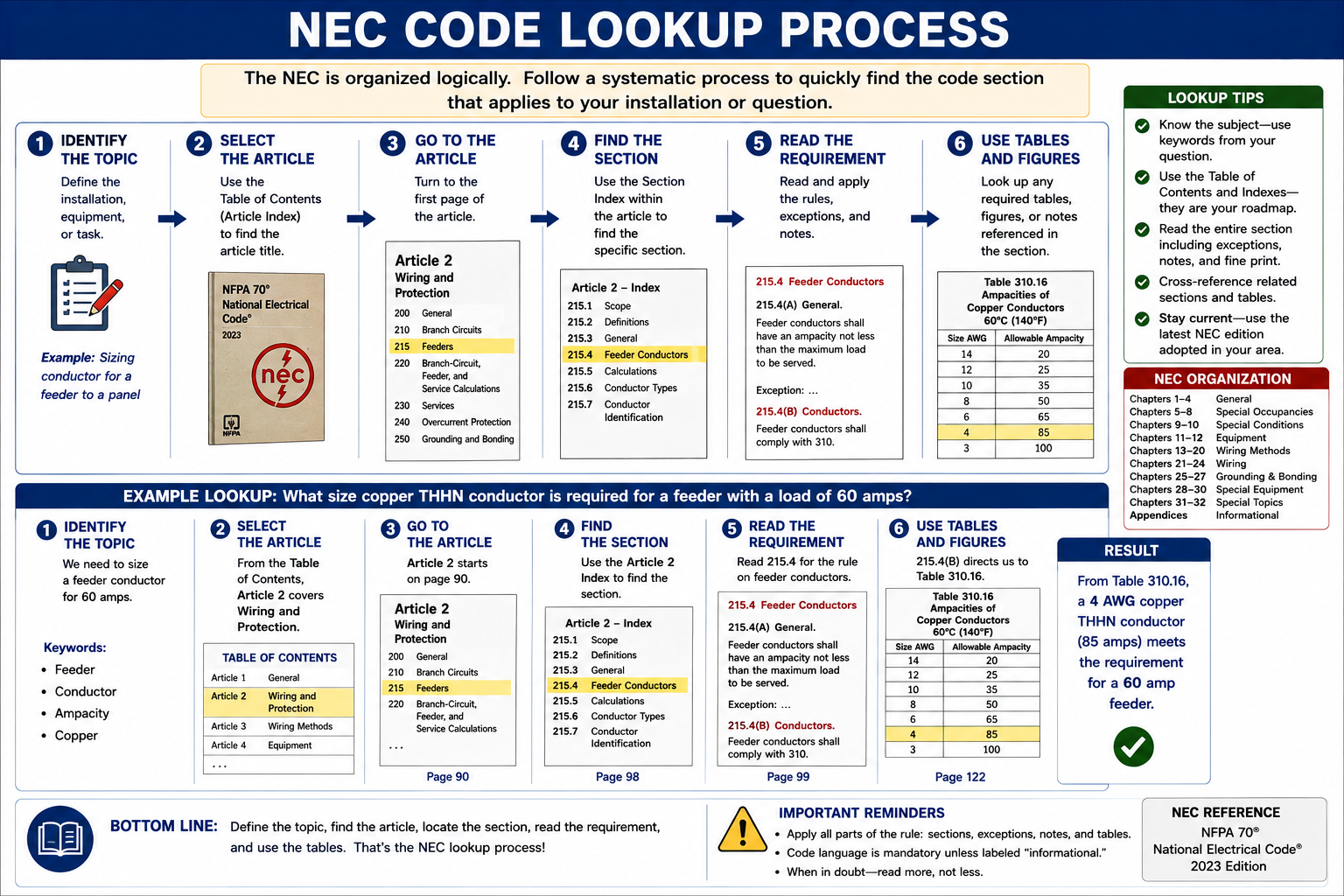
Use a Repeatable Search Method
A disciplined lookup process reduces wasted time and prevents the common mistake of stopping at the first section containing a familiar word.
Read the Entire Question
Before opening the NEC, determine what the question is actually asking. Identify the equipment, system, occupancy, voltage, current, conductor type, location, installation condition, and other facts that could change the applicable requirement.
Reading only part of the question can send you to the correct subject but the wrong requirement because an important condition appears later in the wording.
Identify the Key Subject
Translate the wording of the question into the terminology used by the NEC. A question may describe a component in ordinary trade language while the Code uses a more precise defined term.
What Equipment?
Panelboard, transformer, motor, disconnect, receptacle, raceway, conductor, service equipment, or another specific component.
What Circuit?
Service, feeder, branch circuit, separately derived system, motor circuit, control circuit, or another electrical system.
What Condition?
Wet location, hazardous location, working space, overcurrent protection, grounding, conductor ampacity, voltage drop, or another installation condition.
What Is Being Asked?
Minimum size, maximum rating, required clearance, permitted wiring method, number of conductors, equipment suitability, or another specific requirement.
Do Not Search the Entire Question as a Sentence
The NEC index and table of contents work best when you identify the controlling subject. Reduce the question to a few useful Code terms before beginning the lookup.
For example, a question describing clearance in front of a panelboard is more effectively approached through terms such as working space or electrical equipment access than by searching every word contained in the question.
Use the Table of Contents or Index
The table of contents is useful when you already recognize the likely article or major subject. The index is especially useful when you know the concept but do not know where the Code addresses it.
Neither tool replaces the actual Code requirement. Their purpose is to direct you to the article or section where the requirement can be evaluated.
Table of Contents
Best when you recognize the article, chapter, or major equipment category and need to move directly to it.
Index
Best when you know the electrical subject but need help locating the applicable article or section.
Article Contents
Useful after reaching an article because larger articles can contain many parts and specialized subsections.
Tabs
Useful for reaching frequently referenced articles quickly, but they should support rather than replace an understanding of Code organization.
The Index Points to the Rule — It Is Not the Rule
An index entry is a navigation aid. Once it directs you to an article or section, read the actual Code requirement before answering the question.
Do not answer an exam question from the wording of an index entry alone.
Locate the Article, Part, and Section
Once the index or table of contents identifies a likely location, move to the referenced article and examine its organization. Large NEC articles can contain several parts covering very different applications.
Confirm that the section you found applies to the equipment and conditions described in the question before relying on it.
Check Definitions When Terminology Controls the Answer
Article 100 and definitions contained within individual articles can determine how a requirement applies. If the question turns on whether conductors are a feeder or branch circuit, whether something is an outlet or receptacle, or whether equipment is readily accessible, the definition can control the answer.
Do not assume that the everyday meaning of a word is necessarily the NEC meaning.
Read the Complete Requirement
After finding the applicable section, read enough surrounding material to understand the complete rule. Requirements may contain numbered subdivisions, conditions, exceptions, informational notes, references, or limitations that materially affect the answer.
Reading only the first sentence can produce an incorrect answer when the next paragraph establishes an exception or additional condition.
Follow Cross-References
The NEC frequently directs the reader to another article, section, table, or definition. These references are part of the lookup path and should not be ignored.
A cross-reference can contain the numerical value, special condition, exception, conductor limitation, equipment requirement, or other information needed to complete the problem.
Apply Conditions and Exceptions
Many NEC requirements contain exceptions or conditional rules. An exception should not be assumed to apply merely because it would make an installation easier.
Compare every condition stated in the exception with the facts given in the examination question. If even one required condition is not satisfied, the exception cannot be used.
Select the Answer That Matches the Complete Requirement
Only after the complete requirement has been evaluated should you select the examination answer. The correct answer must satisfy the general rule, applicable specialized rules, definitions, tables, conditions, and exceptions relevant to the question.
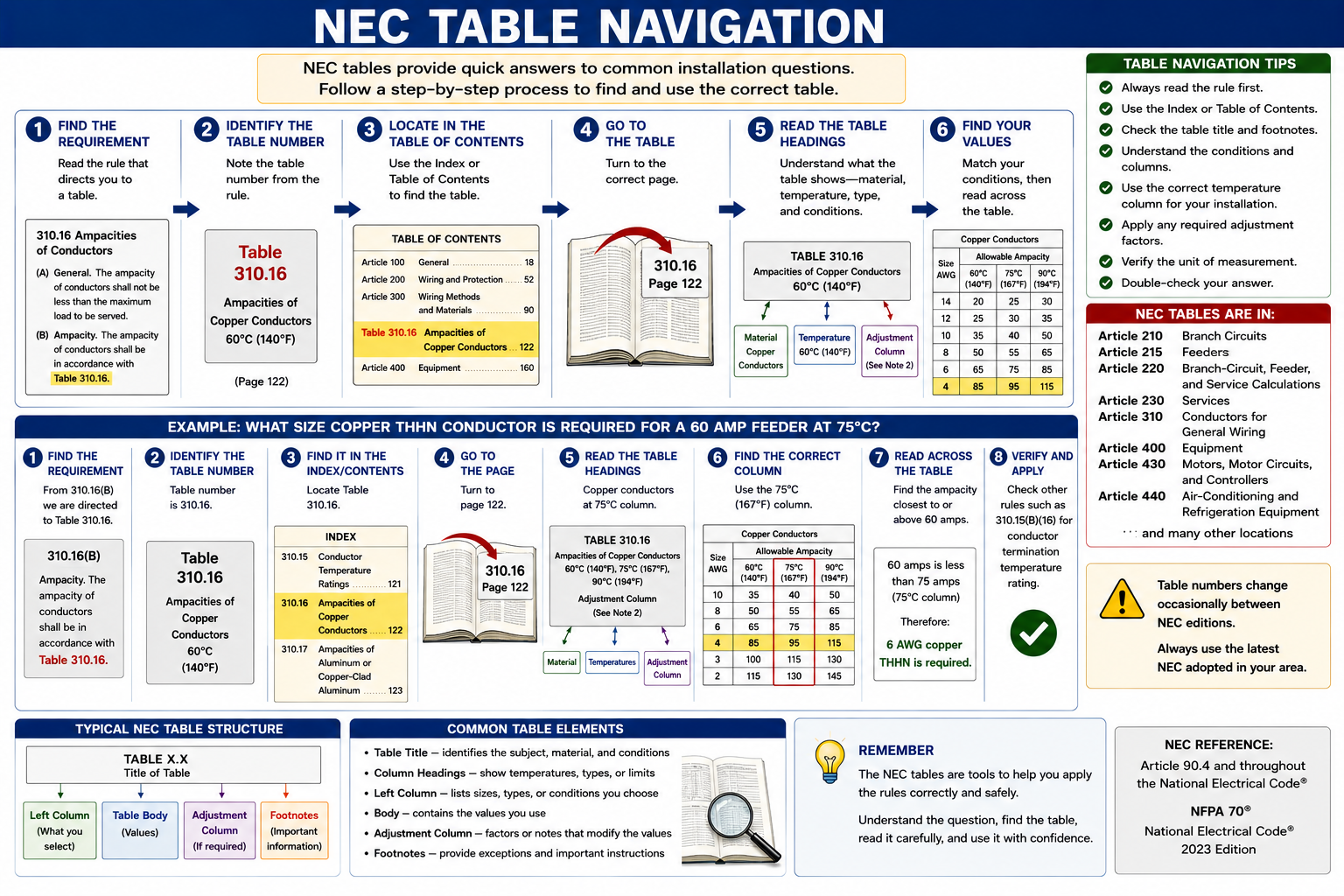
Tables Must Be Read in Context
NEC tables organize large amounts of technical information efficiently, but a table is useful only when you understand why you were directed to it and how its headings, rows, columns, notes, and limitations apply.
Use Tables Systematically
Start With the Governing Requirement
Determine why the Code is directing you to the table and what value or limitation you need to obtain.
Read the Table Title
Confirm that the table addresses the equipment, conductor, raceway, voltage, temperature, or other condition in the question.
Read All Column Headings
Identify the units, conductor types, temperatures, conditions, material, or other classifications represented by each column.
Select the Correct Row
Match the row to the conductor size, trade size, voltage, equipment rating, number of conductors, or other variable specified by the problem.
Read Notes and Footnotes
Table notes can change how a value is applied or direct you to additional conditions and requirements.
Return to the Governing Section
Apply the table value according to the requirement that directed you to the table rather than treating the table value as a complete answer by itself.
Finding the Right Number in the Wrong Column Is Still Wrong
Many incorrect examination answers are values that actually appear somewhere in the correct table. The trap is that the value comes from the wrong temperature column, conductor material, voltage category, raceway type, condition, or other classification.
Always read the table headings before reading the numerical values.
Chapter 9 Tables Are Reference Tools Used When Applicable
Chapter 9 contains tables used for calculations and wiring-method applications when the NEC directs the reader to them. These tables can address conductor and raceway characteristics, dimensions, resistance and reactance information, conduit and tubing fill, and related technical information.
The important examination principle is that Chapter 9 tables should be used in the context established by the applicable Code requirement. Do not assume every Chapter 9 table automatically applies to every calculation involving a similar subject.
Do Not Skip the Notes
A table note can be just as important as the numerical entries in the body of the table. Notes can establish limitations, alternative methods, special conditions, units, or instructions for applying the values.
If an exam question appears to produce an answer that does not match any answer choice, recheck the table headings and notes before assuming the calculation itself is wrong.
Useful Information Without Creating Mandatory Requirements
Informative annexes provide supplemental information that can help explain concepts, calculations, design considerations, examples, and other electrical subjects. They can be extremely useful for understanding how a Code concept works.
However, informative annex material is not itself a mandatory NEC requirement. An examination answer requiring a Code rule should ultimately be supported by applicable mandatory Code text rather than by treating an informative annex as though it were a requirement.
Informative Does Not Mean Unimportant
An informative annex can contain valuable technical guidance and calculation examples. The distinction is that the annex is provided for information rather than as mandatory Code text.
Use informative material to understand and verify your reasoning, but identify the applicable mandatory section when the examination question asks what the NEC requires.
Recognize Explanatory Material
The NEC also contains informational material associated with mandatory requirements. Such notes can provide references, explanations, examples, or connections to other standards without themselves establishing the mandatory requirement.
On an examination, distinguish the enforceable requirement from explanatory information that helps you understand or apply that requirement.
Search by Concept, Then Refine
Effective index use requires more than finding the first occurrence of a word. A subject can contain several subentries that point to different requirements depending on the equipment or condition involved.
Read the related entries and subentries until the reference matches the specific issue described in the question.
Start Broad
Begin with the main electrical subject, such as motors, transformers, grounding, services, conductors, or panelboards.
Refine the Subject
Look for a subentry describing the exact issue, such as disconnecting means, overcurrent protection, conductor size, working space, or grounding.
Follow Alternate Terms
If the expected word does not appear, consider the NEC term that describes the same component or condition.
Verify the Section
Once the index points to a section, read the section itself and confirm that it actually addresses the facts in the question.
Terminology Can Unlock the Index
One reason Article 100 is important for an open-book examination is that knowing the correct defined term makes navigation easier. Searching for an informal trade term can be less effective than searching for the terminology actually used by the NEC.
If you repeatedly have difficulty finding a subject in the index, determine whether you are searching with the correct Code terminology.
Follow the Trail Until the Requirement Is Complete
Code sections often reference other requirements rather than repeating the same information in several locations. A question can therefore require movement through multiple sections before the complete answer becomes clear.
Do not interpret a cross-reference as an inconvenience. It is part of the NEC’s organizational system and frequently indicates exactly where the remaining information can be found.
Exceptions Must Be Earned by the Facts
An exception applies only when the installation satisfies the conditions stated by that exception. It should never be treated as an alternative method available automatically to every installation.
On an examination, answer choices sometimes reflect the general rule while another answer reflects an exception. Carefully compare the question facts with every condition required by the exception before deciding which answer applies.
Find the Rule Before Doing the Math
Many NEC calculation questions cannot be solved correctly by arithmetic alone. The Code determines which loads are included, what demand factors apply, what conductor ampacity is required, which temperature limitations control, and what adjustment or correction factors must be applied.
Identify the governing rule first, gather the correct table values and conditions, and only then perform the calculation.
Code Lookup Is Part of the Calculation
A calculator can produce an accurate mathematical result from incorrect inputs. On an NEC examination, selecting the correct inputs is often more important than the arithmetic.
Before calculating, identify where every number came from and why that number applies to the installation in the question.
Finding a Working-Space Requirement
Suppose a question asks for the minimum clear distance in front of electrical equipment. Begin by recognizing working space as the controlling subject. The index or Article 110 organization can then direct you to the appropriate working-space requirement.
From there, determine the voltage to ground, identify the condition across from the equipment, use the applicable working-space table, and then check the surrounding requirements for width, height, door opening, access, and any conditions relevant to the question.
Finding a Conductor Ampacity
Suppose a question asks for the minimum conductor size for a particular load. Finding an ampacity table is only part of the problem. You must first determine the required load calculation and applicable conductor ampacity, then identify the conductor material, insulation rating, termination limitations, ambient conditions, number of current-carrying conductors, and any other applicable adjustment or correction requirements.
The correct table value becomes useful only after the Code requirements establish how that value must be selected and applied.
Finding a Raceway Fill Answer
A raceway-fill question may require information from the applicable wiring-method rules and Chapter 9 tables. The process can involve determining the permitted percentage fill, identifying conductor dimensions, determining the internal area of the raceway, and applying any applicable notes or special conditions.
Do not begin by selecting an arbitrary Chapter 9 table. Follow the applicable requirement to the tables needed for the specific calculation.
Special Equipment Can Modify the General Rule
Suppose you find a general rule in Chapters 1 through 4 and the question involves specialized equipment addressed in a later chapter. Before answering, check the specialized article to determine whether it supplements or modifies the general requirement.
This prevents the common error of finding a technically correct general rule that is not the final rule for the installation described in the question.
Know When to Move On
An open-book exam does not provide unlimited lookup time. If a question is consuming too much time, mark it and continue. Questions that are easier to locate or calculate should not be sacrificed because one difficult lookup became a prolonged search.
Returning later can also help because another exam question may remind you where the subject is located.
Build Navigation Speed Before Exam Day
Tabs, highlighting, familiar page locations, and repeated practice can reduce lookup time, but the greatest improvement comes from repeatedly solving realistic questions using the same references that will be available during the examination.
The goal is for major subjects to become familiar enough that you know approximately where to begin before opening the book.
Use This Process on Exam Day
Read the Complete Question
Identify exactly what is being asked and note every condition that could affect the answer.
Identify the Key NEC Subject
Translate the problem into the terminology used by the Code.
Use the Index or Table of Contents
Locate the likely article or section efficiently.
Check Definitions
Confirm the meaning of any defined term that affects application of the requirement.
Read the Complete Requirement
Do not stop after finding one familiar sentence or numerical value.
Follow Cross-References and Tables
Gather all information necessary to apply the rule correctly.
Apply Conditions and Exceptions
Determine whether specialized rules or exceptions change the general requirement.
Perform the Calculation if Required
Use Code-derived inputs and the correct mathematical process.
Select and Verify the Answer
Confirm that the answer actually addresses the question asked and complies with the complete applicable requirement.
Test Your NEC Navigation Knowledge
Which NEC chapters generally establish the broad requirements used throughout electrical installations?
Answer: Chapters 1 through 4 generally establish the foundational requirements that apply throughout the Code.
Can requirements for a special occupancy or special equipment modify a general NEC requirement?
Answer: Yes. Applicable specialized requirements can supplement or modify the general requirements.
Are Chapter 9 tables automatically applicable to every electrical calculation?
Answer: No. Chapter 9 tables are applied when referenced or otherwise made applicable by the governing NEC requirements.
Are informative annexes mandatory NEC requirements?
Answer: No. They provide informational material and are not themselves mandatory Code requirements.
Should an exam answer be selected directly from an NEC index entry?
Answer: No. The index is a navigation tool. Follow its reference to the actual Code requirement and read that requirement before answering.
What should you examine before selecting a numerical value from a table?
Answer: The governing requirement, table title, column headings, row headings, units, applicable notes, and the conditions described by the question.
When does an NEC exception apply?
Answer: Only when the facts of the installation satisfy all applicable conditions of that exception.
What should you do when a Code section directs you to another section or table?
Answer: Follow the cross-reference and incorporate the referenced requirement or information into the complete analysis.
Why should definitions be checked during a Code lookup?
Answer: The NEC meaning of a term can determine which requirement applies and may differ from ordinary trade usage.
What is the most important rule when using the NEC during an examination?
Answer: Do not stop at the first relevant reference. Follow the Code until you have located and applied the complete requirement.
What You Should Take From This Lesson
Understand the NEC Structure
Knowing how the chapters relate to one another makes it easier to predict where requirements are located and when specialized rules must be checked.
Use Navigation Tools Properly
The table of contents, index, article organization, and tabs help locate requirements but do not replace reading the actual Code text.
Follow the Complete Requirement
Definitions, cross-references, conditions, exceptions, and specialized requirements can all affect the final answer.
Read Tables in Context
Use the referencing section, table title, headings, rows, columns, units, and notes together before selecting a value.
Recognize Informational Material
Informative annexes and explanatory notes can be valuable resources, but they should not be mistaken for mandatory NEC requirements.
Practice the Process
Fast Code navigation develops through repeated use. Practice identifying the subject, locating the rule, following references, applying tables and exceptions, and verifying the answer.
Leave a Reply
You must be logged in to post a comment.