Back to: NASCLA Master Electrical Contractor Exam Preparation
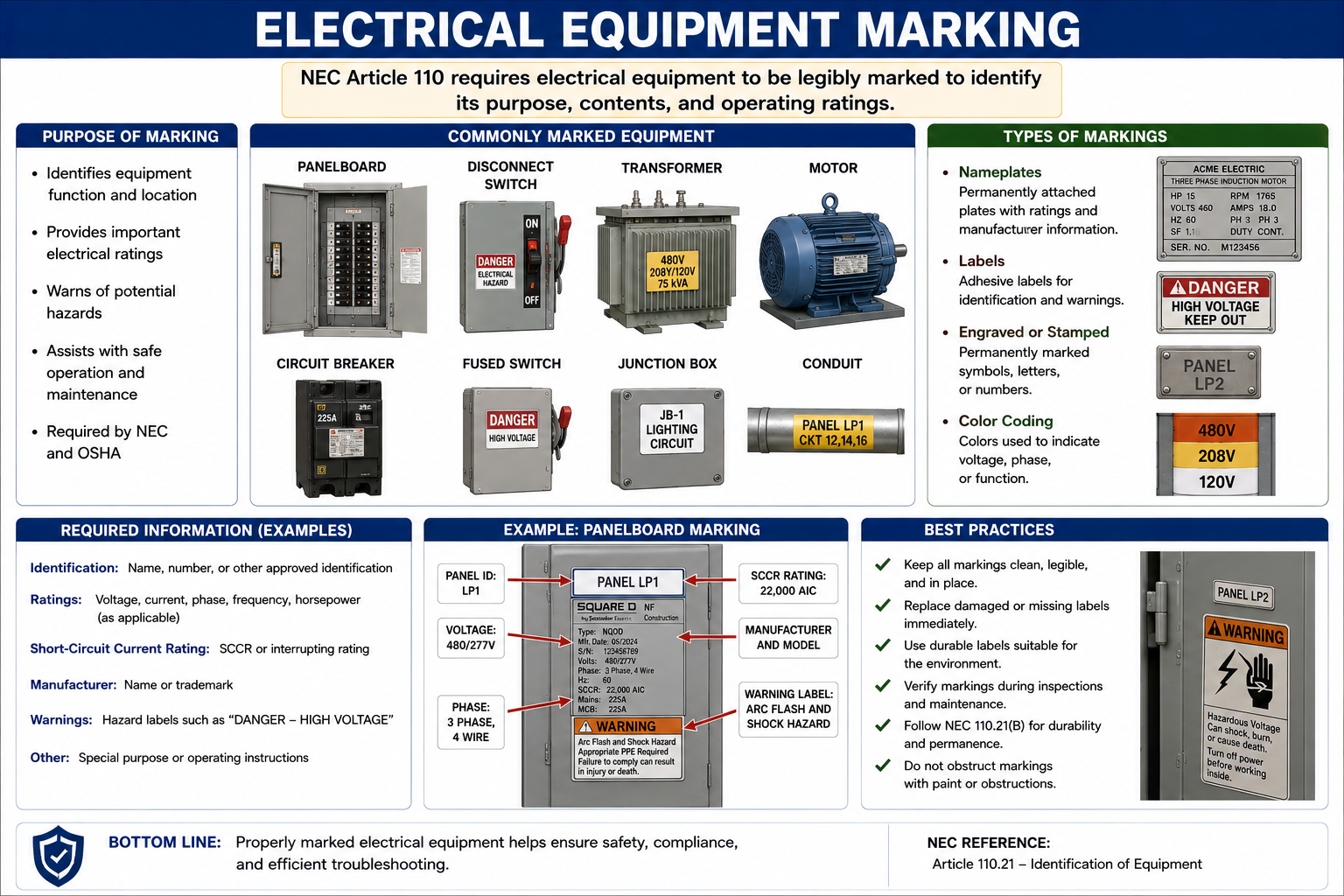
Electrical equipment carries markings that communicate who manufactured it, its electrical ratings, the conditions under which it may be used, and other information needed for proper installation and inspection. The NEC also requires field identification of circuits, disconnecting means, equipment, and electrical system characteristics in many applications.
For the NASCLA Electrical Contractor examination, it is important to distinguish manufacturer markings from field-applied circuit identification and from listing or labeling marks. Each serves a different purpose, and each can affect whether equipment is acceptable for a particular installation.
Electrical Markings Communicate Installation Requirements
Electrical equipment cannot be evaluated only by its physical appearance. Nameplates, labels, identification directories, listing marks, ratings, warning labels, and field-applied markings provide information needed to determine whether the equipment is suitable for the electrical system and how it must be installed.
These markings can identify voltage, current, short-circuit ratings, conductor limitations, disconnect functions, circuit destinations, manufacturer information, environmental suitability, and conditions of use. Contractors must know where to look for this information and how to distinguish one type of marking from another.
Do Not Treat Every Marking as the Same Thing
Electrical equipment can carry several different kinds of information. Knowing who placed the marking and what it represents can help determine how it should be used.
Manufacturer Markings
Identify the organization responsible for the product and provide electrical or equipment ratings needed for proper installation and use.
Listing or Labeling Marks
Indicate that equipment has been evaluated by an appropriate organization for specified uses or conditions according to the applicable certification or listing program.
Field Identification
Identifies circuits, disconnecting means, equipment functions, sources, system characteristics, or other installation-specific information after equipment is installed.
A Manufacturer Nameplate Is Not the Same as a Listing Mark
A manufacturer’s nameplate identifies the product and typically provides ratings and model information. A listing or labeling mark indicates evaluation by an organization whose certification or listing program applies to that equipment.
Seeing a manufacturer’s name on equipment does not by itself establish that the equipment is listed for a particular application.
Know Who Is Responsible for the Product
Electrical equipment must provide sufficient identification to determine the manufacturer or other organization responsible for the product. This may appear as a company name, trademark, trade name, or another descriptive marking.
Manufacturer identification becomes important when locating installation instructions, replacement components, technical data, certification information, or documentation needed to determine whether equipment remains suitable after modification or repair.
Read the Nameplate Before Installing the Equipment
Electrical equipment markings commonly provide ratings needed to match the equipment to the electrical system. Depending on the product, these can include voltage, amperage, frequency, phase, power, horsepower, short-circuit current rating, interrupting rating, temperature limitations, and other characteristics.
Voltage
The marked voltage must be compatible with the circuit and the way the equipment will be connected.
Current
Current ratings establish the equipment’s permitted electrical loading under the applicable conditions.
Phase and Frequency
Alternating-current equipment may be identified for single-phase or three-phase operation and for a specified system frequency.
Fault-Current Capability
Equipment can carry SCCR or interrupting-rating information that must be compared with the available fault current at its installation point.
Temperature Information
Terminal or conductor information can affect the ampacity permitted for conductors connected to the equipment.
Environmental Rating
Enclosures and equipment can be marked for particular environmental conditions such as indoor, outdoor, wet, corrosive, dusty, or other locations.
Identify What a Rating Actually Means
A number printed on equipment is useful only when you know what characteristic it describes. For example, a marked current rating, interrupting rating, and short-circuit current rating can all be expressed in amperes but represent different characteristics.
Read the complete marking rather than comparing numbers without their labels.
Required Markings Must Remain Legible
A required electrical marking must be suitable for the environment in which the equipment is installed. A handwritten paper label that becomes unreadable from moisture, heat, sunlight, chemicals, or normal maintenance may not provide acceptable long-term identification.
Outdoor equipment, industrial installations, mechanical rooms, wet environments, and corrosive areas can require particularly durable identification methods.
Identify What the Circuit Supplies
Services, feeders, and branch circuits often require identification at disconnecting means or overcurrent devices so that personnel can determine their purpose. The identification should clearly describe the circuit or area served rather than relying on vague or ambiguous wording.
Accurate identification reduces the possibility of disconnecting the wrong circuit during maintenance and allows contractors, inspectors, and service personnel to understand the electrical distribution system more quickly.
A Circuit Directory Should Be Specific
Panelboard directories should identify the actual purpose or area supplied by each circuit. Generic descriptions such as lights, plugs, or miscellaneous may be inadequate when several similar loads or areas exist.
A useful directory identifies the location or function clearly enough that someone unfamiliar with the original installation can determine what the circuit controls.
Better
Second-floor east bedroom receptacles.
Better
Kitchen countertop receptacles — north wall.
Better
RTU-2 rooftop air-conditioning unit.
Poor
Misc., plugs, unknown, spare when the circuit is actually connected, or another description that does not clearly identify the load.
Mark the Purpose When It Is Not Evident
A disconnecting means should be identified to show what equipment or circuit it controls unless its purpose is obvious from its location and arrangement. This requirement allows personnel to quickly determine which disconnect controls a particular load.
Remote motor disconnects, rooftop equipment disconnects, multiple service disconnects, and grouped disconnecting means are examples where clear identification can be particularly important.
Labels Should Answer a Useful Question
A good field marking answers a question such as What does this disconnect control?, Where does this feeder go?, or What source supplies this equipment?
A label that merely repeats an equipment type without identifying its actual function may not provide the information needed for safe operation or maintenance.
What a Listing Tells You
Listed equipment is equipment included in a published listing by an organization that evaluates products and maintains appropriate oversight of the equipment covered by its listing program. The listing indicates that the product has been evaluated for specified conditions or uses.
A listing should always be considered together with the particular application. A product can be listed without being listed for every possible environment, voltage, installation method, or use.
The Label Connects the Equipment to the Evaluation
Labeled equipment bears a label, symbol, or other identifying mark associated with the organization responsible for the applicable product evaluation or certification program.
The presence of the label provides a visible way to identify equipment produced under that program. However, the specific meaning of the mark must still be understood in relation to the product and its intended application.
Suitability for a Particular Application
When the NEC requires equipment to be identified for a particular purpose, the issue is whether the equipment has been recognized as suitable for that specific function, use, environment, or application.
Listing and labeling are common ways of demonstrating such suitability, but the important examination concept is that identified means suitability for the particular use described by the requirement.
Approval Ultimately Involves the AHJ
Article 100 defines approved in relation to acceptability to the authority having jurisdiction. Listing or labeling provides important evidence of equipment suitability, but listing and approval should not be treated as identical words.
The AHJ is responsible for determining whether an installation and its equipment satisfy the applicable requirements within the jurisdiction.
Listed, Labeled, Identified, and Approved Are Not Synonyms
These terms are related but describe different concepts. Listed concerns inclusion in an organization’s product listing. Labeled concerns a mark placed on the equipment. Identified concerns suitability for a particular purpose or condition. Approved concerns acceptability to the AHJ.
When an exam question uses one of these terms, answer according to that specific term rather than substituting another.
Markings and Instructions Work Together
The equipment label or nameplate may not contain every installation condition. Article 110 also requires listed or labeled equipment to be installed and used according to instructions included in the listing or labeling.
Installation instructions can specify conductor types, terminal torque, mounting position, environmental limits, accessory compatibility, ventilation clearances, overcurrent protection, maximum conductor sizes, or other conditions necessary for the equipment to remain within its evaluated use.
Changing Equipment Can Affect Its Evaluation
Electrical equipment is evaluated in a particular construction and configuration. Field modifications that alter internal components, enclosures, bus structures, wiring, overcurrent protection, ventilation, or other significant characteristics can affect whether the equipment continues to comply with its listing or labeling conditions.
A contractor should not assume that any modification is acceptable simply because the modified equipment appears to operate normally.
Use Components Suitable for the Equipment
Replacement breakers, fuses, contactors, overload devices, terminals, and accessories must be suitable for the equipment in which they are installed. Similar physical dimensions do not automatically establish compatibility.
Equipment markings, manufacturer instructions, listing information, and applicable Code requirements should be used to determine whether a replacement component is permitted.
“It Fits” Does Not Mean “It Is Listed for the Equipment”
A replacement circuit breaker that physically fits onto a panelboard bus does not automatically mean it is permitted for use in that panelboard.
Compatibility must be established through the applicable equipment information, listing or classification, manufacturer documentation, and Code requirements rather than by physical fit alone.
Match the Equipment to the Location
Electrical equipment may be marked or identified for specific environmental conditions. Enclosure types and other environmental ratings are intended to address particular hazards and should be selected according to the actual installation.
Indoor Dry Locations
Equipment intended only for ordinary indoor conditions may not provide suitable protection against water or other environmental hazards.
Wet Locations
Outdoor or wet-location equipment must provide the level of protection required for exposure to moisture and weather.
Corrosive Locations
Chemicals, salt, fumes, or other corrosive agents can require equipment specifically suitable for those conditions.
Dust and Contaminants
Dust, lint, dirt, fibers, or other contaminants can affect enclosure selection and equipment suitability.
Identify More Than One Source Where Required
Modern electrical systems can contain utility services, generators, photovoltaic systems, battery systems, uninterruptible power supplies, and other sources. Required markings help personnel understand when equipment can remain energized from another source after one disconnect has been opened.
When an examination question includes multiple power sources, look carefully for requirements involving source identification, disconnect locations, directory information, and warning markings.
Special Ratings Require Special Identification
Where circuit breakers or fuses are applied as part of an approved series-rated combination, field identification is required so that future replacement work does not unknowingly defeat the tested or permitted combination.
The marking alerts service personnel that specific replacement components are required and that ordinary substitution based only on ampere rating can invalidate the series rating.
Connect Lesson 25 With Lesson 24
Electrical equipment can carry fault-current information such as SCCR or interrupting ratings, while other installations can require field markings identifying available fault-current information or related system characteristics.
When evaluating a fault-current marking, determine whether it represents the available fault current of the system, the interrupting rating of a protective device, or the SCCR of equipment. These values must not be treated as interchangeable.
Read Electrical Equipment Systematically
Identify the Manufacturer
Determine who is responsible for the equipment and locate the model or other identifying information when provided.
Read the Electrical Ratings
Check voltage, current, phase, frequency, fault-current capability, temperature information, and other applicable ratings.
Look for Listing or Labeling Information
Determine whether the equipment carries the required product certification or listing information for the application.
Check Conditions of Use
Review manufacturer instructions, environmental limits, conductor requirements, permitted accessories, and other conditions associated with the equipment.
Check Field Identification
Verify required circuit directories, disconnect labels, source identification, fault-current information, and other installation-specific markings.
Verify Durability and Accuracy
Required markings should remain legible, accurately describe the present installation, and withstand the environment.
Outdoor Disconnect With an Indoor-Only Enclosure
Suppose a disconnect has the correct voltage and current ratings but is identified only for an indoor dry location. Installing it outdoors where it will be exposed to weather is not justified merely because the electrical ratings match the circuit.
The environmental suitability of the equipment is also part of determining whether it is acceptable for the installation.
Unclear Panelboard Directory
Suppose a commercial panelboard directory lists several circuits simply as lights and several more as outlets, even though the circuits supply different rooms and areas.
The directory should identify the actual purpose or area supplied clearly enough to distinguish the circuits. Accurate circuit identification is important both for Code compliance and for safe maintenance.
Replacement Breaker From Another Manufacturer
Suppose a circuit breaker from another manufacturer physically fits in an existing panelboard and has the same voltage and ampere rating as the original breaker.
Physical fit and matching electrical ratings do not by themselves establish that the breaker is suitable. The installer must determine whether the replacement breaker is listed, classified, or otherwise specifically permitted for use with that panelboard.
Unreadable Equipment Nameplate
Suppose equipment remains mechanically functional but its required nameplate information has deteriorated to the point that the voltage, current, or other necessary ratings can no longer be determined.
Required markings must be durable for the environment. Without reliable rating information, it can become impossible to establish whether the equipment remains suitable for the electrical system.
Ask Who Applied the Mark and What It Means
When an exam question describes a marking or label, determine whether it is a manufacturer rating, a third-party listing or labeling mark, or field-applied identification.
Then determine what information the marking establishes. This prevents errors such as treating an SCCR as an interrupting rating, a manufacturer nameplate as proof of listing, or a panel directory as a product certification label.
Test Your Identification and Marking Knowledge
What basic information should electrical equipment provide about the organization responsible for the product?
Answer: The manufacturer’s name, trademark, or another descriptive marking that identifies the organization responsible for the equipment.
Why are voltage, current, and other equipment ratings marked on electrical equipment?
Answer: They provide information needed to determine whether the equipment is suitable for the electrical system and intended application.
Must required equipment markings remain legible in the installation environment?
Answer: Yes. Required markings must be sufficiently durable for the environment involved.
Is a manufacturer’s nameplate automatically proof that equipment is listed?
Answer: No. Manufacturer identification and a listing or labeling mark serve different purposes.
Does listed equipment automatically qualify for every possible application?
Answer: No. The equipment must be suitable and evaluated for the particular purpose, environment, and conditions of use.
What does approved mean in NEC terminology?
Answer: Acceptable to the authority having jurisdiction.
Can a replacement breaker be used in a panelboard merely because it physically fits?
Answer: No. Its suitability for that panelboard must be established through the applicable listing, classification, manufacturer information, and Code requirements.
Why are circuit and disconnect markings important?
Answer: They allow personnel to identify what equipment or area is controlled and help prevent operating or disconnecting the wrong circuit.
What You Should Take From This Lesson
Equipment Markings Provide Essential Information
Manufacturer identification and electrical ratings help determine whether equipment is suitable for an installation.
Required Markings Must Be Durable
Identification must remain legible under the environmental conditions in which the equipment is installed.
Field Identification Serves a Different Purpose
Circuit directories, disconnect labels, source identification, and similar markings describe the installed electrical system rather than the original manufacture of the equipment.
Listed, Labeled, Identified, and Approved Are Different Terms
Each describes a different aspect of product evaluation, identification, suitability, or acceptance.
Listing Conditions Matter
Equipment must be installed and used according to applicable instructions and conditions associated with its listing or labeling.
Read the Complete Marking
Determine what each rating or label actually represents before using it to answer an examination question.
Leave a Reply
You must be logged in to post a comment.