Back to: NASCLA Master Electrical Contractor Exam Preparation
Electrical equipment must be capable of safely handling the fault-current conditions that can exist at the point where it is installed. Article 110 addresses the interrupting rating of devices that open fault current and the short-circuit capability of electrical equipment and assemblies.
For the NASCLA Electrical Contractor examination, three terms must be kept separate: available fault current, interrupting rating, and short-circuit current rating. They are related, but they do not describe the same electrical characteristic and should never be treated as interchangeable.
Fault Current Must Be Matched to Equipment Capability
During a short circuit or ground fault, extremely high current can flow through portions of an electrical system. The amount of fault current available at a particular location depends on the electrical source and the impedance between the source and that point.
Overcurrent protective devices must be capable of safely interrupting the current they may be required to clear, while equipment and assemblies must have short-circuit current ratings suitable for the fault current available at their locations.
Available Fault Current, Interrupting Rating, and SCCR
The first step in solving fault-current questions is understanding exactly what each term describes.
Available Fault Current
The amount of current that the electrical system could deliver at a specific location during a short circuit or fault, considering the source and system impedance.
Interrupting Rating
The maximum fault current that a device intended to interrupt current, such as a circuit breaker or fuse, can safely interrupt under specified conditions.
Short-Circuit Current Rating
The amount of fault current that equipment or an assembly can safely withstand under specified short-circuit conditions.
Interrupting Rating Is Not SCCR
A circuit breaker or fuse is intended to interrupt fault current. Its interrupting rating describes its ability to safely open the circuit when high current is flowing.
An electrical panel, industrial control panel, disconnect assembly, or other equipment can instead have a short-circuit current rating describing the fault current the equipment can withstand under specified conditions. SCCR is not simply another name for breaker interrupting rating.
Fault Current Is Location-Specific
Available fault current is not one fixed value that applies everywhere in an electrical system. It must be considered at the particular point where equipment is installed.
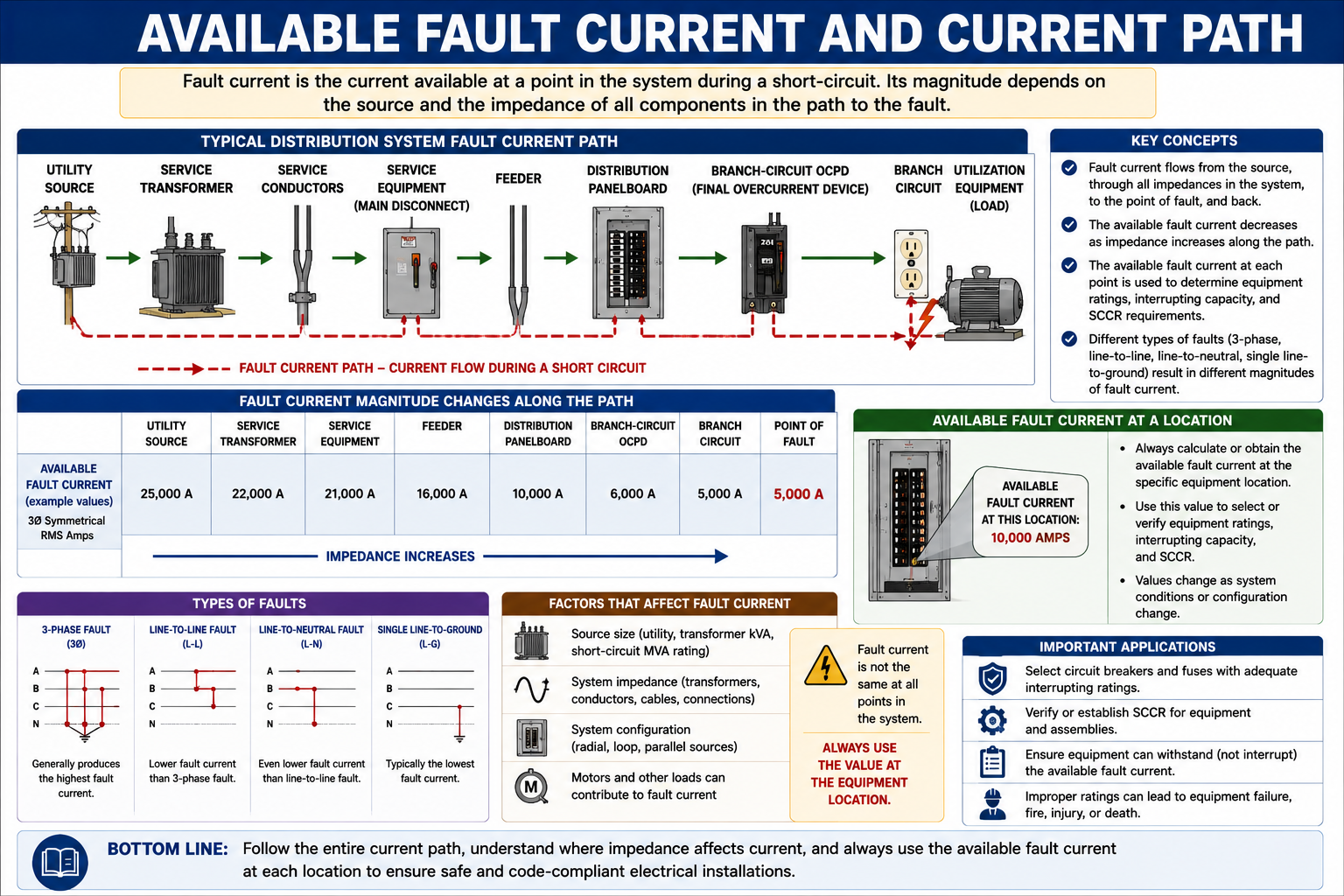
A location close to a large utility transformer may have substantially more available fault current than a downstream location supplied through long feeders because transformer and conductor impedance affect how much fault current can flow.
Impedance Limits the Current
A fault creates a very low-impedance path, but the electrical system itself still contains impedance. Transformer impedance, conductor impedance, source impedance, and other circuit characteristics limit the current that can reach the fault.
Electrical Source
The utility system, generator, transformer, or other source establishes the available energy that can contribute to a fault.
Transformer
Transformer kVA, voltage, and impedance strongly influence the available fault current on the secondary system.
Service Conductors
Conductor length, size, and material add impedance between the transformer and the service equipment.
Service Equipment
The available fault current at the service must be compared with the ratings of the service equipment and protective devices.
Feeders
Additional conductor and equipment impedance usually reduces the fault current available farther downstream.
Downstream Equipment
Each panelboard, disconnect, control panel, and other applicable piece of equipment must be suitable for the available fault current at its own location.
Do Not Assume Fault Current Always Decreases Predictably
System impedance generally reduces available fault current as the distance from the source increases, but additional sources can affect the result. Motors, generators, energy-storage systems, and other sources can contribute current during a fault.
For examination problems, use the information provided in the question and the applicable calculation method rather than assuming a fault-current value based only on physical distance from the service.
Why Transformer Impedance Matters
A transformer does not behave as an ideal zero-impedance source. Its impedance limits the maximum current that can flow during a secondary fault.
Two transformers with the same secondary voltage and kVA rating can produce different available fault currents if their percent impedance values are different. A transformer with lower percent impedance generally permits more fault current to flow than a comparable transformer with higher impedance.
Length and Size Affect Available Fault Current
Conductors add resistance and reactance to the fault-current path. As conductor impedance increases, the available fault current at the downstream location generally decreases.
Longer Conductors
Increasing conductor length increases impedance and generally reduces available fault current downstream.
Larger Conductors
Larger conductors generally have lower impedance and can permit greater available fault current than smaller conductors of the same material and length.
Conductor Material
Copper and aluminum have different electrical resistance characteristics that affect circuit impedance.
Parallel Conductors
Parallel conductor arrangements can substantially reduce circuit impedance and therefore affect available fault current.
The Protective Device Must Be Able to Open the Fault
A circuit breaker or fuse installed where it may be required to interrupt fault current must have an interrupting rating sufficient for the nominal circuit voltage and the current available at the line terminals of the device.
If the available fault current exceeds the device’s permitted interrupting capability, the protective device may not be able to safely clear the fault. The resulting failure can cause extensive equipment damage and create serious hazards.
10 kA Breaker on a 22 kA System
Suppose the calculated available fault current at a panelboard is 22,000 amperes. A circuit breaker used as the protective device has an individual interrupting rating of only 10,000 amperes at the applicable voltage.
Unless the equipment is being applied as part of a properly rated and permitted series combination or another approved arrangement, the breaker’s individual 10 kA interrupting capability would not be sufficient for a location where 22 kA is available.
Available Fault Current Must Not Exceed the Applicable Rating
If a question provides an available fault current and asks whether a circuit breaker, fuse, panelboard, control panel, or other equipment is adequately rated, compare the available current with the applicable interrupting rating or SCCR.
For a straightforward fully rated application, the applicable equipment rating must be equal to or greater than the available fault current at that location.
Short-Circuit Current Rating Applies to Equipment
Short-circuit current rating describes the maximum prospective short-circuit current at which equipment or an assembly has been evaluated for use under specified conditions. SCCR is commonly encountered on equipment such as industrial control panels and machinery and can also be associated with other assemblies and components.
If equipment has a 10 kA SCCR, installing it at a point where 25 kA of fault current is available is not acceptable unless an applicable approved method changes the equipment rating or limits the fault current to a permitted level.
Interrupting Rating Versus SCCR
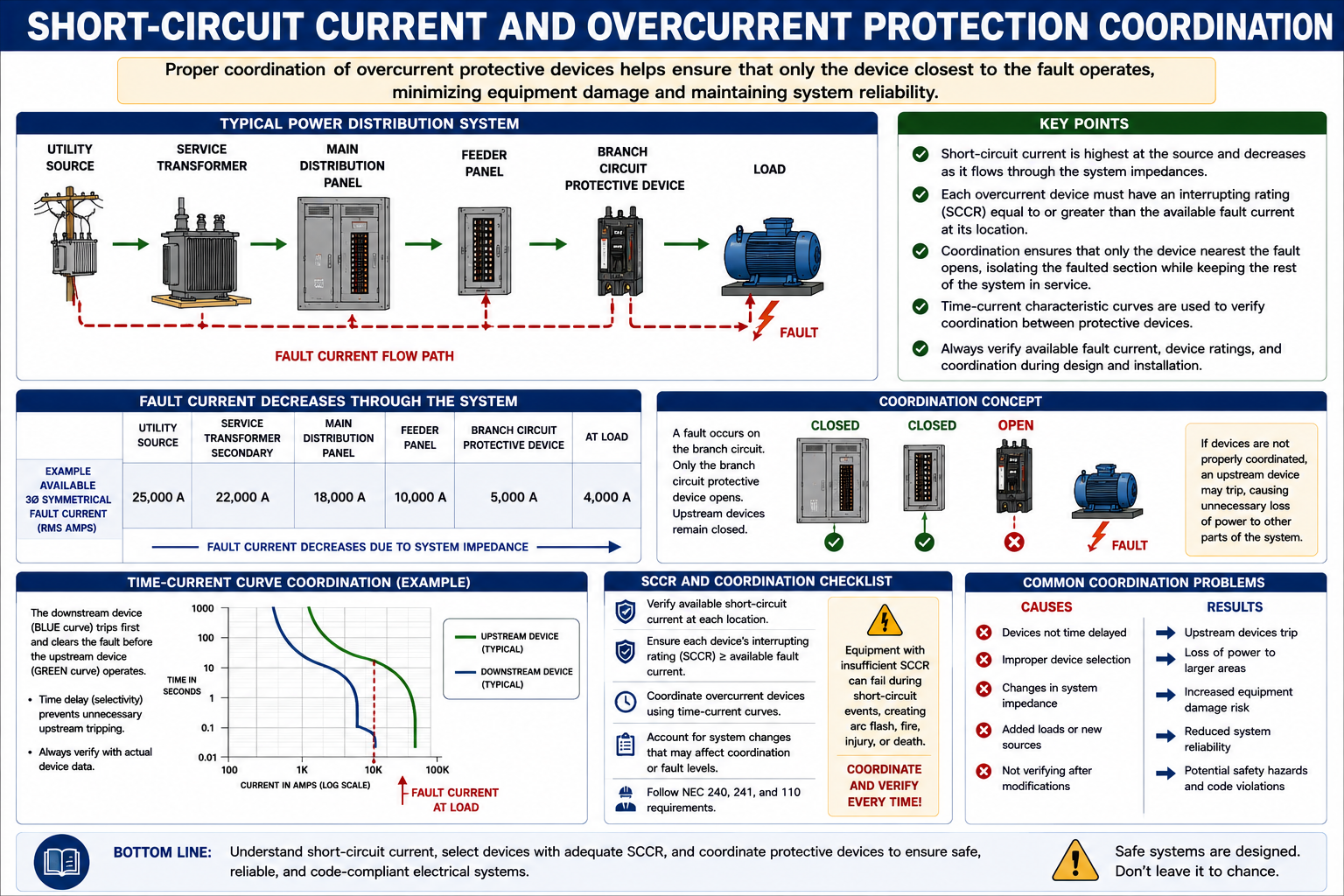
Interrupting Rating
Associated with devices such as circuit breakers and fuses whose function includes interrupting current.
SCCR
Associated with electrical equipment, components, or assemblies that must safely withstand specified short-circuit conditions.
Available Fault Current
A characteristic of the electrical system at the particular installation location.
Required Relationship
The interrupting rating and applicable equipment SCCR must be suitable for the available fault current at the equipment location.
A Breaker’s Interrupting Rating Does Not Automatically Establish the SCCR of the Entire Assembly
A circuit breaker may have a high interrupting rating while an electrical assembly containing that breaker has a lower short-circuit current rating because the SCCR of an assembly depends on the components, configuration, protective devices, and conditions under which the equipment was evaluated.
Do not look only at the breaker rating when the question asks whether the complete equipment assembly is suitable for the available fault current.
The Complete Assembly Matters
Electrical assemblies can contain bus structures, disconnects, contactors, terminal blocks, overload devices, motor controllers, drives, and many other components. The short-circuit capability of the complete assembly must be established according to the applicable equipment standard and installation requirements.
A single component with a high short-circuit rating does not automatically cause every other component in the assembly to have the same rating.
Some Systems Use Tested or Permitted Combinations
Not every electrical distribution system is fully rated using individual downstream breakers whose standalone interrupting ratings equal the entire available fault current. Properly applied series-rated combinations can permit downstream circuit breakers to be used with specified upstream protective devices under the conditions established for that combination.
A series-rated system is not created simply by installing a high-interrupting-rating main breaker ahead of lower-rated branch breakers. The combination must satisfy the applicable NEC requirements and the equipment must be identified for the permitted combination.
Do Not Invent a Series Rating in the Field
A 65 kA main circuit breaker ahead of a 10 kA branch breaker does not automatically make the downstream breaker suitable for 65 kA of available fault current.
Series combinations depend on tested or otherwise specifically permitted combinations and their associated limitations. When an exam question does not identify a permitted series rating, do not assume one exists.
Fault Current Can Sometimes Be Limited
Properly selected current-limiting fuses or circuit breakers can reduce the let-through current and energy experienced by downstream equipment during a short circuit. This characteristic can be used in certain applications to establish an adequate equipment SCCR.
However, simply placing a device labeled current-limiting ahead of low-SCCR equipment does not automatically make the downstream installation acceptable. The specific protective device, equipment ratings, and applicable evaluation method must support the installation.
Motors Can Contribute to Fault Current
During the initial portion of a fault, rotating motors can briefly act as generators and contribute current back toward the fault. In facilities with significant motor loads, this contribution can affect the available fault current at certain locations.
Fault-current studies can therefore require consideration of more than utility and transformer contributions alone, depending on the system and the level of accuracy required.
Modern Systems May Have Multiple Fault-Current Sources
Generators, photovoltaic systems, battery energy-storage systems, and other power sources can affect system fault-current conditions depending on their design and connection to the electrical system.
For examination questions, carefully identify every source shown or described before calculating or evaluating the available fault current.
Related Concepts, but Not the Same Rating
Available fault current and equipment SCCR are related to electrical safety, but SCCR should not be confused with an arc-flash incident-energy rating. They answer different questions.
SCCR addresses whether equipment can withstand specified short-circuit conditions. Arc-flash analysis evaluates the thermal energy that personnel could experience during an arcing fault. A proper electrical design may need to consider both, but they are not interchangeable values.
Fault-Current Information May Appear on Equipment
Equipment nameplates and labels can provide interrupting ratings, short-circuit current ratings, voltage ratings, and other information needed to evaluate the installation. Required field markings can also provide information about available fault current at certain equipment.
Always determine what the marked number actually represents before comparing it with a calculated fault-current value. A marked SCCR should not be interpreted as an interrupting rating unless the equipment and marking specifically establish that function.
Evaluate Fault-Current Questions Systematically
Identify the Equipment Location
Determine exactly where in the electrical distribution system the equipment is installed.
Determine Available Fault Current
Use the value provided in the question or calculate it from the source, transformer, conductors, and other specified system information.
Identify What Rating Is Being Tested
Determine whether the question concerns the interrupting rating of an overcurrent protective device or the SCCR of equipment or an assembly.
Compare the Ratings
Verify that the applicable rating is sufficient for the available fault current at that location.
Look for Special Conditions
Determine whether the problem involves a permitted series rating, current-limiting protection, motor contribution, or another condition affecting the analysis.
Apply the Complete Requirement
Use the NEC requirement, equipment markings, listing information, and system conditions together before selecting the answer.
Panel With an SCCR Lower Than the Available Fault Current
Suppose an industrial control panel is marked with a 10 kA SCCR and is installed at a location where the available fault current is 18 kA.
The panel’s marked SCCR is lower than the fault current available at its supply terminals. Without an applicable approved method that limits the fault current or establishes a higher permitted rating, the panel is not adequately rated for that installation.
Breaker With Adequate Interrupting Rating but Inadequate Equipment SCCR
Suppose the available fault current is 35 kA. The circuit breaker supplying a control panel has a 65 kA interrupting rating, but the control panel itself has an SCCR of only 10 kA.
The breaker has adequate interrupting capability, but that alone does not make the panel suitable. The panel’s SCCR must also be adequate for the available fault current under the applicable installation conditions.
Different Fault Current at Different Locations
Suppose a service has 42 kA of available fault current, while a distant downstream panel has only 14 kA available after the impedance of a long feeder is considered.
Equipment at the service must be evaluated against the fault current available at the service, while the downstream panel is evaluated using the fault current available at its own location. The 42 kA service value should not automatically be assigned to every point in the system.
Ask What the Number Describes
When a fault-current question contains several values in amperes or kiloamperes, label each one before performing any calculation or comparison.
Write down whether each value represents available fault current, interrupting rating, or SCCR. Keeping those terms separate eliminates many of the most common errors on fault-current questions.
Test Your Fault-Current Knowledge
What is available fault current?
Answer: The amount of fault current the electrical system can supply at a particular location under the specified fault condition.
What does a circuit breaker’s interrupting rating describe?
Answer: Its ability to safely interrupt current at specified fault levels and circuit voltage.
What does SCCR describe?
Answer: The short-circuit current that applicable equipment, components, or an assembly can safely withstand under specified conditions.
Is SCCR another term for circuit-breaker interrupting rating?
Answer: No. They describe different equipment characteristics.
Can a 10 kA SCCR panel normally be installed where 22 kA of fault current is available?
Answer: No, unless an applicable approved arrangement establishes that the equipment is suitable for those fault-current conditions.
Does a 65 kA breaker automatically make a downstream 10 kA breaker suitable for 65 kA?
Answer: No. A permitted series-rated combination or other applicable method must specifically support that application.
Does available fault current have the same value everywhere in an electrical system?
Answer: No. It varies with the source, transformer, conductors, system impedance, additional sources, and the location being evaluated.
What should be compared with the SCCR of an equipment assembly?
Answer: The available fault current at the location where the equipment is installed.
What You Should Take From This Lesson
Available Fault Current Is a System Value
It describes the current that can be delivered during a fault at a specific point in the electrical system.
Interrupting Rating Applies to Interrupting Devices
Circuit breakers and fuses must have sufficient interrupting capability for the available current they may be required to interrupt.
SCCR Applies to Equipment Capability
Equipment and assemblies must have short-circuit current ratings suitable for the fault current available at their locations.
Interrupting Rating and SCCR Are Not Interchangeable
A protective device can have adequate interrupting capability while the equipment it supplies still has an inadequate SCCR.
System Impedance Affects Fault Current
Transformer impedance, conductor impedance, conductor length, conductor size, and additional sources can affect the fault current available at a particular point.
Compare the Correct Values
Identify whether the question involves available fault current, interrupting rating, or SCCR before comparing numbers or selecting an answer.
Leave a Reply
You must be logged in to post a comment.