Back to: NASCLA Master Electrical Contractor Exam Preparation
Article 110 contains many of the general requirements that form the foundation of a compliant electrical installation. These rules address equipment approval and suitability, examination of equipment, installation and use, conductor connections, equipment ratings, workmanship, environmental conditions, markings, and access around electrical equipment.
For the NASCLA Electrical Contractor examination, Article 110 is especially important because its requirements apply broadly across electrical systems. A question may appear to involve a panelboard, motor, transformer, raceway, disconnect, or other piece of equipment while the controlling requirement is actually found in Article 110.
General Requirements That Apply Across the NEC
Article 110 establishes requirements that apply broadly to electrical conductors and equipment. Rather than addressing one specific type of electrical system, it establishes fundamental rules governing whether equipment is suitable, how it must be installed, how electrical connections are made, what ratings must be considered, and how equipment must be maintained and accessed safely.
These requirements frequently work together with more specific articles. A motor installation may be governed by Article 430, for example, while still being subject to Article 110 requirements concerning equipment suitability, conductor terminations, markings, interrupting ratings, workmanship, and access.
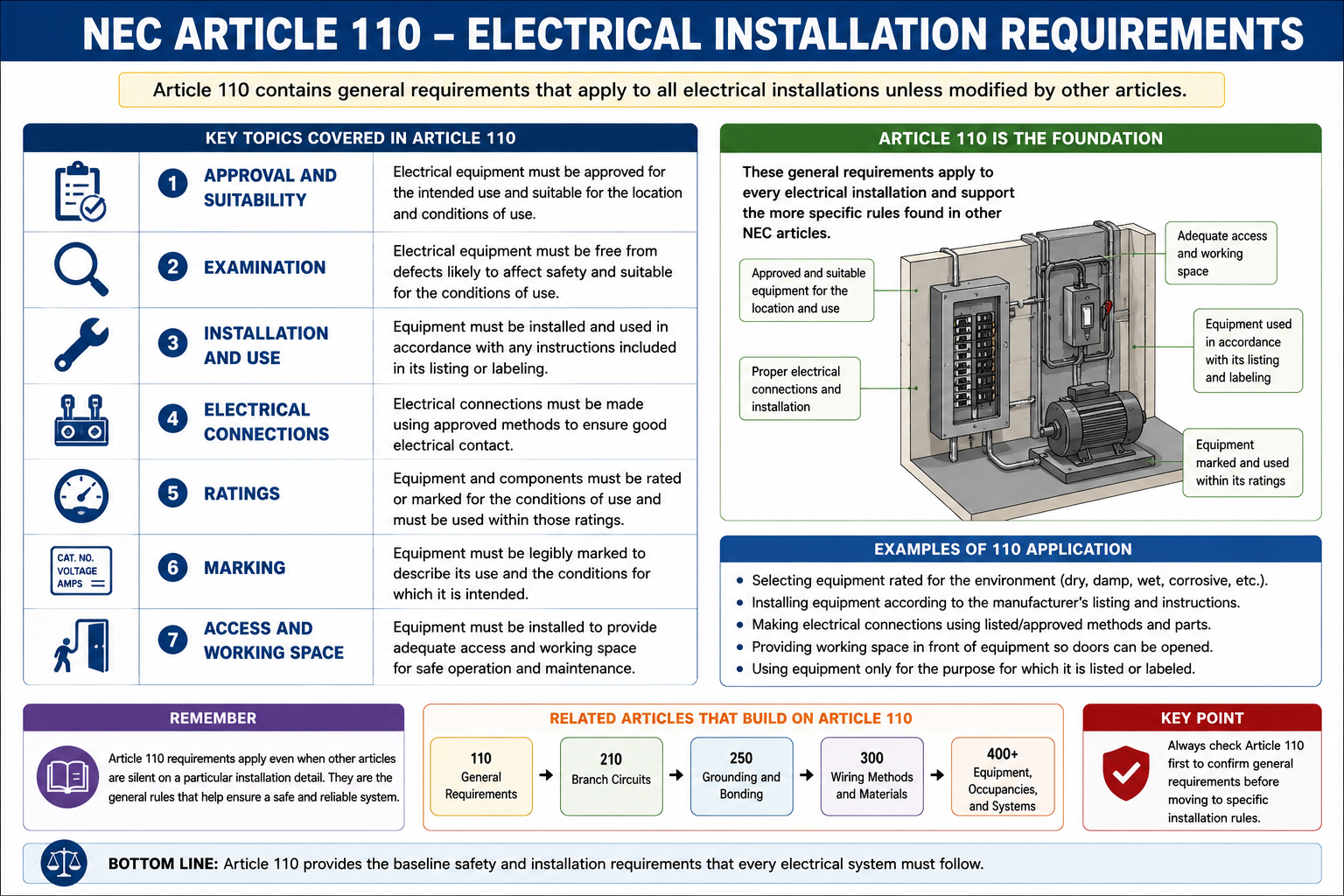
A Foundation for Electrical Installations
Article 110 should be viewed as a set of general installation rules that accompanies the more specialized requirements found elsewhere in the NEC. Understanding these principles helps prevent the common mistake of searching only the article associated with a particular type of equipment.
Approval and Suitability
Electrical conductors and equipment must be acceptable for their intended installation and use.
Examination of Equipment
Equipment must be evaluated for characteristics such as suitability, mechanical strength, insulation, heating effects, arcing effects, ratings, and intended use.
Installation and Use
Listed or labeled equipment must be installed and used according to the instructions and conditions associated with its listing or labeling.
Electrical Connections
Conductor materials, terminals, splices, and connection methods must be compatible and suitable for their intended purpose.
Ratings
Equipment must have ratings suitable for the voltage, current, fault-current conditions, and other characteristics of the electrical system.
Marking and Access
Electrical equipment must have required markings, and appropriate access and working space must be provided where required.
Do Not Forget Article 110
When an exam question asks whether equipment can be installed in a certain manner, whether a termination is suitable, whether equipment can interrupt an available fault current, or whether sufficient access has been provided, Article 110 should be one of the first places you consider.
A specialized equipment article may establish what equipment is required, while Article 110 determines whether that equipment is suitable and properly installed.
Electrical Equipment Must Be Acceptable
Article 110 begins with the principle that conductors and equipment required or permitted by the NEC must be acceptable for their intended use. The term approved is defined in Article 100 as acceptable to the authority having jurisdiction.
Approval is therefore not simply a contractor deciding that a product appears suitable. The AHJ evaluates whether equipment and installations satisfy applicable requirements, often relying on listing, labeling, manufacturer information, recognized standards, and other evidence of suitability.
Suitability Requires More Than a Voltage Rating
When electrical equipment is evaluated for safety and suitability, many characteristics must be considered. A product can have the correct nominal voltage and still be unsuitable because of its construction, environmental rating, current capacity, mechanical strength, temperature limitations, or intended use.
Suitability for Installation
The equipment must be suitable for the location, application, electrical characteristics, and conditions in which it will be installed.
Mechanical Strength
Equipment and enclosures must have sufficient mechanical strength and durability for their intended application.
Connection Space
Equipment must provide appropriate space and arrangements for conductor bending, routing, and termination.
Electrical Insulation
Insulation must be appropriate for the electrical stresses and conditions expected during normal operation.
Heating Effects
The effect of operating temperature and heat generation must be considered when determining whether equipment is suitable.
Arcing Effects
Equipment that can produce arcs, sparks, or similar effects must be installed in a manner suitable for the environment and surrounding materials.
Install Equipment According to Its Instructions
One of the most important Article 110 concepts is that listed or labeled equipment must be installed and used in accordance with instructions included in the listing or labeling.
This means that manufacturer installation instructions associated with a product’s listing are not merely optional suggestions. They can establish requirements involving conductor sizes, terminal torque, mounting orientation, enclosure clearances, accessory compatibility, environmental conditions, overcurrent protection, and other installation details.
Exam clue: If a question asks whether listed equipment may be installed contrary to instructions provided as part of its listing or labeling, the answer is generally no.
Read the Equipment Instructions
Electrical contractors frequently work with equipment whose installation requirements cannot be determined from the NEC alone. Panelboards, transfer equipment, generators, photovoltaic equipment, motor controllers, variable-frequency drives, disconnects, and other products can have specific installation conditions established by the manufacturer and listing.
The NEC establishes the rule requiring proper use of listed or labeled equipment, while the equipment documentation provides many of the details needed to satisfy that rule.
Install Electrical Work Properly
Article 110 requires electrical equipment to be installed in a neat and workmanlike manner. This principle includes more than appearance. Poor installation practices can damage equipment, reduce accessibility, expose conductors to physical damage, or interfere with proper operation.
Close Unused Openings
Unused openings in boxes, cabinets, raceways, equipment cases, and similar enclosures must be effectively closed to maintain the intended protection of the enclosure.
Protect Internal Components
Busbars, terminals, insulators, conductors, and other internal components should not be contaminated by paint, plaster, cleaners, corrosive materials, or construction debris.
Avoid Damaged Equipment
Broken, bent, overheated, corroded, or otherwise damaged equipment can compromise electrical safety and mechanical integrity.
Maintain Accessibility
Conductors and equipment should be installed so that required inspection, servicing, maintenance, and operation can be performed safely.
Equipment Must Be Secure and Able to Dissipate Heat
Electrical equipment must be securely mounted and installed so that required cooling is not impaired. Equipment that relies on ventilation openings, natural convection, or specified clearances must not be installed in a manner that blocks airflow.
This is another example of Article 110 working together with listing and labeling requirements. A piece of equipment may physically fit in a location but still be improperly installed if the location prevents the ventilation or clearances required by its design.
Equipment Must Be Suitable for the Location
Environmental conditions can affect the suitability of conductors and equipment. Moisture, corrosive vapors, chemicals, excessive heat, physical damage, and other deteriorating influences can make otherwise acceptable electrical equipment unsuitable for a particular installation.
Dry Locations
Equipment intended only for dry locations should not be installed where it will be exposed to moisture unless another appropriate rating or protection is provided.
Damp and Wet Locations
Equipment installed in damp or wet environments must be identified or otherwise suitable for those environmental conditions.
Corrosive Conditions
Chemicals, fumes, vapors, liquids, and similar agents can deteriorate conductors, enclosures, connections, and electrical equipment.
High Temperatures
Ambient temperature and nearby heat-producing equipment can affect conductor ampacity, equipment life, insulation, and overall suitability.
Connections Must Be Compatible and Reliable
Electrical connections are a major focus of Article 110. Improperly selected terminals, incompatible conductor materials, poor splices, and loose connections can create excessive resistance, overheating, arcing, and equipment failure.
Conductor Material
Terminals and connectors must be suitable for the conductor material being used, including copper, aluminum, or other permitted conductor constructions.
Dissimilar Metals
Dissimilar conductor metals should not be intermixed in terminals or connectors unless the device is specifically identified for that use and condition.
Multiple Conductors
A terminal intended for more than one conductor must be identified for that purpose. Do not assume that a physically large terminal automatically permits multiple conductors.
Splices
Splicing devices and methods must be suitable for the conductors, environment, electrical characteristics, and intended installation.
Just Because Two Conductors Fit Does Not Mean the Terminal Permits Them
A terminal that is designed and identified for one conductor cannot automatically be used for two conductors simply because both conductors physically fit under the terminal.
Always consider the terminal identification, conductor material, permitted conductor size, number of conductors, and applicable equipment instructions.
Conductor Ampacity and Equipment Terminations Work Together
Conductor ampacity calculations must account for the temperature limitations of equipment terminations. A conductor may have insulation with a relatively high temperature rating, but that does not automatically permit the conductor to be loaded according to the highest-temperature ampacity column.
The applicable terminal temperature rating, conductor size, equipment rating, and specific Code provisions must be considered together. This subject becomes especially important in conductor-sizing and load-calculation questions.
Proper Tightening Is Part of a Reliable Connection
Where equipment or connector instructions specify a tightening torque, the connection must be made according to the applicable instructions. Under-tightening can create a high-resistance connection, while excessive torque can damage conductors, terminals, or equipment.
Modern electrical installations increasingly emphasize verification of terminal torque because connection quality directly affects heating, equipment reliability, and electrical safety.
Can the Device Safely Interrupt the Current?
Equipment intended to interrupt current must have an interrupting rating sufficient for the voltage and current that the equipment may be required to interrupt. This becomes especially important under short-circuit and fault conditions.
A circuit breaker or fuse can be suitable for the normal operating current but still be unsuitable if the available fault current at its location exceeds the device’s interrupting rating.
Important: Interrupting rating applies to equipment intended to interrupt current. Do not confuse interrupting rating with the short-circuit current rating of equipment or assemblies. That distinction is addressed in greater detail in Lesson 24.
The Entire Circuit Must Be Suitable for the Available Fault Current
Article 110 requires consideration not only of the interrupting device but also of circuit impedance, equipment short-circuit current ratings, and other circuit characteristics. Protective devices and equipment must be selected and coordinated so that a fault can be cleared without extensive damage to the electrical system.
Available fault current varies by location in the electrical system and depends on characteristics such as the source, transformer impedance, conductor impedance, and other connected sources. Equipment must therefore be evaluated at the location where it is installed.
Match Equipment to the Electrical System
Electrical equipment must be suitable for the electrical characteristics of the circuit. Important ratings can include voltage, current, frequency, number of phases, interrupting rating, short-circuit current rating, temperature limitations, and other manufacturer-specified characteristics.
Voltage
Equipment must have a voltage rating appropriate for the circuit on which it is installed.
Current
Current ratings must be sufficient for the load and operating conditions established by the applicable NEC requirements.
Fault Current
Interrupting ratings and short-circuit current ratings must be adequate for the available fault-current conditions at the installation point.
Environmental Rating
Enclosures and equipment must be suitable for moisture, dust, corrosion, temperature, and other environmental conditions.
Equipment Must Provide Necessary Identification
Electrical equipment requires markings that allow installers, inspectors, service personnel, and operators to identify the equipment and its important electrical characteristics. Typical markings can include manufacturer identification, voltage, current, wattage, or other ratings needed for safe installation and use.
Required markings must also be durable enough to remain legible in the environment where the equipment is installed. Circuit and disconnect identification requirements can also apply where the function is not otherwise evident.
Safe Operation and Maintenance Require Space
Article 110 establishes requirements for access and working space around electrical equipment. These provisions address issues such as working-space depth, width, height, equipment-door opening, illumination, dedicated equipment space, entrances, and egress.
The exact requirements depend on factors such as equipment voltage, configuration, rating, arrangement, and the conditions surrounding exposed or grounded surfaces. There is not one universal working-space dimension that applies to every installation.
Next lesson: Lesson 23 is dedicated to working space, dedicated space, equipment access, and egress, including how the applicable dimensions and conditions are determined.
Recognize Questions That Lead to Article 110
Identify the Installation Issue
Determine whether the question involves equipment suitability, installation instructions, conductor connections, ratings, workmanship, environmental conditions, markings, or access.
Check Article 110
Look for the general requirement that applies to the issue before assuming the answer is contained only in a specialized equipment article.
Check the Specialized Article
Determine whether another article adds, modifies, or supplements the Article 110 requirement for the particular equipment or installation.
Check Equipment Information
Where listing, labeling, terminal information, or manufacturer instructions are relevant, apply that information together with the Code requirement.
Apply the Complete Requirement
Evaluate the Code rule, equipment ratings, installation conditions, and any referenced requirements before selecting the answer.
A Listed Disconnect Installed Contrary to Instructions
Suppose a listed disconnect is installed in an orientation that is specifically prohibited by the installation instructions included with the equipment listing. The disconnect may have the correct voltage and current ratings, but the installation is still improper because listed or labeled equipment must be installed and used according to the instructions included with its listing or labeling.
The lesson is that electrical suitability is not determined from nameplate ratings alone. Installation conditions and listing requirements matter as well.
Two Conductors Under One Terminal
Suppose an installer places two branch-circuit conductors under a breaker terminal that is identified for only one conductor. Even if both conductors physically fit and appear secure, the installation is not acceptable because the terminal is not identified for that use.
On an exam, avoid judging electrical connections based solely on whether they appear mechanically possible. The terminal identification and applicable equipment instructions control the permitted use.
Interrupting Rating at the Service
Suppose the available fault current at a service location is greater than the interrupting rating of the installed circuit breaker. The breaker can carry the normal load current, but it is not adequately rated for the fault current that could appear at its terminals.
This illustrates the difference between normal current rating and fault-current capability. Both must be considered when selecting electrical equipment.
Article 110 Appears Throughout the NASCLA Exam
Article 110 concepts are not limited to questions labeled “general requirements.” They can appear in questions involving services, feeders, motors, transformers, panelboards, disconnects, wiring methods, grounding and bonding, special equipment, or other electrical systems.
When equipment is involved, ask yourself three questions: Is it suitable? Is it properly rated? Is it installed and used correctly?
Test Your Article 110 Knowledge
What does approved mean in NEC terminology?
Answer: Acceptable to the authority having jurisdiction.
May listed equipment normally be installed contrary to instructions included with its listing or labeling?
Answer: No. Listed or labeled equipment must be installed and used according to instructions included in the listing or labeling.
Can aluminum conductors be terminated in any connector that physically accepts the conductor?
Answer: No. The connector or terminal must be identified as suitable for the conductor material and conditions of use.
Can two conductors be installed under a terminal identified for only one conductor if both physically fit?
Answer: No. A terminal used for more than one conductor must be identified for that purpose.
What must be considered when selecting equipment intended to interrupt fault current?
Answer: The equipment’s interrupting rating must be sufficient for the circuit voltage and the available current at the equipment location.
Does equipment with the correct voltage rating automatically qualify for every installation?
Answer: No. Suitability also depends on characteristics such as current rating, environmental conditions, mechanical construction, listing or labeling, temperature limitations, fault-current capability, and intended use.
Why must electrical equipment ventilation openings remain unobstructed?
Answer: Equipment that depends on airflow for cooling must be installed so that the required circulation of air is not prevented.
Does Article 110 establish one universal working-space depth for all equipment?
Answer: No. Required working space depends on the equipment, voltage, surrounding conditions, configuration, and applicable Code provisions.
What You Should Take From This Lesson
Article 110 Applies Broadly
Its general installation requirements work together with specialized NEC articles throughout electrical systems.
Equipment Must Be Suitable
Approval and examination involve more than matching nominal voltage. Construction, environment, ratings, intended use, and other characteristics matter.
Follow Listing and Labeling Instructions
Listed or labeled equipment must be installed and used according to applicable instructions associated with the listing or labeling.
Connections Must Be Compatible
Terminals, conductor materials, number of conductors, splicing methods, and tightening requirements all affect whether a connection is acceptable.
Ratings Must Match the System
Voltage, current, interrupting rating, short-circuit current rating, temperature limitations, and environmental ratings must be appropriate for the installation.
Safe Access Is Part of the Installation
Electrical equipment must be installed with the access, working space, and environmental conditions required for safe operation and maintenance.
Leave a Reply
You must be logged in to post a comment.