Back to: NASCLA Master Electrical Contractor Exam Preparation
Electrical terms used in everyday conversation do not always have the same meaning when they appear in the National Electrical Code. Article 100 establishes definitions for many of the words and phrases used throughout the NEC so that requirements can be interpreted consistently.
For the NASCLA Electrical Contractor examination, definitions are especially important because a single word can determine which Code rule applies. Understanding terms such as service, feeder, branch circuit, outlet, receptacle, device, equipment, listed, labeled, and readily accessible can prevent errors even when you have located the correct Code section.
Code Words Have Specific Meanings
Article 100 provides definitions used throughout the NEC. Some of these terms are familiar to electricians, but their Code meaning can be narrower, broader, or more specific than the way the same word is used in ordinary conversation.
Definitions should therefore be treated as part of the requirement itself. When the wording of an exam question depends on the meaning of a particular term, checking Article 100 can be just as important as finding the article that contains the installation rule.
Why Definitions Matter
The NEC uses standardized terminology so that electrical requirements can be interpreted consistently. Without defined terms, words such as outlet, accessible, approved, service, feeder, or equipment could be interpreted differently by contractors, inspectors, designers, manufacturers, and examination candidates.
They Establish Boundaries
A definition can determine exactly where one portion of an electrical system ends and another begins.
They Affect Application
The meaning of a defined word can determine whether a particular NEC requirement applies to the installation described in a question.
They Prevent Assumptions
Common trade usage may not be precise enough for Code interpretation. Article 100 provides the terminology that should control the analysis.
They Improve Navigation
Knowing the correct Code term makes the NEC index and electronic search tools much more effective.
When a Word Seems Important, Check Its Definition
Exam questions sometimes test a definition directly, but definitions are also frequently embedded inside larger installation questions. If two answer choices appear plausible, the distinction may depend on the exact Code meaning of a word used in the question.
Do not rely entirely on memory when the definition controls the answer. Article 100 is normally a fast lookup, and confirming the exact terminology can prevent an otherwise unnecessary mistake.
Service, Feeder, and Branch Circuit
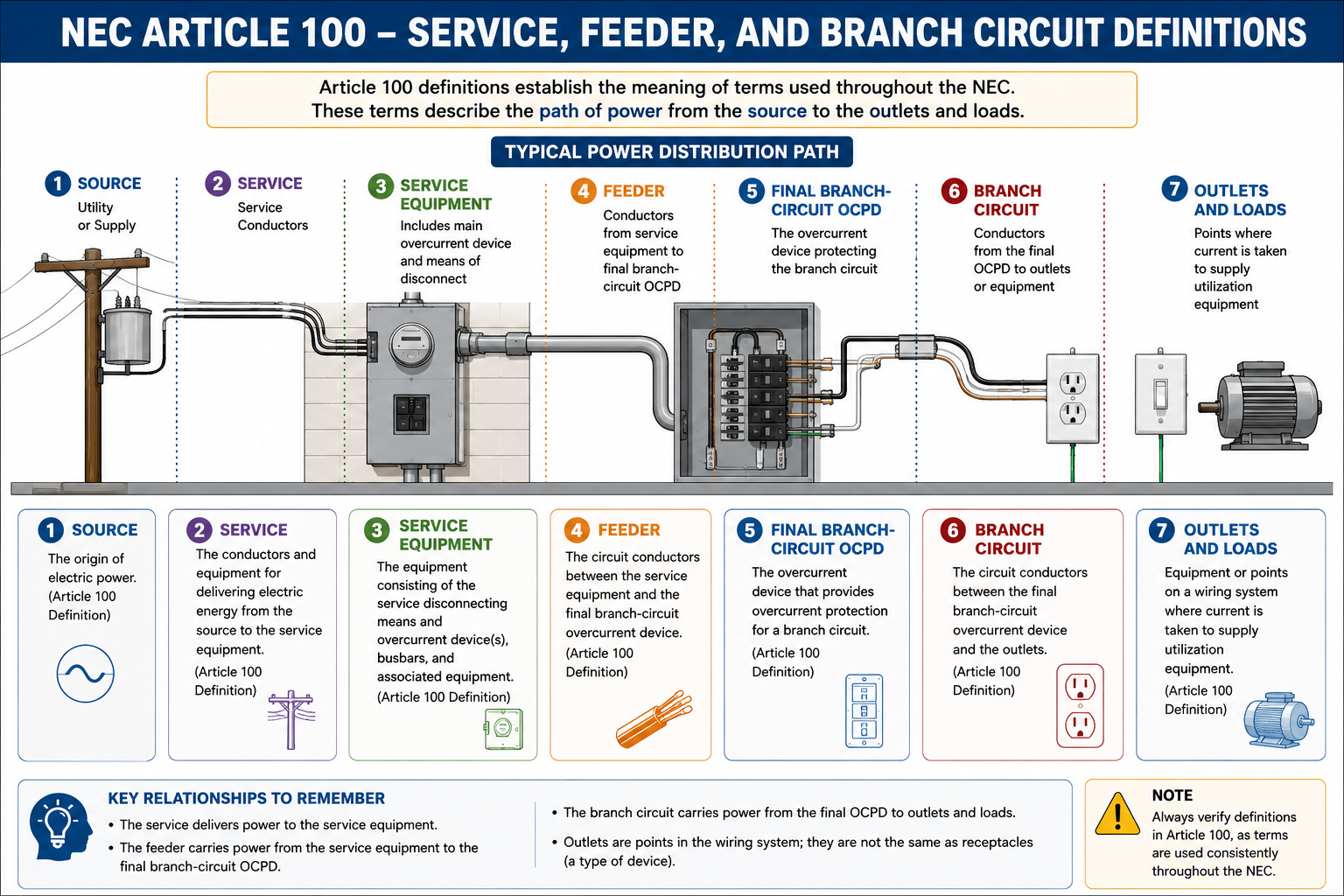
Three of the most important definitions describe the path electrical power takes through a typical premises wiring system. Understanding where the service ends, where a feeder exists, and where a branch circuit begins is fundamental to applying many NEC requirements.
The Connection Between the Serving Source and Premises Wiring
The service is associated with delivering electrical energy from the serving source to the premises wiring system. Several related Article 100 terms identify specific portions of this connection, including service conductors, service equipment, service point, service drop, and service lateral.
On an examination, do not treat all conductors ahead of a panelboard as feeders. Conductors associated with the service have different definitions and are governed by different NEC requirements.
Service Point
The service point identifies the connection between the facilities of the serving utility and the premises wiring. It is an important boundary for determining responsibility and applying service requirements.
Service Conductors
Service conductors are associated with the conductors extending from the service point toward the service equipment. Specific terms distinguish overhead and underground arrangements.
Service Equipment
Service equipment contains the principal means for controlling and disconnecting the electrical supply to the premises wiring system.
Service Is Not a Feeder
The service portion of the system must be identified separately. Feeder requirements generally begin on the load side of the applicable source or service equipment.
Conductors Supplying the Final Branch-Circuit Overcurrent Device
A feeder consists of the circuit conductors between the service equipment, the source of a separately derived system, or another power supply source and the final branch-circuit overcurrent device.
A feeder can supply a panelboard, distribution panel, motor control center, transformer-related distribution equipment, or another point from which branch circuits originate. The critical concept is that the feeder terminates at the final overcurrent protective device protecting the branch circuit.
Exam clue: When conductors supply another panelboard that contains branch-circuit breakers, those conductors are commonly functioning as a feeder rather than as a branch circuit.
From the Final Overcurrent Device to the Outlets
A branch circuit consists of the circuit conductors between the final overcurrent device protecting the circuit and the outlets supplied by that circuit.
The word final is important. A distribution system can contain multiple overcurrent devices, but the branch circuit begins after the final overcurrent device providing protection for that circuit.
Panelboard to Receptacles
A circuit breaker in a panelboard supplying receptacle outlets is a common example of the final branch-circuit overcurrent device.
Panelboard to Lighting
Conductors from the final breaker to lighting outlets are branch-circuit conductors.
Dedicated Equipment Circuit
A circuit supplying a single piece of utilization equipment can also be a branch circuit when it extends from the final overcurrent device to the outlet supplying that equipment.
Not Every Downstream Conductor Is a Feeder
Once the final branch-circuit overcurrent device has been reached, conductors leaving that device are part of the branch circuit rather than the feeder.
Recognize the System Boundaries
Source or Utility
Electrical energy originates at the serving source and is delivered toward the premises wiring system.
Service
The service connects the serving source to the premises electrical system and reaches the service equipment.
Service Equipment
The main service disconnecting and controlling equipment establishes an important system boundary.
Feeder
Feeders carry power from the service equipment or another qualifying source toward the final branch-circuit overcurrent devices.
Final Branch-Circuit Overcurrent Device
The final breaker or fuse protecting the branch circuit establishes the transition between the feeder side and the branch circuit.
Branch Circuit
Branch-circuit conductors extend from the final overcurrent device toward the outlets and utilization equipment supplied by the circuit.
Outlet, Receptacle, Device, and Equipment
Another group of frequently confused definitions involves the components and connection points found throughout electrical installations. In everyday speech, electricians may refer to a wall receptacle as an outlet, but the NEC definition of outlet is broader than a receptacle.
An Outlet Is a Point in the Wiring System
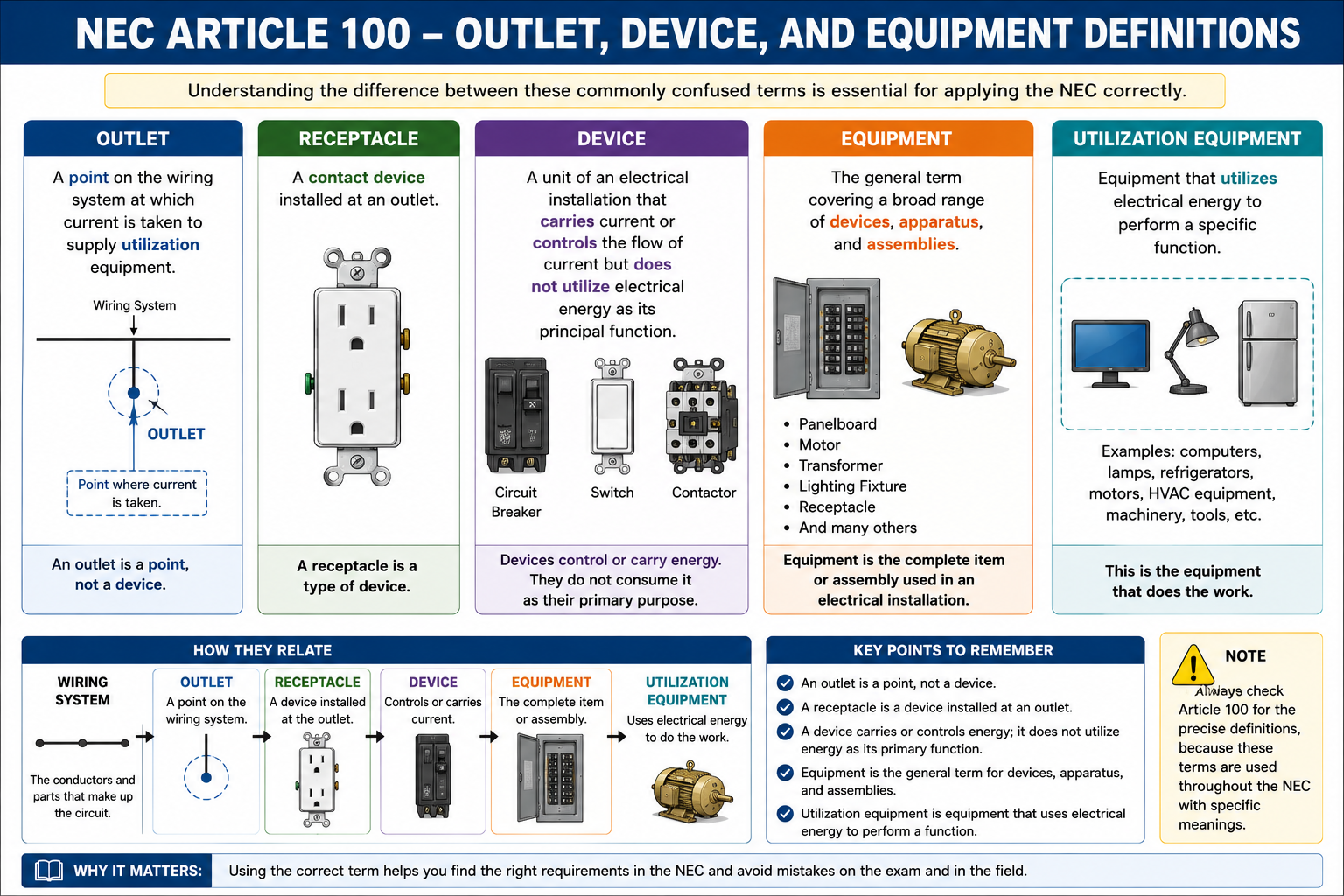
An outlet is a point in the wiring system where current is taken to supply utilization equipment. The definition describes a location or point in the electrical wiring system rather than one particular type of device.
This distinction is important because a receptacle outlet is only one example. Lighting outlets and other points where electrical energy is taken to supply utilization equipment can also meet the definition of an outlet.
Outlet Does Not Mean Receptacle
In ordinary conversation, the words outlet and receptacle are often used as though they mean the same thing. In NEC terminology they do not.
An outlet is the point in the wiring system where current is taken to supply utilization equipment. A receptacle is a contact device installed at an outlet for connection of an attachment plug.
A Contact Device Installed at an Outlet
A receptacle provides contacts for connecting an attachment plug. It is installed at an outlet, but the receptacle itself should not be confused with the broader definition of the outlet.
Single Receptacle
A single receptacle contains one contact device on the yoke.
Multiple Receptacle
A multiple receptacle contains two or more contact devices on the same yoke. A common duplex receptacle is therefore a multiple receptacle.
Receptacle Outlet
A receptacle outlet is an outlet where one or more receptacles are installed.
Not Every Outlet Has a Receptacle
An outlet can supply utilization equipment through another type of connection rather than through an attachment-plug receptacle.
A Component That Carries or Controls Electrical Energy
The NEC uses the term device for a unit of an electrical system whose principal function involves carrying or controlling electrical energy rather than using that energy to perform the ultimate work of the connected load.
Switches and similar control components are common examples. The distinction becomes useful when a requirement applies specifically to devices rather than to utilization equipment or to electrical equipment generally.
A Broad Electrical Term
Equipment is a broad term covering materials, fittings, devices, appliances, fixtures, apparatus, and similar items used as part of or in connection with an electrical installation.
Because the term is broad, a Code rule applying to equipment can cover many different electrical products. Do not interpret the word as referring only to large machinery or major electrical assemblies.
Equipment That Uses Electrical Energy
Utilization equipment uses electrical energy for an electronic, electromechanical, chemical, heating, lighting, or similar useful purpose. Motors, heaters, luminaires, appliances, and many other loads are examples of equipment whose function is to use electrical energy.
This provides an important contrast with the definition of a device. A switching device can control electrical energy, while utilization equipment consumes or converts electrical energy to perform its intended function.
Approved, Listed, Labeled, and Identified
NEC questions frequently use terms related to equipment suitability and approval. These words should not be treated as interchangeable because each communicates a different concept.
Approved
Approved means acceptable to the authority having jurisdiction. Approval therefore involves the AHJ rather than merely the opinion of the installer.
Listed
Listed equipment has been included in a published list by an organization acceptable to the authority having jurisdiction and has been evaluated for specified use or safety criteria.
Labeled
Labeled equipment bears a label, symbol, or other identifying mark from an organization that evaluates the equipment and maintains applicable follow-up control over production.
Identified
Identified equipment has been recognized as suitable for a particular purpose, function, use, environment, or application where the Code requires that suitability.
Listed Does Not Automatically Mean Suitable for Every Use
A product can be listed and still be unsuitable for a particular environment or application. The listing, labeling, equipment markings, installation instructions, and specific NEC requirements must all be considered when determining whether the equipment is suitable for the installation.
This principle leads directly into Article 110, which requires equipment to be installed and used according to applicable listing and labeling instructions and establishes other general installation requirements.
Accessible and Readily Accessible Are Not the Same
The NEC uses several forms of the word accessible. Pay close attention to the exact term because a requirement for equipment to be accessible is not necessarily the same as a requirement that it be readily accessible.
Readily accessible generally means that the item can be reached quickly for operation, inspection, or service without requiring a person to climb over or remove obstacles or resort to portable ladders, chairs, or similar means.
Whenever an exam question uses the phrase readily accessible, treat it as a defined term rather than as casual wording.
Terms Worth Recognizing Quickly
Article 100 contains many definitions, and attempting to memorize every one is not an efficient examination strategy. However, several frequently used terms are worth recognizing because they appear throughout the Code.
Authority Having Jurisdiction
The organization, office, or individual responsible for enforcing Code requirements or approving equipment, materials, installations, or procedures.
Disconnecting Means
A device, group of devices, or other means by which circuit conductors can be disconnected from their source of supply.
Enclosure
A case, housing, fence, or surrounding structure used to prevent accidental contact with energized parts or to protect equipment from physical damage.
Exposed
The exact meaning depends on whether the term is being applied to live parts or to wiring methods. Read the applicable definition carefully.
Grounded
Connected to ground or to a conductive body that extends the ground connection.
Qualified Person
A person whose skills and knowledge related to electrical equipment and installations, together with applicable safety training, qualify that person for the task described by the applicable requirements.
Use Article 100 as Part of the Question-Solving Process
When the wording of an exam question depends on a Code term, the fastest approach is often to verify the definition before searching for the detailed installation rule.
Identify the Important Term
Look for a word in the question that appears to establish a system boundary, equipment classification, accessibility requirement, or approval condition.
Check Article 100
Confirm whether the term has a specific NEC definition and read the complete applicable definition.
Apply the Definition to the Question
Determine how the defined term changes the way the installation should be classified or analyzed.
Locate the Governing Requirement
Use the correct terminology to locate the article and section containing the installation requirement.
Read the Requirement in Context
Apply the Article 100 definition together with the actual requirement, including any conditions, exceptions, tables, and cross-references.
Feeder or Branch Circuit?
Suppose a 200-amp service panel supplies a 100-amp panelboard located elsewhere in the building. The 100-amp panelboard contains the breakers that supply lighting and receptacle circuits.
The conductors between the service equipment and the 100-amp panelboard are feeder conductors because they supply the final branch-circuit overcurrent devices located in that panelboard. The conductors leaving those final breakers and supplying the lighting and receptacle outlets are branch-circuit conductors.
Exam technique: When you are unsure whether conductors are service, feeder, or branch-circuit conductors, locate the service equipment and then locate the final branch-circuit overcurrent device. Those two points usually reveal the applicable system boundaries.
Outlet or Receptacle?
A wall-mounted duplex receptacle is installed at an outlet. The outlet is the point in the wiring system where current is taken to supply utilization equipment, while the receptacle is the contact device installed at that outlet for connection of an attachment plug.
A lighting outlet can therefore be an outlet even though no receptacle is installed there. This is exactly the type of terminology distinction that can change the answer to an NEC examination question.
Do Not Memorize Article 100 From Beginning to End
The objective is not to memorize every definition. Instead, become familiar with the definitions that repeatedly affect electrical calculations, wiring methods, equipment installations, grounding and bonding, services, feeders, branch circuits, motors, transformers, and general Code requirements.
During practice exams, whenever a definition causes you to miss or hesitate on a question, mark that term in your reference book and add it to your review list. Over time, the definitions most relevant to the examination will become familiar through repeated use.
Test Your Article 100 Knowledge
Where does a branch circuit begin?
Answer: At the load side of the final overcurrent device protecting that branch circuit.
Where does a branch circuit extend?
Answer: From the final branch-circuit overcurrent device to the outlets supplied by the circuit.
Are conductors between service equipment and a downstream panelboard containing branch-circuit breakers normally feeders?
Answer: Yes. They are supplying the final branch-circuit overcurrent devices located in the downstream panelboard.
Is an outlet the same thing as a receptacle?
Answer: No. An outlet is a point in the wiring system where current is taken to supply utilization equipment. A receptacle is a contact device installed at an outlet.
Who determines whether equipment is approved?
Answer: Approval means acceptable to the authority having jurisdiction.
Does listed equipment automatically qualify for every possible environment or application?
Answer: No. The equipment must be suitable for the particular purpose, environment, and application and must be installed according to applicable Code requirements and listing or labeling information.
Why is the term readily accessible important?
Answer: It is a defined term establishing a higher level of accessibility than simply being capable of access. A person should be able to reach the item quickly without overcoming obstacles or using portable access equipment.
What should you do when an exam question appears to depend on the exact meaning of a Code term?
Answer: Check Article 100 and apply the defined meaning before selecting the applicable requirement or answer.
What You Should Take From This Lesson
Article 100 Establishes NEC Terminology
Defined terms provide consistent meanings that must be used when interpreting Code requirements.
Know the Major System Boundaries
Service, feeder, and branch-circuit definitions help establish where different NEC requirements apply within the electrical distribution system.
Outlet and Receptacle Are Different
An outlet is a point in the wiring system. A receptacle is a contact device that can be installed at an outlet.
Equipment Is a Broad Term
The NEC definition includes many materials, devices, appliances, fixtures, fittings, and apparatus associated with an electrical installation.
Approval Terms Have Different Meanings
Approved, listed, labeled, and identified describe different aspects of equipment acceptance and suitability.
Definitions Are an Exam Tool
When terminology controls the answer, confirming the Article 100 definition can be faster and more reliable than trying to resolve the question from memory.
Leave a Reply
You must be logged in to post a comment.