Back to: NASCLA Master Electrical Contractor Exam Preparation
Article 90 is the introduction to the National Electrical Code and establishes the framework for understanding how the NEC is intended to be used. It addresses the purpose and scope of the Code, explains how the Code is arranged, and establishes important principles concerning enforcement and application.
For the NASCLA Electrical Contractor examination, Article 90 is important for more than memorizing a few introductory rules. It helps you determine whether an installation falls within the scope of the NEC and provides the organizational principles needed to correctly apply requirements found throughout the rest of the Code.
Understanding the Foundation of the NEC
Article 90 explains what the NEC is intended to accomplish, the types of electrical installations it covers, installations that are outside its scope, how its requirements are arranged, and how the Code is interpreted and enforced.
These principles matter whenever you encounter an NEC question. Before applying a detailed requirement, you must first understand whether the NEC applies and how that requirement fits within the overall structure of the Code.
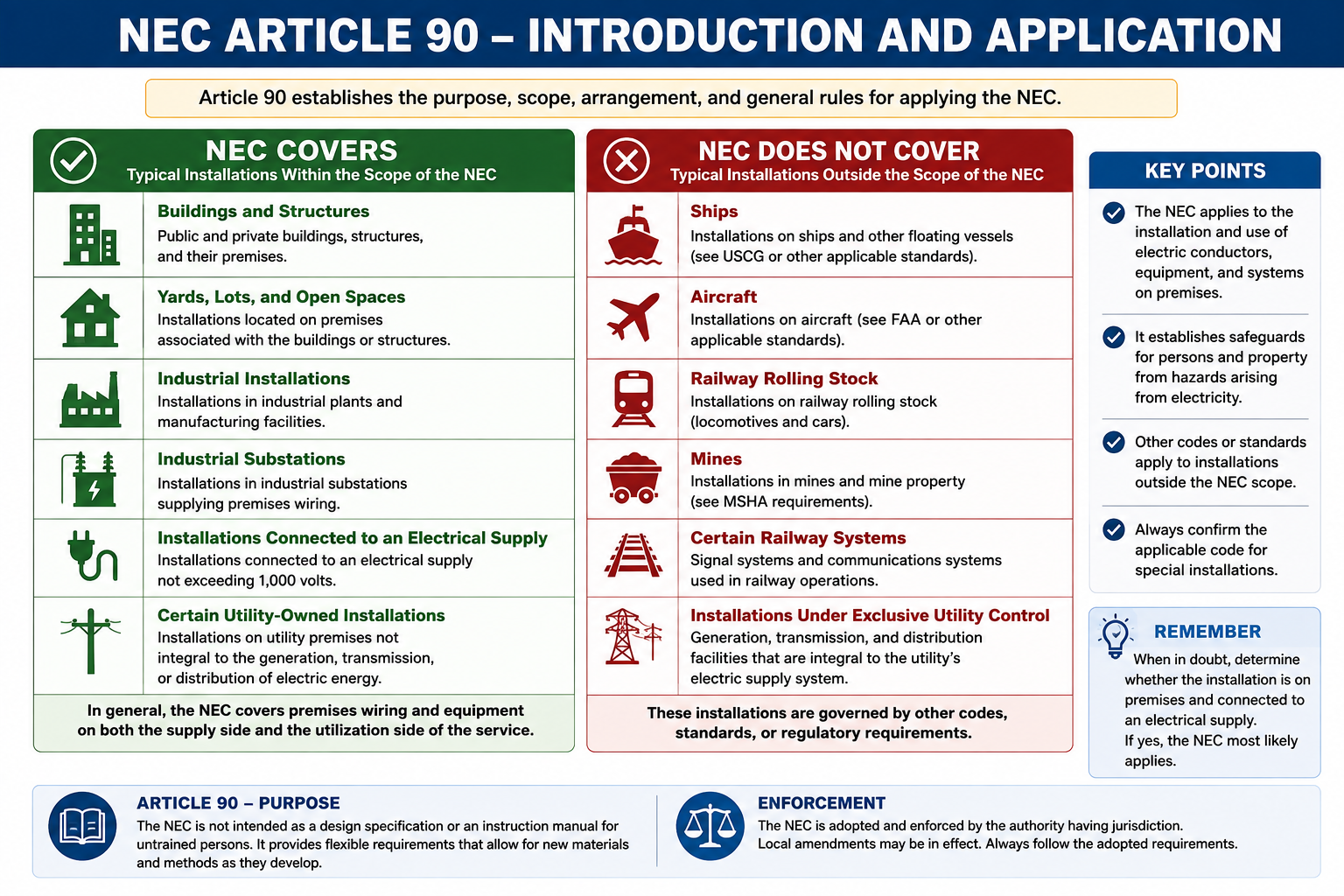
What Article 90 Establishes
Article 90 serves as the introduction to the NEC. Instead of providing detailed installation requirements for one particular type of equipment, it establishes the principles that govern the Code as a whole.
Purpose
Explains the fundamental safety objective of the NEC and the limits of what compliance with the Code is intended to accomplish.
Scope
Identifies the electrical installations and systems generally covered by the NEC and identifies specific installations that are outside its scope.
Arrangement
Explains how the NEC is organized and how general requirements interact with requirements for particular occupancies, equipment, conditions, and systems.
Enforcement
Establishes the role of the authority having jurisdiction in interpreting requirements, approving equipment and materials, and enforcing the Code.
Mandatory Requirements
Provides guidance for recognizing Code language that establishes mandatory requirements and permitted alternatives.
Explanatory Material
Distinguishes mandatory Code requirements from informational material intended to provide explanation or guidance.
Practical Safeguarding
The fundamental purpose of the NEC is practical safeguarding of persons and property from hazards arising from the use of electricity. This concept is important because it explains why Code requirements exist.
The NEC establishes minimum safety requirements. Compliance is intended to produce an installation that is essentially free from electrical hazards when the installation is properly maintained and used.
The NEC Is a Safety Code
The NEC is not intended to function primarily as a design manual or an instruction manual for untrained persons. An installation can satisfy minimum Code requirements without necessarily representing the most efficient, convenient, expandable, or economical design.
This distinction can matter on an examination. When a question asks for the minimum requirement permitted by the NEC, do not automatically substitute a preferred design practice for the actual Code requirement.
Minimum Requirements and Future Expansion
The NEC recognizes that an installation designed only to minimum requirements may not necessarily provide adequate capacity or convenience for future electrical use. Electrical systems can become overloaded through later additions even though the original installation complied with the Code when constructed.
Contractors often design beyond minimum requirements by installing additional circuits, larger raceways, spare capacity, additional panel spaces, or larger conductors where appropriate. These design decisions can improve an installation but should be distinguished from the minimum requirements established by the NEC.
Installations Generally Covered by the NEC
The NEC applies broadly to electrical conductors, equipment, raceways, signaling and communications conductors and equipment, and related installations on or associated with premises within its scope.
Buildings and Structures
Electrical installations in and on public and private buildings and structures are among the principal installations covered by the NEC.
Premises and Property
Coverage can extend to yards, lots, parking areas, and other portions of premises associated with electrical installations.
Mobile and Similar Installations
Specified installations involving mobile homes, recreational vehicles, floating buildings, and similar applications are addressed by the NEC.
Industrial Substations
Industrial substations and associated electrical installations can fall within the scope of the NEC.
Supply Connections
Conductors and equipment connecting covered premises installations to a supply of electricity can fall within NEC scope according to the applicable boundaries and requirements.
Other Outside Conductors
Outside conductors and equipment located on premises can also fall within NEC scope even when they are not located inside a building.
Installations the NEC Generally Does Not Cover
Article 90 also identifies installations that are generally outside the scope of the NEC. These exclusions are important because an electrical installation is not automatically governed by the NEC merely because electricity is involved.
Ships and Watercraft
Certain electrical installations in ships and watercraft are outside NEC scope. Floating buildings are treated differently and should not be automatically grouped with ordinary vessels.
Aircraft
Electrical installations associated with aircraft are generally outside the scope of the NEC.
Railway Rolling Stock
Electrical installations associated with railway rolling stock and certain railway systems are excluded under the conditions established by Article 90.
Underground Mines
Installations underground in mines and certain mining-related electrical installations are outside NEC scope.
Certain Railway Installations
Specific railway installations involving generation, transformation, transmission, energy storage, or distribution used exclusively for railway purposes can fall outside NEC scope.
Certain Utility Installations
Qualifying installations under the exclusive control of an electric utility can be outside NEC scope when they meet the conditions established by Article 90.
Do Not Assume All Utility-Owned Wiring Is Excluded
The utility exclusion is conditional. Ownership by an electric utility does not by itself mean that every installation owned by that utility is outside NEC jurisdiction.
When a question involves utility equipment or conductors, determine the location, function, and control of the installation before deciding whether the NEC applies.
Use a Systematic Process
Scope questions become easier when you evaluate the installation rather than trying to memorize a list of isolated exceptions.
Identify the Installation
Determine what conductors, equipment, structure, system, or premises the question describes.
Identify the Location
Determine whether the installation is associated with a building, premises, utility facility, mine, railway, vessel, aircraft, or another specialized environment.
Determine Who Controls It
Control and function can be especially important when determining whether a utility-related installation qualifies for an exclusion.
Check Article 90
Compare the installation with the covered and excluded installations described in the NEC scope provisions.
Apply the Appropriate Requirements
If the installation is within NEC scope, continue to the articles and sections governing the particular electrical installation.
How General and Specific Requirements Work Together
Article 90 explains the organizational relationship between different portions of the NEC. This arrangement is important because a specialized article does not necessarily replace all of the generally applicable requirements found earlier in the Code.
Chapters 1–4
Contain requirements that apply generally to electrical installations.
Chapters 5–7
Address special occupancies, special equipment, and special conditions and can supplement or modify the general requirements.
Chapter 8
Addresses communications systems and has a special relationship to the requirements in the other chapters as established by the Code arrangement rules.
Chapter 9
Contains tables that are applicable when referenced by the Code.
A Specific Article Does Not Always Stand Alone
Suppose an examination question involves electrical equipment installed in a hazardous location. The requirements for the particular hazardous location can modify or supplement generally applicable requirements for conductors, raceways, grounding, equipment, and installation methods.
Finding the special-occupancy requirement therefore may not complete the lookup. You may need to follow references back to generally applicable requirements or to another article before determining the complete answer.
The Authority Having Jurisdiction
Article 90 establishes an important role for the authority having jurisdiction, commonly abbreviated AHJ. The AHJ has responsibility for interpreting requirements, approving equipment and materials, and enforcing the Code within its jurisdiction.
Depending on the location and type of project, the AHJ might be a state electrical authority, municipal building department, electrical inspector, fire authority, or another organization legally responsible for enforcing applicable electrical requirements.
Approval Is an Enforcement Concept
Throughout the NEC you will encounter words such as approved, identified, listed, and labeled. These terms have specific meanings and should not be treated as interchangeable.
Article 90 establishes the enforcement framework, while Article 100 provides definitions for many of these terms. Understanding those definitions will be the focus of Lesson 21.
Recognize Mandatory and Permissive Language
Exam questions frequently depend on the exact wording of a requirement. Pay attention to the verbs used in the Code rather than relying only on your general understanding of the subject.
“Shall”
Indicates a mandatory requirement. When the Code states that something shall be done, compliance is required unless another applicable provision provides an exception or alternative.
“Shall Not”
Indicates a prohibition. The described practice is not permitted unless another applicable Code provision establishes an exception.
“Permitted”
Identifies an allowed method, condition, or alternative rather than an action that must always be performed.
Informational Material
Informational notes and informative annex material provide explanation and assistance but are not themselves mandatory requirements.
Watch for Exceptions and Conditions
Finding the correct section is only part of answering a Code question. A requirement can contain exceptions, conditions, limitations, references to other sections, and references to tables that change how the rule applies.
When you locate a promising section, read the complete applicable provision before selecting an answer. Stopping after the first sentence that appears to match the question is a common source of open-book examination errors.
Recognize Article 90 Questions Quickly
Questions involving the purpose of the NEC, installations covered or excluded by the Code, the authority having jurisdiction, Code arrangement, mandatory language, or general application principles should immediately suggest Article 90.
Purpose?
Think Article 90.
Scope?
Think Article 90.
Code Arrangement?
Think Article 90.
AHJ?
Think Article 90 and Article 100.
Exam technique: Recognizing the subject before opening the book dramatically reduces lookup time. Article recognition is more useful than trying to memorize page numbers.
Test Your Article 90 Knowledge
What is the fundamental purpose of the NEC?
Answer: Practical safeguarding of persons and property from hazards arising from the use of electricity.
Is the NEC primarily intended to serve as an electrical design manual?
Answer: No. It is fundamentally a safety code establishing minimum requirements rather than a complete design specification.
Does ownership by an electric utility automatically place an electrical installation outside NEC scope?
Answer: No. The utility exclusion applies only when the installation satisfies the conditions established by the scope provisions.
Are underground mine installations generally within NEC scope?
Answer: No. Underground mine installations are among the installations generally excluded from NEC scope.
What is the relationship between Chapters 1–4 and Chapters 5–7?
Answer: Chapters 1–4 contain requirements that apply generally, while Chapters 5–7 can supplement or modify those general requirements for particular occupancies, equipment, and conditions.
Does an informational note establish a mandatory Code requirement?
Answer: No. Informational notes provide explanatory information and are not themselves mandatory requirements.
Who is responsible for interpretation, approval, and enforcement of the NEC within a jurisdiction?
Answer: The authority having jurisdiction, or AHJ.
What You Should Take From This Lesson
Article 90 Establishes the Framework
It introduces the NEC’s purpose, scope, arrangement, enforcement principles, and application.
The NEC Establishes Minimum Safety Requirements
Code compliance should not automatically be confused with optimum electrical system design or provision for future expansion.
Scope Has Boundaries
The NEC applies broadly to premises electrical installations but specifically excludes certain installations such as aircraft, underground mines, portions of railway systems, and qualifying utility-controlled installations.
General and Specific Requirements Work Together
Requirements for special occupancies, equipment, and conditions can supplement or modify requirements that apply generally.
The AHJ Plays an Essential Role
The authority having jurisdiction interprets and enforces applicable requirements and determines approval within the jurisdiction.
Read the Complete Requirement
Mandatory language, exceptions, conditions, cross-references, and informational material must be distinguished when answering Code questions.
Leave a Reply
You must be logged in to post a comment.