Back to: NASCLA Master Electrical Contractor Exam Preparation
The National Electrical Code contains a large amount of information, but it is not a random collection of electrical rules. The NEC follows an organized structure that allows contractors, electricians, inspectors, designers, and examination candidates to move from broad subjects to increasingly specific requirements.
For the NASCLA Electrical Contractor examination, understanding this structure is an important reference-navigation skill. Instead of attempting to memorize thousands of individual requirements, learn where different types of requirements are located and how chapters, articles, parts, sections, tables, and other Code elements relate to one another.
Learn the Structure Before Searching for the Rule
Efficient NEC navigation begins with understanding how the Code is assembled. A broad electrical subject is normally associated with a chapter and article. Within an article, the requirements can be divided into parts, sections, and additional subdivisions that progressively narrow the subject.
The NEC also contains tables, informational notes, figures, cross-references, and informative annexes that help organize or support the application of Code requirements. Understanding the role of each element makes it easier to determine where to begin a lookup and how far to continue before selecting an answer.
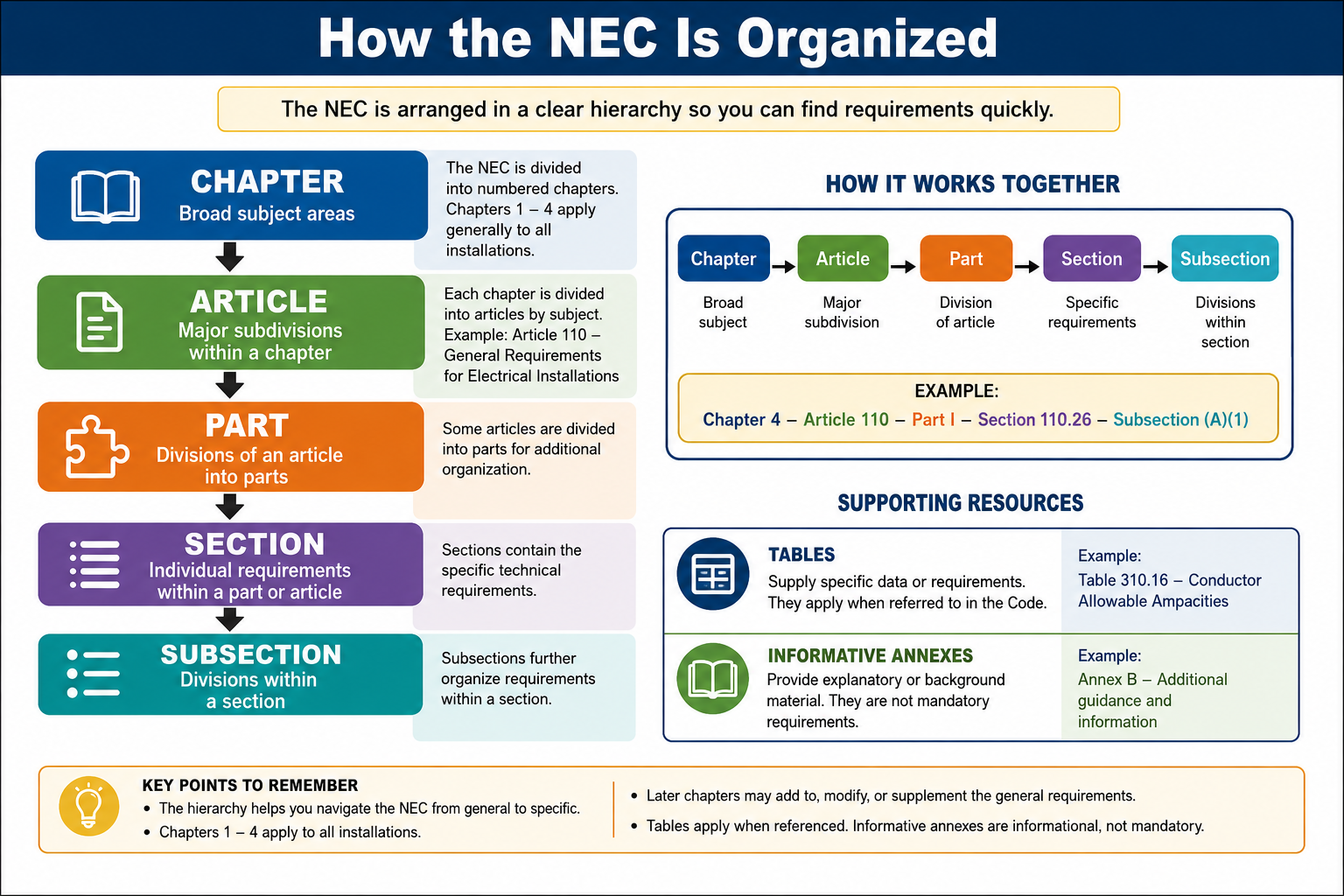
The NEC Uses a Hierarchy
The NEC moves from broad categories toward increasingly specific requirements. Learning this hierarchy makes Code references such as 110.26, 250.122, or 430.52 much easier to understand because the numbers themselves indicate where the requirement is located.
Chapter
A chapter groups major categories of electrical requirements. Examples include general requirements, wiring and protection, wiring methods and materials, and equipment.
Article
An article addresses a particular electrical subject within the broader chapter. Article numbers provide one of the most useful navigation landmarks in the NEC.
Part
Longer articles can be divided into parts that organize related requirements into manageable subject groups.
Section
A section contains a specific Code requirement or group of closely related requirements. Section numbers are the references commonly cited when applying the NEC.
Subdivisions
Sections can be divided further using letters, numbers, and additional levels of organization. These subdivisions identify the exact portion of a requirement that applies.
Supporting Material
Tables, figures, informational notes, cross-references, and informative annexes can provide values, explanations, references, or other information needed to apply a requirement correctly.
Start With the Major NEC Subjects
The NEC is organized into an introduction and nine chapters. The chapter structure provides a useful mental map because different types of electrical questions tend to lead toward particular portions of the Code.
Chapter 1 — General
Contains requirements and concepts that apply broadly to electrical installations, including definitions and general installation requirements.
Chapter 2 — Wiring and Protection
Contains major requirements involving branch circuits, feeders, services, overcurrent protection, grounding, bonding, and related wiring and protection subjects.
Chapter 3 — Wiring Methods and Materials
Addresses conductors, raceways, cables, boxes, enclosures, and the wiring methods used to construct electrical installations.
Chapter 4 — Equipment
Addresses equipment used throughout electrical systems, including flexible cords, switches, receptacles, panelboards, transformers, motors, and other equipment categories.
Chapters 5–7
Address requirements associated with particular occupancies, equipment, conditions, and systems. These requirements can supplement or modify requirements that apply generally.
Chapter 8
Addresses communications systems. Its relationship to other NEC chapters must be determined according to the applicable edition and the Code arrangement rules.
Chapter 9 — Tables
Contains tables used when referenced by applicable Code requirements. These tables provide information such as conductor and raceway characteristics used in electrical calculations and installations.
Informative Annexes
Provide supplemental information, examples, calculations, and reference material. Informative annexes are not mandatory NEC requirements unless material is made applicable through another requirement.
General Requirements Come Before Specific Applications
A requirement found in a later chapter does not necessarily stand by itself. General requirements can continue to apply unless a more specific requirement supplements or modifies them.
This is why NEC questions sometimes require more than one lookup. A candidate may begin with an equipment article and then need to check a general requirement, definition, conductor rule, overcurrent-protection requirement, or another referenced section before the complete answer is known.
Articles Narrow the Subject
Article numbers are among the most useful landmarks in the NEC. Once you recognize the article associated with a subject, the amount of Code material that must be searched becomes much smaller.
Identify the General Subject
Determine whether the question concerns services, feeders, branch circuits, grounding, wiring methods, motors, transformers, special occupancies, or another recognizable electrical subject.
Identify the Article
Use your familiarity with the Code, the table of contents, or the index to locate the article associated with that subject.
Use the Article Structure
Look at the article’s parts and section headings to narrow the search to the particular requirement described by the question.
Read the Complete Requirement
Read enough surrounding material to understand the conditions, exceptions, references, and limitations associated with the section.
Understand What the Numbers Tell You
Consider a reference such as 110.26. The first portion identifies Article 110, while the number following the decimal identifies Section 26 within that article. Additional letters and numbers can identify progressively more specific subdivisions of the section.
110
Identifies the article. Article 110 contains general requirements for electrical installations.
.26
Identifies the section within Article 110 associated with spaces about electrical equipment.
(A)
A capital letter commonly identifies the next subdivision of the section.
(1)
A number in parentheses can narrow the reference to another level within the requirement.
Navigation point: Do not treat a subsection as an isolated sentence. Read its parent section and surrounding provisions when necessary to understand when and how the requirement applies.
Later Requirements Can Supplement or Modify Earlier Requirements
One of the most important organizational concepts is the relationship between generally applicable requirements and requirements addressing more specific installations. The Code arrangement establishes the framework for determining how these rules interact.
Begin With the Installation
Identify exactly what is being installed and where it is being installed.
Apply General Requirements
Determine which generally applicable requirements govern the conductors, wiring methods, equipment, protection, grounding, and installation.
Check for Specific Requirements
Determine whether the occupancy, equipment, condition, or system has additional requirements elsewhere in the NEC.
Apply the Complete Set of Rules
Use the specific provisions together with the applicable general provisions, recognizing where the Code specifically supplements or modifies another requirement.
Know What Role the Supporting Material Plays
NEC questions frequently require the use of tables. A section can establish the rule and then direct the user to a table containing the numerical values needed to apply that rule.
Tables Within Articles
Many articles contain tables directly associated with their requirements. Always read the table title, headings, notes, and the section that directs you to the table.
Chapter 9 Tables
Chapter 9 contains technical tables that apply when referenced. These are commonly used for raceway, conductor, and electrical calculation information.
Figures and Diagrams
Figures can illustrate concepts and arrangements, but their regulatory significance depends on how they are incorporated and referenced by the Code.
Informational Notes
Informational notes provide explanatory or reference information and are not themselves mandatory requirements.
Useful Information Is Not Always Mandatory Code Text
The NEC includes informative annexes that provide supporting information such as examples, calculations, references, and explanatory material. They can be extremely useful when learning or applying electrical concepts.
However, informative annexes are identified as informational rather than mandatory requirements of the NEC. On an exam, distinguish between a requirement contained in enforceable Code text and supporting material intended to help explain or apply the Code.
Search by Subject, Not by Page Number
A page number is useful only for the particular edition and printing in front of you. Article numbers, subject relationships, definitions, and Code structure provide a much more reliable navigation system.
When practicing, train yourself to think in subjects: motor question — think Article 430; transformer question — think Article 450; service question — think Article 230. You can then use the table of contents or index to confirm the location and narrow the search to the applicable section.
Knowing Where to Look Is Different From Knowing the Answer
The NASCLA Electrical Contractor examination is open book, but access to reference material does not eliminate the need to understand the Code’s organization. Searching without knowing the likely subject area can consume valuable examination time.
A strong candidate develops enough familiarity with the NEC to identify the likely chapter or article first and then uses the book to confirm the exact requirement. The objective is not complete memorization. The objective is efficient, accurate retrieval.
Test Your NEC Organization Skills
What organizational level normally contains a broad electrical subject such as motors or transformers?
Answer: An article. For example, motors are primarily addressed by Article 430 and transformers by Article 450.
What does the reference 110.26 identify?
Answer: Section 26 within Article 110.
Do Chapter 9 tables automatically apply to every electrical installation?
Answer: No. Chapter 9 tables are applicable as referenced by the Code.
Are informative annexes mandatory NEC requirements?
Answer: No. Informative annexes are provided for informational purposes rather than as mandatory Code requirements.
Why should you read surrounding Code text instead of stopping when you find one matching sentence?
Answer: The complete requirement can include conditions, exceptions, subdivisions, tables, or cross-references that affect how the rule applies.
If you do not know the article number for a subject, what reference tools can help you locate it?
Answer: The NEC table of contents and index are primary navigation tools for locating an unfamiliar subject.
What You Should Take From This Lesson
The NEC Has a Predictable Structure
Chapters establish broad categories, articles address particular subjects, and parts and sections progressively narrow the requirements.
General and Specific Requirements Work Together
Later requirements can supplement or modify generally applicable requirements, so some questions require navigation through more than one Code location.
Tables Must Be Used in Context
Read the section directing you to a table and pay attention to the table title, headings, conditions, and notes.
Informative Material Is Different From Mandatory Requirements
Informational notes and informative annexes can help explain the Code but should not be confused with mandatory Code requirements.
Navigation Is an Exam Skill
Learn electrical subjects and their likely Code locations so the open-book format becomes an advantage rather than a time-consuming search exercise.
Leave a Reply
You must be logged in to post a comment.