Back to: NASCLA Master Electrical Contractor Exam Preparation
Electrical load calculations are used to determine the electrical demand that branch circuits, feeders, and services must be capable of supplying. These calculations require more than simply adding every connected load. The applicable NEC rules determine which loads are included, how they are calculated, and when demand factors, continuous-load provisions, or equipment-specific requirements apply.
This lesson introduces a systematic method for organizing load calculations and distinguishing connected load from calculated load. The goal is not to memorize every value in Article 220, but to recognize the type of load involved, locate the applicable requirement in the approved reference material, apply the correct calculation rule, and keep units and calculation steps organized.
Identify the Load Before Applying a Calculation Rule
A reliable load calculation begins by identifying each load and determining which NEC provision applies to it. General lighting, receptacles, appliances, heating and air-conditioning equipment, motors, and other loads do not necessarily receive identical treatment.
The calculation process therefore moves from identifying loads to determining their calculated values, applying any permitted demand or adjustment provisions, combining the applicable loads, and then using the result for the branch circuit, feeder, service, or other calculation being performed.
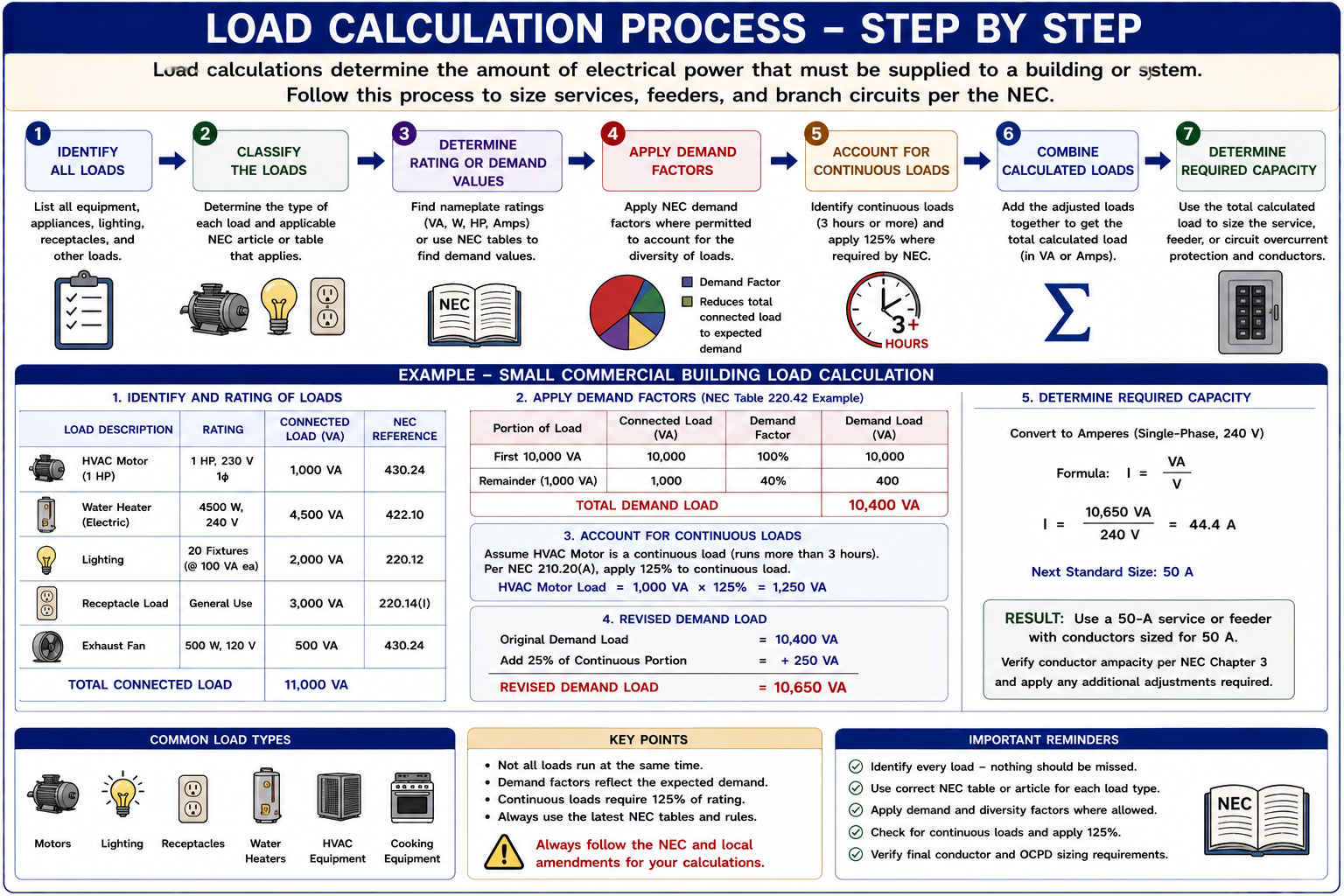
Branch-Circuit, Feeder, and Service Load Calculations
NEC Article 220 provides requirements for calculating branch-circuit, feeder, and service loads. The article is organized into calculation methods for different portions and types of electrical installations, while other NEC articles contain additional requirements for particular equipment and applications.
This means that Article 220 is an important starting point, but it is not always the only place that must be consulted. A motor load, air-conditioning load, heating load, or other specialized equipment can require reference to another applicable NEC article.
Exam strategy: Do not assume that every load-calculation question can be answered from one table or one section. Identify the equipment or occupancy first, then determine which Article 220 provision or other referenced article controls the calculation.
The Sum of Nameplate Loads Is Not Always the Final Answer
Connected load represents the loads physically connected to the electrical system. Calculated load is the value obtained after applying the calculation rules required or permitted by the NEC for the installation being evaluated.
Depending on the load and application, the calculated value may involve unit loads, demand factors, continuous-load treatment, noncoincident-load provisions, equipment-specific rules, or other calculation requirements.
Connected Load
The electrical load represented by the equipment, outlets, appliances, lighting, motors, or other utilization equipment connected to the system.
Calculated Load
The load value determined after applying the NEC calculation method applicable to the installation.
Demand Factor
A permitted demand factor can reduce the portion of a load included in a particular calculation when the applicable NEC provision allows it.
Equipment-Specific Rules
Some loads are calculated under requirements found in articles specifically addressing that equipment rather than solely from general Article 220 provisions.
Organize the Problem Before Using the Calculator
Identify the Installation
Determine whether the question involves a branch circuit, feeder, service, dwelling, commercial occupancy, motor load, HVAC equipment, or another specific application.
List Each Load
Write down the loads provided by the problem and keep their units clearly identified.
Classify the Loads
Determine the type of each load and whether special rules such as continuous-load treatment or equipment-specific calculations apply.
Locate the Applicable Rule
Use the approved NEC reference to locate the section, table, demand factor, or equipment article that governs the load.
Calculate Each Portion
Apply the applicable rule to each category before combining the values.
Combine the Applicable Loads
Add the calculated portions according to the applicable calculation method.
Convert to Current if Required
If the problem asks for amperes rather than volt-amperes, use the applicable single-phase or three-phase relationship after determining the calculated load.
Check the Result
Verify units, calculation factors, system voltage, phase, and whether the result answers the question actually asked.
Duration Can Change the Required Calculation
The NEC definition of a continuous load involves a load where the maximum current is expected to continue for three hours or more. When an applicable conductor or overcurrent-protection rule requires continuous loads to be included at 125%, that factor must be applied as directed by the governing Code provision.
Do not classify a load as continuous merely because equipment can remain energized for a long time. The expected maximum-current duration and the applicable Code requirements determine how the load is treated.
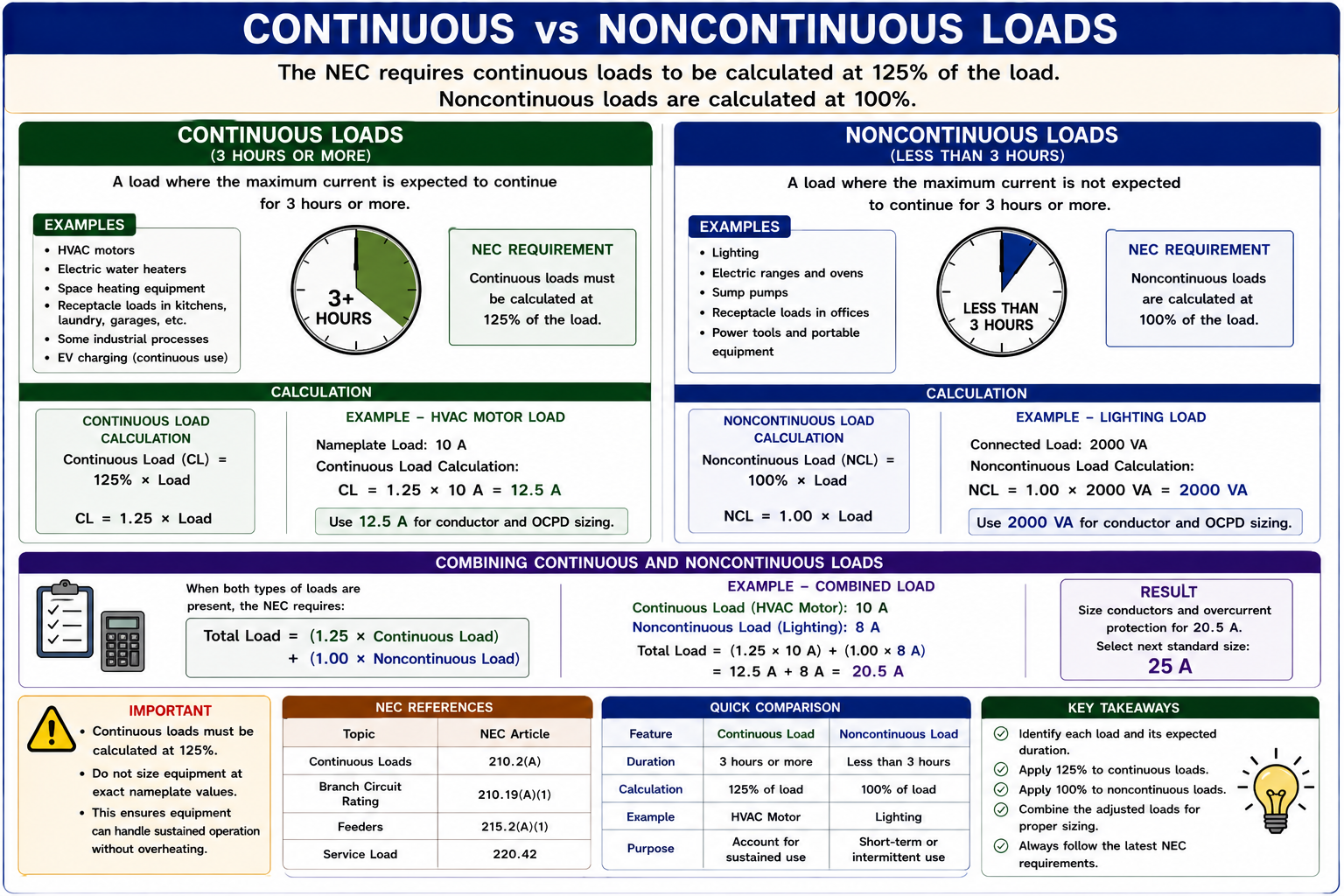
Continuous and Noncontinuous Portions
Where an applicable NEC rule requires the continuous portion to be calculated at 125%, a common calculation relationship is:
Calculated Load = Noncontinuous Load + (Continuous Load × 125%)
This relationship should be used only when the applicable Code provision requires that treatment. Always identify the governing requirement before applying the multiplier.
Continuous and Noncontinuous Load
Assume a calculation requires a 40 A continuous load to be included at 125% and also includes a 25 A noncontinuous load. Determine the resulting calculated current for those two portions.
Identify the Continuous Portion
Continuous load = 40 A.
Apply 125%
40 A × 1.25 = 50 A.
Add the Noncontinuous Portion
50 A + 25 A = 75 A.
Answer: Under the stated calculation requirement, the combined calculated current is 75 A. Notice that the actual connected current is 65 A, while the applicable calculation produces a 75 A value.
Keep Load Calculations in Compatible Units
Many load calculations are performed in volt-amperes before the final value is converted to amperes. Keeping the calculation in VA or kVA until the loads have been properly combined can reduce errors caused by adding currents from different voltages or system configurations.
Convert VA to Current
I = VA / V
Convert VA to Line Current
I = VA / (√3 × VLL)
Convert Calculated Load to Amperes
A calculated single-phase load is 28,800 VA on a 240 V system. Determine the corresponding current.
Identify the Values
VA = 28,800 and V = 240 V.
Select the Formula
I = VA / V.
Calculate
I = 28,800 / 240 = 120 A.
Answer: The calculated 28,800 VA single-phase load corresponds to 120 A at 240 V.
Convert Three-Phase VA to Line Current
A balanced three-phase calculated load is 72,000 VA on a 208 V line-to-line system. Determine the approximate line current.
Identify the Values
VA = 72,000 and VLL = 208 V.
Select the Formula
I = VA / (√3 × VLL).
Substitute
I = 72,000 / (1.732 × 208).
Calculate
I = approximately 199.9 A.
Answer: The balanced three-phase load corresponds to approximately 200 A at 208 V line-to-line.
Use the Applicable Occupancy Calculation Method
General lighting calculations depend on the occupancy and the calculation provisions applicable to that installation. A problem may provide the floor area and require use of an NEC unit load, or it may provide lighting loads directly.
Do not rely on a memorized volt-ampere-per-square-foot value without checking the approved NEC reference. Tables, occupancy classifications, and calculation provisions should be located directly in the reference material used for the examination.
Open-book strategy: Learn where the lighting-load requirements and tables are located. Accurate navigation is more dependable than trying to memorize a large collection of occupancy values.
Receptacle Calculations Depend on the Installation
Receptacle outlets can be subject to specific unit-load and demand provisions depending on the occupancy and type of calculation. The correct treatment must be determined from the applicable NEC provisions rather than by assuming every receptacle contributes the same final demand.
On an exam question, first determine whether the problem gives an actual connected receptacle load, a number of receptacle outlets, or another basis for calculation. That information determines which reference provision you need.
Nameplates and Code Rules Work Together
Appliances and other utilization equipment may be included at nameplate rating, calculated under specific equipment requirements, or subject to permitted demand provisions depending on the installation. The equipment type therefore matters as much as the numerical rating.
Nameplate Rating
Read voltage, current, wattage, VA, phase, and other relevant nameplate information carefully.
Equipment Type
Identify whether the load is cooking equipment, a dryer, water heater, HVAC equipment, motor, or another type of utilization equipment.
Applicable Article
Determine whether another NEC article supplements or modifies the general load-calculation requirements.
Demand Provision
Apply a demand factor only when the applicable calculation method permits it.
Motor Calculations Have Their Own Requirements
Motor calculations should not be treated as ordinary miscellaneous loads. NEC Article 430 contains requirements for motors, motor circuits, and controllers, including provisions that affect feeder calculations where multiple motors or motors and other loads are supplied.
When a load calculation contains motors, identify the motor information and locate the applicable motor calculation requirement rather than automatically applying a general demand factor from Article 220.
Connection to Lesson 15: Motor theory explains how the equipment operates. Code calculations determine how the electrical system supplying that equipment must be sized. Keep those two types of questions separate.
Determine Whether Loads Are Expected to Operate Simultaneously
Heating and air-conditioning equipment can introduce noncoincident-load considerations because some heating and cooling loads are not expected to operate simultaneously. The applicable NEC calculation provisions determine when only the larger of mutually exclusive loads may be included and when other loads must still be added.
Do not automatically discard the smaller HVAC load whenever both heating and cooling appear in a problem. Identify the actual equipment and operating arrangement, then apply the applicable NEC provision.
A Demand Factor Is Not an Arbitrary Reduction
A demand factor recognizes that the maximum demand of a group of loads can be less than the total connected load under conditions addressed by the Code. Demand factors are applied only where the applicable calculation method permits them.
Start With the Applicable Load
Determine the load quantity to which the demand factor applies.
Locate the Applicable Factor
Use the appropriate NEC section or table rather than choosing a percentage based on experience or assumption.
Apply It Only to the Correct Portion
A demand factor that applies to one load category does not automatically apply to unrelated loads in the same calculation.
Keep the Calculation Visible
Show the original load, factor, and resulting calculated load so the calculation can be checked easily.
Apply a Provided Demand Factor
Assume an exam problem states that a 20,000 VA portion of a load is to be included at a 75% demand factor. Determine the calculated contribution of that load.
Identify the Load
Applicable load = 20,000 VA.
Convert the Percentage
75% = 0.75.
Apply the Factor
20,000 VA × 0.75 = 15,000 VA.
Answer: The calculated contribution is 15,000 VA. The 75% factor in this example is supplied by the problem; do not assume that 75% applies to another load category unless the applicable reference permits it.
Do Not Add Unlike Electrical Quantities
One of the easiest ways to make a load-calculation error is to add values that are not expressed in compatible units. Watts, volt-amperes, kilowatts, kilovolt-amperes, and amperes are related quantities, but they cannot always be added directly without first establishing the appropriate electrical relationship.
VA and kVA
1 kVA = 1,000 VA.
W and kW
1 kW = 1,000 W.
Current
Amperes must be related to voltage, phase, and the type of power quantity being calculated before being combined with VA or watts.
Power Factor
Where power factor is relevant, watts and volt-amperes are not necessarily equal. Use the appropriate relationship rather than treating them as interchangeable.
Let the Question Tell You Where to Look
Load calculations are especially well suited to an open-book examination because the wording of the problem usually provides clues to the correct reference location. Words such as dwelling, receptacle, lighting, range, dryer, motor, heating, air conditioning, feeder, and service should immediately narrow the search.
Identify the Load Category
Underline or note the equipment or occupancy described in the question.
Go to the Applicable Article
Begin with Article 220 for general branch-circuit, feeder, and service calculations, then follow references to equipment-specific articles when required.
Find the Table or Rule
Locate the specific provision that applies to the load described in the question.
Apply Only That Rule
Avoid importing a demand factor or multiplier from a different load category merely because the percentage looks familiar.
Do Not Try to Memorize Article 220
The more useful exam skill is recognizing the type of calculation and knowing where the applicable requirement is located. Tables and calculation rules are easy to confuse when memorized without context.
Use your approved reference efficiently: identify the load category, navigate to the applicable section, read the table headings and notes carefully, and then perform the arithmetic. A correct formula using the wrong demand factor is still a wrong answer.
Avoid These Load-Calculation Mistakes
Adding Everything at 100%
The connected load is not necessarily the same as the final calculated load. Apply the applicable NEC calculation rules.
Applying 125% Automatically
Determine whether the load meets the applicable continuous-load definition and whether the governing provision requires 125% treatment.
Using the Wrong Demand Table
Demand factors are specific to the loads and calculation methods identified by the applicable Code provision.
Ignoring Equipment Articles
Motors, HVAC equipment, heating equipment, and other specialized loads can have calculation requirements outside the general Article 220 provisions.
Mixing Units
Convert loads to compatible units before combining them.
Using the Wrong Voltage
When converting calculated VA to amperes, use the voltage and phase relationship applicable to the circuit being calculated.
Check Your Understanding
Question 1
Which NEC article is the primary starting point for general branch-circuit, feeder, and service load calculations?
A. Article 100
B. Article 220
C. Article 250
D. Article 430
Question 2
A calculation requires a 32 A continuous load to be included at 125%. What value represents that portion of the calculated load?
A. 25.6 A
B. 32 A
C. 40 A
D. 57 A
Question 3
A single-phase calculated load is 24,000 VA at 240 V. What is the corresponding current?
A. 50 A
B. 100 A
C. 120 A
D. 240 A
Question 4
A problem states that 16,000 VA of a particular load is to be included at a 75% demand factor. What is its calculated contribution?
A. 4,000 VA
B. 8,000 VA
C. 12,000 VA
D. 16,000 VA
Question 5
Which statement about demand factors is correct?
A. Any load can be reduced to 75%.
B. Demand factors are applied only where the applicable calculation method permits them.
C. Demand factors apply only to three-phase systems.
D. Demand factors eliminate continuous-load requirements.
Question 6
A balanced three-phase calculated load is 36,000 VA at 208 V line-to-line. Approximately what is the line current?
A. 50 A
B. 75 A
C. 100 A
D. 173 A
Practice Question Explanations
B — Article 220
Article 220 provides the general requirements for branch-circuit, feeder, and service load calculations and directs the user to other provisions where specific-purpose calculations apply.
C — 40 A
32 A × 1.25 = 40 A.
B — 100 A
I = VA / V = 24,000 / 240 = 100 A.
C — 12,000 VA
16,000 VA × 0.75 = 12,000 VA.
B — Apply Them Only Where Permitted
A demand factor is not a general-purpose reduction. It must be authorized by the applicable calculation provision.
C — Approximately 100 A
I = 36,000 / (1.732 × 208) = approximately 99.9 A, or about 100 A.
What You Should Take From This Lesson
Start by Identifying the Load
Different load categories can be subject to different calculation rules, tables, and equipment-specific requirements.
Article 220 Is the General Starting Point
Article 220 addresses branch-circuit, feeder, and service load calculations while directing users to additional requirements where necessary.
Connected Load and Calculated Load Are Different Concepts
The final calculated load can reflect applicable unit loads, demand factors, continuous-load provisions, noncoincident loads, and equipment-specific requirements.
Continuous Loads Require Careful Identification
Use the Code definition and applicable calculation requirement rather than assuming that any long-running equipment automatically receives a 125% multiplier.
Demand Factors Must Be Authorized
Apply demand factors only to the loads and under the conditions identified by the applicable NEC provision.
Keep Units Consistent
Organize calculations in VA or other compatible units before converting the final load to amperes when required.
Use Equipment-Specific Articles
Motor, HVAC, heating, appliance, and other specialized loads can require calculations outside the general Article 220 provisions.
Reference Navigation Is an Exam Skill
Recognize the load category, locate the controlling section or table, read its notes carefully, and then perform the calculation.
Leave a Reply
You must be logged in to post a comment.